

How to Build an AI-Powered App with FlutterFlow (2026 Guide)
17 min
read
Learn how to build an AI-powered app with FlutterFlow using APIs like OpenAI. Step-by-step setup, real use cases, and best practices for 2026.


What AI Capabilities FlutterFlow Supports
Before building an AI-powered app, it’s important to understand what FlutterFlow actually supports today. FlutterFlow enables AI in two very different ways, and confusing them often leads to unrealistic expectations.
- Built-in AI generation tools
FlutterFlow includes AI features like prompt-to-page and prompt-to-component. These tools help generate UI layouts, basic screens, and components faster. They are productivity tools for builders, not AI features your end users interact with. - AI Agents inside FlutterFlow
FlutterFlow supports AI Agents that can connect to external AI models and respond to user input. These agents act as controlled AI workflows, not autonomous systems, and are best used for chat, suggestions, summaries, or guided actions. - Supported AI providers
FlutterFlow integrates with major AI providers like OpenAI, Google, and Anthropic through APIs. This allows you to use models for text generation, classification, embeddings, and reasoning, as long as the logic is handled correctly. - UI-generation AI vs runtime AI features
UI-generation AI helps you build the app faster. Runtime AI is what your users experience inside the app. Mixing these two leads to confusion. FlutterFlow supports both, but they serve very different purposes.
It's important to understand the pros and cons of using FlutterFlow. FlutterFlow is not an AI platform by itself. It is a frontend and orchestration layer that becomes powerful when paired with the right AI models and backend logic.
Common AI App Use Cases Built with FlutterFlow
FlutterFlow works best for AI apps where the UI, workflows, and user interaction matter as much as the model itself. These use cases fit well because they rely on structured inputs, clear outputs, and backend-driven AI calls.
- AI chatbots and assistants
FlutterFlow is well suited for chat-style interfaces, support assistants, and guided AI helpers. The app handles conversation flow, history, and UI, while the AI model generates responses through backend APIs. - Text generation, summarization, and translation apps
Apps that create content, summarize documents, rewrite text, or translate between languages work well. Inputs are predictable, outputs are structured, and performance depends more on API efficiency than frontend complexity. - Recommendation and suggestion engines
FlutterFlow can power recommendation flows where AI suggests next actions, content, or options. The app collects context and user data, sends it to the model, and displays results without embedding complex logic in the UI. - AI-powered forms, search, and content tools
Forms that validate inputs, search tools that rank results, or content tools that enhance user data fit naturally. FlutterFlow manages the experience, while AI handles interpretation and decision support.
FlutterFlow is a strong choice when AI enhances workflows instead of replacing them. Apps that guide users and apply AI selectively are the easiest to build and scale.
Read more | How to build a cross-platform app with FlutterFlow
Planning Your AI-Powered App Before You Build
Most AI apps fail not because the model is weak, but because the role of AI was never clearly defined. Planning this upfront saves cost, complexity, and painful rewrites later.
- Define the role of AI in your app clearly
Decide whether AI acts as an assistant, a generator, or a recommender. An assistant guides users, a generator creates content, and a recommender suggests options. Mixing roles without clarity leads to confusing user experiences. - Choose between AI Agents and external AI APIs
FlutterFlow AI Agents work well for simple, guided interactions. External APIs offer more control for complex logic, custom prompts, or advanced workflows. The choice depends on how much control and flexibility you need. - Identify required data, context, and memory
AI responses depend on context. Decide what user data, history, or session memory the model needs. Poor context planning results in generic or inconsistent outputs. - Understand cost and usage implications early
AI costs scale with usage, not features. Frequent calls, large prompts, and long outputs increase expenses quickly. Estimating usage upfront helps avoid surprises after launch.
AI works best when it has a clear job. Planning the role, data flow, and cost early makes building with FlutterFlow far more predictable and sustainable.
Read more | How to hire FlutterFlow developers
Creating a FlutterFlow Project for an AI App
Once planning is clear, setting up the project correctly makes AI features easier to build and maintain. A clean structure matters more for AI apps because logic, UI, and data flows are closely connected.
- Create a new FlutterFlow project
Start with a blank project unless your app is very simple. AI apps usually evolve quickly, and a blank setup gives more flexibility for custom flows and logic later. - Choose the right project settings early
Enable the platforms you plan to support from the start. Set up authentication, environment variables, and API access before adding AI logic to avoid reworking flows later. - Organize pages around AI interactions
Separate input, processing, and output screens clearly. For example, user input pages, loading or thinking states, and result pages should be distinct to keep the experience understandable. - Prepare UI layouts for AI-driven content
AI responses vary in length and format. Design layouts that handle long text, dynamic lists, and empty states gracefully instead of assuming fixed outputs.
A well-structured project makes AI behavior easier to control. When pages and flows are planned around AI interactions, the app feels intentional instead of experimental.
Read more | Top FlutterFlow agencies
Using FlutterFlow AI Gen to Speed Up UI Creation
FlutterFlow’s AI Gen features are best used as accelerators, not replacements for design thinking. When used correctly, they save time on setup while leaving important decisions in your control.
- Prompt-to-page and prompt-to-component workflows
You can describe a screen or component in plain language and let AI Gen create a starting layout. This is useful for common screens like dashboards, forms, or chat interfaces where structure matters more than polish. - Generating layouts and widgets with AI
AI Gen produces usable UI elements such as lists, cards, input fields, and basic navigation. It helps you move past the blank canvas phase and focus on refining flows instead of assembling widgets from scratch. - Cleaning up and wiring AI-generated UI
Generated UI usually needs cleanup. You will adjust spacing, responsiveness, naming, and connect actions, data sources, and navigation manually to make the screen production-ready. - What AI Gen does well vs where manual work is needed
AI Gen is good at layout scaffolding and speed. It is not good at understanding business logic, edge cases, or UX nuance. Manual work is still required to align the UI with real user behavior.
AI Gen works best as a starting point. Teams that treat it as a helper, not an architect, get faster results without sacrificing quality.
Read more | What you can and can’t do with FlutterFlow
Building AI Agents Inside FlutterFlow
AI Agents are how FlutterFlow delivers real, user-facing AI behavior. They act as controlled intermediaries between your app and AI models, which makes them powerful when configured intentionally.
Creating and configuring an AI Agent
An AI Agent is only as good as its instructions and constraints. Treat setup as product design, not just configuration.
- Set a clear agent purpose and system instructions
Define exactly what the agent should and should not do. Narrow instructions produce more reliable outputs than broad, open-ended prompts. - Choose the right AI model and provider
Different models excel at different tasks. Some are better for conversation, others for summarization or structured output. Match the model to the job instead of defaulting blindly. - Control tone, behavior, and output format
Decide whether responses should be short, structured, friendly, or formal. Output rules reduce inconsistency and make AI behavior predictable inside the app.
A well-configured agent feels intentional. A poorly configured one feels random and untrustworthy.
Connecting AI Agents to app screens
Once configured, the agent must be wired cleanly into real user flows.
- Add chat or structured input components
Inputs should guide users clearly. Free-text chat works for assistants, while structured fields work better for tasks like analysis or generation. - Trigger AI responses from explicit user actions
AI calls should happen on clear events like button clicks or form submissions. Avoid automatic triggers that increase cost and confuse users. - Display AI output in a controlled UI
Design output areas that handle long text, errors, and loading states. AI responses should feel like part of the product, not raw model output.
AI Agents work best when users understand when AI is involved and why. Clear triggers and predictable output build trust in AI-driven experiences.
Read more | Build Mental Health App With FlutterFlow
Integrating External AI APIs (OpenAI, Gemini, Claude)
External AI APIs give you more control than built-in agents, especially when logic, cost, or output quality really matters. FlutterFlow works well as the UI and orchestration layer when AI calls are handled cleanly and securely.
- Set up API keys securely
Never store API keys in the frontend. Use backend services, cloud functions, or secure API proxies to keep keys private. Treat any key used directly in the app as public and unsafe. - Create API calls in FlutterFlow
FlutterFlow’s API configuration lets you define endpoints, headers, and request bodies. Keep these calls reusable and centralized so changes to prompts or models do not require updating multiple screens. - Pass prompts and parameters intentionally
Build prompts from structured inputs instead of raw text when possible. Control temperature, max tokens, and response format to keep outputs consistent and costs predictable. - Handle responses and errors properly
Always plan for failures. Show loading states, handle timeouts, and display clear fallback messages when AI calls fail. Silent errors break trust quickly in AI-powered apps. - Know when external APIs are better than built-in agents
External APIs are the better choice for complex logic, custom memory handling, structured outputs, or strict cost control. Built-in agents are simpler to start with, but external APIs scale better for advanced use cases.
External AI APIs turn FlutterFlow into a serious AI app frontend. The key is keeping AI logic backend-driven while FlutterFlow focuses on user experience and flow control.
Read more | FlutterFlow vs WeWebBuild Mental Health App With FlutterFlow
Managing AI Context, Memory, and Data
AI feels intelligent only when it remembers what matters. Without proper context and memory, even strong models produce repetitive or generic responses. This is where most AI apps quietly fail.
- Storing conversation history intentionally
Decide what parts of a conversation are worth saving. Full transcripts increase cost and noise, while selective summaries keep context useful. Store only what the AI needs to respond better next time. - Persisting user context across sessions
Context should survive sessions when it improves experience. Preferences, recent actions, or goals help the AI stay relevant. Session-only memory works for quick tasks, but long-term tools need persistent context. - Structuring databases for AI workflows
AI works best with structured data. Separate user inputs, AI outputs, metadata, and summaries instead of dumping everything into one field. Clean structure makes prompts simpler and responses more accurate. - Avoiding stateless or repetitive responses
Stateless AI repeats itself because it has no memory of prior steps. Even lightweight memory, like last intent or last result, dramatically improves usefulness and makes the AI feel consistent.
Good AI apps do not just call a model. They manage memory deliberately. When context and data are designed well, AI behavior feels thoughtful instead of random.
Read more | FlutterFlow vs Flutter
Designing AI-Friendly User Experience
A strong AI model can still feel useless if the user experience is confusing. AI apps succeed when users understand what the AI is doing, why it is doing it, and what to do next.
- Use clear chat and interaction patterns
Chat works well for open-ended help, while structured inputs work better for tasks like analysis or generation. Mixing both without guidance creates confusion. Choose one primary pattern per flow. - Handle loading states and response delays gracefully
AI responses are not instant. Show clear loading indicators, thinking states, or progress messages so users know the app is working. Silence during delays feels broken, not intelligent. - Design error handling and fallback messages
AI calls can fail. Network issues, timeouts, or model errors should return helpful messages, not raw errors. Always guide the user on what to try next instead of leaving them stuck. - Make AI feel helpful, not unpredictable
Set expectations with labels, hints, and examples. Users should know what kind of input works best and what kind of output to expect. Predictability builds trust faster than flashy behavior.
Good AI UX reduces uncertainty. When users understand how to interact with the AI, they focus on value instead of guessing what the system will do next.
Read more | FlutterFlow vs Glide
Testing AI Features in FlutterFlow
AI features introduce new failure modes that traditional apps do not have. Testing must focus on behavior, not just whether the feature works once.
- Test prompts and edge cases deliberately
Try vague inputs, extreme inputs, and incorrect inputs. AI behaves differently under ambiguity, and these cases reveal where guardrails or clearer prompts are needed. - Plan for unexpected AI responses
AI can return long, incomplete, or off-topic outputs. Design UI and logic to handle these safely, including truncation, retries, or clarification prompts instead of breaking the flow. - Test across mobile and web platforms
AI responses may look fine on mobile but break layouts on web due to length or formatting. Always test on real devices and browsers, not just previews. - Validate performance and response time
Slow AI responses feel worse than wrong ones. Measure response times under real usage and adjust prompt size, model choice, or backend logic to keep interactions responsive.
AI testing is about confidence. When edge cases are handled well, users trust the system even when AI behavior varies.
Read more | FlutterFlow vs Outsystems
Costs, Limits, and Performance Considerations
AI adds real value, but it also adds variable cost and performance risk. Teams that plan for this early avoid surprises after launch.
- FlutterFlow plan requirements for AI features
AI Agents and advanced integrations require higher FlutterFlow plans. This is not just a tooling upgrade. It affects who can access features, environments, and collaboration as the app grows. - External AI API usage costs
Most AI costs come from the model, not FlutterFlow. Every prompt, response length, and retry adds usage. High-frequency features like chat or live suggestions can scale costs faster than expected if not controlled. - Rate limits and latency concerns
AI providers enforce rate limits, and responses are not instant. Poor handling leads to slow screens or failed requests. Caching, batching, and clear user-triggered actions help reduce unnecessary calls. - When AI costs grow faster than expected
Costs spike when prompts are large, context is repeated, or AI is triggered automatically instead of intentionally. Monitoring usage early helps you adjust prompts, models, or flows before costs become painful.
We have explained FlutterFlow pricing in detail so you will know the actual cost of an AI app in the future, allowing you to plan accordingly. Clear limits, intentional usage, and cost awareness help keep AI features sustainable rather than risky.
Deploying an AI-Powered FlutterFlow App
Deployment is where many AI apps stumble, not because the build is wrong, but because environments, keys, and usage are not handled carefully. A clean launch sets you up for stability after release.
- Deploying to iOS and Android
Mobile deployment follows standard FlutterFlow build steps, but AI apps need extra checks. Make sure API calls are routed through secure backends, loading states are handled, and network failures do not block the app experience. - Publishing AI apps on the web
Web deployments require special attention to response length, layout breaks, and latency. AI outputs that look fine on mobile can overflow or feel slow on web if not tested properly. - Environment configuration for production
Separate development and production environments. Use different API keys, limits, and logging levels so testing does not affect live usage or costs. - Monitoring AI usage after launch
Track how often AI features are used, where users drop off, and how long responses take. Monitoring helps you refine prompts, adjust limits, and control costs before problems scale.
Deployment is not the finish line for AI apps. It is the start of real-world learning, where usage patterns matter more than assumptions.
Read more | FlutterFlow vs PowerApps
Common Mistakes When Building AI Apps with FlutterFlow
Most problems in AI-powered FlutterFlow apps don’t come from the models. They come from how AI is used inside the product. These mistakes show up repeatedly and are expensive to fix later.
- Overloading AI with too much responsibility
AI should support workflows, not replace core product logic. When AI is asked to make critical decisions, handle business rules, and manage edge cases, results become unpredictable and hard to trust. - Poor prompt design and vague instructions
Weak prompts lead to inconsistent output. Long, unstructured prompts increase cost and reduce reliability. Clear instructions, constraints, and expected formats matter more than model choice. - Not planning for cost and scaling early
AI costs scale with usage, not users alone. Apps that trigger AI too often, repeat context unnecessarily, or allow uncontrolled inputs see costs rise faster than expected. - Relying only on frontend logic
Frontend-only AI logic exposes prompts, increases abuse risk, and limits control. Sensitive logic, validation, and decision-making should always live in the backend.
One common mistake is ignoring security in FlutterFlow AI apps, which can lead to user data leaks. AI works best when it has a focused role, strong guidelines, and clear ownership. Most failures occur when teams treat AI as magic instead of infrastructure.
Read more | FlutterFlow vs Appsheet
When FlutterFlow Is the Right Tool for AI Apps
FlutterFlow is ideal for AI apps where speed, iteration, and user experience are more important than deep model engineering. It allows teams to quickly validate ideas without overbuilding.
- MVPs and early AI products
FlutterFlow is a strong fit when you are testing whether an AI feature is actually useful. You can ship fast, gather feedback, and adjust prompts, flows, or models without rewriting large parts of the app. - Internal tools with AI features
AI-powered dashboards, assistants, and workflow tools work well in FlutterFlow. These apps benefit from structured inputs, controlled usage, and clear outcomes rather than complex AI autonomy. - Startups testing AI-driven ideas quickly
When the goal is learning, not perfection, FlutterFlow helps you move from idea to real users fast. You can validate demand before committing to heavy infrastructure or a full engineering team.
FlutterFlow is the right choice when AI enhances a product rather than defining its entire foundation. If you want some inspiration, check out these FlutterFlow app examples we built using best practices.
When FlutterFlow Is Not the Best Choice for AI
FlutterFlow is not designed to be a full AI platform. Some AI-heavy products need deeper infrastructure control than a visual builder can offer.
- Heavy AI workloads needing custom infrastructure
Apps that require continuous AI processing, streaming responses, or high-frequency model calls usually need custom backends and scaling strategies beyond FlutterFlow’s scope. - Advanced ML pipelines and model training
FlutterFlow does not support training models, managing datasets, or running complex ML pipelines. Products focused on custom models or experimentation belong closer to traditional backend and ML stacks. - Apps requiring full backend control
When security, performance, or compliance demands fine-grained backend control, FlutterFlow becomes a constraint. These cases benefit from custom services and engineering-led architectures.
FlutterFlow is ideal as an AI interface and orchestration layer. However, if AI is the core of your product rather than just a feature, a more detailed engineering approach is often preferable. If FlutterFlow doesn't meet your needs, consider exploring Bubble for AI app development or other FlutterFlow alternatives for AI-powered apps.
How We Build AI-Powered Apps at LOW/CODE Agency
We don’t start with models or tools. We start with the product problem. AI works best when it has a clear role and clear limits, and that mindset shapes how we build.
- Product-first AI planning
We define what AI should do, where it should help, and where it should not be involved. This avoids overusing AI and keeps user experience predictable. - Choosing the right AI architecture
We decide early whether built-in AI Agents are enough or if external APIs and backend services are needed. This keeps control, security, and cost in check as usage grows. - Avoiding unnecessary complexity
We keep AI logic backend-driven, prompts structured, and context intentional. Simple systems scale better than clever but fragile setups. - Building AI features that scale responsibly
We plan for usage, latency, and cost from day one. Monitoring, limits, and iteration are built in so AI improves over time instead of becoming a liability.
LOW/CODE Agency is an AI product development company for SMBs. We build web apps, mobile apps, RAG systems, chatbots, and AI agents — custom software engineered for businesses that are not enterprise but demand enterprise-grade AI. We’ve built AI-powered FlutterFlow apps across MVPs, internal tools, and production products, helping teams move fast without losing control.
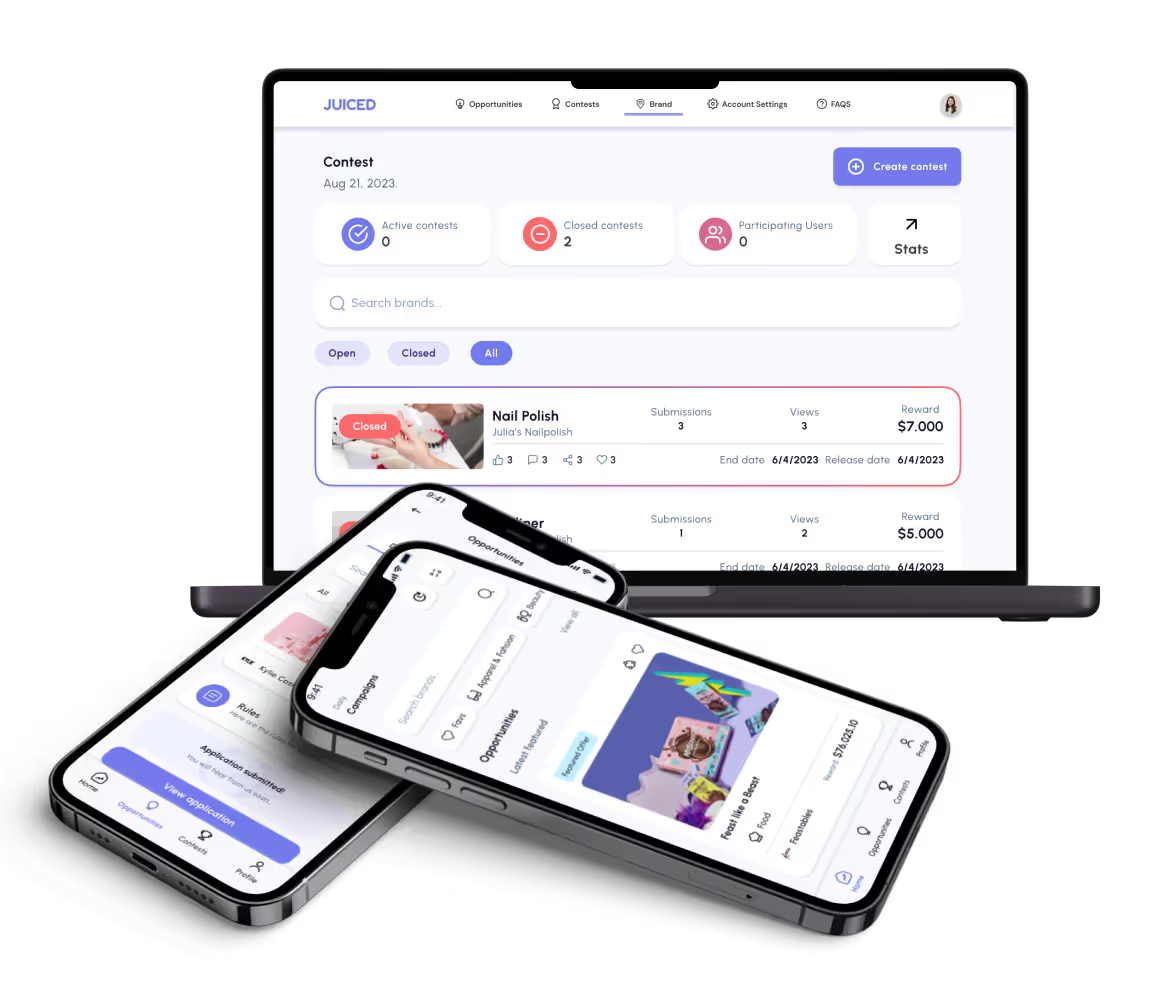

Partner with our experts in generative AI development to turn your ideas into scalable AI applications.
Last updated on
September 25, 2026
.

Jesus is a visionary entrepreneur and tech expert. After nearly a decade working in web development, he founded LOW/CODE Agency to help businesses optimize their operations through custom software solutions.


FAQs
Can FlutterFlow be used to build real AI apps?
Do I need coding skills to add AI in FlutterFlow?
Which AI providers work best with FlutterFlow?
How much does it cost to run an AI-powered FlutterFlow app?
Can FlutterFlow AI apps scale?
Are FlutterFlow AI features production-ready?
Related Articles
AI
How to Automatically Generate Video Highlights with AI
Learn how to use AI tools to create video highlights automatically, saving time and enhancing content engagement effectively.
AI
Vertical AI Agents: Why Niche Beats General
Learn why vertical AI agents outperform general AI by focusing on specific industries. Discover benefits, real examples, and how niche AI agents deliver higher accuracy and ROI.

FlutterFlow
How to Build an EMR System with FlutterFlow
Learn step-by-step how to create an EMR system using FlutterFlow with best practices for design, security, and data management.

FlutterFlow
How to Build a Livestock Tracking App with FlutterFlow
Learn how to create a livestock tracking app using FlutterFlow with step-by-step tips for design, features, and deployment.

Why customers trust us for no-code development


