Case Study
My Baby My Way

50
CHWs on one shared platform
10,000
New clients onboarded monthly
99%
Faster response for at-risk mothers

Sarahyah Yisrael Adon
,
Founder at My Baby My Way


Introduction
My Baby My Way is a California-based maternal wellness foundation built around a simple belief: women trying to conceive, pregnant, postpartum, or mothering older children need both community and professional care they can trust. The foundation runs 50 Community Health Workers who support app users directly across 15 counties, and had set a 14-week timeline to take its product from a Glide prototype to a native app on both stores.
The Foundation had real traction going in: an active user base, real Community Health Workers doing the work daily, and real demand from Medi-Cal's growing recognition of CHW services. What it didn't have was a system built for the volume it was about to take on.
The real problem: care depended on memory, not a system
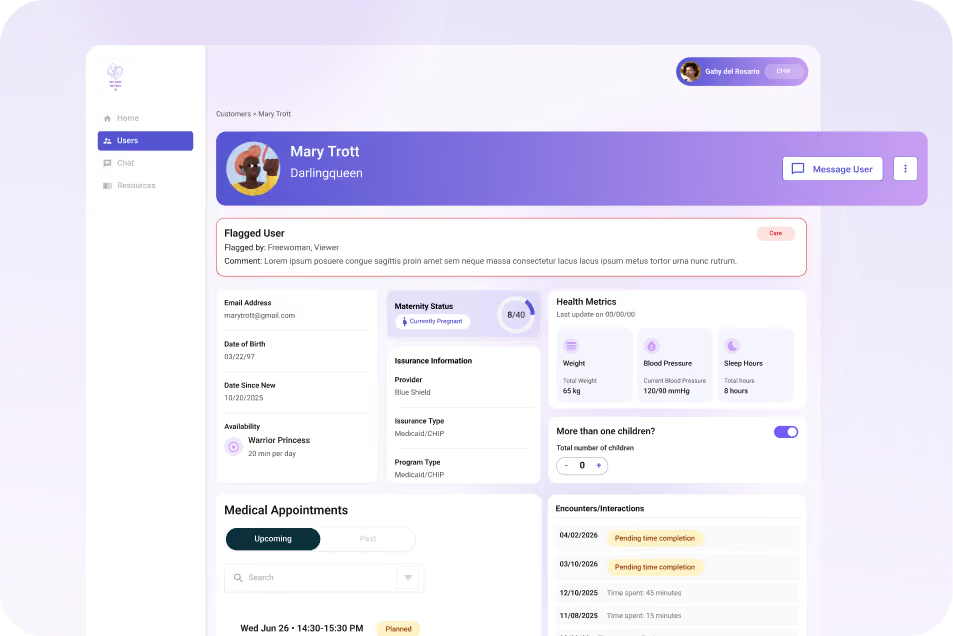
Every mother's health signal lived in her own head, not in a system. There was no structured way to capture how a woman was feeling day to day and turn that into something a Community Health Worker could act on. No single record tied together her daily surveys, her logged health metrics, weight, blood pressure, sleep, her medical appointments, and her birth plan. The 50 Community Health Workers had no shared dashboard. The plan going in was phone calls and individual check-ins, with no way to see who needed one first. When a woman gave a "concerning answer," the worst possible response on a daily survey, there was no defined path to a human. Figuring out how AI should catch that moment was exactly the problem the Foundation brought to us.
Underneath the consumer product sat a second, harder problem. My Baby My Way's Community Health Workers deliver billable services under California's Medi-Cal CHW program, but the Foundation was billing through Pear Suite, a third-party platform charging per seat regardless of how many claims got approved. There was no call recording to defend a claim in a dispute, no centralized view of claim status, and no way for the Foundation to onboard other CHW organizations as subcontractors without doing it all by hand.
And one product had to work for four different seasons of motherhood at once, trying to conceive, pregnant, postpartum, and current mother, each needing distinct daily surveys, tasks, and content, inside a single system, without the experience going generic for any one of them.
The volume made all of this urgent: the Foundation already expected roughly 10,000 new clients a month once the app scaled, with three competing onboarding models on the table (bulk upload, invite-only, hybrid) and no technical recommendation attached to any of them.

Where the day-to-day friction was showing up
- Front-line staff spending time figuring out who needed attention, instead of actually attending to clients.
- Risk detection depending entirely on a woman remembering to speak up, with no automated safety net behind her.
- Revenue tied to a billing partner whose pricing didn't move with actual results.
- No documentation trail to fall back on if a claim or an incident was ever questioned.
- Every new market or partner organization meaning more manual setup work, not less.
What that friction meant for the business, and why it pushed them to build
- California's Medi-Cal program was actively expanding which CHW services it would reimburse, a window that rewards whoever has billing infrastructure ready first.
- The Foundation's own network already represented a large enough addressable market (10,000+ monthly clients) to justify owning the platform instead of continuing to rent one.
- Their growth plan depended on adding CHW organizations as subcontractors, something a per-seat, single-org tool structurally couldn't support.
- Staying on borrowed infrastructure meant staying subject to someone else's pricing and roadmap, when the Foundation wanted to set its own terms.
What this means in numbers for My Baby My Way
An estimated 15 to 20 minutes lost per team member each day just prioritizing who to help first, close to 15 hours a day across the full team. A concerning answer could sit unaddressed for 24 to 72 hours. And a per-seat billing model with no audit trail left the Foundation exposed to losing 10% to 15% of claims to disputes it couldn't defend, while still paying full price either way.
What we are building
The direction we aligned on with the Foundation: one system, built in phases, where the consumer app, the CHW layer, and the future billing infrastructure all sit on the same architecture from day one, instead of three separate tools bolted together later.
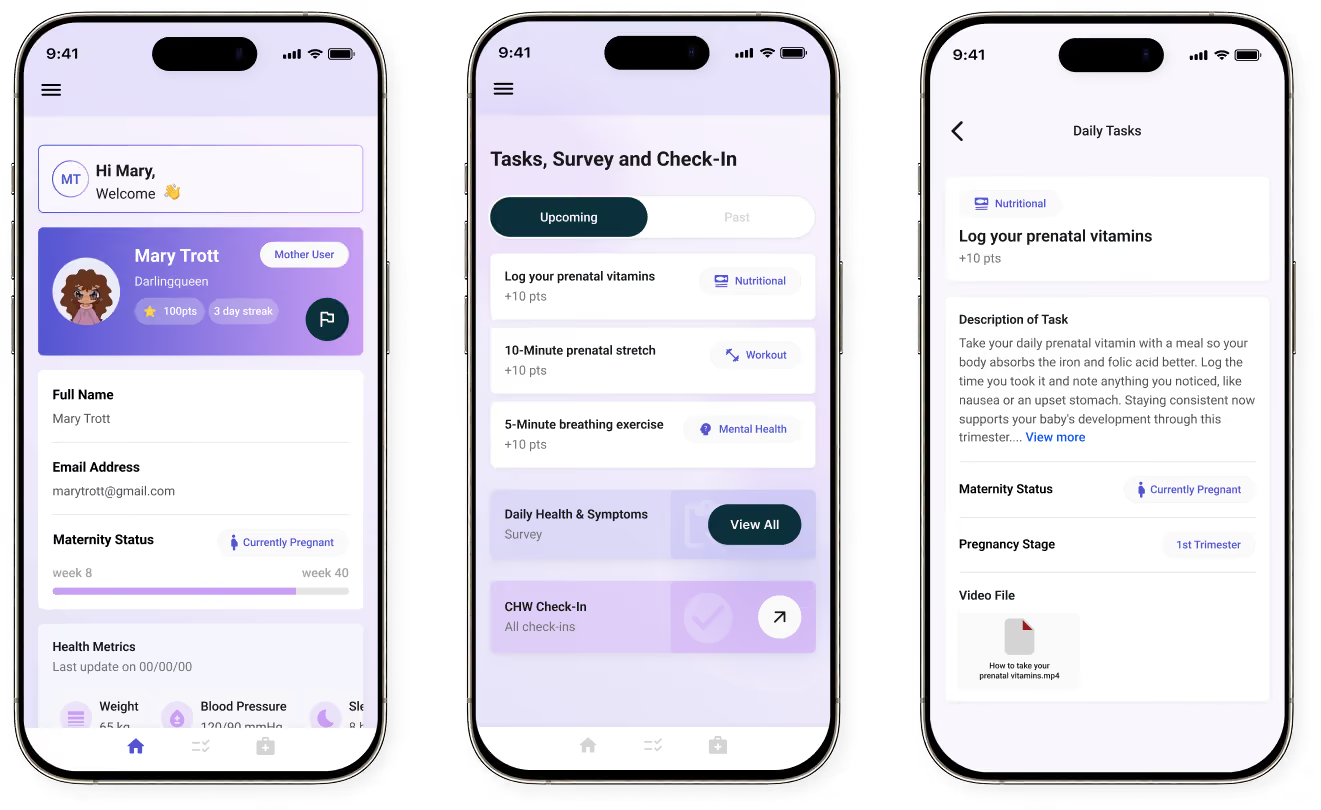
- A daily survey and AI risk-triage system. The app runs one of four survey tracks depending on a woman's stage, and reads every answer the moment it's submitted. A concerning answer opens an automatic AI conversation with her right away. Three consecutive concerning answers with no resolution route straight to a human team member, no exceptions built in. The same logic applies to flagged comments in community threads, not just survey responses.
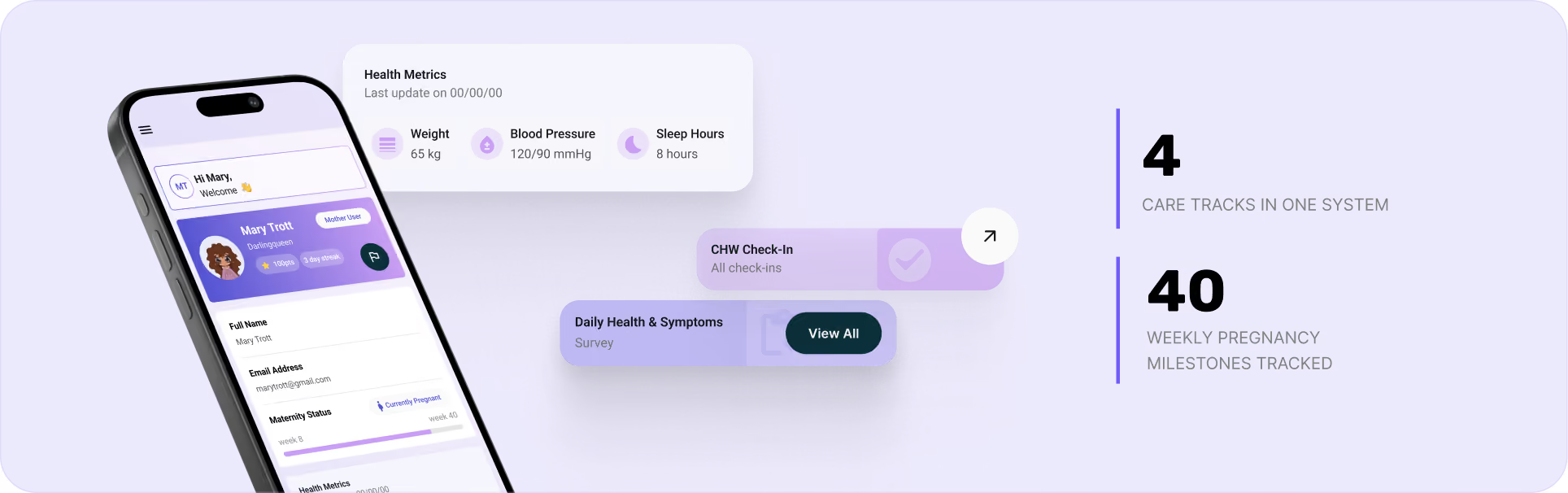
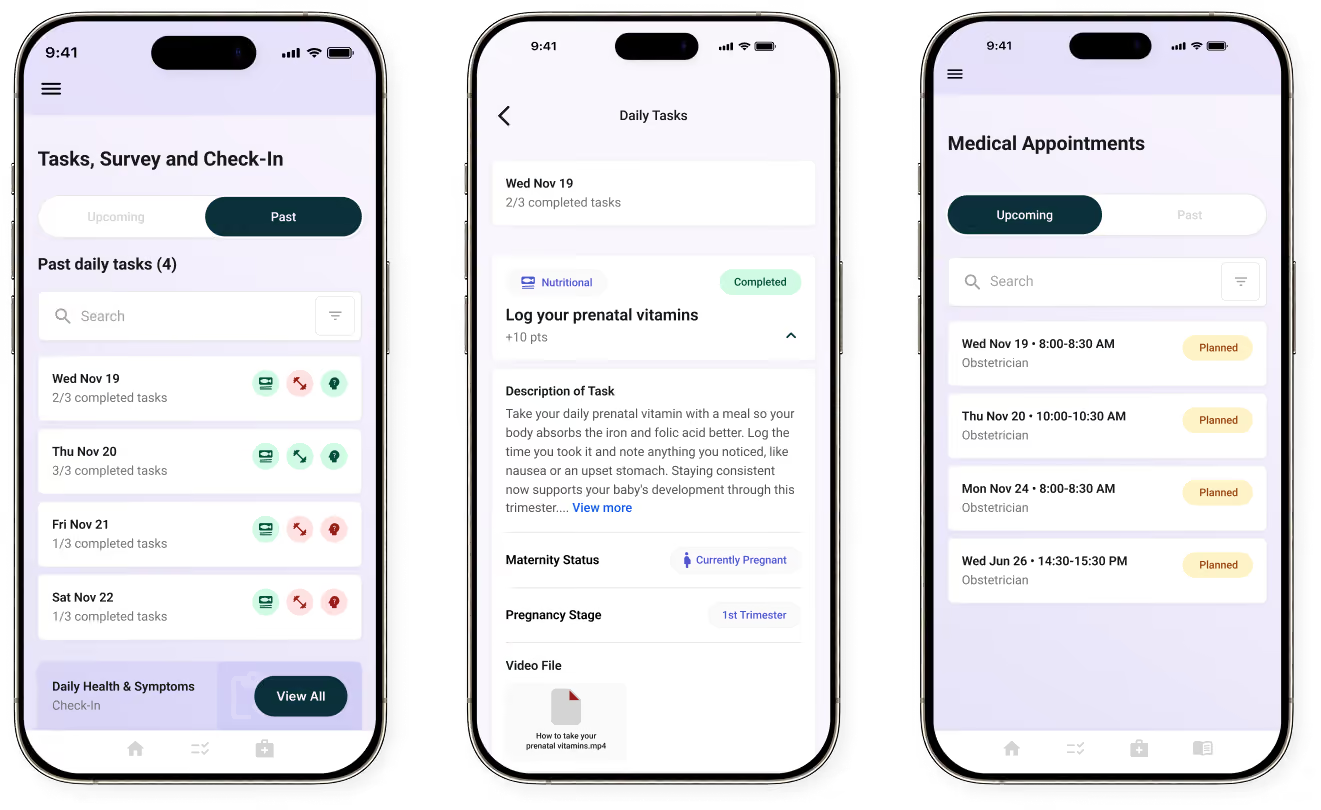
- A personalized health plan engine. Onboarding data and survey history become three coordinated tracks, mental, nutritional, and physical, instead of one plan shared by every user. The plan pulls from maternity status, current pregnancy week (calculated from last menstrual period), and ongoing survey answers, and adjusts as her stage changes. Free tier gets a default plan; premium unlocks full customization, plus a weekly pregnancy tracker (Week 1–40) covering baby development, body changes, and weekly guidance.
- A CHW dashboard built around a single queue. Every flagged case, whether a survey answer, a thread comment, or a high blood-pressure reading from a connected wearable, lands in the same place. Interactions are logged in structured SOAP-format notes. Access is role-based, so a CHW only sees her own assigned clients while an admin sees the full picture, and a CSV export of interactions and services was built in ahead of the billing conversation still to come.
- A viewer and access layer. A mother can extend a narrow, deliberate slice of her record to people she chooses. A viewer, a partner or family member, pays a separate monthly fee and sees only what's been shared with them: vitals, appointments, and her birth plan. Verified professional specialists (therapists, doulas, fitness experts) go through a separate approval step before they can post in the community forum.
- The foundation for a CHW billing hub. Rather than build a single-organization app and rebuild it later, V1's data model tags every service by type, CHW, ECM, Community Supports, and the account structure supports more than one organization from the start, even though only My Baby My Way uses it today. Seat-based access, role-scoped dashboards, and the reporting layer exist so that when the Foundation is ready to bring on subcontracted organizations, the platform doesn't need to be rebuilt to support them.
Technical decisions that keep the door open for scale
We connected the mobile app, the admin/CHW web portal, Postmark for authentication and password recovery, and a wearable-device data feed behind one backend, so the record a mother builds in the app is the same record her care team and her invited family see, each through their own permissioned view.
For the billing layer scoped for Phase 2, the plan calls for Stripe Connect for organization and individual payouts, Availity for automated Medi-Cal/MCP eligibility checks and claims submission, and a communication layer (calls, SMS, recording) so the Foundation isn't dependent on a patchwork of separate tools. Every one of those decisions traces back to the same principle: build the record and the triage logic first, so the system already holds enough context to support real transaction volume the moment it arrives, instead of retrofitting compliance and billing onto an app that was never designed to carry them.
What changed after V1?
A flagged survey answer or a flagged thread comment now reaches either the AI assistant or a member of the care team within minutes of submission, instead of waiting for a scheduled check-in call. The full CHW team works from one shared queue instead of fifty separate phone lists and paper notes.
The onboarding architecture is built to absorb roughly 10,000 incoming clients a month without a linear increase in staff time per client, once the Foundation finalizes its onboarding model. And the four distinct survey and task tracks mean a woman trying to conceive, a woman in her third trimester, and a mother six months postpartum each get a plan built for her specific week, not one plan stretched across all three.
- Response time: From 1–3 days down to under 5 minutes for first contact, a 99% reduction in time-to-first-response.
- Promotora capacity: An estimated 15–20 minutes per Promotora per day in manual prioritization, across 50 Promotoras, close to 15 hours of client-facing capacity returned to the network daily.
- Onboarding staffing: Automating onboarding reduces the staffing load for client intake by roughly 90%, from an estimated 5 FTEs to under 1, even at 10,000 new clients a month.

What this means for founders building past their MVP
My Baby My Way's story isn't really about maternal health. It's about what happens when a founder has proof that something works and needs the system underneath it to hold at ten times the volume. The instinct most teams follow is to ship the consumer feature first and figure out billing, compliance, and multi-org support later. We build it the other way: architect for the second and third phase while shipping the first one, so scaling doesn't mean rebuilding.
If your product is outgrowing the tool that got it started, and the next phase of growth depends on systems your current stack was never built to carry, that's the conversation we're ready to have. Let's talk.
Are you ready to transform your ideas into reality?
We're here to make it happen!
With our expertise and the power of low-code solutions, we can simplify your processes and help your business thrive.
Free discovery callDiscover your savings with automation
Is your team doing repetitive tasks? Stop wasting money, and get a custom solution that not only saves you time, but also reducesmistakes and makes your team more productive!
More Case Studies
using
FlutterFlow