Case Study
BetterFit.Dental

1,500
visits the first month
200+
Fit checks completed
270
registrations at 90 days waitlist

,


Introduction
Most founders with a marketplace idea start by building the marketplace. It feels like progress: months of development, a five-figure budget, and a finished app pointed at an audience that may or may not exist.
The founder of BetterFit came to us with a different kind of matching problem. Dental hiring is broken in a specific way: dentists and practice owners find each other through job boards and recruiters that match on paperwork: years of experience, specialty, location. They ignore the thing that actually determines whether the relationship works: philosophy of care. How you treat patients. How you make clinical decisions. What kind of environment you thrive in. Think of it as matching for dental careers: compatibility first, identity revealed later.
The vision was a full platform: calibration, anonymous browsing, mutual matching. The question was whether anyone on either side of this market actually wanted it. Before committing to the build, BetterFit needed proof.
The marketplace trap most founders walk into
Two-sided marketplaces fail in a predictable way. You need dentists to attract practices, and practices to attract dentists, and on day one you have neither. Building the full product first means spending the largest part of your budget before you have any evidence that either side will show up.
The standard hedge is a landing page with an email field. But a passive waitlist produces weak signals. An email address tells you someone was mildly curious for eleven seconds. It doesn't tell you whether they'd complete a 20-question calibration, whether they're a dentist or a practice owner, or whether the core promise of matching on philosophy instead of paperwork actually resonates enough to act on.
BetterFit needed something in between: the smallest possible asset that could capture qualified demand, segmented by side of the marketplace, before a single feature of the app existed.
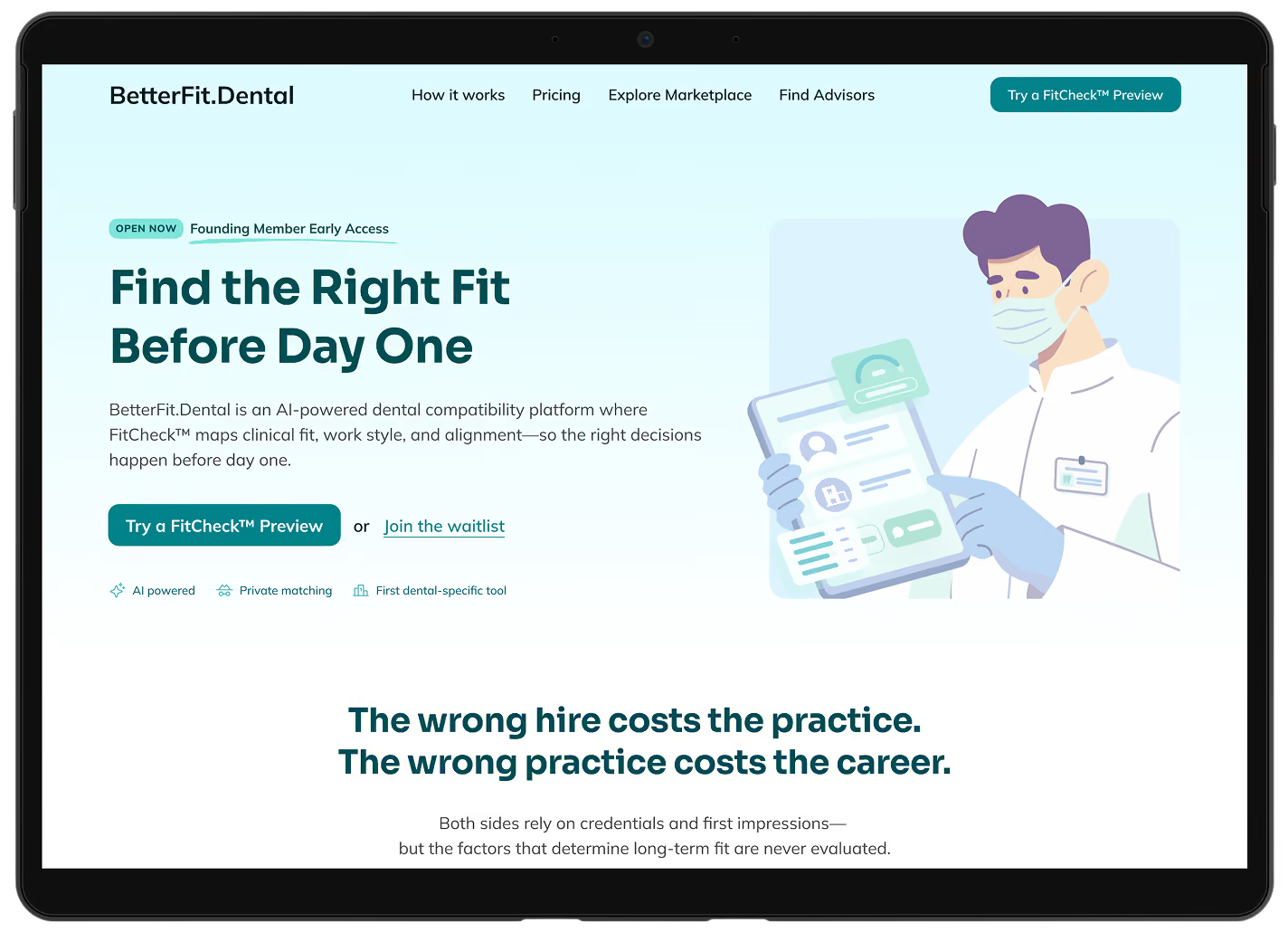
What we built: a website that behaves like the product
We scoped the engagement deliberately small: a single-page site with one real job, turning curiosity into evidence. Four pieces make that work:
- A story that sells to both sides at once: The page walks visitors through the problem with dental hiring today, how philosophical matching works, and why it's different speaking to a dentist tired of bad-fit jobs and a practice owner tired of bad-fit hires in the same scroll. Custom mockup screens of the future app (calibration, anonymous browse, match reveal) give visitors something concrete to want before that product exists in code.
- The Fit Check, the product before the product: A 20-question assessment built directly into the page. Not a demographics form, but situational questions about how you'd act, decide, and communicate in real clinical scenarios. Responses route to the BetterFit team, who analyze them manually and send a personalized profile preview by email. To the user, BetterFit is already matching. Behind the scenes, the founder is doing by hand what the platform will eventually automate, learning how calibration should work from real responses at zero engineering cost.
- A waitlist that doubles as market intelligence: Every signup declares its side, dentist or practice owner, from the first interaction. That single field turns the waitlist from a vanity number into strategy: total demand, plus the supply-to-demand ratio that will dictate launch sequencing when the app gets built.
- SEO and analytics from day one: A full technical foundation (meta tags, structured data, page speed, copy written around how dentists and practice owners actually search) plus tracking on visitor behavior, conversion rates, and waitlist growth. Every marketing effort the founder makes from here produces a measurable signal.
Technical decisions that kept the scope honest
The most important technical decision on this project was restraint. Every feature we didn't build (accounts, profiles, browsing, matching logic) was a deliberate call to keep the timeline at three weeks, not months, while still producing real market signals. Validation doesn't need the product to exist; it needs the right questions in front of the right audience.
Making the Fit Check a structured form with manual analysis behind it, rather than an automated scoring engine, was the same call. Automating the calibration before knowing what good calibration looks like would have meant guessing in code. Routing responses to the team instead means every completed Fit Check does double duty: it captures a qualified lead and trains the founder's understanding of the matching model the future app will need.
Webflow gave us the speed to go from the client's Figma to a live, SEO-ready page in three weeks, with a design system clean enough to extend when the app phase begins. Nothing built here gets thrown away: the story, the Fit Check structure, and the segmented user base all carry directly into the platform when BetterFit decides to build it.
What changed after launch?
BetterFit went from an idea in a Figma file to a live validation engine in three weeks. Instead of waiting months for an app to test the market, the founder is testing it now, with a page that captures demand, qualifies it through a 20-question assessment, and splits it by side of the marketplace from the first click.
Every completed Fit Check is doing work a passive waitlist never could. It's a lead who invested real time in the core product experience, a data point on which side of the market demand concentrates, and a training example for the calibration model the future app will run on. When the time comes to build the platform, the matching algorithm won't be a hypothesis; it will be a spec written by hundreds of real responses.
And the decision to build is no longer a leap of faith. The analytics foundation gives BetterFit clear thresholds to act on: strong Fit Check completion with both sides represented says build; weak conversion says fix the message first, at a cost of hundreds of dollars, not tens of thousands.


What this means for founders
The cheapest mistake in product development is the one you never make. BetterFit answered the question most marketplace founders discover too late, and too expensively: does anyone want this? The site doesn't just collect interest. It rehearses the product, segments the market, and turns the founder's manual work into the spec for what gets built next.
And that's exactly what comes next. Everything running today carries directly into the platform: the waitlist becomes the first user base, the Fit Check responses become the calibration model, and the story already selling on the page becomes the product's voice. When BetterFit scales into the app, it won't be starting from zero, it will be launching to an audience it already built.
If you're sitting on a product idea and the only options on the table are "build it all" or "do nothing," there's a smaller, smarter first move. Let's talk about your vision.

Are you ready to transform your ideas into reality?
We're here to make it happen!
With our expertise and the power of low-code solutions, we can simplify your processes and help your business thrive.
Free discovery callDiscover your savings with automation
Is your team doing repetitive tasks? Stop wasting money, and get a custom solution that not only saves you time, but also reduces mistakes and makes your team more productive!
More Case Studies
using
Webflow