

Low-code Employee App Development Guide
16 min
read
Low-code employee app development guide covering features, use cases, tools, costs, and best practices to build internal apps faster and scale teams.

What Is a Low-code Employee App?
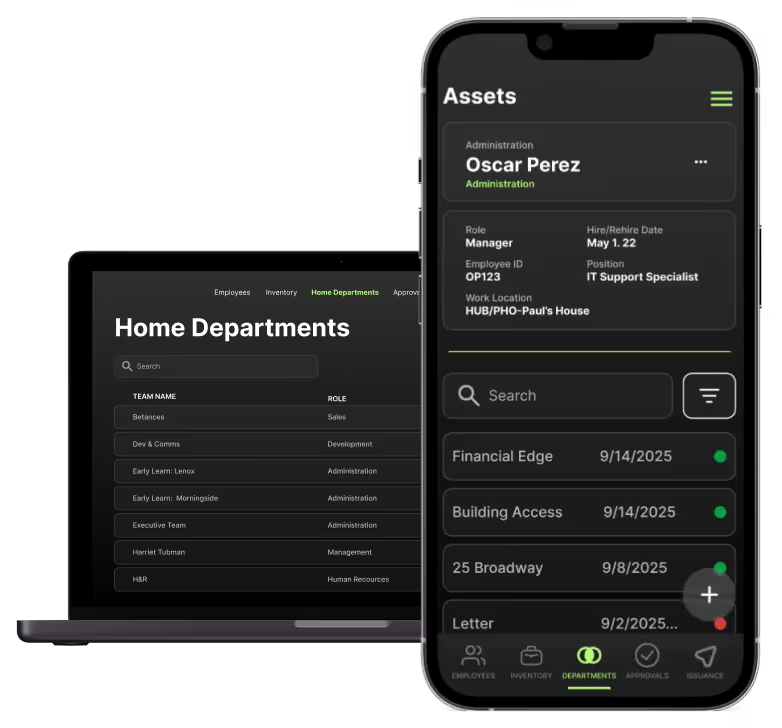
Employee apps are no longer just digital notice boards. Modern teams use them as daily work tools. Low-code technology makes these apps faster to build, easier to change, and closer to how teams actually work.
- What an employee app actually means in modern organizations
An employee app is an internal tool that helps teams do their work. It can handle requests, tasks, updates, approvals, and access to shared information in one place. - How low-code changes internal app development
Low-code lets teams build employee apps without long development cycles. Apps can be updated quickly as workflows change, without waiting months for engineering releases. - Difference between employee apps and traditional HR portals
HR portals are static and policy-driven. Employee apps are workflow-driven. They focus on actions like requests, updates, and collaboration, not just reading documents. - Common examples of employee-facing internal apps
Examples include leave request apps, internal dashboards, onboarding tools, task trackers, IT helpdesk apps, and simple internal chat or announcement systems.
A low-code employee app is not about replacing people. It is about removing friction so employees can focus on real work instead of manual processes.
Why Companies Are Building Employee Apps with Low-code
Internal teams move faster than traditional software can keep up with. Low-code helps companies build employee apps that match real workflows and change as teams change.
- Faster internal tool development
Low-code removes long build cycles. Teams can launch employee apps in weeks, not months, and respond quickly when processes or policies change. - Lower cost compared to traditional development
Employee apps rarely need complex custom code. Low-code reduces development and maintenance costs while still delivering reliable internal tools. - Ability to iterate quickly based on employee feedback
Employee feedback can be applied immediately. Forms, workflows, and permissions can be adjusted without rebuilding the entire system. - Empowering operations and HR teams without heavy engineering
Ops and HR teams can own their tools instead of waiting on developers. This keeps apps aligned with real daily needs.
Low-code employee apps work because they stay close to the people using them. Speed and flexibility matter more than perfect software architecture.
Read more | Build Workforce Management Apps With Low-code
When You Should Build an Employee App (and When You Shouldn’t)
Not every company needs a custom employee app. Low-code makes building easier, but the decision should still be based on real operational pain, not convenience.
- Growing teams with fragmented tools
When teams rely on emails, spreadsheets, chat messages, and shared drives to run daily work, information gets lost. An employee app brings workflows and data into one place. - Distributed, remote, or frontline workforces
Employee apps work well when teams are not at desks all day. Mobile-friendly apps help frontline and remote staff access tasks, updates, and requests without friction. - Manual HR or operations workflows
If approvals, requests, onboarding, or reporting depend on manual follow-ups, an employee app can automate these flows and reduce delays and errors. - Situations where simpler tools or existing software are enough
If your team is small or current tools already solve the problem well, a custom app may add unnecessary complexity. Sometimes configuration is better than building.
The right time to build an employee app is when process pain is clear and recurring. If the problem is small or temporary, low-code should still be used carefully, not automatically.
Read more | Low-code BPA Examples Using Make
Common Use Cases for Low-code Employee Apps
Low-code employee apps work best when they solve everyday problems employees already face. Instead of replacing systems, they connect workflows, information, and actions in one simple place.
- Internal communication and announcements
Employee apps centralize company updates, policy changes, and alerts. This reduces missed messages and removes reliance on email threads or chat noise. - HR self-service (leave, documents, requests)
Employees can submit leave requests, access documents, and track approvals without manual follow-ups. HR teams spend less time answering the same questions. - Task, shift, and workflow management
Low-code apps help manage tasks, shifts, and approvals in real time. This is especially useful for operations, retail, and frontline teams. - Knowledge base and internal resources
Teams can access SOPs, guides, and internal resources from one place. Content stays updated as processes change. - Feedback, surveys, and engagement tracking
Employee apps make it easy to collect feedback, run surveys, and spot issues early without complex tools.
The best employee apps focus on daily use. When employees rely on the app to get work done, adoption happens naturally.
Read more | BPA Problems Automated With Low-code
Core Features Every Employee App Should Include
An employee app should support daily work, not just store information. These core features help teams communicate, complete tasks, and stay aligned without unnecessary complexity.
Communication and Updates
Clear communication reduces confusion and keeps everyone informed.
- Centralized announcements and updates
All company-wide messages live in one place so employees do not miss important information. - Targeted notifications and alerts
Send updates to the right teams or roles instead of broadcasting everything to everyone. - Read status and acknowledgment tracking
Know who has seen important messages to avoid follow-ups and miscommunication.
Employee Directory and Self-Service
Self-service features reduce HR workload and empower employees.
- Employee profiles and contact visibility
Employees can quickly find teammates, roles, and contact details without relying on chat or email. - HR requests and approvals
Leave, expense, and basic requests move through clear workflows instead of manual emails. - Secure document access
Policies, payslips, and internal files stay accessible while respecting role-based permissions.
Read more | Business Process Automation Detailed Guide
Tasks, Workflows, and Scheduling
Workflows turn intent into action.
- Task assignment and tracking
Teams can see what needs to be done, by whom, and by when in one place. - Approval workflows and status visibility
Requests move through defined steps so employees know where things stand. - Shift and schedule management
Schedules stay up to date and easy to adjust for teams with rotating or frontline roles.
When these features are designed around real workflows, employee apps become part of everyday work instead of an extra system to manage.
Engagement and Feedback
Engagement features help teams feel heard and involved, not just informed.
- Surveys and polls for regular feedback
Run quick pulse surveys or polls to understand sentiment, identify issues early, and improve decisions without long feedback cycles. - Recognition and peer appreciation
Simple recognition features encourage positive behavior and make good work visible across teams. - Closed feedback loops
Show employees what changed based on their feedback. This builds trust and increases future participation.
Mobile-first and Accessibility
An employee app only works if everyone can use it easily.
- Responsive, mobile-first design
The app should work smoothly on phones, tablets, and desktops so all employees can access it anywhere. - Offline access for essential features
Basic information and tasks should remain available even with limited or unstable connectivity. - Simple and accessible user experience
Clear navigation, readable layouts, and accessibility support ensure adoption across roles, ages, and tech comfort levels.
When engagement and accessibility are done right, employee apps feel helpful instead of forced, which drives long-term adoption.
Read more | Top 6 Automation Agencies
Planning Your Low-code Employee App Before Development
A low-code employee app works best when planning comes before building. Clear goals and realistic scope prevent rework and low adoption later.
- Defining clear goals and success metrics
Decide what problem the app should solve. This could be faster approvals, fewer HR tickets, or better communication. Clear metrics help measure real impact, not just usage. - Identifying employee personas (office, frontline, remote)
Different roles have different needs. Office staff, frontline workers, and remote teams use apps in different ways. Planning for these personas improves adoption. - Mapping workflows and data requirements
List the steps, approvals, and data each workflow needs. This helps design clean logic and avoid patchwork solutions later. - Deciding what to build now vs later
Start with core workflows and expand over time. Building everything at once increases complexity and slows adoption.
Good planning reduces friction during development and ensures the employee app supports real work from day one.
Read more | Procurement automation guide
Choosing the Right Low-code Platform for Employee Apps
The low-code platform you choose shapes how usable, scalable, and maintainable your employee app will be. There is no single best tool. The right choice depends on how employees work and how complex your internal workflows are.
- Web vs mobile-first considerations
Web-first platforms work well for office teams using desktops and dashboards. Mobile-first platforms are better for frontline, field, or remote employees who rely on phones during the day. - Backend and data management needs
Employee apps often handle sensitive data, approvals, and history. Platforms with strong backend logic, databases, and permission control make it easier to manage workflows safely. - Integration capabilities
Most employee apps must connect with HR systems, payroll tools, calendars, or messaging platforms. Strong API and integration support prevents data silos and manual syncing. - Scalability and long-term flexibility
As teams grow, workflows change. The platform should allow new features, roles, and logic without rebuilding the app from scratch. - Typical platforms used for employee apps
Bubble is common for workflow-heavy web apps and internal dashboards.
Glide works well for simple, fast internal tools.
FlutterFlow suits mobile-first employee apps that need native performance.
The best platform is the one that fits how your employees actually work today and can adapt as those needs evolve.
Read more | AI business process automation guide
Steps to Build Low-code Employee Apps
Building a low-code app for employees is not about rushing into development. The best results come from following clear steps that keep the app aligned with how employees actually work.
- Requirements gathering and validation
Start by talking to employees, managers, HR, and operations. Identify repetitive tasks, approval bottlenecks, and communication gaps. Validate that the problem is real and recurring before building anything. - UX design and wireframing
Design simple screens around daily tasks, not around features. Employees should understand what to do in seconds. Wireframes help test flow and clarity before development starts. - Data modeling and permissions
Define what data is needed, who can see it, and who can act on it. Role-based access, approval rules, and audit trails should be planned early to avoid security issues later. - Building features using low-code tools
Use low-code platforms to build workflows, forms, dashboards, and notifications quickly. Focus on core use cases first instead of trying to cover every scenario. - Internal testing with real employees
Test the app with a small group of employees from different roles. Watch how they actually use it, where they get stuck, and what they ignore. - Iteration based on feedback
Refine workflows, simplify screens, and adjust logic based on real feedback. Low-code makes iteration fast, which is key to building an app employees want to use.
Following these steps keeps development focused on usability and adoption, not just delivery.
Read more | Low-code business process automation
Integrations Needed for Employee Apps
Employee apps rarely work in isolation. Their value comes from how well they connect existing systems and remove manual handoffs. Planning integrations early avoids data gaps and rework later.
- HRIS and payroll systems
Integration with HRIS and payroll tools keeps employee data, leave balances, and approvals accurate. This avoids duplicate entry and ensures HR teams trust the app as a single source of truth. - Single Sign-On (SSO)
SSO simplifies access and improves security. Employees log in using existing company credentials, reducing password issues and making onboarding smoother, especially for large or distributed teams. - Calendars and scheduling tools
Calendar integrations help sync shifts, meetings, approvals, and deadlines. This is useful for operations teams, managers, and employees who rely on shared schedules. - Internal databases and legacy systems
Many companies still depend on older systems or internal databases. A good employee app should pull and push data where needed instead of forcing teams to maintain parallel systems.
The best employee apps feel seamless because they fit into existing tools. Strong integrations turn the app into a hub, not another system employees must manage.
Read more | Business Process Automation Types
Security, Privacy, and Governance Considerations
Employee apps handle sensitive data and internal processes. Security and governance should be designed in from day one, not added after launch. Low-code makes building fast, but responsibility stays the same.
- Role-based access and permissions
Employees should only see and act on what matches their role. Managers, HR, and frontline staff need different access levels. Clear permissions reduce mistakes and protect sensitive information. - Data privacy and compliance basics
Employee apps often store personal and operational data. Follow basic privacy practices like data minimization, access logging, and clear retention rules to stay compliant and avoid risk. - Secure authentication and access control
Strong authentication, session management, and optional multi-factor access protect internal apps from misuse. Using existing identity systems improves both security and ease of access. - Governance rules for internal app usage
Define who can change workflows, approve updates, and access reports. Clear ownership prevents uncontrolled changes and keeps the app aligned with company policies.
Good governance does not slow teams down. It creates trust, consistency, and long-term stability for employee apps built with low-code.
Read more | Business Process Automation in Healthcare
Driving Adoption and Employee Engagement
Even the best employee app fails if people do not use it. Adoption depends on clarity, trust, and usefulness, not on how many features you ship.
- Simple onboarding flows
Onboarding should take minutes, not hours. Use clear first-time guidance, role-based views, and simple actions so employees know exactly what to do on day one. - Clear value communication to employees
Explain how the app helps employees save time or reduce effort. When people see personal value, not just company value, adoption happens naturally. - Feedback-driven improvements
Give employees easy ways to share feedback and act on it quickly. Visible improvements show that the app responds to real needs, not assumptions. - Avoiding feature overload
Too many features create confusion. Start with core workflows employees use daily, then expand only when there is clear demand.
Employee engagement grows when the app feels helpful, simple, and responsive. Adoption is earned through usefulness, not enforcement.
Read more | Business Process Automation Examples
Measuring Success and ROI of an Employee App
An employee app is successful only if it improves how work gets done. Measuring the right signals helps you prove value, guide iteration, and decide what to build next.
- Usage and engagement metrics
Track active users, feature usage, and task completion rates. Consistent daily or weekly use shows the app fits real workflows, not just one-time announcements. - Workflow efficiency improvements
Measure cycle times for approvals, requests, and handoffs before and after launch. Faster turnaround and fewer follow-ups indicate real operational gains. - Reduction in manual processes
Look at fewer emails, spreadsheets, and manual checks. When teams stop using workarounds, the app is doing its job. - Employee satisfaction indicators
Use short pulse surveys and feedback to assess clarity, ease of use, and trust. Positive sentiment and fewer complaints signal sustainable adoption.
Strong ROI comes from steady improvement. Use these metrics to refine workflows, remove friction, and keep the app aligned with how employees actually work.
Read more | Business Process Automation Challenges
Common Mistakes to Avoid in Employee App Development
Employee apps fail more often due to poor decisions than poor tools. Avoiding these common mistakes saves time, budget, and employee trust.
- Building too much too early
Trying to solve every problem at once leads to complex apps that employees avoid. Start with a few high-impact workflows and expand only after real usage proves value. - Ignoring frontline or non-desk employees
Many apps are designed only for office teams. If frontline or field employees cannot use the app easily on mobile, adoption will suffer across the organization. - Weak onboarding and communication
Launching an app without clear onboarding or explanation causes confusion. Employees need to know why the app exists and how it helps them personally. - Underestimating maintenance and iteration
Internal processes change often. Employee apps need regular updates, feedback handling, and workflow tuning. Treating the app as a one-time project leads to slow decay.
The best employee apps stay small, focused, and adaptable. Avoiding these mistakes keeps the app useful long after launch.
Read more | Business Process Automation Benefits
How LOW/CODE Agency Builds Scalable Employee Apps
Most employee apps fail quietly. They launch on time, look fine, and then slowly get ignored. That usually happens because the app was built to exist, not to be used. This is exactly what we avoid.
At LOW/CODE Agency, we build employee apps the same way strong product teams build customer-facing software: with clarity, intent, and long-term ownership.
- Product-first approach to internal tools
We start by understanding how work actually flows inside your company. Where requests stall, where approvals break, where people fall back to email or spreadsheets. We design the app around those real friction points, not around generic “employee app features.” This ensures the app earns daily usage instead of becoming shelfware. - Matching low-code platforms to real workflows
We do not force tools to fit the problem. Desk-based teams, frontline workers, and managers all work differently. We choose the right low-code platform based on usage patterns, data sensitivity, and scale requirements so the app feels natural, not imposed. - Designing for adoption, not just delivery
An internal app only succeeds if employees understand it instantly. We design flows that make sense without training, role-based views that reduce noise, and features that solve one clear problem at a time. Adoption is designed in, not hoped for after launch. - Long-term iteration and support mindset
Employee workflows change constantly. We plan for iteration from day one. That means feedback loops, performance tracking, and regular improvements so the app stays useful as teams grow and processes evolve.
We are not a dev shop. We are your product team.
We have built 450+ scalable low-code apps across operations, HR, and internal systems, and we stay involved after launch to make sure they actually work in the real world.
If you are serious about building an employee app that people use, not just one that exists, let’s talk. We’ll help you define the right scope, choose the right platform, and build something that scales with your team.
Conclusion
Low-code employee apps work best when they are built with clarity, not assumptions. Starting small helps teams focus on real problems instead of unnecessary features. Fast validation with real employees builds trust and adoption early.
When the foundation is right, scaling becomes simple and low-risk. The right approach turns internal tools into productivity assets that teams rely on every day, not systems they avoid or work around as processes and teams grow.

Related Articles
- How to Build Workforce Management Apps Using Low-code
- 35 Low-code Automation Ideas Using Make for BPA
- 10 BPA Problems You Can Automate with Low-code
- How to Hire a Low-code AI App Developer (What to Look For)
- Bubble vs FlutterFlow: Which Is Best for AI App Development?
- How to Build Generative AI Apps with Low-code
Building with Glide? Our Glide development services help you turn spreadsheets into polished apps.
Building a FlutterFlow app? Our FlutterFlow development services help you launch cross-platform apps faster.
Last updated on
September 28, 2026
.

Jesus is a visionary entrepreneur and tech expert. After nearly a decade working in web development, he founded LOW/CODE Agency to help businesses optimize their operations through custom software solutions.


FAQs
What is a low-code employee app?
Which teams benefit most from employee apps?
Are low-code employee apps secure?
Can employee apps integrate with HR and payroll systems?
How long does it take to build an employee app with low-code?
How much does a low-code employee app cost?
Related Articles

Custom App Development
No-code/Low-code
Low-code Real Estate App Development Guide
Low-code real estate app development guide covering app types, core features, workflows, integrations, costs, and scalability for modern property platforms.

No-code/Low-code
How to Hire No-code Developers (Practical Guide for Founders)
Learn how to hire no-code developers the right way. Avoid mistakes, evaluate skills, and choose the best fit for your project and budget.

No-code/Low-code
No-code App Development Cost (2026 Guide)
Get a clear breakdown of no-code app development cost in 2026. Compare pricing, hidden costs, timelines, and real estimates to plan your app budget confidently.
![What Is a Low-code Development Platform? [Full Guide]](https://cdn.prod.website-files.com/61cbe22a00483909d327afc6/69de878d902970291a8e413c_69b2c79cd1630296914bbb4f_what-is-a-low-code-development-platform.avif)
No-code/Low-code
What Is a Low-code Development Platform? [Full Guide]
Learn what a low-code development platform is, how it works, and why teams use it to build apps faster. Simple explanation with features and examples.


Why customers trust us for no-code development


