

What Are Low-code Applications? [Detailed Guide]
12 min
read
Understand what low-code applications are, how they work, and where they’re used. A simple guide with examples, benefits, and common use cases.


Low-code applications are becoming popular as businesses look for faster ways to build custom software without long development cycles. Many teams need tools that match their workflows, automate tasks, and improve daily operations, but traditional coding takes time and specialized skills.
Low-code offers a faster path by letting you design applications visually and use simple logic instead of writing complex code. This makes it easier to build tools for customers, employees, or internal teams without waiting months for engineering work.
A low-code application is any software created with minimal manual coding, allowing you to launch features quickly and update them with ease. This approach helps businesses move faster and stay flexible as needs change.
What Are Low-code Applications?
Low-code applications are software tools built with minimal hand-written code, using visual builders, drag and drop components, and automated workflows. They work like traditional apps but take far less time to create.
Teams can design screens, manage data, and automate processes without deep programming skills, making development faster and more accessible.
- A low-code application is any software built mainly with visual tools instead of manual coding. You assemble components, define logic, and connect data through simple steps, allowing faster delivery and easier updates.
- They differ from traditional coded applications because most of the technical work is handled by the platform. Instead of building everything from scratch, you customize prebuilt elements to match your needs.
- Visual builders and automated logic make development smoother. You create workflows, set conditions, and connect APIs through clear, guided interfaces instead of writing long scripts.
- Businesses adopt low-code applications to move faster, reduce costs, and empower more team members to build solutions. This helps companies innovate without waiting for large engineering resources.
Low-code applications offer a practical way to build modern software quickly while still keeping room for scale and ongoing improvements.
How Low-code Applications Work
Low-code applications work by turning complex development steps into simple visual actions. Instead of writing long code, you build your app through guided interfaces that handle design, logic, data, and deployment.
This allows teams to move from idea to working software much faster while still keeping enough flexibility for advanced needs.
- Drag and drop interfaces let you design screens visually. You place buttons, forms, lists, and layouts on the page, allowing you to shape the user experience without touching front-end code.
- Backend logic is created through visual workflows that run actions and conditions. You define triggers, rules, and automated steps that manage how the app behaves behind the scenes.
- Data is connected using built-in data tools or API connectors. You can add tables, fields, and relationships or link the app to external services without writing custom integrations.
- Deployment is handled by the platform with simple controls. You publish updates instantly, and the platform manages hosting, scaling, and security for you.
- Optional custom scripts allow deeper control when needed. Developers can add advanced logic or custom functions when the visual tools are not enough.
Low-code applications work smoothly because they remove complexity while still giving room for customization when your project requires it.
Types of Low-code Applications
Low-code applications come in many forms, each designed to solve different business needs. Because they are easy to build and update, teams use them for internal operations, customer-facing experiences, automation, and quick product testing.
These app types help companies move faster without relying on heavy engineering resources.
- Internal business tools support daily operations across teams. You can build apps for inventory, HR workflows, scheduling, or data management tailored to your exact processes.
- Workflow automation apps remove manual tasks by running actions in the background. They connect systems, manage approvals, and keep information updated automatically.
- CRMs and project management tools help teams track customers, tasks, and project timelines. They centralize communication and reduce scattered spreadsheets.
- Dashboards and reporting apps give real-time visibility into key metrics. You can combine data from different sources and build visual reports.
- Customer portals and self-service apps allow clients to view information, submit tickets, or check progress. They reduce support workload and improve customer experience.
- Mobile apps let you reach users or field workers on the go. You can design screens, manage data, and sync updates easily.
- MVPs and prototypes help test ideas quickly before full development. They allow fast feedback and lower risk.
- Extensions to enterprise systems fill gaps in ERPs, CRMs, or HR tools. They add custom features without replacing core systems.
These application types show how flexible low-code can be for both internal and external business needs.
Key Features of Low-code Applications
Low-code applications come with features that make development faster, cleaner, and easier for teams. These features remove many technical barriers and let you focus on solving business problems instead of writing complex code.
They support smooth design, automation, data handling, and secure deployment for both simple and advanced applications.
- Prebuilt UI components help you design screens quickly using buttons, forms, lists, and layouts. These ready elements save time and keep your app consistent without needing custom front-end coding.
- Visual logic and workflow automation let you create actions through simple rules. You define triggers, conditions, and tasks, allowing the app to run processes automatically in the background.
- Data modeling tools help you structure information clearly. You create tables, fields, and relationships visually, making it simple to manage how your app stores and uses data.
- Integrations with external services connect your app to CRMs, ERPs, APIs, or third-party tools. You link systems easily without writing heavy integration code.
- Secure user authentication protects your application. You control access levels, roles, and permissions to ensure the right people see the right data.
- Responsive design allows apps to work on web and mobile. Screens adjust automatically, making the experience smooth for all devices.
- Fast updates and iteration capabilities help you improve features quickly. You can change logic, UI, or data without breaking the whole app.
These features make low-code applications powerful and practical for building real software across many use cases.
Examples of Low-code Applications
Low-code applications can solve many real business problems by giving teams the freedom to build tools that match their workflows. These apps can support operations, improve customer experience, and remove manual work across different departments.
Because they are easy to create and update, businesses use them to move faster and stay organized.
- An employee onboarding system helps HR track tasks, documents, and new hire progress. It centralizes forms, checklists, and approvals so teams can manage onboarding without manual follow-ups.
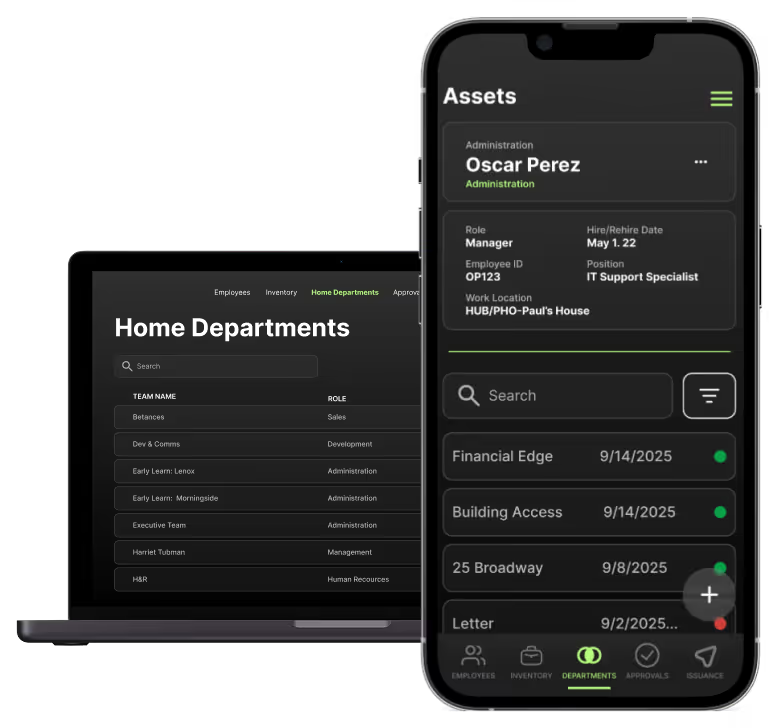
- An inventory or asset management tool keeps real-time records of items, stock levels, and usage. It reduces errors and makes it easier for teams to update quantities or track movement.
- A CRM built for a specific team supports custom pipelines, client details, and task management. It fits unique workflows better than generic software.
- A customer support portal lets clients submit tickets, view updates, and access resources. It reduces email overload and improves response times.
- An appointment booking app allows customers to schedule times, receive reminders, and manage changes. It simplifies coordination for service-based businesses.
- A workflow automation platform handles approvals, reminders, and multi-step processes. It removes repetitive tasks and keeps work moving smoothly.
- Data dashboards and analytics tools combine information into visual insights. Teams can track performance and make decisions faster.
These examples show how low-code applications support daily operations and help teams build useful tools quickly.
Benefits of Low-code Applications
Low-code applications help businesses move faster by reducing the time, cost, and technical effort required to build software. Low-code development is more accessible, allowing teams to solve problems quickly without waiting for long engineering cycles.
This creates a smoother path for innovation, internal improvement, and customer-facing solutions across different industries.
- Low-code applications are built much faster than traditional apps because most parts are visual and preconfigured. Teams can design, test, and launch features in days instead of months.
- They are cheaper to develop and maintain since they require fewer engineering hours. The platform handles hosting, updates, and deployment, lowering long-term costs.
- Teams can update low-code apps easily without deep coding knowledge. You can adjust screens, logic, or data structures through simple interfaces.
- Scalability depends on the platform, allowing apps to grow with your business. Enterprise-grade tools support more users, larger databases, and complex workflows.
- They reduce dependency on overloaded IT teams by letting non-technical members build and manage tools. This frees developers to focus on high-impact work.
- Rapid experimentation becomes easier because changes can be made quickly. Teams can test ideas, gather feedback, and refine features with minimal risk.
Low-code applications bring speed, flexibility, and efficiency together, helping businesses deliver better tools in far less time.
Limitations of Low-code Applications
Low-code applications offer speed and simplicity, but they also come with limitations that can affect complex or highly specialized projects. These limits appear when you need deep customization, full control over infrastructure, or advanced performance requirements.
Understanding these constraints helps you decide when low-code is the right approach and when traditional development is a better fit.
- Deep customization may require coding when visual tools are not enough. Complex UI elements, unusual workflows, or advanced calculations sometimes need custom scripts or external services.
- Platform restrictions can affect design flexibility and logic complexity. Some builders limit how much you can adjust layouts, user interactions, or multi-step workflows.
- Vendor lock-in becomes a concern because hosting, structure, and features depend on the provider. Migrating away can be expensive or time-consuming.
- Performance depends heavily on the platform’s infrastructure. If servers slow down or the provider has outages, your application may be affected without a direct fix.
- Highly specialized or real-time systems may not fit low-code limitations. Apps that require ultra-fast processing or unique architectures may need custom development.
Low-code applications work well for most business needs, but choosing the right platform and project scope is key to long-term success.
Who Should Use Low-code Applications?
Low-code applications are useful for teams that want to build software quickly without relying heavily on traditional coding. They help businesses move faster, test ideas sooner, and give more people the ability to create tools that solve real problems.
Different types of organizations can benefit depending on their goals and resources.
- Startups needing quick MVPs can validate ideas fast using low-code. They build features quickly, gather feedback, and avoid heavy engineering costs during early stages.
- Small teams building internal tools gain speed and flexibility. They create custom apps for operations, tracking, or data management without long development cycles.
- Enterprises automating workflows use low-code to modernize processes. They replace spreadsheets and manual tasks with structured apps that improve efficiency.
- Non-technical teams needing autonomy can build simple tools on their own. They no longer wait for IT availability to solve everyday workflow problems.
- Developers wanting to deliver faster use low-code to skip repetitive work. They focus on advanced logic while the platform handles UI, hosting, and basic workflows.
Low-code applications serve a wide range of organizations by offering speed, accessibility, and room for innovation.
Low-code Applications vs Traditional Applications
Low-code applications and traditional applications follow very different development paths. Low-code focuses on speed, visual building, and easier updates, while traditional coding offers full control and deep customization.
Understanding how these two approaches compare helps you decide which one fits your project’s needs, budget, and long-term goals.
- Visual development in low-code replaces much of the manual coding process. You design screens and workflows through drag and drop tools, while traditional apps require writing code for every feature and interface element.
- Speed is a major benefit of low-code, but traditional apps offer complete customization. Low-code helps you build quickly, while coded apps allow unique designs, advanced logic, and full control over the system.
- Cost differences are significant because low-code reduces engineering hours. Traditional applications require larger teams, longer timelines, and higher development budgets.
- Maintenance is easier with low-code since platforms handle hosting, updates, and deployment. Traditional apps need ongoing engineering support and manual server management.
- Security and hosting differ because low-code platforms manage infrastructure for you. Traditional apps give full control over hosting, compliance, and security setup, but require more effort to maintain.
Both approaches are useful, and choosing the right one depends on your timeline, complexity, and level of customization required.
How Low-code Applications Fit Into Modern IT Strategy
Low-code applications now play an important role in modern IT strategies because they help teams move faster while still supporting long-term goals. Instead of replacing traditional development, low-code works alongside it, giving companies more options for building and improving software.
This balanced approach helps IT teams stay efficient and flexible.
- A hybrid development model lets IT teams combine low-code programming with traditional coding power. Simple apps are built visually, while complex systems still use full engineering, creating a balanced workflow.
- Low-code complements traditional engineering by removing repetitive work. Developers can focus on advanced logic, integrations, and architecture instead of rebuilding common components.
- Supporting digital transformation becomes easier with low-code. Teams modernize processes, replace spreadsheets, and automate workflows without waiting for long development cycles.
- Business operations become more agile because updates can be made quickly. Teams respond to changes faster, improving decision-making and overall efficiency.
Low-code fits naturally into modern IT by speeding delivery, reducing workload, and giving teams the tools they need to build and adapt quickly.
Conclusion
Low-code applications are software built with visual tools and minimal manual coding, making development faster and easier for teams of any size. They matter because businesses today need custom tools quickly, without long engineering cycles or large budgets. Low-code technology gives companies a practical way to launch, improve, and scale applications with far less complexity.
These applications now play a major role in modern software development, supporting internal systems, customer experiences, and automation projects. They help teams innovate faster and stay flexible as needs change.
If you want to build smarter and move faster, LOW/CODE Agency can help. We act as your strategic product partner, not a dev shop, using Bubble, Flutterflow, Glide, Webflow, and AI automation.
With 450+ apps delivered, we help you turn ideas into real impact. Let’s build together.

Related Articles
- How to Choose a Low-code Platform [12 Things to Know]
- What Is a Low-code Development Platform? [Full Guide]
- Low-code vs No-code [Key Differences Explained]
- What Are Low-code Tools? [Features, and Examples]
- How Low-code Works? [Step-by-Step Process Explained]
- What Is Low-code Technology? [Meaning and How It Works]
Last updated on
September 3, 2026
.

Jesus is a visionary entrepreneur and tech expert. After nearly a decade working in web development, he founded LOW/CODE Agency to help businesses optimize their operations through custom software solutions.


FAQs
What is a low-code application?
Are low-code applications suitable for large businesses?
Do low-code applications require coding skills?
Can low-code applications integrate with existing systems?
How secure are low-code applications?
When should I work with LowCode Agency for low-code development?
Related Articles

No-code/Low-code
How to Work With No-code Agency
Work with a no-code agency the right way. Learn how to choose, collaborate, avoid mistakes, and build scalable products without wasting time or money.

Bubble
No-code/Low-code
Top 11 Bubble Agencies (2026) | Hire the Best One
Need a Best Bubble agency? See our 2026 list of 11 vetted teams, plus expert tips to compare, evaluate, and pick the perfect partner for fast, smart app builds

No-code/Low-code
Low-code Mobile App Monetization Strategies for Founders
Learn proven low-code mobile app monetization strategies for founders. Covers pricing models, in-app purchases, subscriptions, ads, and scaling revenue.
![Best 11 No-code Agencies [2026] | Hire the Best one](https://cdn.prod.website-files.com/61cbe22a00483909d327afc6/6a19ce4f7d0b56b04ef8a18d_69318e14a79b823e45f0b8e8_Best%2520No-code%2520Agencies%2520(1).avif)
No-code/Low-code
Best 11 No-code Agencies [2026] | Hire the Best one
Looking for the best no-code agency in 2026? Explore the top 11 no-code teams for SaaS, mobile apps, automation, and MVPs. Find the perfect partner today.
![What Is Low-code? [Meaning, Benefits, and How It Works]](https://cdn.prod.website-files.com/61cbe22a00483909d327afc6/6a19ce2d4b7e09eeb309a944_69b2c9a9a3244ac7189ba24f_what-is-low-code%2520(1).avif)

Why customers trust us for no-code development


