

How to Build an Employee Training Tracker with FlutterFlow
12 min
read
Learn how to create an employee training tracker using FlutterFlow with step-by-step guidance and best practices.

Enterprise LMS platforms charge per seat and deliver more complexity than most businesses need. A FlutterFlow employee training tracker gives HR teams structured completion tracking, certification management, and compliance visibility at a fraction of the cost.
This guide covers what FlutterFlow can build, realistic timelines, honest costs, and the limitations that matter before you commit to the platform.
Key Takeaways
- Progress tracking works well: Module completion, quiz results, certification records, and compliance deadlines are all manageable within FlutterFlow.
- SCORM is not supported: Formal e-learning standards like SCORM and xAPI are not achievable in FlutterFlow without substantial custom code.
- Video hosting is external: Training videos must live on YouTube, Vimeo, or Firebase Storage; FlutterFlow embeds the player only.
- Certification alerts work natively: Scheduled Cloud Functions trigger push notifications and manager alerts before certifications lapse.
- Offline access needs planning: Field workers in warehouses or remote sites require an explicit Firestore offline caching strategy.

What Can FlutterFlow Build for an Employee Training Tracker?
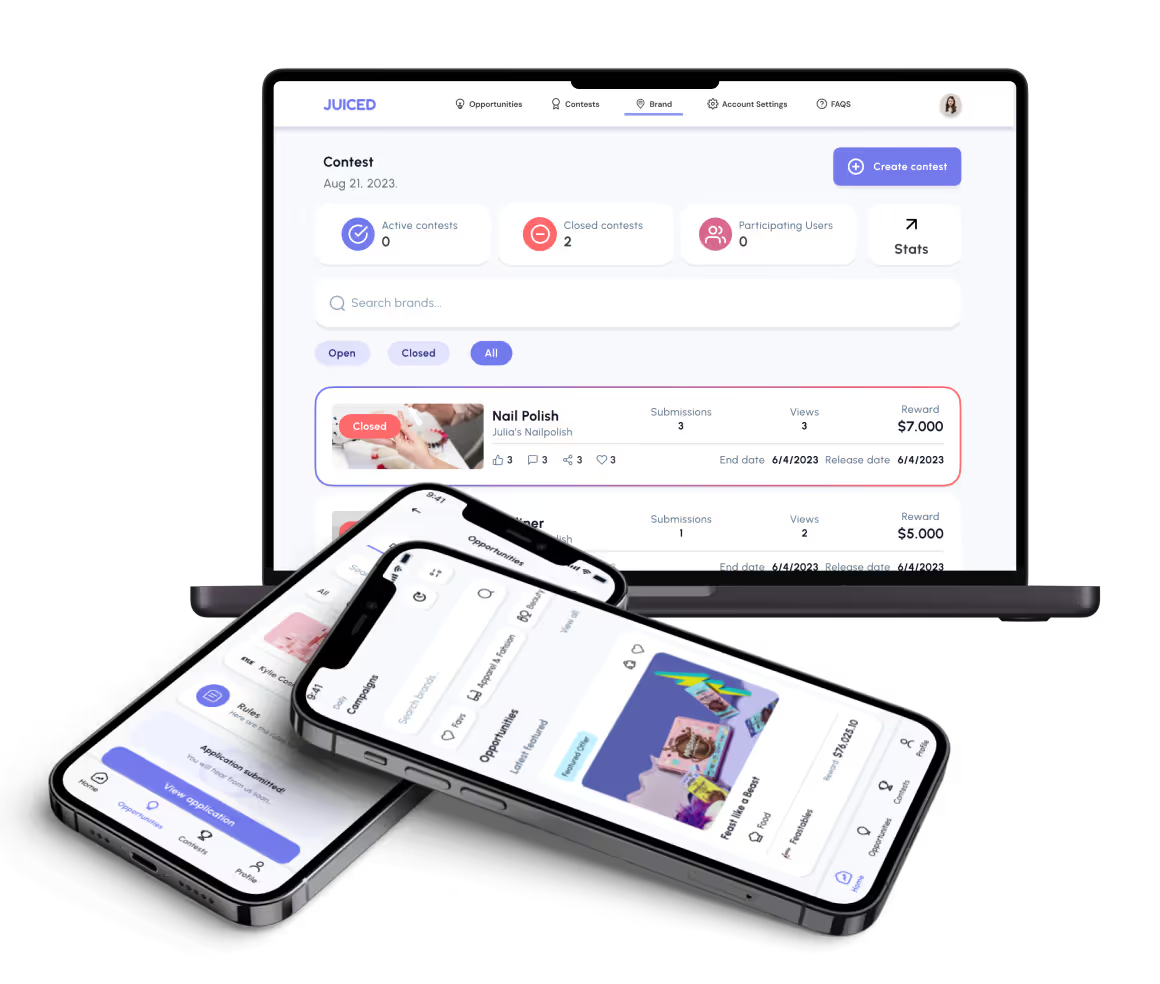
FlutterFlow can build a fully functional employee training tracker covering module libraries, progress records, quizzes, certification management, compliance alerts, and manager dashboards. It handles the full tracking workflow for most SME and franchise training programmes.
FlutterFlow HR app build examples demonstrate how training and compliance tracking features have been shipped in production operational environments.
Training Module Library
- Structured content organisation: Group text, images, PDFs, and embedded videos into categorised modules assigned by role, department, or location.
- Role-based assignment: Automatically push the right training tracks to employees based on job function and department at account creation.
- Content flexibility: Modules support mixed media so HR teams can combine written policies with embedded video walkthroughs in one place.
Progress Tracking and Completion Records
- Firestore-backed records: Each employee's percentage completion, last-accessed timestamp, and pass or fail status store in Firestore with clinician-specific access controls.
- Real-time manager visibility: Line managers see team completion status update live without refreshing a spreadsheet or requesting a weekly report.
- Audit-ready records: Every completion event is timestamped and tied to a user ID, creating a reliable compliance trail.
Assessment and Quiz Engine
- Multiple question types: Build multiple-choice and true or false quizzes at module checkpoints with configurable pass marks and retry limits.
- Score records per employee: Each quiz attempt stores the score, date, and pass or fail result against the employee's training profile.
- Flexible pass thresholds: HR teams set different minimum pass marks per module without needing developer involvement for content updates.
Certification and Licence Management
- Full certificate records: Store earned certifications with issue date, expiry date, and attached certificate documents for each employee.
- Dual access control: Both the employee and their manager can access certification records, reducing HR admin queries significantly.
- Document attachment support: Scanned or downloaded certificates attach directly to the record, replacing physical filing systems.
Compliance Deadline Tracking
- Automated push notifications: Cloud Functions trigger alerts to employees before certifications lapse, removing manual HR follow-up for routine renewals.
- Manager escalation alerts: When an employee misses a renewal deadline, their line manager receives an automatic escalation notification.
- Configurable lead times: HR teams set notification windows, such as 30, 14, and 7 days before expiry, per certification type.
Manager Reporting Dashboard
- Team completion overview: Line managers see completion rates, outstanding modules, and overdue certifications for their direct reports in one screen.
- CSV export functionality: HR and compliance teams export training records directly from the dashboard for audits or regulatory submissions.
- Aggregated compliance view: Senior HR leaders see compliance status across departments, locations, or the whole organisation at a glance.
Role-Based Training Assignment
- Automatic track assignment: New employees receive their training track at account creation based on their role, reducing manual HR setup time per hire.
- Multi-track support: Employees in dual or transitional roles can be assigned multiple tracks without manual duplication of module assignments.
- Reassignment on role change: When an employee's role changes, their training assignment updates automatically to reflect new requirements.
How Long Does It Take to Build a FlutterFlow Employee Training Tracker?
A simple training tracker MVP with a module library, progress tracking, and manager dashboard takes 4 to 7 weeks. A full-featured platform with quizzes, certifications, expiry alerts, and role-based assignment takes 9 to 15 weeks.
Timeline depends heavily on the number of training tracks, quiz complexity, certification expiry logic, and whether HRIS integration is in scope.
- Simple MVP timeline: A module library, basic progress tracking, and manager dashboard delivers in 4 to 7 weeks with an experienced FlutterFlow developer.
- Full platform timeline: Adding quizzes, certification management, expiry alerts, and role-based assignment extends the build to 9 to 15 weeks.
- Phased delivery is faster: Launching the module library and progress tracking first, then adding certifications and compliance reporting in phase two, reduces time to first value.
- Speed advantage over custom: FlutterFlow is 45 to 60 percent faster than a bespoke LMS or training management system build at equivalent scope.
- Timeline factors: Number of training tracks, quiz complexity, expiry notification logic, and HRIS integration scope each add time to estimates.
The phased approach consistently delivers a working tool to employees faster, while keeping the full feature set on a realistic second-phase timeline.
What Does It Cost to Build a FlutterFlow Employee Training Tracker?
A FlutterFlow employee training tracker typically costs $12,000 to $60,000 depending on scope. Enterprise LMS alternatives charge per seat, making a custom FlutterFlow build increasingly cost-effective for businesses with 100 or more employees.
Reviewing FlutterFlow plan pricing tiers helps HR teams understand what platform features are included before factoring in Firebase and video hosting infrastructure costs.
- Platform cost is minimal: FlutterFlow's monthly fee is the smallest line item; Firebase and video hosting grow with employee count and content volume.
- Agency vs freelancer: Agencies suit multi-site or franchise training platforms; freelancers are cost-effective for a single-department system with a defined scope.
- Hidden cost: HRIS integration: Syncing employee rosters from BambooHR, Workday, or SAP HCM requires API work outside FlutterFlow's native capability.
- Hidden cost: content migration: Moving existing training materials from a previous LMS or shared drive into structured modules takes more time than most HR teams plan for.
- Cost comparison with enterprise LMS: Per-seat licensing for platforms like TalentLMS or Cornerstone becomes expensive at scale; a custom FlutterFlow build often has a lower 3-year total cost for businesses with 100 or more employees.
The economics shift clearly in FlutterFlow's favour once your employee count makes per-seat LMS licensing a significant recurring budget line.
How Does FlutterFlow Compare to Custom Development for Employee Training Trackers?
FlutterFlow delivers a training tracker MVP in 4 to 7 weeks at 40 to 60 percent of the cost of a bespoke build. Custom development wins only when SCORM compliance, adaptive learning paths, or deep HRIS integration with enterprise systems is genuinely required.
The comparison hinges on whether your training programme's requirements fall within FlutterFlow's capability ceiling.
- Speed is FlutterFlow's main advantage: A 4 to 7 week MVP versus 4 to 8 months for a custom build makes FlutterFlow a practical choice for businesses that need a working system this quarter.
- Maintenance is simpler: HR teams can update training content and add new modules in FlutterFlow without developer involvement, keeping ongoing costs low.
- When custom wins: Regulated industries needing SCORM or xAPI accreditation, enterprise HRIS integration with Workday or SAP HCM, and complex adaptive learning personalisation all require custom development.
- FlutterFlow fits SMEs well: Independent businesses, franchise networks, field service operations, and retail or hospitality training programmes are natural fits for the platform's capability range.
Understanding the FlutterFlow training app trade-offs helps learning and development leaders decide whether the platform ceiling fits their compliance and accreditation requirements.
What Are the Limitations of FlutterFlow for Employee Training Trackers?
FlutterFlow does not support SCORM or xAPI, which are hard requirements for many formal e-learning programmes. Video hosting is external, offline access requires explicit configuration, and HRIS integration with enterprise systems sits outside the platform's native capability.
Following FlutterFlow training tracker best practices for offline caching and role-based content assignment prevents the deployment failures that arise when field workers lose connectivity.
- SCORM and xAPI are not available: If formal e-learning accreditation or interoperability with SCORM-compliant content is required, FlutterFlow is not the right platform.
- Video hosting is external: Training videos must be hosted on YouTube, Vimeo, or Firebase Storage; FlutterFlow embeds players but does not host or transcode video.
- Offline access needs design: Employees in warehouses or remote sites need training content cached locally; Firestore offline persistence must be explicitly configured and tested.
- Adaptive learning requires backend logic: Personalised learning paths that adjust based on quiz performance exceed what FlutterFlow's visual builder handles without custom code.
- HRIS integration is not native: Syncing employee rosters from Workday, BambooHR, or SAP HCM requires API integration work outside the platform's default tools.
- Code export is available: Paid plans allow full codebase export for organisations needing ownership outside the FlutterFlow environment.
SCORM is a genuine dealbreaker for certain industries. If your training programme requires formal accreditation or compatibility with existing SCORM-compliant content libraries, identify that requirement before selecting FlutterFlow.
How Do You Get a FlutterFlow Employee Training Tracker Built?
Knowing how to hire a FlutterFlow developer with compliance tracking and certification management experience ensures the training app handles regulatory requirements correctly from the start.
Freelancers suit a single-department training system with a well-defined scope. Agencies are the stronger choice for multi-site or franchise training platforms with certifications, compliance reporting, and potential HRIS integration.
- Core expertise to look for: Firestore data modelling for training progress, scheduled Cloud Functions for expiry alerts, role-based content assignment, and Firebase Auth integration.
- Freelancer fits: A single-department training system with a clear scope and no HRIS integration requirement is a workable freelancer project.
- Agency fits: Multi-site or franchise training platforms with certification expiry logic, compliance reporting, and HRIS integration scope are better suited to an experienced agency.
- Red flag: SCORM claims: Any developer claiming SCORM compliance is achievable in FlutterFlow without custom code is not being honest about the platform's limitations.
- Red flag: no offline plan: If a developer has no strategy for field workers losing connectivity, the app will fail for warehouse and remote site users.
- Key question to ask: "How do you handle training assignment when a new employee is created?" and "How do you manage certification expiry alerts at scale?"
- Expected timeline: A working build covering a full training feature set typically takes 6 to 15 weeks depending on scope and integration requirements.
Conclusion
FlutterFlow is a capable and cost-effective platform for employee training trackers at SME and franchise scale. Module tracking, certifications, compliance dashboards, and role-based assignment all work well within the platform.
The ceiling is clear: SCORM accreditation and enterprise HRIS integration require custom development. Identify whether any of your training content requires SCORM compliance or formal accreditation before choosing FlutterFlow. That single requirement changes the platform decision entirely.
Building an Employee Training Tracker with FlutterFlow? Here Is How LOW/CODE Agency Approaches It.
Most training tracker projects stall not because the platform is wrong, but because the data model and compliance logic were not designed properly at the start. Certification expiry logic, role-based assignment, and offline access for field workers each require specific architectural decisions that determine whether the app works reliably at scale.
As AI development experts, we at LOW/CODE Agency help SMBs ship real software — web and mobile applications, intelligent chatbots, RAG pipelines, and autonomous AI agents built for businesses that need results, not platforms. We scope, design, and build FlutterFlow training trackers with the compliance architecture, Firestore data modelling, and notification logic that makes them work in production, not just in demos.
- Training workflow mapping: We document your full training programme structure, certification requirements, and compliance deadlines before writing a single line of logic.
- Firestore data model design: We architect the database structure for progress tracking, certification records, and role-based assignment at the start, not as an afterthought.
- Quiz and assessment build: We configure quizzes with pass thresholds, retry logic, and score records per employee, connected to the broader progress tracking system.
- Certification and expiry logic: We set up Cloud Functions for multi-stage expiry alerts to employees and managers, with configurable notification windows per certification type.
- Offline caching strategy: We explicitly configure Firestore offline persistence for field workers in warehouses and remote sites, with testing under real connectivity conditions.
- Manager dashboard and reporting: We build completion dashboards with CSV export for compliance audits, giving HR and line managers the visibility they need without manual reporting.
- Full product team: Strategy, design, development, and QA from a single team, covering every phase from data model to production deployment.
We have built 350+ products for clients including Coca-Cola, American Express, and Sotheby's. We know where training tracker builds go wrong, and we address those points before they become problems.
Related Articles
- How to Build Entertainment Apps with FlutterFlow
- How to Build Energy and Utility Apps with FlutterFlow
- How to Build an EMR System with FlutterFlow
- How to Build an Employee Onboarding App with FlutterFlow
- How to Build an Electricity Usage Dashboard with FlutterFlow
- How to Build an Education App with FlutterFlow
Last updated on
September 24, 2026
.

Jesus is a visionary entrepreneur and tech expert. After nearly a decade working in web development, he founded LOW/CODE Agency to help businesses optimize their operations through custom software solutions.


FAQs
What are the key features to include in an employee training tracker?
How can FlutterFlow simplify building a training tracker app?
What data structure is best for storing training records in FlutterFlow?
Can I integrate notifications for training deadlines in FlutterFlow?
How do I track employee progress and completion status in the app?
Is it possible to customize the training tracker for different departments?
Related Articles
FlutterFlow
How to Build a Rental Agreement App with FlutterFlow
Learn how to create a rental agreement app using FlutterFlow with step-by-step guidance and key features to include.

FlutterFlow
How to Build a Dropshipping App with FlutterFlow
Learn how to create a dropshipping app using FlutterFlow with step-by-step guidance and tips for beginners.

FlutterFlow
Are Flutterflow Apps Secure? (And How to Build One in 2026)
Yes, FlutterFlow apps can be secure in 2026. Learn how security really works, common risks, and how to build a secure FlutterFlow app correctly.

FlutterFlow
How to Build Equipment Rental Tech with FlutterFlow
Learn how to create equipment rental software using FlutterFlow with ease and speed. Start building your app today.

Why customers trust us for no-code development


