

How to Build an Education App with FlutterFlow
11 min
read
Learn step-by-step how to create an education app using FlutterFlow with no coding skills required. Start building today.

FlutterFlow education app development gives course creators and online academies a fast path to a working learning platform without the cost of a custom build. The ed-tech market rewards speed, and teams that launch in weeks reach students before slower competitors do.
The platform handles core learning flows well: course browsing, video lessons, quizzes, and progress tracking are all achievable. The gaps are in SCORM compliance and adaptive learning, and knowing them upfront prevents a costly platform switch later.
Key Takeaways
- Core learning flows covered: Course browsing, video lessons, quizzes, progress tracking, and completion certificates are all achievable in the visual builder.
- Video streaming requires third-party hosting: FlutterFlow does not host video. Vimeo, YouTube, or Mux must be integrated for lesson delivery.
- Build timeline is 8–16 weeks: A basic education app MVP ships in 7–9 weeks. A full platform with subscriptions, progress tracking, and certificates takes 14–18 weeks.
- Costs range from $18,000–$65,000: Video integration, quiz engine design, and subscription billing are the primary complexity drivers.
- SCORM compliance requires middleware: FlutterFlow is not natively SCORM-compatible. Enterprise LMS compliance needs a custom backend layer.

What Can FlutterFlow Build for an Education App?
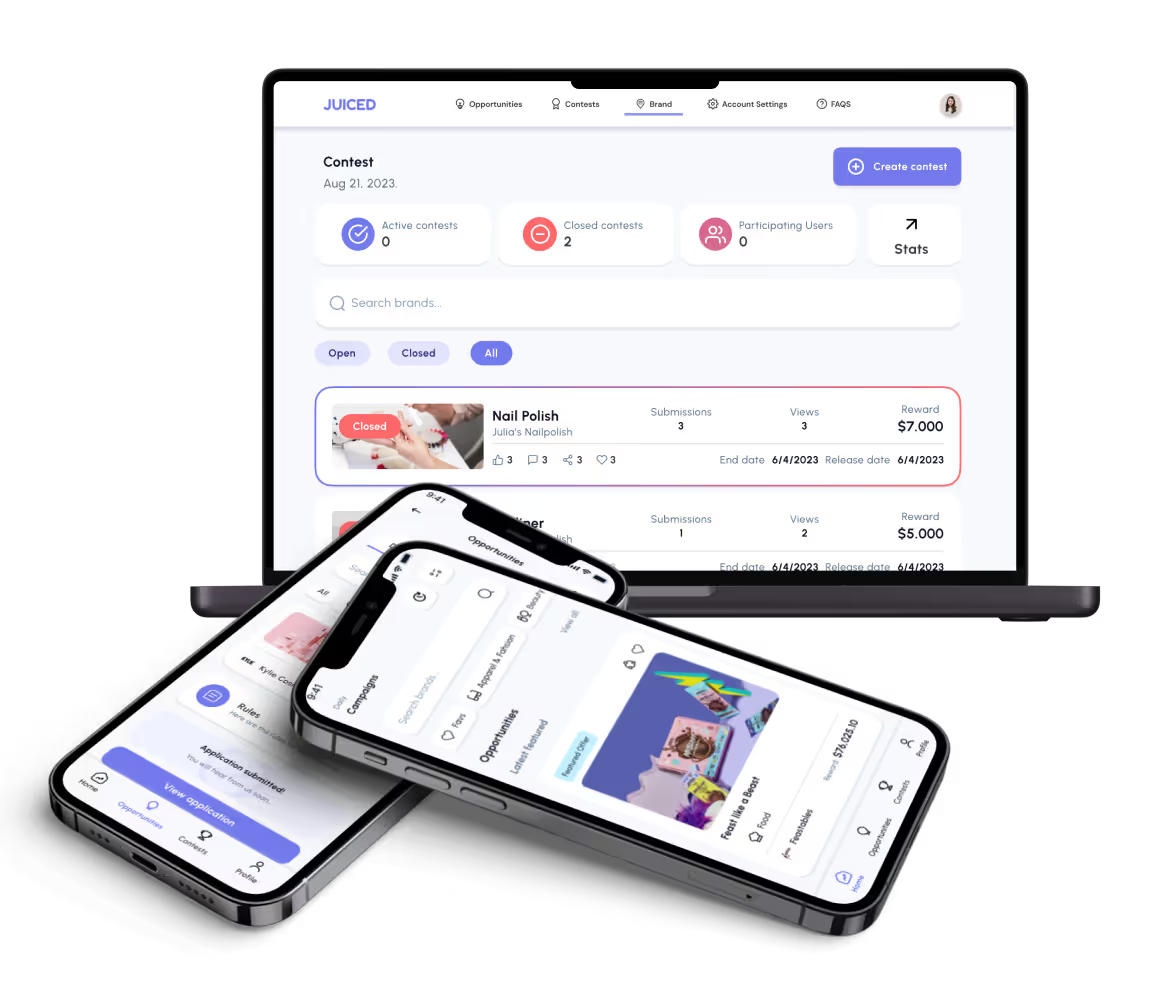
FlutterFlow can deliver a course catalog, video lesson player, quiz engine, progress tracking, completion certificates, discussion threads, and subscription billing in one mobile and web app. Course creators and ed-tech founders considering education apps built as SaaS should understand how FlutterFlow handles subscription billing and multi-tenant content access before committing.
The visual builder handles the student experience cleanly. Video hosting, quiz scoring, and certificate generation each require deliberate backend configuration.
Course Catalog and Browsing
Students browse available courses with category filters, search, ratings, and preview content in a clean filterable catalog layout.
Video Lesson Player
Lessons stream from a third-party video host embedded within the app. Progress tracking per video and per course records completion state in Firestore.
Quiz and Assessment Engine
Multiple-choice, true/false, and short-answer questions deliver scored results, pass/fail thresholds, and immediate feedback on submission.
Progress Tracking and Course Completion
Student progress tracks per lesson and per course. Completion percentages display on the dashboard, and completion unlocks the next module or a certificate.
Completion Certificates
Digital certificates generate via a Cloud Function PDF generator or certificate image template and store in the student's account on course completion.
Discussion and Comment Threads
Students post questions and comments per lesson or course. Instructors respond, creating an asynchronous learning community without leaving the app.
Subscription and One-Time Purchase
Students subscribe for monthly course access or purchase individual courses via Stripe, with content gating based on enrolment status.
Push Notifications for Learning Reminders
Automated reminders prompt students who have not engaged in a defined period, boosting completion rates through consistent re-engagement.
A Firestore data model that cleanly separates course structure, student progress, and subscription status makes all eight features maintainable as content grows.
How Long Does It Take to Build an Education App with FlutterFlow?
A simple education app MVP with course catalog, video lessons, basic quiz, and progress tracking takes 7–9 weeks. A full education platform with subscriptions, completion certificates, discussion threads, and push notifications takes 14–18 weeks.
Timeline extends when video hosting integration is complex, when quiz engines need branching logic, or when subscription billing requires multiple access tiers.
- MVP is genuinely fast: A working course catalog with video lessons and progress tracking is achievable in 7–9 weeks with an experienced team.
- Video player configuration adds time: Integrating Vimeo, Mux, or YouTube with per-video progress tracking takes longer than most teams anticipate.
- Certificate generation needs a Cloud Function: PDF certificate creation requires backend code, not a visual builder configuration.
- Subscription billing complexity: Multiple access tiers, trial periods, and content gating each add scope to the payment integration layer.
- FlutterFlow is 40–60% faster: Pre-built components reduce build time significantly compared to a custom Flutter or React Native build.
A phased launch, free courses first with progress tracking, then adding payment gating and certificates, lets you validate student experience before investing in billing complexity.
What Does It Cost to Build an Education App with FlutterFlow?
Getting a clear view of FlutterFlow education app pricing including video hosting and payment processing is essential before committing to a development budget. Video hosting is the most variable ongoing cost line.
Platform costs run $0–$70 per month. Video hosting, Stripe fees, and developer time are the real budget items.
- Video hosting is an ongoing cost: Vimeo starts at $75 per month. Mux charges per minute of video delivered. Choose based on your course library size and expected student volume.
- SCORM middleware adds cost: Enterprise or institutional clients requiring SCORM compliance need a custom backend middleware layer that adds to the build budget.
- Accessibility compliance adds scope: WCAG or Section 508 compliance testing, if required, adds time and cost to the QA phase.
- Custom comparison: An equivalent education platform in custom code costs $80,000–$250,000, making FlutterFlow 3–5x more cost-effective for most course creators.
- App store fees are fixed: Budget $99 per year for Apple and $25 one-time for Google Play alongside your ongoing infrastructure costs.
Video transcoding costs scale with course library size. Plan the video hosting model before committing to a provider, because migration is disruptive once students are enrolled.
How Does FlutterFlow Compare to Custom Development for an Education App?
FlutterFlow delivers a working education app in 7–18 weeks versus 6–14 months for a custom build. It costs $18,000–$85,000 versus $80,000–$300,000 for an equivalent platform. The comparison shifts when SCORM compliance, adaptive learning, or institutional integrations are required.
For independent course creators, online academies, and tutoring platforms, FlutterFlow wins on speed and cost. Custom wins when enterprise compliance or adaptive learning algorithms are required.
- FlutterFlow wins: Independent course creators, online academies, tutoring platforms, school supplement apps, and employee learning tools.
- Custom wins: Enterprise LMS with SCORM compliance, adaptive learning paths, accreditation requirements, or institutional student data integrations.
- Maintenance advantage: Updating course structure, adding new modules, and changing UI layouts are fast in FlutterFlow without ongoing developer dependency.
- Learning engine ceiling: AI-driven personalisation and content that adapts to quiz performance require custom backend development beyond the visual builder.
Understanding education app builder tradeoffs clearly, especially around SCORM compliance and adaptive learning, is what separates a tool choice from a technology mistake.
What Are the Limitations of FlutterFlow for an Education App?
Education platform scalability limits in FlutterFlow become relevant when concurrent video streaming and quiz submission volumes grow. Education platform scalability limits require backend architecture planned for peak usage, not average usage.
The limitations are significant for enterprise clients but manageable for independent academies and course creators.
- SCORM and xAPI not natively supported: Enterprise and institutional clients requiring LMS standards need custom middleware or backend code that FlutterFlow cannot produce visually.
- Adaptive learning paths are too complex: Content that responds to quiz performance or learner behaviour exceeds the visual builder's maintainability as logic branches grow.
- Video hosting is not included: Every education app built in FlutterFlow depends on an external video provider with its own cost, uptime, and configuration requirements.
- Visual logic maintainability: Complex business logic for content access rules and course prerequisite chains becomes harder to audit as the platform grows.
- Vendor dependency on video provider: Vimeo pricing changes and Mux API updates directly impact lesson delivery and must be monitored as ongoing operational risk.
- Code export as an escape valve: Exporting Flutter code allows teams to implement custom learning engine logic beyond visual builder limits, but requires Flutter expertise.
These limitations matter most for institutional education clients. Independent course creators with well-defined content structures rarely encounter them in practice.
How Do You Find the Right Team to Build a FlutterFlow Education App?
Knowing how to hire education app FlutterFlow developers with video integration and quiz engine experience prevents the most common ed-tech build failures. A developer who assumes video hosting is built into FlutterFlow is not ready for this project.
The right team has built quiz engines with scored results and integrated video players with progress tracking before.
- Video integration experience is required: Confirm the team has integrated Vimeo, Mux, or YouTube with per-video progress tracking in a live FlutterFlow app.
- Quiz engine portfolio: Ask to see a quiz implementation with scored results, pass/fail thresholds, and course gating logic from a previous project.
- Subscription billing depth: Teams must understand Stripe subscription tiers, trial periods, and content gating in Firestore, not just basic payment forms.
- Red flag: no questions about course structure: A developer who does not ask about module hierarchy, content access rules, and subscription tiers before quoting has not built education apps.
- Freelancer versus agency: Simple course catalog builds work with a capable freelancer. Subscription platforms with complex content gating and progress tracking warrant an agency.
Expect a strong team to spend one to two weeks in discovery covering course structure, content access model, and subscription logic before any build work begins.
Conclusion
FlutterFlow is a practical platform for education app development, particularly for course creators and online academies that need to launch quickly and iterate based on student feedback.
Before approaching a developer, outline your course structure in terms of modules and lessons, and decide whether access will be free, subscription-based, or per-course. These two decisions determine the data model and payment architecture, which determine the entire build timeline.
Building an Education App with FlutterFlow? Here Is How LOW/CODE Agency Approaches It.
Most education app builds run into the same two problems: video integration is treated as a simple embed when it is a structured backend decision, and subscription billing is scoped without thinking through content gating. Both cause rework.
At LOW/CODE Agency, we help SMBs compete with AI-powered software built for them — custom web and mobile apps, RAG systems, chatbots, and intelligent agents delivered by a senior development team. We design the course data structure, video hosting integration, and subscription access model before the visual builder is opened. That planning prevents the rework that costs most education app projects three to four weeks.
- Course architecture design: We map your module, lesson, and quiz hierarchy as a Firestore data model before any screen is built.
- Video hosting selection: We recommend and integrate the right video provider for your content volume, student count, and budget constraints.
- Quiz engine build: We build scored quiz flows with pass/fail thresholds, immediate feedback, and course progression gating in the visual builder.
- Subscription billing and gating: We implement Stripe subscription tiers and Firestore-based content access control so students see only what they are entitled to.
- Completion certificates: We build the Cloud Function PDF generator that creates and stores certificates on course completion automatically.
- Progress tracking dashboard: We build the student progress view and the instructor-facing completion rate dashboard together as part of the core build.
- Full product team: Strategy, design, development, and QA from a single team invested in your education platform outcome, not just the delivery.
We have built 350+ products for clients including Coca-Cola, American Express, and Sotheby's. We know where education app builds stall and how to prevent it before it costs you students.
Related Articles
- How to Build an Employee Training Tracker with FlutterFlow
- How to Build an Employee Onboarding App with FlutterFlow
- How to Build an Electricity Usage Dashboard with FlutterFlow
- How to Build an Ecommerce App with FlutterFlow
- How to Build a Dropshipping App with FlutterFlow
- How to Build a Driver Tracking Dashboard with FlutterFlow
Last updated on
September 24, 2026
.

Jesus is a visionary entrepreneur and tech expert. After nearly a decade working in web development, he founded LOW/CODE Agency to help businesses optimize their operations through custom software solutions.


FAQs
What are the first steps to create an education app in FlutterFlow?
Can I build an education app in FlutterFlow without coding experience?
How do I add quizzes and interactive lessons in FlutterFlow?
Is it possible to integrate a database for student progress tracking in FlutterFlow?
What are common challenges when building education apps with FlutterFlow?
How do I publish and maintain my education app built with FlutterFlow?
Related Articles

FlutterFlow
How to Build a Carpooling Platform with FlutterFlow
Learn how to create a carpooling app using FlutterFlow with step-by-step guidance and essential tips for success.

FlutterFlow
How to Build Transportation Apps with FlutterFlow
Learn how to create efficient transportation apps using FlutterFlow with step-by-step guidance and best practices.
FlutterFlow
How to Build Sports Apps with FlutterFlow
Learn how to create sports apps using FlutterFlow with easy steps, features, and tips for beginners and pros.
FlutterFlow
How to Build a Trucking Dispatch App with FlutterFlow
Learn how to create a trucking dispatch app using FlutterFlow with step-by-step guidance and key features to include.


Why customers trust us for no-code development


