

How to Build Entertainment Apps with FlutterFlow
13 min
read
Learn how to create engaging entertainment apps using FlutterFlow with step-by-step guidance and best practices.


Entertainment app development has historically meant months of custom work and six-figure budgets. FlutterFlow changes that equation for most entertainment use cases, but not for all of them, and knowing the boundaries prevents expensive surprises.
The platform builds event discovery, ticketing, content libraries, user profiles, and subscriptions efficiently. Video streaming, DRM, and concurrent scale at broadcast level are separate infrastructure problems that no app framework solves on its own.
Key Takeaways
- Entertainment infrastructure builds well: Ticketing, content discovery, event listings, and user profiles are native FlutterFlow capabilities.
- Video streaming is not natively supported: FlutterFlow does not host or adaptively stream video, external platforms like Mux or Cloudflare Stream are required.
- DRM requires the video CDN: FlutterFlow has no native content protection layer, Widevine and FairPlay DRM are entirely a function of the chosen video CDN.
- Subscription billing is doable but layered: Stripe integration handles recurring billing, but app store IAP compliance for digital content adds overhead.
- Concurrent scale needs architecture planning: Firestore and CDN configuration must be designed for high-traffic launch moments and live event audiences.
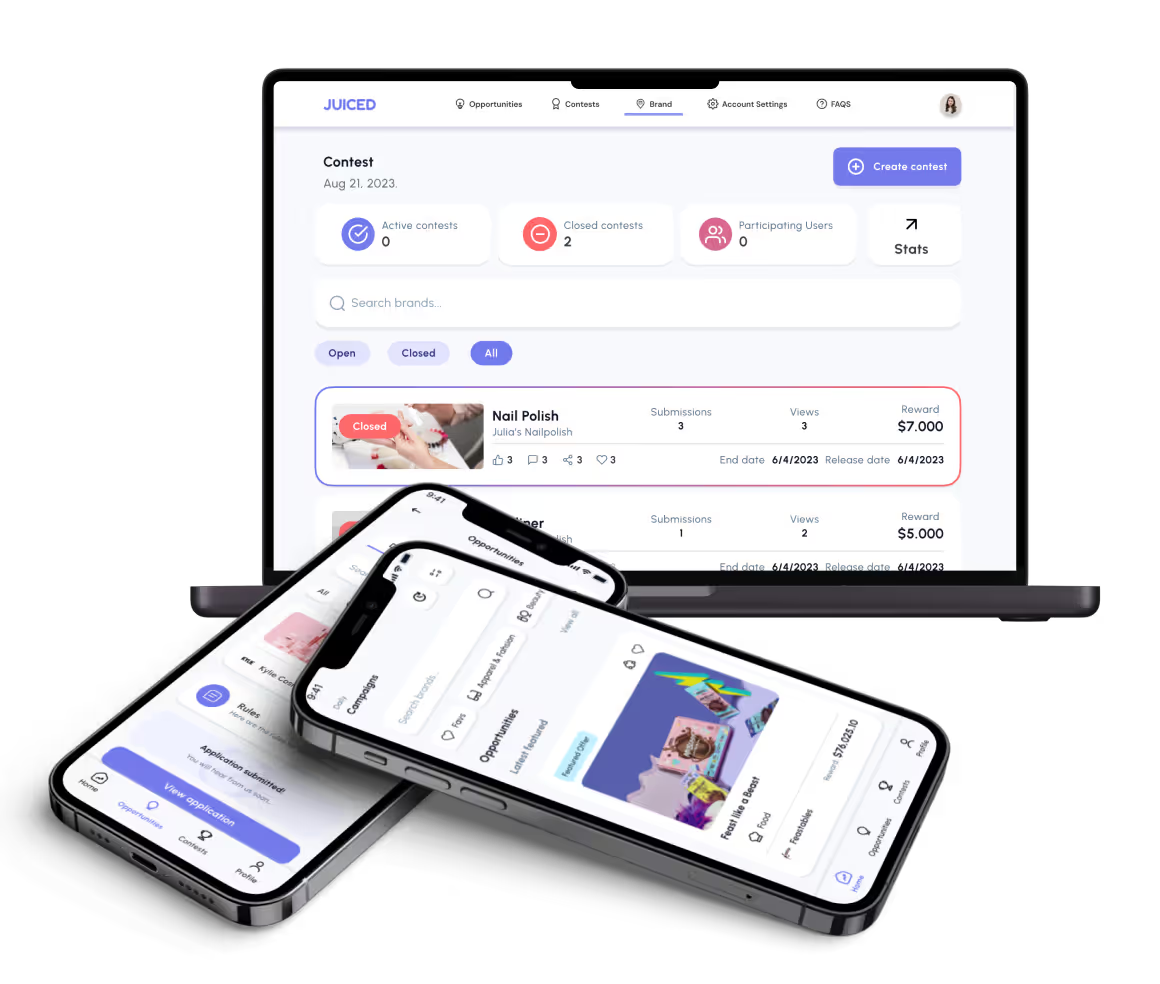

What Can FlutterFlow Build for Entertainment?
FlutterFlow can build the full infrastructure layer of an entertainment app: event discovery, ticketing, content libraries, video playback via external integration, user profiles, social features, and push notification campaigns. It handles everything except video encoding and content protection.
Understanding what FlutterFlow can and cannot build across entertainment and media use cases is required reading before finalising a feature scope.
Event and Show Discovery Interface
Build browsable event listings with categories, filters, search, and personalised recommendations using Firestore data and conditional logic.
- Category and filter navigation: Customers browse events by genre, location, date, and venue with real-time filter results from Firestore queries.
- Personalised recommendations: Conditional logic and Firestore query filtering surface events matching a user's saved preferences and viewing history.
- Search functionality: A Firestore text search or Algolia integration delivers keyword event search with results ranked by relevance and date.
Ticketing and Seat Selection
Implement event ticket purchasing flows with Stripe payment, digital ticket delivery, and QR code generation via third-party services.
- Stripe-powered purchase flow: Customers complete ticket purchases through a Stripe payment integration with order confirmation and receipt delivery.
- Digital ticket delivery: Purchased tickets render in-app with event details, seat information, and a QR code generated via third-party service integration.
- Inventory management: Ticket availability tracks in Firestore with real-time updates to prevent overselling when multiple customers purchase simultaneously.
Content Catalogue and Media Library
Display a structured library of articles, podcasts, short-form videos, or music content with category navigation and user favouriting.
- Structured content browsing: A Firestore-backed catalogue organises content by type, genre, creator, and release date with filtered navigation.
- Favouriting and save lists: Users save content to personal lists stored in their Firestore profile, accessible across devices on the same account.
- Content release scheduling: New content items become visible at a configured release date by toggling a published field in the Firestore document.
Video Playback via External Integration
Embed video content from Mux, Vimeo, or YouTube using FlutterFlow's video player widget or custom iframe integration for managed streaming.
- Mux and Vimeo embedding: FlutterFlow's video player widget embeds managed streaming URLs from Mux or Vimeo with playback controls and progress tracking.
- YouTube integration: Public or unlisted YouTube content embeds via the video player widget with standard playback functionality.
- Playback progress tracking: Viewing progress stores in Firestore against the user's profile, enabling resume playback across sessions and devices.
User Profiles and Watch History
Store personalised user data, preferences, viewing history, saved content, and subscription status, in Firestore with Auth-linked access.
- Auth-linked profile records: Each user's preferences, viewing history, saved content, and subscription status store in a Firestore document linked to their Firebase Auth UID.
- Cross-device access: Profile data syncs across devices automatically because it lives in Firestore rather than local device storage.
- Subscription status gating: Content visibility rules reference the user's subscription tier in their Firestore profile to gate premium versus free content.
Social and Community Features
Add comments, ratings, reviews, and follower relationships using Firestore collections and real-time listeners.
- Comments and reviews: Users post comments and star ratings on content items and events, stored in Firestore subcollections with real-time listener updates.
- Follower relationships: A Firestore-based follow system lets users follow creators or curators, with followed content surfacing in a personalised feed.
- Moderation tooling: Flagging and admin review actions connect to a moderation queue where content team members review and action reported posts.
Push Notification Campaigns
Send content release alerts, event reminders, and personalised recommendations through Firebase Cloud Messaging.
- Content release alerts: New episode or event announcements push to relevant subscriber segments via Firebase Cloud Messaging targeting.
- Event reminders: Automated reminders fire at configurable intervals before a purchased event, reducing no-shows and increasing engagement.
- Personalised recommendation push: Notifications based on a user's watch history and saved preferences drive return engagement with relevant content suggestions.
How Long Does It Take to Build an Entertainment App with FlutterFlow?
A simple entertainment app MVP with content listings, user profiles, and notifications takes 5–8 weeks. A full-featured platform with ticketing, video integration, subscriptions, and social features takes 12–20 weeks.
A phased approach works well here: launch event discovery and ticketing first, then add streaming and social features in phase two.
- Simple MVP timeline: Content listings, user profiles, and push notification setup deliver in 5–8 weeks with an experienced FlutterFlow developer.
- Full platform timeline: Ticketing, video CDN integration, subscription billing, and social features extend the build to 12–20 weeks.
- Speed advantage: FlutterFlow delivers the non-streaming infrastructure, discovery, ticketing, profiles, and subscriptions, 50–60% faster than a custom build.
- Video infrastructure is parallel: Video CDN setup, encoding pipeline, and DRM configuration happen alongside the FlutterFlow build as a separate workstream.
- Timeline factors: Video integration complexity, subscription billing setup, DRM requirements, and content management needs are the main variables.
The video infrastructure decisions, CDN selection, encoding pipeline, and DRM, should be scoped separately before the FlutterFlow build begins, since they involve different vendors and different timelines.
What Does It Cost to Build a FlutterFlow Entertainment App?
A FlutterFlow entertainment app typically costs $15,000–$80,000 depending on scope. Video hosting and CDN costs are external and comparable regardless of what app framework is used.
Start with the FlutterFlow pricing plans overview to understand which subscription tier supports the API integrations a production entertainment app requires.
- Video infrastructure cost is framework-neutral: Mux, Cloudflare Stream, or equivalent CDN costs are the same whether you build in FlutterFlow, React Native, or fully custom, these are not FlutterFlow costs.
- App store fees apply: Apple and Google take 15–30% of in-app purchase revenue for digital content subscriptions, factor this into your subscription pricing model.
- Hidden cost: content management system: A content team needs a way to add and manage content without developer involvement, a headless CMS or Firestore-based admin panel adds scope.
- Hidden cost: DRM service subscription: If premium video content requires Widevine or FairPlay protection, the DRM service from your chosen video CDN adds a recurring cost.
The economics of FlutterFlow versus custom development are clearest on the UI and logic layers, discovery, ticketing, profiles, and subscriptions. The video pipeline costs are identical either way.
How Does FlutterFlow Compare to Custom Development for Entertainment Apps?
FlutterFlow saves 40–60% on the UI and data logic of an entertainment app. Video infrastructure cost is external and the same regardless of framework. The capability gap opens at broadcast-quality streaming, multi-bitrate adaptive encoding, and proprietary recommendation engines.
FlutterFlow wins for event apps, podcast platforms, community content hubs, and ticket marketplaces. Custom development wins at Netflix-scale streaming.
- When FlutterFlow wins: Event apps, podcast platforms, community content hubs, and ticket marketplaces benefit from FlutterFlow's speed and cost profile.
- When custom wins: Netflix-scale streaming services, broadcast system integrations, and proprietary ML recommendation engines require custom architecture.
- Maintenance advantage: FlutterFlow's visual editor lets content and product teams update listings, categories, and UI without developer involvement post-launch.
For teams where FlutterFlow's streaming limitations are a constraint, reviewing entertainment app platform alternatives helps map the right technical path.
What Are the Limitations of FlutterFlow for Entertainment Apps?
FlutterFlow concurrent user scale is critical for entertainment apps expecting launch-day traffic or live event simulcast audiences. Several hard limits apply before reaching that scale.
Video streaming, DRM, and recommendation algorithms are the three areas where FlutterFlow delegates entirely to external infrastructure.
- Video streaming is not native: FlutterFlow embeds external video players, it does not encode, transcode, or adaptively stream video. This is a video CDN problem, not a FlutterFlow limitation to work around.
- DRM requires the video CDN: FlutterFlow has no built-in Widevine or FairPlay DRM. Content protection depends entirely on the video CDN chosen, Mux, Cloudflare Stream, or equivalent.
- Concurrent streaming scale: Thousands of simultaneous video viewers require a CDN capable of the load, Firestore alone cannot handle concurrent streaming traffic.
- App store IAP compliance: Apple and Google require in-app purchases for digital content subscriptions, adding compliance overhead and revenue sharing obligations.
- Recommendation algorithm depth: Personalised content recommendations beyond simple category and history filters require a backend ML service that FlutterFlow integrates with via API.
- Vendor dependency: All visual logic lives in FlutterFlow's proprietary builder, code export is available on paid plans for teams needing codebase ownership.
FlutterFlow does not stream video natively. The platform embeds players from external services. Any developer who presents video streaming as a simple FlutterFlow configuration is misrepresenting the architecture.
How Do You Get a FlutterFlow Entertainment App Built?
Reviewing top FlutterFlow development agencies that have shipped entertainment apps prevents the video infrastructure mistakes that derail media platform builds.
Freelancers suit simple event listing or podcast apps. Agencies are better for multi-format entertainment platforms with streaming, subscription billing, and social features.
- Video CDN integration experience is mandatory: Any developer you hire must have prior experience integrating Mux, Cloudflare Stream, or an equivalent video CDN, not just general API knowledge.
- Stripe subscription billing experience: Recurring billing with free trial logic, tier upgrades, and cancellation flows requires prior Stripe experience, not just a basic payment integration.
- Red flag: streaming confidence: A developer who describes video streaming as "easy in FlutterFlow" without referencing a CDN strategy does not understand the architecture.
- Red flag: no DRM discussion: For platforms with premium video content, a developer who has not raised DRM and content protection is not thinking about production requirements.
- Key question to ask: "How do you handle video delivery at scale, and what is your approach to Apple IAP compliance for entertainment subscriptions?"
- Expected timeline: A well-scoped entertainment app build runs 8–20 weeks from project start to production launch depending on feature complexity and video infrastructure scope.
Conclusion
FlutterFlow is a capable and cost-effective platform for entertainment app infrastructure. Discovery, ticketing, user profiles, and subscriptions all work well within the platform.
Video streaming, DRM, and concurrent scale are external infrastructure decisions that exist independently of what app framework you choose. Separate the video infrastructure workstream, CDN, encoding, DRM, from the FlutterFlow scope before writing a project brief. These are different vendors with different timelines.
Building an Entertainment App with FlutterFlow? Here Is How LOW/CODE Agency Approaches It.
Most entertainment app projects run into trouble at two points: video infrastructure that was not scoped separately from the app build, and subscription billing that did not account for app store IAP requirements until late in the project.
At LOW/CODE Agency, we help SMBs compete with AI-powered software built for them — custom web and mobile apps, RAG systems, chatbots, and intelligent agents delivered by a senior development team. We scope your video CDN strategy, subscription billing architecture, and app store compliance requirements before we write a line of FlutterFlow code, because getting those decisions right determines whether the app works in production.
- Feature scoping: We map every entertainment feature, discovery, ticketing, video, subscriptions, social, and separate the FlutterFlow scope from the video infrastructure workstream.
- Video CDN strategy: We advise on Mux, Cloudflare Stream, and Vimeo OTT based on your content type, scale, and DRM requirements, independent of the FlutterFlow build.
- Ticketing and payment build: We implement Stripe-powered ticket purchasing with digital delivery, QR code generation, and inventory management in Firestore.
- Subscription billing architecture: We set up recurring billing with tier management, free trial logic, and app store IAP compliance for both Apple and Google.
- Content library and discovery: We build your catalogue, category navigation, user profiles, and personalised discovery features with clean Firestore data modelling.
- Social and community features: We add comments, ratings, follower relationships, and moderation tooling where your platform requires community engagement.
- Full product team: Strategy, UX, FlutterFlow development, Firebase architecture, and QA from a single team delivering your entertainment app end to end.
We have built 350+ products for clients including Coca-Cola, American Express, and Sotheby's. We know how to scope entertainment apps so the video infrastructure decisions do not derail the build.
Related Articles
- How to Build an Equipment Maintenance Scheduler with FlutterFlow
- How to Build Equipment Rental Tech with FlutterFlow
- How to Build an Equipment Rental Marketplace with FlutterFlow
- How to Build Energy and Utility Apps with FlutterFlow
- How to Build an EMR System with FlutterFlow
- How to Build an Employee Training Tracker with FlutterFlow
Last updated on
September 24, 2026
.

Jesus is a visionary entrepreneur and tech expert. After nearly a decade working in web development, he founded LOW/CODE Agency to help businesses optimize their operations through custom software solutions.


FAQs
What are the first steps to create an entertainment app in FlutterFlow?
Can FlutterFlow handle complex media playback for entertainment apps?
How do I integrate user authentication in a FlutterFlow entertainment app?
Is FlutterFlow suitable for building scalable entertainment apps?
What are common challenges when building entertainment apps with FlutterFlow?
How can I monetize my FlutterFlow entertainment app?
Related Articles
FlutterFlow
How to Build a Fitness Tracking App with FlutterFlow
Learn how to create a fitness tracking app using FlutterFlow with step-by-step tips and best practices for beginners and developers.
FlutterFlow
How to Build a Team Management App with FlutterFlow
Learn how to create a team management app using FlutterFlow with step-by-step guidance and best practices for efficient app development.
FlutterFlow
How to Build a Sports Event Registration App with FlutterFlow
Learn how to create a sports event registration app using FlutterFlow with step-by-step guidance and essential tips.

FlutterFlow
How to Build Hospitality and Travel Apps with FlutterFlow
Learn how to create hospitality and travel apps using FlutterFlow with step-by-step guidance and best practices for smooth app development.

Why customers trust us for no-code development


