

How to Build a Cargo Tracking App with FlutterFlow
11 min
read
Learn how to create a cargo tracking app using FlutterFlow with step-by-step guidance and essential features for real-time tracking.


Importers and exporters managing ocean, air, or road freight need visibility at every stage of the cargo journey. The businesses that can track in real time rather than waiting for email updates hold a genuine operational advantage.
A flutterflow cargo tracking app connects to carrier APIs, port authority systems, and maritime data feeds to surface container status, vessel position, and delay alerts in one place. This article covers what FlutterFlow can build, what it costs, how long it takes, and where the real project risks lie.
Key Takeaways
- Cargo milestone tracking works well: Container status, vessel position, customs clearance updates, and estimated arrival times are all displayable via carrier and port API integration.
- Data comes from external APIs: FlutterFlow aggregates and displays tracking data from shipping line APIs and freight forwarder feeds. It does not generate this data itself.
- Multi-modal tracking adds complexity: Tracking cargo across ocean, air, and road legs requires separate API integrations for each mode, with FlutterFlow unifying the display.
- Builds take 8–22 weeks: Timeline depends on the number of shipping lines and transport modes integrated.
- Cost is $20,000–$65,000: Significantly below enterprise visibility platform licensing for equivalent functionality.
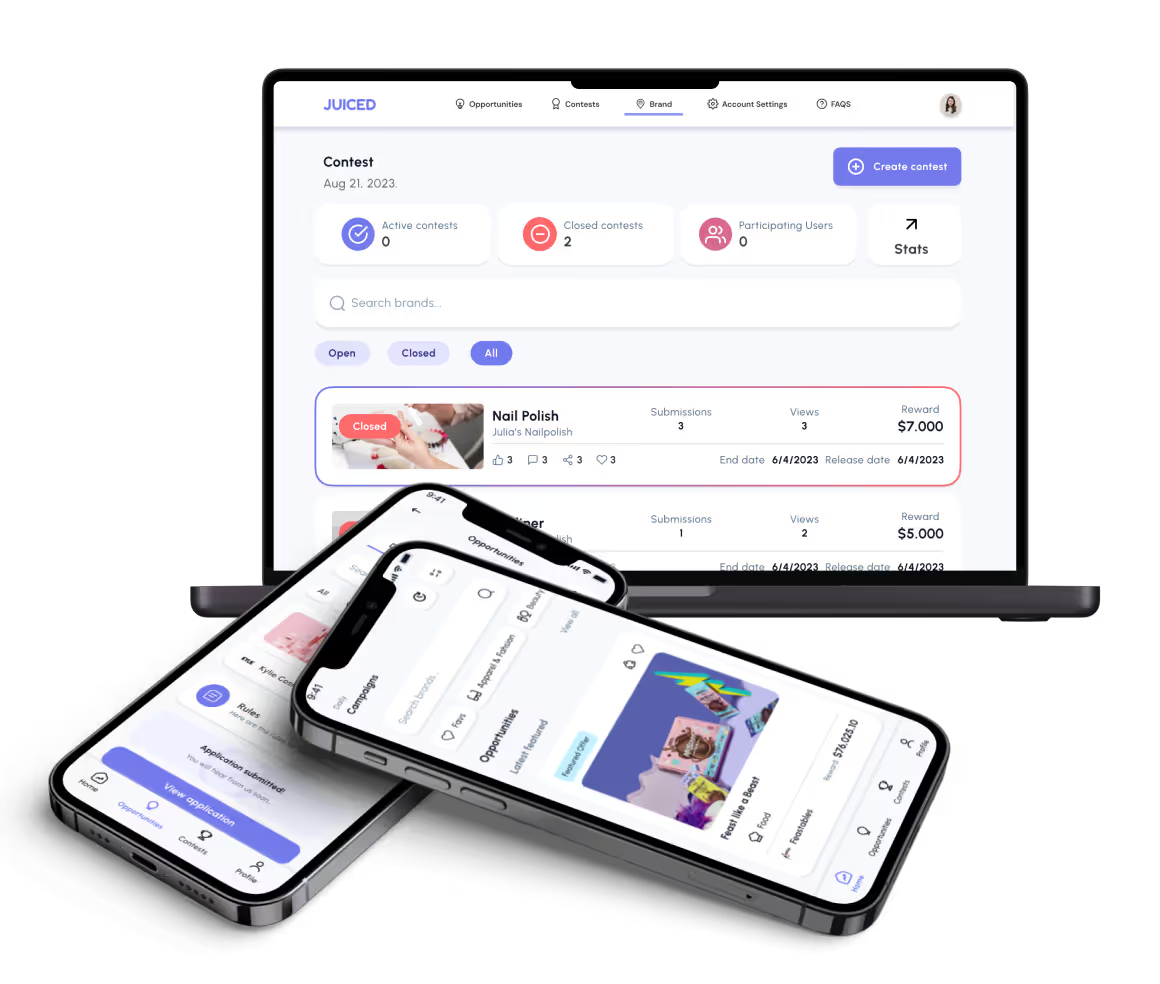

What Can FlutterFlow Build for a Cargo Tracking App?
FlutterFlow can deliver a fully functional cargo visibility app covering container lookup, milestone timelines, vessel position, customs status, delay alerts, and document access. All data draws from external carrier and maritime APIs. For freight forwarders building customer-facing portals, it is a capable and cost-effective platform.
Building a cargo tracking app with FlutterFlow means connecting to external data sources and presenting that data clearly. Here is what the feature set looks like in practice.
Shipment Search and Container Lookup
Users enter a container number, bill of lading reference, or booking number to retrieve current status and tracking history from a shipping line API, displayed on a structured detail screen.
Cargo Status Timeline and Milestone View
A chronological timeline of cargo milestones renders from API data: booking confirmed, gate-in at origin port, vessel departed, arrived, customs cleared, available for pickup, and delivered.
Vessel Position and ETA Display
For ocean freight, the vessel's current position from AIS data via a maritime API like MarineTraffic and the estimated port arrival time can be displayed on a map or as a text status within the app.
Customs Clearance Status Tracking
Customs clearance updates received from a customs broker API or manual entry by a freight forwarder appear in the tracking timeline, reducing customer service calls about clearance progress.
Multi-Shipment Dashboard
Importers managing multiple active shipments can view all cargo on a single dashboard sorted by ETA or status, with colour-coded alerts for delayed or exception shipments.
Proactive Exception and Delay Alerts
Push notifications via Firebase Cloud Messaging alert users when cargo is delayed, held at customs, or rerouted, with the notification linking directly to the affected shipment detail screen.
Document Storage and Shipping Document Access
Shipping documents uploaded by the freight forwarder, including bills of lading, commercial invoices, and packing lists, are accessible via Firebase Storage through the app.
For freight forwarders tracking thousands of active shipments simultaneously, FlutterFlow scalability for cargo apps covers the Firestore and API polling architecture that keeps the platform performant at volume.
How Long Does It Take to Build a Cargo Tracking App with FlutterFlow?
A simple single-carrier cargo tracking MVP takes 8–12 weeks with an experienced developer. A full multi-carrier visibility platform with vessel tracking, customs status, and document management takes 14–22 weeks. Shipping line API access approval is the most common cause of delays and must begin before the build starts.
Timeline depends heavily on integration scope. A cross-platform cargo app build in FlutterFlow delivers the same tracking experience on iOS and Android from a single development effort.
- API access approval is a blocker: Major carriers like Maersk and CMA CGM require formal applications for API access. Start these before the FlutterFlow build begins.
- Data normalisation adds time: Each carrier returns tracking events in different formats with different event codes, requiring a backend normalisation layer.
- Phased delivery reduces risk: Launch single-carrier container tracking and push notifications first, then add multi-carrier, vessel position, customs status, and document management in phase two.
- FlutterFlow is 40–60% faster than custom code: Pre-built UI components, Firebase integration, and the visual workflow builder reduce development time significantly.
What Does a FlutterFlow Cargo Tracking App Cost to Build?
A FlutterFlow cargo tracking app typically costs $20,000–$65,000 to build, compared to $100,000–$300,000 for a custom-coded equivalent or $50,000–$200,000 per year in enterprise visibility platform licensing. The FlutterFlow platform fee itself is minimal; the real costs are shipping line API fees and developer time.
The FlutterFlow plan pricing breakdown sits well below enterprise visibility platform licensing. Factor in shipping line API costs, which vary significantly by carrier and volume.
- Maritime AIS data is never free: Quality real-time vessel position data requires a paid subscription; free tiers have severe latency and coverage limitations.
- Carrier API onboarding takes time: Some carriers impose lengthy approval processes before granting API access. This is a project timeline risk unrelated to FlutterFlow itself.
- Data normalisation is a required backend layer: Each carrier returns event codes in proprietary formats; normalising these into a consistent data model adds $3,000–$10,000 to build scope.
How Does FlutterFlow Compare to Custom Development for Cargo Tracking Apps?
FlutterFlow delivers a feature-equivalent cargo tracking app in 8–22 weeks for $20,000–$85,000. Custom development of the same product takes 10–20 months and costs $100,000–$350,000. FlutterFlow loses ground only when real-time predictive ETAs using machine learning or deep port community system integration is required.
FlutterFlow wins clearly at the display and aggregation layer. Custom development wins at the data processing layer for large-scale platforms.
- FlutterFlow wins for freight forwarders: Customer-facing visibility portals, importer tracking dashboards, and logistics platforms adding tracking as a feature are all ideal FlutterFlow use cases.
- Custom wins at enterprise scale: Global visibility platforms aggregating data from dozens of carriers in real time, with ML-driven predictive ETAs, require custom development.
- Maintenance overhead is lower with FlutterFlow: Updating tracking milestones, alert rules, and dashboard layouts is fast without needing full developer availability.
For platforms requiring real-time multi-carrier data aggregation at scale, FlutterFlow alternatives worth considering covers the full spectrum of options beyond low-code.
What Are the Limitations of FlutterFlow for Cargo Tracking Apps?
FlutterFlow's primary limitations for cargo tracking are not about what the platform builds. They are about the data it depends on. Shipping line API access is controlled by carriers, AIS data quality varies by provider, and real-time data at high polling frequency requires careful backend architecture to avoid rate limits.
Understanding where FlutterFlow ends and where your backend architecture begins is the most important scoping decision in a cargo tracking build.
- API access is controlled by carriers: Not all shipping lines offer public APIs; approval for major carriers can take weeks and cannot be accelerated by any development tool.
- AIS vessel data quality varies widely: Free-tier maritime APIs have poor coverage and high latency; production-quality data requires a paid subscription with trade-offs between cost and refresh rate.
- Rate limit management is essential at scale: Tracking platforms polling multiple carrier APIs for thousands of active shipments need a caching and rate limit strategy that sits outside FlutterFlow.
- Complex business logic is harder to maintain: Multi-step data transformation rules built in FlutterFlow's visual environment are harder to audit than equivalent backend code.
- Code export before committing: Understand FlutterFlow's code export option before making a long-term platform commitment; it allows Dart-level extension if you hit the visual editor's limits.
How Do You Hire the Right Team to Build a FlutterFlow Cargo Tracking App?
Look for a team combining freight or international trade domain knowledge with FlutterFlow expertise and hands-on experience normalising shipping line API data. The domain knowledge matters as much as the technical skill because carrier API formats are inconsistent and require logistics-aware interpretation.
Understanding how to hire FlutterFlow developers fast with freight API integration experience is critical. Shipping line API formats vary enormously and require domain knowledge to normalise correctly.
- Domain knowledge is non-negotiable: A developer unfamiliar with freight terminology will struggle to interpret carrier event codes, AIS data feeds, and customs status fields correctly.
- Ask for a logistics API portfolio: "Show me a FlutterFlow app you built with third-party logistics API integration and multi-source data aggregation" is the right screening question.
- Agencies bring normalisation experience: Comprehensive visibility platforms with multi-carrier integration need the data architecture experience that most freelancers lack.
- Red flag to watch for: Any developer who cannot explain the difference between ocean AIS tracking, IATA air cargo tracking, and road GPS telematics is not ready for this build.
- Expect a phased delivery structure: Scoping call, proposal within one week, then staged delivery starting with single-carrier tracking before adding layers.
The shipping line API access approval process should start in parallel with developer selection, not after. Approval timelines for major carriers can add four to six weeks to your project if started late.
Conclusion
FlutterFlow is a strong platform for cargo tracking apps that aggregate and display external carrier data. The platform's speed advantage is real: build times of 8–22 weeks and costs of $20,000–$65,000 compare favourably against any alternative.
The primary project risks lie in API access approval timelines and data quality from shipping lines, not in FlutterFlow's capabilities. Start your shipping line API access applications immediately and run them in parallel to the build.
Building a Cargo Tracking App with FlutterFlow? Here Is How LOW/CODE Agency Approaches It.
Most cargo tracking projects stall not because of FlutterFlow, but because API access applications started too late and data normalisation was underestimated. Getting both right from the outset is what separates a smooth delivery from a delayed one.
As AI development experts, we at LOW/CODE Agency help SMBs ship real software — web and mobile applications, intelligent chatbots, RAG pipelines, and autonomous AI agents built for businesses that need results, not platforms. We scope FlutterFlow cargo tracking builds with freight domain expertise, starting with carrier API access planning and data normalisation architecture before a single screen is designed.
- Carrier API audit: We identify which shipping lines support APIs, their access approval processes, and integration timelines before the build scope is finalised.
- Data normalisation architecture: We design the backend layer that normalises event codes and data formats across multiple carriers into a consistent data model.
- FlutterFlow UI build: We build the tracking screens, milestone timelines, vessel position displays, and multi-shipment dashboards to production quality.
- Maritime data integration: We select and integrate the right AIS data provider for your vessel tracking requirements and budget.
- Push notification pipeline: We configure Firebase Cloud Messaging for delay alerts, exception notifications, and status updates that route directly to the relevant shipment.
- Phased delivery: We deliver single-carrier MVP first, then layer in multi-carrier, customs status, and document management in defined phases with measurable milestones.
- Full product team: Strategy, UX, development, and QA from one team that understands both FlutterFlow and international freight.
We have built 350+ products for clients including Coca-Cola, American Express, and Sotheby's. We know where cargo tracking projects go wrong, and we address those risks before they become delays.
Related Articles
Last updated on
September 24, 2026
.

Jesus is a visionary entrepreneur and tech expert. After nearly a decade working in web development, he founded LOW/CODE Agency to help businesses optimize their operations through custom software solutions.


FAQs
What are the key features needed for a cargo tracking app in FlutterFlow?
How do I integrate GPS tracking into a FlutterFlow cargo app?
Can I build a cargo tracking app without coding in FlutterFlow?
What backend options work best with FlutterFlow for cargo tracking apps?
How do I ensure data security in my cargo tracking app?
What are common challenges when building a cargo tracking app with FlutterFlow?
Related Articles

FlutterFlow
How to Build Nonprofit Apps with FlutterFlow
Learn how to create nonprofit apps using FlutterFlow with step-by-step guidance and best practices for effective app development.

FlutterFlow
What You Can and Can’t Do with FlutterFlow (2026 Guide)
See what you can and can’t do with FlutterFlow in 2026. Learn real capabilities, limits, use cases, and when FlutterFlow is the right fit.

FlutterFlow
How to Build a Construction Progress Tracker with FlutterFlow
Learn how to create a construction progress tracker using FlutterFlow with step-by-step guidance and tips for effective project monitoring.

Comparison
Glide
FlutterFlow
FlutterFlow vs Glide | 10 Factors Compared (2026)
Compare FlutterFlow vs Glide across 10 key factors including flexibility, database control, scalability, pricing, and app performance to choose the right builder in 2026.

Why customers trust us for no-code development


