

How to Build a Dropshipping App with FlutterFlow
10 min
read
Learn how to create a dropshipping app using FlutterFlow with step-by-step guidance and tips for beginners.


FlutterFlow dropshipping app development gives founders a faster path to a supplier-integrated storefront without the cost of a full custom build. The gap between customer purchase and supplier notification is where fulfilment time is won or lost, and that gap should be automated.
The right platform choice depends on how many suppliers you work with and how reliable their APIs are. This guide covers what FlutterFlow can build, realistic timelines and costs, and honest limitations.
Key Takeaways
- Automated order routing: FlutterFlow can trigger supplier order submissions via API the moment a customer checkout completes.
- Supplier catalogue sync: Product listings can be populated from supplier APIs with pricing and availability updated in near real time.
- Stripe checkout included: Customer-facing payment processing is straightforward with Stripe in FlutterFlow.
- Supplier integration is the hard part: Most dropshipping complexity sits in supplier API reliability, not the storefront UI.
- Margin calculation logic: Markup rules and dynamic pricing can be implemented but require careful Firestore document design.

What Can FlutterFlow Build for a Dropshipping App?
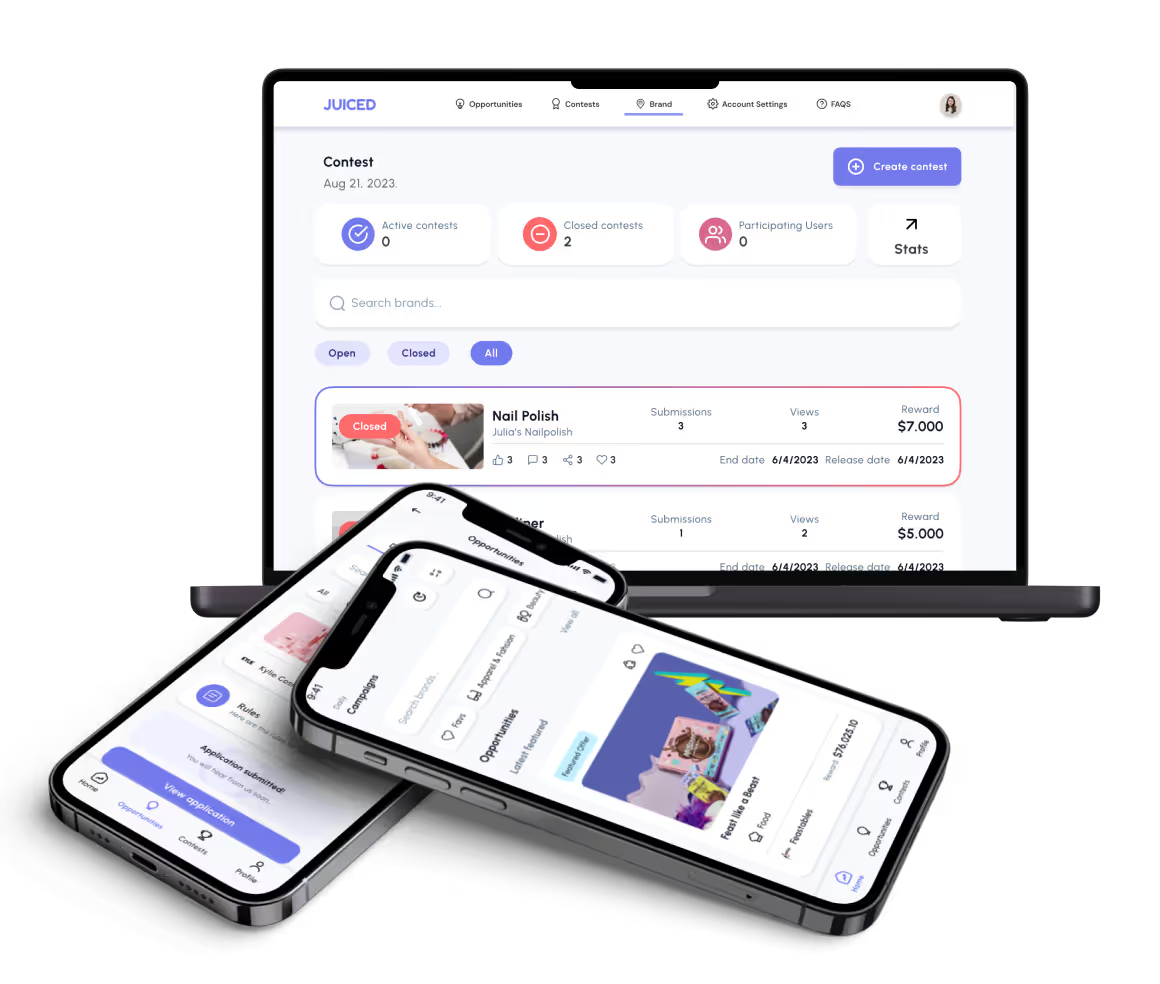
FlutterFlow can handle the full customer-facing storefront, automated order forwarding, supplier catalogue import, and order status sync. Understanding what FlutterFlow can build natively versus through API integrations is critical for dropshipping, where most complexity sits in supplier connectivity.
The visual builder covers storefront, checkout, and customer notifications well. The supplier integration layer relies on Cloud Functions and API connections that require developer experience.
Customer-Facing Storefront
Product grids, detail pages, and a checkout flow give customers a fully branded store experience built in the visual editor.
Supplier Product Catalogue Import
A Cloud Function or scheduled job pulls product data from supplier APIs and populates Firestore collections with SKU, price, and stock fields.
Dynamic Markup Pricing Engine
A pricing rule document in Firestore defines markup percentages per supplier or category, applied automatically to customer-facing prices.
Automated Order Forwarding to Supplier
On successful Stripe payment, a Cloud Function posts the order details to the supplier's API or email system for fulfilment processing.
Order Status Sync from Supplier
Webhook listeners receive tracking and status updates from supplier systems, updating the customer's order record in Firestore automatically.
Customer Notification on Shipping
When tracking data arrives from the supplier, an automated notification fires to the customer with carrier and tracking number.
Returns and Refund Coordination
Returns are logged in Firestore with supplier notification triggered by Cloud Function. Stripe refunds issue on supplier return confirmation.
Admin Margin and Performance Dashboard
The back-office admin view shows per-product margin, order volume by supplier, and refund rates for operational oversight.
The storefront, checkout, and notification flows build quickly in FlutterFlow. The supplier API integration is where build time concentrates regardless of platform.
How Long Does It Take to Build a Dropshipping App with FlutterFlow?
A simple dropshipping MVP with a storefront, Stripe checkout, and manual supplier notification takes 5–8 weeks in FlutterFlow. A full-featured app with automated order routing, status sync, catalogue import, and returns handling takes 14–20 weeks.
Timeline is determined almost entirely by supplier API quality, not the storefront build.
- Simple MVP timeline: Storefront, Stripe checkout, and manual supplier email notification ship in 5–8 weeks with one supplier.
- Full automation timeline: Automated order routing, webhook-driven status sync, catalogue import, and returns take 14–20 weeks depending on supplier API reliability.
- Phased approach advantage: Launch with manual supplier notification first, then automate routing and status sync in phase two with real order data.
- Supplier API quality matters: Clean, documented supplier APIs with reliable webhooks cut integration time significantly versus poorly documented or unstable APIs.
- Speed versus custom development: FlutterFlow handles the storefront and customer-facing logic in days; supplier API work takes time on any platform.
A phased launch protects budget. The customer-facing store goes live quickly, and the automation layer builds on real order volume rather than assumptions.
What Does It Cost to Build a FlutterFlow Dropshipping App?
FlutterFlow plan costs are a minor line item for a dropshipping build. The real investment is in the supplier integration and order automation layer, which requires Cloud Functions experience and API development time.
Platform costs run $0–$70 per month. Development is the primary budget line.
- Platform cost is minimal: FlutterFlow subscription is $0–$70 per month, making it a small fraction of total project cost.
- Freelancer versus agency: A single-supplier simple build can work with a freelancer; multi-supplier automation warrants agency-level Cloud Functions expertise.
- Hidden cost: error handling: Supplier API unreliability requires retry logic and error handling in Cloud Functions, which adds development hours.
- Hidden cost: margin monitoring: A proper admin dashboard with per-supplier margin tracking adds scope that is easy to underestimate early.
- Custom comparison: Equivalent dropshipping automation built from scratch costs $70,000–$180,000, making FlutterFlow 3–5x more cost-effective.
Ongoing costs are modest. The largest variable after launch is supplier API subscription fees, which vary widely by supplier relationship.
How Does FlutterFlow Compare to Custom Development for a Dropshipping App?
FlutterFlow delivers a dropshipping app in 8–20 weeks versus 12–24 months for custom development at equivalent automation scope. For founders with one to five suppliers and a defined product catalogue, FlutterFlow wins clearly on speed and cost.
The comparison shifts when supplier complexity grows beyond what the visual builder can manage cleanly.
- FlutterFlow wins: Single or small supplier count, defined product catalogue, mobile-first dropshipping brand needing fast go-to-market.
- Custom wins: Large supplier networks, real-time inventory aggregation across dozens of catalogues, and advanced pricing arbitrage logic.
- Storefront maintenance advantage: Layout changes, product page updates, and new promotional sections are fast in FlutterFlow's visual editor.
- Supplier API parity: API changes from suppliers require developer work regardless of whether the app is built in FlutterFlow or custom code.
Reviewing FlutterFlow pros and cons for automation-heavy applications helps dropshipping founders make the right platform call before investing.
What Are the Limitations of FlutterFlow for a Dropshipping App?
The core limitation for dropshipping in FlutterFlow is real-time inventory aggregation across multiple supplier APIs, which requires robust middleware rather than native platform capability. Dropshipping apps handle payment data and supplier credentials, understanding FlutterFlow security model is essential before building the integration layer.
Most limitations are manageable with the right backend design. A few are genuine constraints that affect platform choice.
- Multi-supplier aggregation: Real-time inventory checks across many supplier APIs simultaneously is not a native capability and requires middleware architecture.
- Supplier API inconsistency: Order routing automation needs extensive error handling and retry logic in Cloud Functions to manage unreliable supplier endpoints.
- Payment reconciliation complexity: Refund coordination across a supplier chain introduces reconciliation steps that Stripe alone does not address.
- Visual logic complexity: Multi-supplier conditional routing and margin calculation rules become hard to audit as logic grows in the visual editor.
- Scale considerations: High-volume dropshipping stores with thousands of daily orders need deliberate Firestore indexing and performance planning.
- Vendor dependency: A dropshipping business already depends on suppliers. Adding FlutterFlow platform dependency is a risk to account for before committing.
These limitations are solvable with experienced developers. They become project risks only when the build team has not encountered them before.
How Do You Find the Right Team for a FlutterFlow Dropshipping App?
When you hire FlutterFlow developers for dropshipping, Cloud Functions and API integration experience matters more than visual builder skills. The storefront builds quickly; the supplier automation layer is where project outcomes are determined.
The right team has built API-driven automation before, not just front-end Flutter apps.
- Cloud Functions experience is required: Automated order forwarding, status sync, and error handling all run in Cloud Functions. No experience here means no automation.
- Stripe webhook handling: Payment confirmation triggers the order routing workflow. Confirm the team has built Stripe webhook listeners in FlutterFlow previously.
- Firestore data modelling: Multi-supplier order records, margin calculations, and status tracking require a well-designed Firestore schema before build begins.
- Red flag: no live automation example: Teams without a portfolio example of API-driven automation will discover the complexity at your expense.
- Questions to ask: How do you handle supplier API downtime? What is your approach to order status sync? Can you build the margin reporting dashboard?
A good team spends week one assessing supplier APIs before writing a single line of build code. That assessment determines timeline and risk, not the storefront design.
Conclusion
FlutterFlow can power a complete dropshipping app. The storefront, payment processing, and order routing pipeline are all achievable at a fraction of custom development cost.
The complexity of dropshipping lives in supplier API reliability and error handling, not the UI. That layer requires experienced developers regardless of platform. Audit your supplier APIs and their documentation before scoping. Then find a team with Cloud Functions and API automation experience, not just FlutterFlow visual builder skills.
Building a Dropshipping App with FlutterFlow? Here Is How LOW/CODE Agency Approaches It.
Most dropshipping app projects underestimate the supplier integration layer. The storefront scoping is clear. The API automation, error handling, and margin logic are where projects run long and over budget.
At LOW/CODE Agency, we help SMBs compete with AI-powered software built for them — custom web and mobile apps, RAG systems, chatbots, and intelligent agents delivered by a senior development team. We scope the supplier API complexity before writing a line of code, design the Firestore data model for margin tracking, and build the Cloud Function automation that connects your storefront to your suppliers reliably.
- Supplier API assessment: We audit your supplier APIs in week one to identify reliability risks and define the error handling architecture before build begins.
- Firestore data modelling: We design your order, margin, and supplier records for the query patterns your admin dashboard and order routing actually need.
- Automated order routing: We build the Cloud Function layer that forwards orders to suppliers on payment confirmation with retry logic and failure alerts.
- Storefront and checkout: We build the customer-facing product catalogue, cart, and Stripe checkout in FlutterFlow's visual editor quickly and cleanly.
- Admin margin dashboard: We build the back-office view showing per-supplier margin, order volume, and refund rates so you can manage the business, not just the orders.
- Post-launch supplier changes: We stay involved when supplier APIs change, which they do, so your order routing does not break silently.
- Full product team: Strategy, design, development, and QA from a single team that understands dropshipping automation from storefront to supplier confirmation.
We have built 350+ products for clients including Coca-Cola, American Express, and Sotheby's. We know exactly where dropshipping app builds go wrong and how to prevent it before it costs you orders.
Related Articles
- How to Build an Electricity Usage Dashboard with FlutterFlow
- How to Build an Education App with FlutterFlow
- How to Build an Ecommerce App with FlutterFlow
- How to Build a Driver Tracking Dashboard with FlutterFlow
- How to Build a Driver Onboarding Platform with FlutterFlow
- How to Build a Downtime Tracking App with FlutterFlow
Last updated on
September 24, 2026
.

Jesus is a visionary entrepreneur and tech expert. After nearly a decade working in web development, he founded LOW/CODE Agency to help businesses optimize their operations through custom software solutions.


FAQs
What are the first steps to create a dropshipping app in FlutterFlow?
Can I connect FlutterFlow to dropshipping suppliers directly?
How do I handle payments in a FlutterFlow dropshipping app?
Is FlutterFlow suitable for building scalable dropshipping apps?
What are common challenges when building a dropshipping app with FlutterFlow?
How can I update product information dynamically in my FlutterFlow app?
Related Articles
FlutterFlow
How to Build a Referral Management App with FlutterFlow
Learn how to create a referral management app using FlutterFlow with step-by-step guidance and best practices for smooth app development.

FlutterFlow
How to Build a Rental Marketplace App with FlutterFlow
Learn how to create a rental marketplace app using FlutterFlow with step-by-step tips and best practices for smooth development.

FlutterFlow
How to Build a Client Onboarding Portal with FlutterFlow
Learn how to create a client onboarding portal using FlutterFlow with step-by-step tips and best practices for smooth user experience.

FlutterFlow
How to Build a Cloud Kitchen Management App with FlutterFlow
Learn how to create a cloud kitchen management app using FlutterFlow with step-by-step guidance and key features.

Why customers trust us for no-code development


