

How to Build a Creator Marketplace App with FlutterFlow
10 min
read
Learn how to create a creator marketplace app using FlutterFlow with step-by-step tips and best practices for success.


A flutterflow creator marketplace app gives creators control over pricing, access, and fan relationships that third-party platforms never allow. Creator storefronts, digital product sales, membership tiers, and fan engagement tools are all achievable inside FlutterFlow's visual builder.
The architecture combines SaaS and ecommerce patterns. Getting the content access control and Stripe configuration right early determines whether the platform functions reliably at scale.
Key Takeaways
- Creator storefronts work well: Each creator gets a personalised profile page displaying products, membership tiers, and content catalogue.
- Digital product sales use Stripe: Downloadable content, presets, templates, and e-books sell via Stripe with Firebase Storage delivering download links on payment.
- Membership tiers are achievable: Monthly subscription tiers gated behind Stripe Billing give fans access to exclusive content and community features.
- Fan engagement tools drive revenue: Tipping, direct messaging, and exclusive Q&A features are all buildable inside FlutterFlow's visual layer.
- Content access control is security-critical: Firebase Security Rules gate content delivery to verified paying subscribers; this is not a toggle in FlutterFlow's UI.

What Can FlutterFlow Build for a Creator Marketplace App?
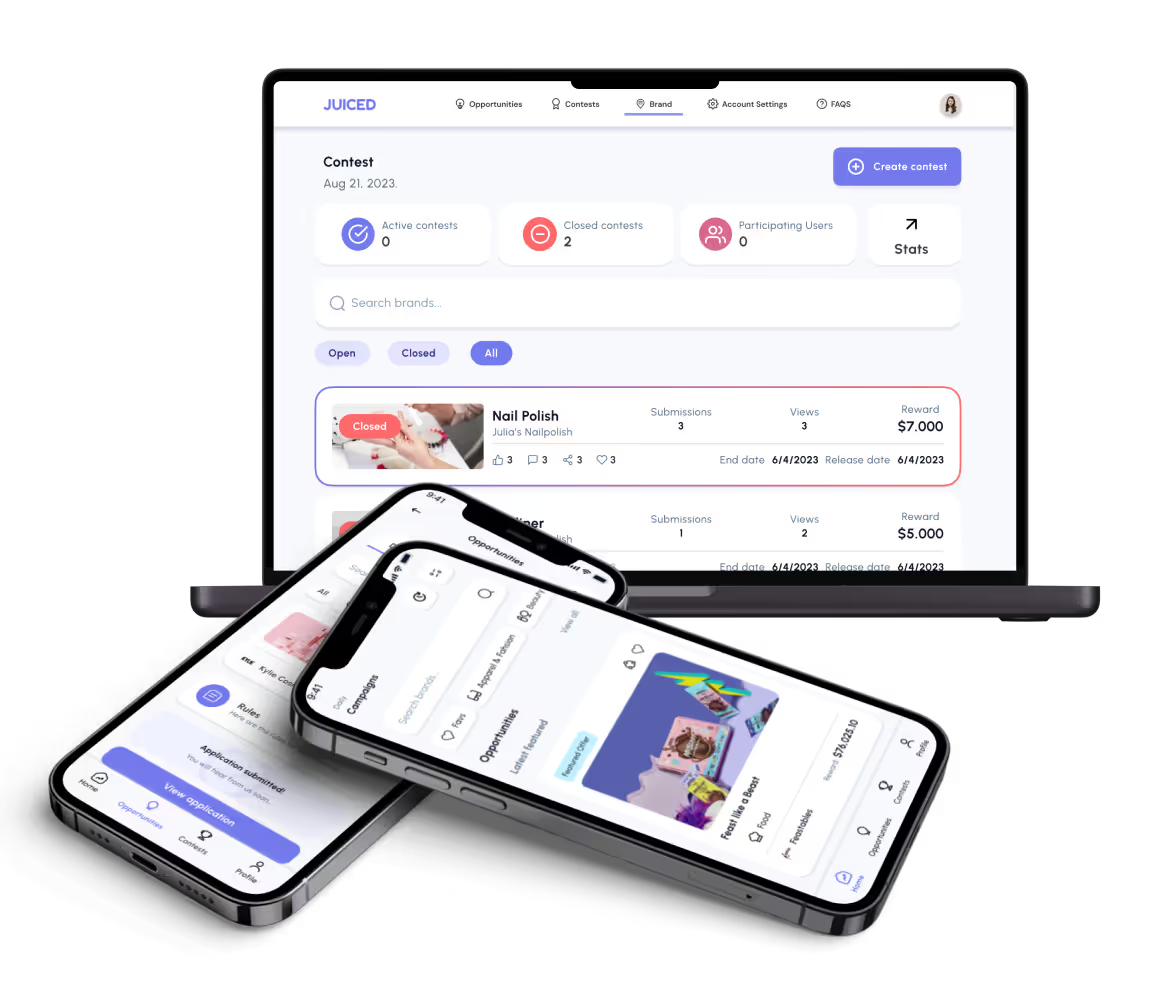
FlutterFlow can deliver creator storefronts, digital product listings, membership tier subscriptions, gated content feeds, fan tipping, in-app messaging, creator earnings dashboards, and a platform discovery feed. Features that require backend support are Stripe Connect payout splitting and algorithmic creator recommendations.
Understanding whether you can build a SaaS with FlutterFlow helps frame what a creator marketplace with subscription and ecommerce layers can genuinely support on the platform.
Creator Profile and Storefront Page
Each creator has a branded profile page with bio, content categories, available products, membership tiers, and aggregate ratings.
Digital Product Listing and Download Delivery
Creators list digital products with one-time Stripe purchases delivering Firebase Storage download links on payment confirmation.
Membership Tier Subscriptions
Creators offer tiered monthly memberships via Stripe Billing, with content and community features gated by subscription level.
Exclusive Content Feed for Members
Subscribers access a gated content feed, posts, videos, downloads, visible only to their membership tier and above via Firestore security rules.
Fan Tipping and Direct Support
Fans send one-off tip payments via Stripe to creators they follow, with tip amounts displayed on creator earnings dashboards.
In-App Creator-to-Fan Messaging
Creators send direct messages or broadcast messages to their subscriber base through Firestore-backed messaging, gated by membership tier.
Creator Earnings Dashboard
Creators view gross revenue, subscriber count, product sales, tip income, and platform commission breakdown in a dedicated earnings panel.
Platform Marketplace Discovery Feed
Buyers browse a curated creator directory filtered by category, content type, and popularity, driving organic discovery across the platform.
How Long Does It Take to Build a Creator Marketplace App with FlutterFlow?
A simple creator marketplace MVP with creator profiles, digital product sales, and basic discovery ships in 8–12 weeks. A full-featured marketplace with memberships, exclusive feeds, tipping, messaging, and earnings dashboards takes 18–26 weeks.
FlutterFlow delivers the creator storefront and buyer discovery UI quickly. Stripe Billing and Firebase content gating require consistent engineering regardless of the build tool.
- Simple MVP timeline: Creator profiles, digital product listings, Stripe one-time payments, and a discovery feed ship in 8–12 weeks.
- Membership and gated content adds time: Stripe Billing subscription setup, Firebase security rules, and gated feed logic add 4–6 weeks to the build.
- Fan engagement features: Tipping, DMs, and Q&A features extend the build by 3–5 weeks depending on Firestore messaging complexity.
- Creator earnings dashboard: A full earnings panel with revenue breakdown, product sales, and tip tracking adds 2–3 weeks to the total timeline.
- Phased approach reduces risk: Launch product sales and creator profiles first, then add memberships and exclusive feeds in phase two when creator count justifies the complexity.
What Does It Cost to Build a FlutterFlow Creator Marketplace App?
FlutterFlow platform costs run $0–$70/month. Developer project costs range from $20,000–$70,000. Agency-built full-featured creator marketplaces run $30,000–$100,000. Custom development for an equivalent platform costs $120,000–$350,000 or more.
FlutterFlow pricing plans are a small fixed cost; the more significant ongoing expenses for creator marketplaces are Stripe Billing fees and Firebase Storage at scale.
- Developer hourly rates: FlutterFlow developers charge $50–$150/hour, with project total driven by Stripe Billing configuration and content gating architecture.
- Stripe ongoing fees: Stripe Connect plus Billing fees apply per transaction and per payout, adding a recurring cost that scales with platform revenue volume.
- Firebase Storage costs: Digital product delivery and exclusive content storage costs grow with creator count and product library size.
- Apple IAP compliance: In-app subscription purchases on iOS must route through Apple's payment system, adding 15–30% commission on iOS subscriber revenue.
- Hidden costs to plan for: Digital product storage and CDN costs, creator verification and fraud tooling, and content moderation overhead are real line items.
How Does FlutterFlow Compare to Custom Development for a Creator Marketplace App?
FlutterFlow builds a creator marketplace in 18–26 weeks at $20,000–$100,000. Custom development takes 18–36 months at $120,000–$350,000 or more. FlutterFlow wins for niche creator verticals and MVP validation; custom wins for large-scale platforms requiring AI recommendations and complex royalty structures.
The speed and cost difference is most dramatic at the MVP and niche-market stage, where FlutterFlow's pre-built UI components deliver the most value.
- Speed advantage: FlutterFlow delivers in 18–26 weeks versus 18–36 months for a comparable custom creator marketplace build.
- Cost advantage: FlutterFlow builds cost 60–80% less than custom at the build stage, with the biggest savings in creator profile and discovery UI work.
- Capability ceiling: Algorithmic content recommendation, AI-powered creator-fan matching, and complex royalty split logic require custom backend investment.
- Maintenance advantage: FlutterFlow reduces the cost of creator and product category management UI iteration; Stripe and content gating layers still need developer involvement.
- When FlutterFlow wins: Niche creator verticals, independent creator platform launches, and MVP validation of the creator-fan commerce model.
- When custom wins: Large-scale platforms with AI recommendations, complex royalty structures, and multi-currency international operations.
Reviewing FlutterFlow pros and cons for content-gating and subscription platforms helps founders make a confident technology decision before committing budget.
What Are the Limitations of FlutterFlow for a Creator Marketplace App?
The core limitations are: Apple IAP policy restricts in-app subscription billing on iOS, Firebase Security Rules for content gating require expert design, algorithmic recommendations are not native to FlutterFlow, and video streaming needs a dedicated CDN outside the platform.
Creator platforms hold both payment data and premium content. Understanding FlutterFlow security architecture is essential before designing access control for subscriber-gated content and payment records.
- Apple IAP policy: In-app subscription purchases on iOS must use Apple's payment system, potentially violating App Store guidelines if Stripe Billing is used directly inside the iOS app.
- Content gating is security-critical: Firebase Security Rules for content access require careful design; poorly structured rules can expose paid content to non-subscribers directly via the API.
- No native recommendations: Algorithmic trending creator feeds and personalised discovery cannot be powered by FlutterFlow natively; they require custom ML or third-party tooling.
- Video streaming needs a CDN: Exclusive video content requires Mux, Cloudflare Stream, or similar; Firebase Storage is not optimised for video streaming delivery.
- Scale planning is required early: Creator platforms with large content libraries and concurrent subscriber access need Firebase Storage and CDN architecture planned before onboarding begins.
- Vendor dependency consideration: Creator platform longevity depends on FlutterFlow's stability; code export on paid plans is an important contingency to design for from the start.
How Do You Find the Right Team for a FlutterFlow Creator Marketplace App?
Look for expertise in Firebase Security Rules for content gating, Stripe Billing subscriptions, Firebase Storage for digital delivery, and Apple IAP compliance. Creator marketplace complexity warrants an agency over a freelancer.
Selecting from top FlutterFlow agencies with content gating and subscription billing experience reduces the risk of costly access control mistakes on a creator platform.
- Firebase Security Rules experience is essential: Any team without demonstrated Firestore content gating rules in their portfolio cannot design a secure creator subscription architecture.
- Stripe Billing subscription examples matter: Look for Stripe Billing subscription portfolio work, not just one-time payment integrations; they are architecturally different.
- Apple IAP compliance awareness: Teams without iOS in-app purchase knowledge will create compliance problems that delay App Store submission and affect revenue.
- Key questions to ask: "How do you gate content by subscription tier?" and "What is your approach to Apple IAP for in-app subscriptions?" reveal whether the team understands both layers.
- Expected timeline from a good team: Content architecture design in weeks 1–2, full scoping in weeks 2–4, build in weeks 5–26 depending on feature scope.
A thorough discovery engagement before development begins is essential. Defining the iOS subscription model, content delivery approach, and revenue split structure shapes the entire architecture.
Conclusion
FlutterFlow can build a creator marketplace app. Storefronts, digital product sales, membership tiers, exclusive feeds, and creator earnings dashboards are all achievable within the platform's capability.
Apple IAP compliance and video streaming delivery require experienced teams who understand the platform's boundaries. Define your iOS subscription model and content delivery approach before scoping begins, then engage a team with Stripe Billing and Firebase content gating experience.
Building a Creator Marketplace App with FlutterFlow? Here Is How LOW/CODE Agency Approaches It.
Most creator marketplace builds stall on two problems: content access rules that were never properly designed at the data layer, and Apple IAP compliance that surfaces late in the build. Both are avoidable with the right team from the start.
At LOW/CODE Agency, we help SMBs compete with AI-powered software built for them — custom web and mobile apps, RAG systems, chatbots, and intelligent agents delivered by a senior development team. We build FlutterFlow creator marketplace apps from discovery through launch, covering Stripe Billing architecture, Firebase Security Rules for content gating, digital product delivery, and Apple IAP compliance. We use FlutterFlow as an accelerator, not a shortcut.
- Content architecture design: We design the Firebase Security Rules and data model that genuinely gates paid content at the data layer, not just in the UI.
- Stripe Billing configuration: We set up tiered membership subscriptions, one-time product payments, and tipping flows with proper webhook handling.
- Digital product delivery: We build the Firebase Storage download link system that delivers purchased content securely after payment confirmation.
- Creator earnings dashboard: We deliver a full revenue panel showing product sales, subscription revenue, tips, and platform commission breakdown in real time.
- Apple and Google IAP compliance: We implement App Store and Play Store in-app purchase flows so your subscription app passes review and earns revenue correctly.
- Discovery and marketplace feed: We build the creator directory with category filters, popularity sorting, and curated featured placements.
- Full product team: Strategy, UX, development, and QA from a single team that stays involved through launch and post-launch iteration.
We have built 350+ products for clients including Coca-Cola, American Express, and Sotheby's. We know exactly where creator marketplace builds go wrong, and we address those failure points before they cost you months.
Related Articles
- How to Build a Credit Score Dashboard with FlutterFlow
- How to Build a Creator Subscription Marketplace with FlutterFlow
- How to Build a Creator Subscription App with FlutterFlow
- How to Build a Creator Fan Subscription App with FlutterFlow
- How to Build a Course Marketplace App with FlutterFlow
- How to Build a Courier Tracking App with FlutterFlow
Explore our low-code development services to build powerful apps with a fraction of the usual effort.
Last updated on
September 24, 2026
.

Jesus is a visionary entrepreneur and tech expert. After nearly a decade working in web development, he founded LOW/CODE Agency to help businesses optimize their operations through custom software solutions.


FAQs
What are the first steps to start building a marketplace app in FlutterFlow?
How can I integrate payment processing in a FlutterFlow marketplace app?
What are common challenges when building a creator marketplace app with FlutterFlow?
Can FlutterFlow handle user authentication for a marketplace app?
How do I ensure my marketplace app is scalable using FlutterFlow?
Is it possible to customize the UI extensively in FlutterFlow for a marketplace app?
Related Articles

FlutterFlow
How to Build a Creator Subscription App with FlutterFlow
Learn how to create a creator subscription app using FlutterFlow with step-by-step tips and best practices for success.

FlutterFlow
How to Build a Marketplace App with FlutterFlow
Learn how to create a marketplace app using FlutterFlow with step-by-step guidance and best practices for success.
FlutterFlow
How to Build a Stock Trading Dashboard with FlutterFlow
Learn how to create a stock trading dashboard using FlutterFlow with step-by-step guidance and tips for beginners.

FlutterFlow
How to Build a Wellness Coaching App with FlutterFlow
Learn how to create a wellness coaching app using FlutterFlow with step-by-step guidance and tips for success.


Why customers trust us for no-code development


