

How to Build a Creator Subscription Marketplace with FlutterFlow
12 min
read
Learn how to create a creator subscription marketplace using FlutterFlow with step-by-step guidance and best practices.


A flutterflow creator subscription marketplace looks like a content app on the surface but functions like financial infrastructure underneath. The difference matters for how you build it, what you budget, and which architectural decisions you make on day one.
FlutterFlow can deliver the creator profile, content delivery, and subscription billing layer that most platforms need at launch. The complexity concentrates in content access control, creator payout mechanics, and content protection, areas that go deeper than the visual builder alone can reach.
Key Takeaways
- Subscription billing is achievable: Stripe Billing for recurring fan subscriptions and Stripe Connect for creator payouts are both viable with Cloud Function backend support.
- Content access control is not trivial: Gating content behind active subscriptions requires Firebase security rules and token-based access, not a FlutterFlow toggle in the UI.
- Video hosting is always external: Creator video content must be hosted on Mux or a CDN; FlutterFlow's video player widget connects to the URL, it does not host or protect the stream.
- Cost range for agency builds: Agency-built creator subscription marketplaces typically cost $25,000–$65,000 depending on feature scope.
- Apple's 30% cut is a business model decision: App Store in-app purchase policy affects whether iOS distribution is financially viable for your creator revenue model.
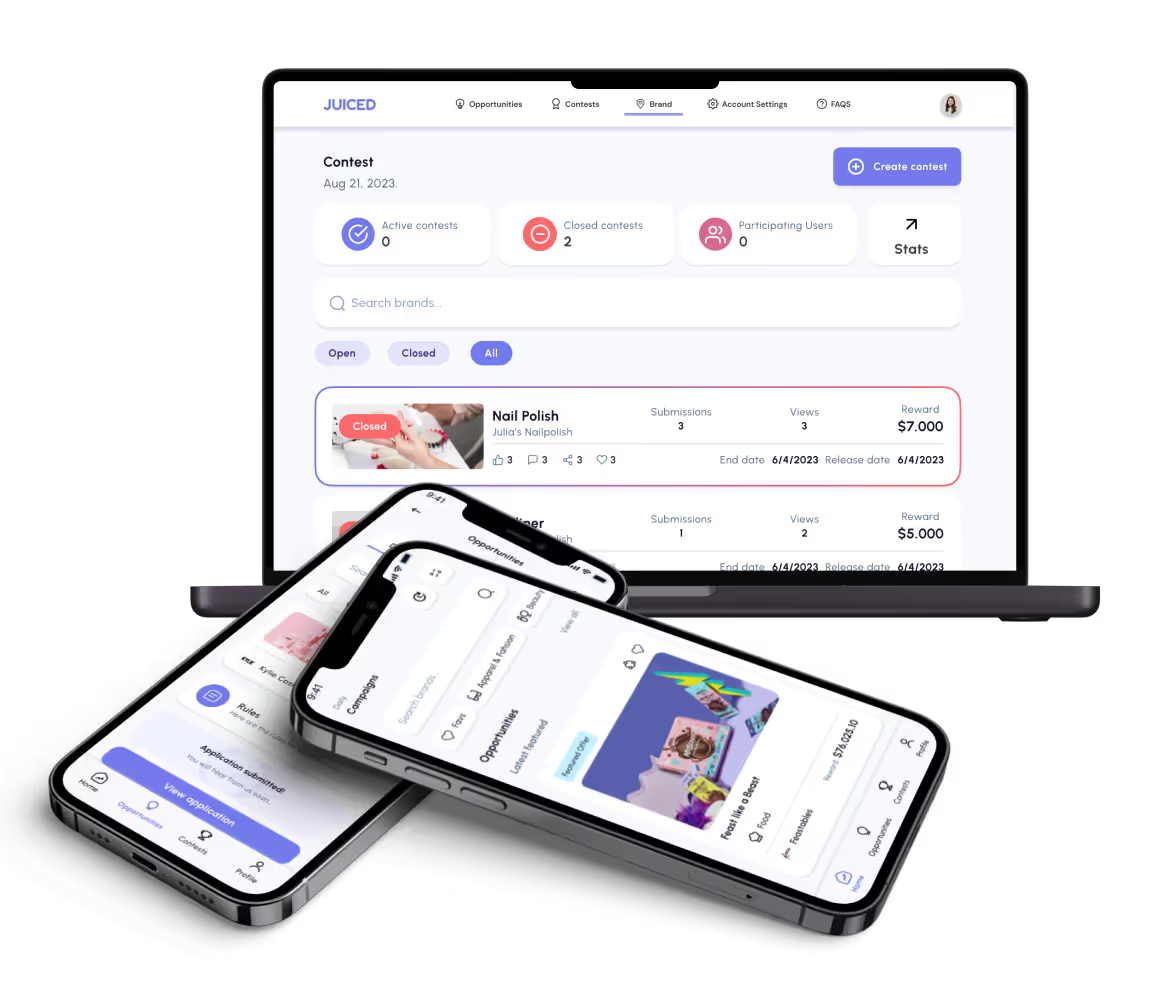

What Can FlutterFlow Build for a Creator Subscription Marketplace?
FlutterFlow can deliver creator profiles, tiered subscription plans, subscriber-gated content feeds, creator content management, in-app messaging, earnings dashboards, tipping, and push notifications. Features that require backend support beyond the visual builder are DRM video protection, content recommendation algorithms, and complex creator payout splitting.
A creator subscription marketplace is a form of subscription SaaS, and understanding whether you can build subscription SaaS with FlutterFlow sets the right architectural expectations before design begins.
Creator Profile and Portfolio Page
FlutterFlow supports creator profile pages with bio, profile photo, header image, category tags, subscriber count display, and a content preview grid.
Tiered Subscription Plans with Stripe Billing
Creators offer multiple subscription tiers at different price points; Stripe Billing handles recurring monthly or annual charges and plan upgrades or downgrades from within the app.
Subscriber-Gated Content Feed
A content feed showing locked posts with teaser previews to non-subscribers and full access to active subscribers, enforced via Firebase security rules checking subscription status.
Creator Content Upload and Management
Creators upload images, video links, audio files, and text posts from an in-app dashboard, with content scheduling controlled via Firestore timestamps.
In-App Messaging and Fan Direct Message
One-to-one messaging between fan and creator with creator-controlled DM permissions, including paid DMs at a per-message rate, built on Firestore real-time listeners.
Creator Earnings Dashboard and Stripe Connect Payout
Creators see a real-time earnings dashboard showing active subscribers, monthly recurring revenue, tips received, and payout history, with Stripe Connect distributing earnings after the platform commission.
Tipping and One-Off Payment for Exclusive Content
Fans send tips or pay a one-off price for premium individual posts via Stripe PaymentIntents, with access granted by a Cloud Function on successful payment.
Push Notifications for New Creator Content
Firebase Cloud Messaging delivers push notifications to subscribers when a creator publishes new content, configurable by notification preference settings in the fan's profile.
How Long Does It Take to Build a Creator Subscription Marketplace with FlutterFlow?
A simple creator platform MVP with profiles, single-tier subscription, content feed, and Stripe payout ships in 8–12 weeks. A full-featured marketplace with tiered subscriptions, pay-per-view, DMs, tipping, earnings dashboard, and admin panel takes 16–24 weeks.
Creator profile, content feed, and notification screens are significantly faster in FlutterFlow. Subscription gating and payout logic close the speed gap with custom development as complexity grows.
- Simple MVP timeline: Creator profiles, single-tier Stripe subscription, gated content feed, and basic payout ship in 8–12 weeks with a focused team.
- Tiered plans and pay-per-view: Adding multiple subscription tiers and pay-per-view individual posts extends the build by 4–6 weeks due to Stripe Billing plan management complexity.
- DMs and messaging: Firestore-backed direct messaging with creator-controlled permissions adds 3–4 weeks to the build timeline.
- Earnings dashboard and admin panel: A full creator earnings dashboard with Stripe Connect payout history and an admin moderation panel add 3–5 weeks.
- Phased approach reduces risk: Launch with single-tier subscription and content feed; add tiered plans, pay-per-view, and DMs in phase two when creator count and revenue justify the complexity.
What Does It Cost to Build a FlutterFlow Creator Subscription Marketplace?
FlutterFlow platform costs run $0–$70/month. Developer project costs range from $20,000–$55,000. Agency-built full creator marketplaces with tiered subscriptions, pay-per-view, DMs, and payout dashboards run $25,000–$65,000. Custom development for equivalent scope costs $100,000–$250,000.
FlutterFlow plan and pricing details are the starting point, but creator platforms carry significant Stripe and video hosting costs that need projecting at the scoping stage before any development begins.
- Stripe fees at scale: Stripe Billing charges 0.5% per subscription transaction for management, plus 2.9% and 30 cents per payment processed; these stack meaningfully at volume.
- Mux video hosting costs: Creator-uploaded video is charged per minute stored and per minute delivered; active creator platforms with prolific video uploaders see Mux costs scale quickly.
- Apple in-app purchase cut: If fans subscribe through an iOS app using Apple's in-app purchase system, Apple takes 30% in year one and 15% after that, directly affecting creator economics.
- Stripe Connect identity verification: Each creator who receives payouts must pass Stripe identity verification, adding a compliance step to the creator onboarding workflow.
- Content moderation API costs: Platforms requiring automated content moderation for creator uploads add per-request API costs that scale with creator count and upload volume.
How Does FlutterFlow Compare to Custom Development for a Creator Subscription Marketplace?
FlutterFlow builds a creator subscription marketplace in 12–20 weeks at $25,000–$65,000. Custom development takes 6–12 months at $100,000–$250,000. FlutterFlow wins for niche creator communities and MVP validation; custom wins when content recommendation algorithms and DRM-protected video are required at launch.
The speed and cost advantage is most significant for niche creator communities and vertical-specific platforms where AI-powered recommendations are not required from day one.
- Speed advantage: FlutterFlow delivers in 12–20 weeks versus 6–12 months for a comparable custom creator marketplace build.
- Cost advantage: FlutterFlow project costs run $25,000–$65,000 versus $100,000–$250,000 for custom, a saving of 60–75% at the build stage.
- Capability ceiling: Content recommendation algorithms, real-time live streaming with tipping overlays, DRM-protected video, and multi-currency payouts require custom backend investment.
- Maintenance comparison: FlutterFlow enables fast creator-facing UI iteration; Stripe Billing plan management and content security rule updates need engineering involvement regardless of the build tool.
- When FlutterFlow wins: Niche creator communities, vertical-specific platforms like fitness, art, or music, MVP validation before content algorithm investment, and budgets under $80,000.
- When custom wins: Platforms requiring a content recommendation engine at launch, DRM-protected video for film or TV content, and Apple in-app purchase compliance at consumer scale.
A clear understanding of FlutterFlow benefits and limitations helps creator platform founders decide whether to start on FlutterFlow and migrate later, or invest in custom development from the start.
What Are the Limitations of FlutterFlow for a Creator Subscription Marketplace?
The four critical limitations are: content access control requires Firebase security rules at the data layer, not just UI-level hiding; DRM video protection is not achievable with FlutterFlow's standard video widget; Apple takes 30% on iOS in-app purchases; and content recommendation algorithms require ML backend logic FlutterFlow cannot provide.
Understanding FlutterFlow content security options is critical for creator platforms where subscription status must genuinely gate content access at the data layer, not just the UI layer.
- Content access control is a security design problem: FlutterFlow's UI can hide content visually but cannot prevent direct API access without properly designed Firebase security rules that check subscription status in real time.
- DRM video protection requires a dedicated solution: For platforms distributing premium video that must be protected from download or screen recording, DRM requires Widevine or FairPlay at the CDN level, not achievable with FlutterFlow's standard video widget.
- Apple App Store 30% cut: If fans subscribe through an iOS app using Apple's in-app purchase system, Apple takes 30% in year one; this is an economic model decision that affects whether iOS distribution is viable.
- No content recommendation algorithm: Surfacing the right creator content to the right fan based on engagement history requires ML backend logic that FlutterFlow cannot provide natively.
- Scale requires infrastructure planning: Creator platforms with millions of content pieces and high concurrent reader loads need Firestore indexing strategies and CDN caching architecture well beyond default Firebase configuration.
- Vendor dependency is a real consideration: FlutterFlow video player widget behaviour ties to the platform's update cycle; Mux API version changes may require custom action updates after platform releases.
How Do You Find the Right Team for a FlutterFlow Creator Subscription Marketplace?
Look for expertise in Stripe Billing for recurring subscriptions, Stripe Connect for creator payouts, Firebase security rules for subscription-gated content, Mux video hosting integration, and iOS App Store in-app purchase policy awareness. Agencies are better than freelancers for full marketplace builds with compliance requirements.
Knowing how to hire FlutterFlow developers for platforms with subscription billing and content gating requirements is the most important hiring decision for this project type.
- Content gating architecture knowledge is essential: Any team treating UI-level content hiding as equivalent to data-layer security has not built a real subscription platform and will create vulnerabilities.
- Stripe Billing subscription experience: Look for Stripe Billing subscription-specific portfolio work, not just one-time Stripe payment integrations; they require different architecture and webhook handling.
- Apple IAP policy awareness: Teams without iOS in-app purchase knowledge will create compliance problems that block App Store submission and affect creator revenue from day one.
- Key questions to ask: "How do you implement subscription-gated content at the Firebase security rules level?" and "What is your approach to Apple App Store IAP for subscription platforms?" reveal technical depth immediately.
- Expected timeline from a good team: Discovery 1–2 weeks, design 2 weeks, build 10–14 weeks, App Store compliance review and QA 2–3 weeks, store submission 1 week.
Budget for a thorough discovery phase before development begins. The decision between iOS App Store distribution with in-app purchase and web-only distribution shapes the entire revenue model and billing architecture.
Conclusion
FlutterFlow is a viable foundation for creator subscription marketplaces at MVP and niche community scale. Subscription billing, gated content feeds, payouts, and direct messaging are all achievable within the platform's capability.
Content access security, DRM video, and Apple's 30% in-app purchase policy require deliberate architectural decisions that affect your business model. Decide early whether your platform will distribute through Apple's App Store using in-app purchase, or distribute via web to use Stripe directly. That single decision shapes your entire revenue model and build approach.
Building a Creator Subscription Marketplace with FlutterFlow? Here Is How LOW/CODE Agency Approaches It.
Most creator subscription marketplace builds run into the same problems: content that is hidden in the UI but accessible directly via the API, and Apple IAP compliance that surfaces as a business model shock mid-build. Both are avoidable with the right team from day one.
At LOW/CODE Agency, we help SMBs compete with AI-powered software built for them — custom web and mobile apps, RAG systems, chatbots, and intelligent agents delivered by a senior development team. We build FlutterFlow creator subscription marketplaces from discovery through launch, covering Stripe Billing subscription architecture, Firebase security rules for content gating, Mux video integration, Stripe Connect creator payouts, and App Store policy compliance. We use FlutterFlow as an accelerator, not a shortcut.
- Subscription billing architecture: We design and build the Stripe Billing recurring subscription setup with webhook handling that keeps content access states synchronised reliably.
- Firebase security rules design: We build Firestore security rules that genuinely gate paid content at the data layer, not just visually in the UI, protecting subscriber-only content from direct API access.
- Mux video integration: We connect Mux for creator video hosting with access control tied to active subscription status, handling storage, delivery, and cost projections at the scoping stage.
- Stripe Connect creator payouts: We build the payout splitting, identity verification, and scheduling logic that distributes creator earnings accurately after platform commission.
- Apple and Google IAP compliance: We implement in-app purchase flows for both app stores alongside Stripe web billing so your platform distributes correctly and earns revenue on both channels.
- Creator content management tools: We build the creator dashboard for uploading content, scheduling posts, assigning tier access, and managing subscriber communications.
- Full product team: Strategy, UX, development, and QA from a single team that stays involved through launch, App Store submission, and post-launch calibration.
We have built 350+ products for clients including Coca-Cola, American Express, and Sotheby's. We know exactly where creator subscription marketplace builds go wrong, and we address those failure points before they surface.
Related Articles
- How to Build a Crop Monitoring Dashboard with FlutterFlow
- How to Build a CRM with FlutterFlow
- How to Build a Credit Score Dashboard with FlutterFlow
- How to Build a Creator Subscription App with FlutterFlow
- How to Build a Creator Marketplace App with FlutterFlow
- How to Build a Creator Fan Subscription App with FlutterFlow
Partner with our low-code development experts to bring your app idea to life faster.
Last updated on
September 24, 2026
.

Jesus is a visionary entrepreneur and tech expert. After nearly a decade working in web development, he founded LOW/CODE Agency to help businesses optimize their operations through custom software solutions.


FAQs
What are the first steps to create a subscription marketplace in FlutterFlow?
How can I integrate payment processing for subscriptions in FlutterFlow?
Can I manage different subscription tiers in a FlutterFlow marketplace?
What are common challenges when building a creator marketplace with FlutterFlow?
How do I ensure content access is restricted to subscribers only?
Is it possible to scale a FlutterFlow subscription marketplace as user numbers grow?
Related Articles

FlutterFlow
How to Build an Invoice Generator App with FlutterFlow
Learn how to create an invoice generator app using FlutterFlow with step-by-step guidance and tips for beginners.

FlutterFlow
How to Build a Bookkeeping Platform with FlutterFlow
Learn how to create a bookkeeping platform using FlutterFlow with step-by-step guidance and best practices for efficient app development.

FlutterFlow
How to Build a Banking App with FlutterFlow
Learn how to create a secure banking app using FlutterFlow with easy steps, key features, and best practices for fintech development.

FlutterFlow
How to Build a Ride Sharing App with FlutterFlow
Learn how to create a ride sharing app using FlutterFlow with step-by-step guidance and best practices for smooth development.


Why customers trust us for no-code development


