

How to Build a Creator Subscription App with FlutterFlow
11 min
read
Learn how to create a creator subscription app using FlutterFlow with step-by-step tips and best practices for success.


Can FlutterFlow replicate the core model of Patreon or Substack in a custom branded app? A flutterflow creator subscription app is within reach for most teams, but the subscription billing logic, content gating, and payout architecture each require careful decisions.
Getting those three layers right determines whether subscribers actually receive what they pay for, reliably, every time a payment processes.
Key Takeaways
- Gated content architecture is well-supported: FlutterFlow's conditional visibility and Firestore security rules can gate content effectively by subscription tier.
- Stripe handles recurring billing: Stripe Subscriptions with webhook-triggered access updates is the standard integration pattern for FlutterFlow subscription apps.
- Multi-tier management is achievable: Free, standard, and premium tier content access is a proven FlutterFlow data model pattern used in production platforms.
- Creator payout flows require Stripe Connect: Splitting subscription revenue between platform and creator requires Stripe Connect, adding integration complexity beyond basic billing.
- Subscriber analytics need a custom build: FlutterFlow has no native subscription analytics; churn rate, MRR, and cohort tracking require Firebase Functions or third-party analytics services.

What Can FlutterFlow Build for a Creator Subscription App?
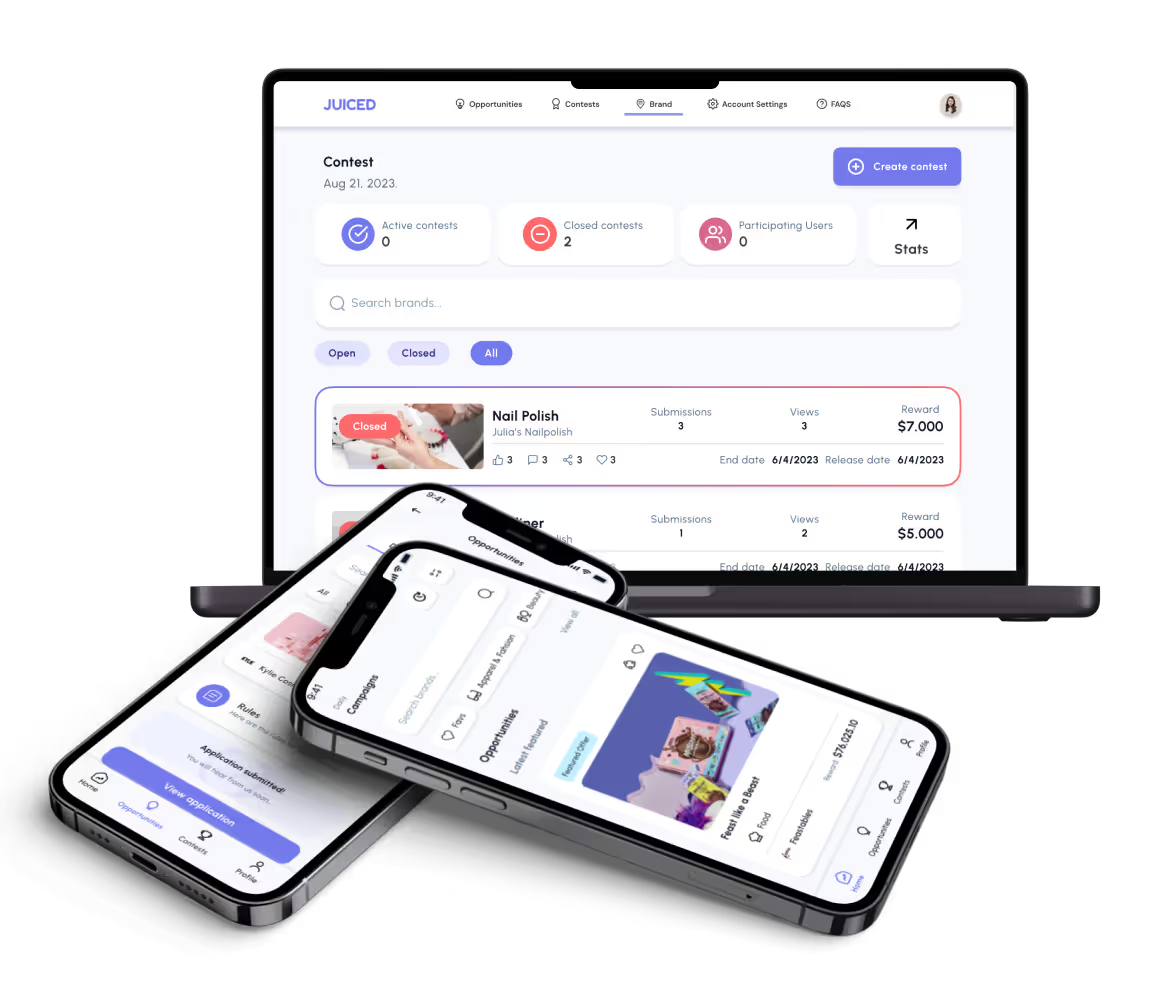
FlutterFlow can deliver subscription tier selection, gated content feeds, creator publishing dashboards, subscriber management, revenue tracking, exclusive content unlocks, community comments, and cancellation flows. Features that require backend support beyond the visual builder are Stripe Connect payout splitting and subscriber analytics aggregation.
The broader question of whether you can build a subscription SaaS with FlutterFlow is answered in detail, but creator subscription apps represent one of the most established patterns on the platform.
Subscription Tier Selection and Signup
A pricing page with tier comparison cards, Stripe Checkout or in-app payment flow, and post-payment access provisioning via Firestore subscription status update.
Gated Content Feed by Tier
A content feed with Firestore security rules and FlutterFlow conditional visibility enforcing access by subscription tier across posts, videos, and downloads.
Creator Dashboard and Content Publisher
A creator-side screen for posting new content with tier assignment, scheduling, and media upload, with real-time subscriber notification on publish.
Subscriber Management and Communication
A subscriber list with search and filter by tier, bulk messaging capability, and direct subscriber messaging via in-app notification or email trigger.
Creator Revenue and Payout Tracking
A revenue dashboard showing MRR by tier, total subscriber count, new sign-ups, and Stripe Connect payout schedule for creator earnings distribution.
Exclusive Content Unlocks and Add-Ons
One-time purchase unlock flows for premium content bundles, separate from recurring subscription billing, handled via Stripe Payment Intents.
Subscriber Comments and Community Access
Gated comment threads and community discussion boards accessible only to active subscribers, with tier-based moderation permissions.
Cancellation and Retention Flow
A subscriber cancellation flow with pause option, downgrade offer, and exit survey before subscription termination is confirmed.
How Long Does It Take to Build a Creator Subscription App with FlutterFlow?
A simple subscription MVP with tiers, gated feed, and billing ships in 5–8 weeks. A full-featured platform with payouts, analytics, community, and content unlocks takes 12–18 weeks.
FlutterFlow delivers creator subscription apps in roughly half the time of a custom Stripe-integrated Flutter build, with the biggest time savings in UI components and content feed screens.
- Simple MVP timeline: Subscription tiers, Stripe billing, and gated content feed ship in 5–8 weeks with an experienced team.
- Stripe Connect adds time: Creator payout splitting, identity verification, and webhook handling via Cloud Functions add 4–6 weeks to any build.
- Content type variety extends timelines: Adding video embed support, audio streaming, and downloadable content each extend the build by 1–2 weeks.
- Subscriber communication features: Bulk messaging, push notifications, and email triggers add 2–3 weeks depending on integration choices.
- Phased approach reduces risk: Launch subscription billing and gated content feed first; add creator dashboard, payout tracking, and community features in phase two.
What Does It Cost to Build a FlutterFlow Creator Subscription App?
FlutterFlow platform costs run $0–$70/month. Developer project costs range from $18,000–$55,000. Agency-built full creator subscription platforms with payouts and community run $25,000–$75,000. Custom development for an equivalent platform costs $60,000–$200,000.
FlutterFlow plan costs are the starting point of the platform budget, but the total recurring cost picture must include Stripe fees, Firebase usage, and storage costs for media content.
- Stripe recurring fees: Stripe charges 1.4–2.9% plus a fixed fee per transaction, with an additional 0.25% per payout for Stripe Connect creator distributions.
- Firebase Firestore and Storage: Firestore read and write costs, Firebase Storage for media content, and Cloud Functions execution time all scale with active subscriber count.
- Hidden compliance costs: Stripe requires identity verification for creators receiving payouts; tax form generation for creators and content moderation for subscriber-visible posts are real operational costs.
- vs Custom development: Custom subscription platforms with equivalent features typically cost $60,000–$200,000; FlutterFlow saves 40–70% at the build stage.
- Hidden ongoing costs: Creator identity verification workflows, tax reporting for payouts, and content moderation for subscriber-visible posts are operational expenses beyond the build.
How Does FlutterFlow Compare to Custom Development for a Creator Subscription App?
FlutterFlow builds a creator subscription app MVP in 5–8 weeks at $25,000–$55,000. Custom development takes 4–6 months at $60,000–$200,000. FlutterFlow wins for solo creators and early-stage platforms; custom wins for multi-creator platforms with complex revenue sharing and enterprise analytics.
The capability gap concentrates in analytics and revenue logic. FlutterFlow handles the subscriber-facing experience well; complex backend revenue models push beyond its native capability.
- Speed advantage: FlutterFlow delivers a working subscription MVP in 5–8 weeks versus 4–6 months for a custom Stripe-integrated Flutter build.
- Cost advantage: FlutterFlow project costs run $25,000–$55,000 versus $60,000–$200,000 for custom, a saving of 40–70% at the build stage.
- Capability ceiling: Complex revenue sharing models, multi-currency payouts, and proprietary subscriber analytics pipelines push beyond FlutterFlow's visual layer.
- Maintenance advantage: FlutterFlow reduces content feed and tier management UI iteration cost; Stripe webhook handling and Firebase Functions need standard backend maintenance.
- When FlutterFlow wins: Solo creator platforms, brand-owned exclusive content apps, and early-stage creator economy SaaS products needing fast validation.
- When custom wins: Platforms with hundreds of creators, complex revenue sharing, multi-currency payout compliance, or enterprise-grade subscriber analytics requirements.
Reviewing FlutterFlow strengths and limitations helps teams decide whether the platform's subscription billing support is sufficient for their creator economy product vision.
What Are the Limitations of FlutterFlow for a Creator Subscription App?
The four hard limitations are: Stripe webhook failures can lock out paying subscribers if not handled correctly with Cloud Functions; Stripe Connect payout logic requires significant backend work; subscriber analytics are not available natively; and Apple requires IAP for iOS subscription billing.
Platforms with aggressive subscriber growth targets should understand FlutterFlow subscription scale constraints before committing to the Firebase and Stripe architecture for their platform.
- Subscription state synchronisation is a reliability risk: Stripe webhook events must trigger Firestore updates via Firebase Functions; any webhook processing failure can lock subscribers out of content they paid for.
- Stripe Connect payout complexity: Multi-creator payout splitting, identity verification for creator accounts, and payout scheduling require significant backend logic beyond FlutterFlow's visual editor.
- No native subscriber analytics: Churn rate, MRR, and cohort retention analytics are not available natively; they require Firebase Functions aggregation or third-party tools like Chartmogul.
- Video streaming needs an external CDN: FlutterFlow does not natively integrate a video CDN; large-volume video content requires Mux or Vimeo integration for reliable streaming delivery.
- Apple IAP is mandatory on iOS: Apple requires in-app purchase for subscription billing on iOS, meaning Stripe cannot be used for iOS subscriber billing without App Store policy consequences.
- Scale requires Firestore optimisation: Platforms with thousands of concurrent subscribers accessing gated content simultaneously need Firestore security rule optimisation built in from the start.
How Do You Build a FlutterFlow Creator Subscription App with the Right Team?
Look for expertise in Stripe Subscriptions and Stripe Connect, Firebase webhook handling, Firestore security rules for content gating, and App Store IAP compliance. Agencies are recommended for multi-creator platforms with payout and analytics complexity.
Finding qualified FlutterFlow developers who understand both Stripe Connect and Apple's IAP requirements is essential for a creator subscription app that actually ships.
- Stripe webhook experience is non-negotiable: Any team without demonstrated Stripe webhook failure handling and subscription state recovery cannot build a reliable creator subscription platform.
- Apple IAP compliance knowledge: Developers who are unaware of Apple's in-app purchase requirement for iOS subscription apps will create compliance problems that delay submission and affect revenue.
- Firebase Security Rules expertise: Content gating must work at the Firestore data layer, not just at the UI visibility layer; verify this in portfolio examples before hiring.
- Key question to ask: "How do you handle Stripe webhook failure and subscription state recovery?" reveals immediately whether the team understands the reliability architecture.
- Expected discovery timeline: 2–3 weeks to define tier structure, payout model, content types, and App Store compliance approach before a single line of development begins.
Budget for a thorough discovery phase before development starts. Confirming whether the app targets iOS, Android, or both determines the billing architecture and shapes the entire project scope.
Conclusion
FlutterFlow is a genuinely capable platform for creator subscription apps. Billing, content gating, subscriber dashboards, and community tools all work within the platform's capability.
The Apple IAP requirement, Stripe Connect payout complexity, and subscription state synchronisation each require expert handling beyond the visual editor. Confirm whether your app targets iOS, Android, or both before scoping the billing architecture. That single decision shapes the entire technical approach and your revenue model.
Building a Creator Subscription App with FlutterFlow? Here Is How LOW/CODE Agency Approaches It.
Most creator subscription builds fail in two places: Stripe webhook handling that was never properly designed for failures, and Apple IAP compliance that surfaces as a blocker during App Store review. Both are avoidable with the right team from day one.
As AI development experts, we at LOW/CODE Agency help SMBs ship real software — web and mobile applications, intelligent chatbots, RAG pipelines, and autonomous AI agents built for businesses that need results, not platforms. We build FlutterFlow creator subscription apps from discovery through launch, covering Stripe Subscriptions and Connect architecture, Firebase content gating, Apple IAP compliance, and subscriber analytics. We use FlutterFlow as an accelerator, not a shortcut.
- Subscription billing architecture: We build Stripe Subscriptions with webhook handling and Firebase Functions that keep subscriber access states synchronised reliably.
- Stripe Connect payout flows: We design and build the creator payout splitting, identity verification, and scheduling logic that distributes earnings correctly.
- Content gating setup: We configure Firestore security rules that genuinely gate paid content at the data layer, not just in the UI visibility layer.
- Apple and Google IAP compliance: We implement in-app purchase flows for App Store and Google Play so your subscription app passes review and processes revenue correctly.
- Creator dashboard build: We deliver the content publishing interface, tier assignment, scheduling, and subscriber communication tools creators need to run the platform.
- Subscriber analytics integration: We connect Chartmogul or equivalent so creators can track MRR, churn, and cohort retention from day one.
- Full product team: Strategy, UX, development, and QA from a single team that stays involved through launch and post-launch refinement.
We have built 350+ products for clients including Coca-Cola, American Express, and Sotheby's. We know exactly where creator subscription builds go wrong, and we address those failure points before they surface.
Related Articles
- How to Build a CRM with FlutterFlow
- How to Build a Credit Score Dashboard with FlutterFlow
- How to Build a Creator Subscription Marketplace with FlutterFlow
- How to Build a Creator Marketplace App with FlutterFlow
- How to Build a Creator Fan Subscription App with FlutterFlow
- How to Build a Course Marketplace App with FlutterFlow
Last updated on
September 24, 2026
.

Jesus is a visionary entrepreneur and tech expert. After nearly a decade working in web development, he founded LOW/CODE Agency to help businesses optimize their operations through custom software solutions.


FAQs
What are the first steps to create a subscription app in FlutterFlow?
How can I integrate payment processing in a FlutterFlow subscription app?
What are common challenges when building subscription apps with FlutterFlow?
Can I customize subscription plans within FlutterFlow?
How do I manage user subscriptions and cancellations in FlutterFlow?
Is FlutterFlow suitable for launching a scalable subscription app?
Related Articles

FlutterFlow
How to Build a Healthcare Workflow System with FlutterFlow
Learn how to create efficient healthcare workflow systems using FlutterFlow with step-by-step guidance and best practices.

FlutterFlow
How to Build an EMR System with FlutterFlow
Learn step-by-step how to create an EMR system using FlutterFlow with best practices for design, security, and data management.
FlutterFlow
Comparison
FlutterFlow vs Noodl | 10 Factors to Decide the Best One
Compare FlutterFlow vs Noodl across 10 key factors like performance, pricing, customization & more to find the best no/low-code platform for your app

FlutterFlow
How to Build a Peer-to-Peer Marketplace with FlutterFlow
Learn how to create a peer-to-peer marketplace using FlutterFlow with step-by-step guidance and best practices.


Why customers trust us for no-code development


