

How to Build a Dating App with FlutterFlow
13 min
read
Learn step-by-step how to create a dating app using FlutterFlow with no coding skills required. Start building your app today.

A FlutterFlow dating app platform involves far more than a swipe UI. Identity verification, location-based matching, safety controls, and App Store compliance all need to be built correctly before a single match is made.
Get any one of those wrong and you face App Store rejection, legal exposure, or a platform that becomes unsafe. This guide covers what FlutterFlow can build, what it cannot, and what the stores require.
Key Takeaways
- Swipe UI is achievable: FlutterFlow's custom widgets and gesture detection support card stack swipe interfaces without custom Flutter code.
- Matching needs a backend: Location-based and preference-based matching cannot run client-side at scale; Firebase Functions or an external recommendation service is required.
- Identity verification is mandatory: App Store and Google Play policies require dating apps to implement age verification, and some markets legally require identity verification.
- Safety features are non-negotiable: Block, report, and photo verification flows are required for App Store approval, not optional additions.
- NSFW moderation cannot be skipped: User-uploaded photos must be screened before display; FlutterFlow has no native image moderation capability.

What Can FlutterFlow Build for a Dating App Platform?
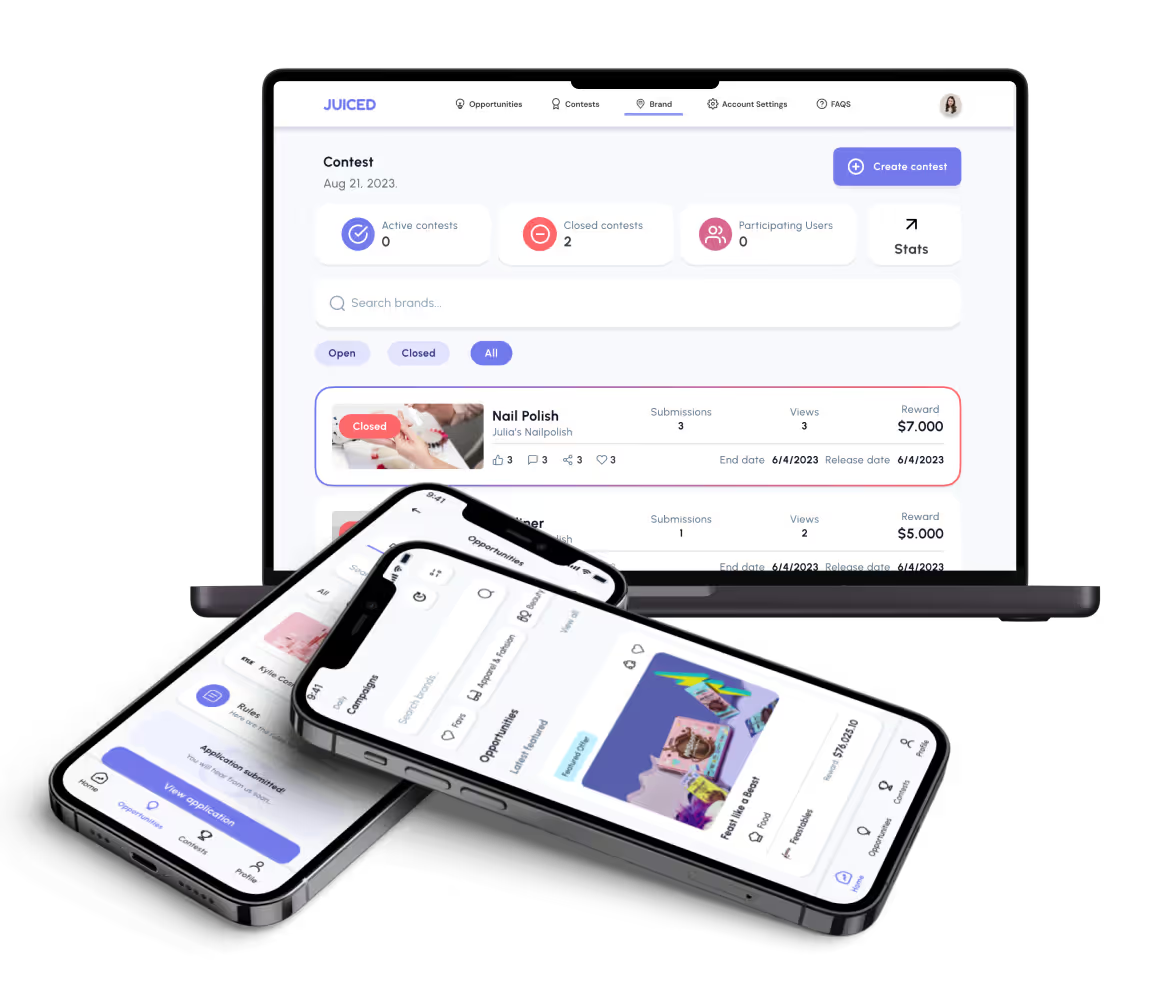
FlutterFlow can deliver profile creation, swipe-based match discovery, location filtering, match inbox, chat, subscription gating, safety tools, and push notifications. Matching algorithms, identity verification, and NSFW moderation each require backend or third-party integration.
Reviewing FlutterFlow dating app examples demonstrates the UI and feature depth already achieved on the platform before committing to a build.
Profile Creation and Photo Upload
Multi-step onboarding collects bio, preferences, and interests, with Firebase Storage handling photo uploads, image cropping, and display order controls.
- Multi-step intake forms: Conditional onboarding questions collect preferences, interests, and deal-breakers across structured form screens.
- Photo upload and ordering: Firebase Storage handles uploads with image cropping, compression, and user-controlled display order.
- Profile completeness gating: Users cannot proceed to match discovery until a minimum profile completeness threshold is met.
Swipe-Based Match Discovery
Card stack UI with left and right swipe gesture detection triggers accept or pass actions, with match notification when both users indicate interest.
- Swipe gestures: FlutterFlow's gesture detection captures left and right swipe actions on stacked profile cards with animation feedback.
- Match trigger logic: When two users both swipe right, a Firebase Function creates a match record and sends push notifications to both parties.
- Card queue refresh: The profile card stack reloads from a Firestore query filtered by location radius, preferences, and existing interaction history.
Location-Based Discovery and Radius Filtering
GeoPoint proximity queries allow distance radius filtering, with location permission handling and approximate location privacy options for user safety.
- GeoPoint-based queries: Firestore stores user GeoPoints and proximity queries surface profiles within a defined radius using GeoHash-based indexing.
- Radius filter control: Users set their preferred discovery radius from 1 to 100 miles, dynamically updating the profile card queue.
- Approximate location option: Users can opt to show approximate rather than precise location, improving privacy without disabling discovery.
Match Inbox and Conversation Threads
Matched user inbox lists active conversations, with Firebase Realtime Database threads accessible immediately on match confirmation.
- Match inbox listing: All active matches display with the most recent message preview and an unread message indicator.
- Real-time chat threads: Firebase Realtime Database powers message delivery, with typing indicators and read receipts per conversation.
- Message expiry option: Unresponsive match conversations can expire after a defined period, reducing inbox clutter for active users.
Profile Verification and Photo Review
User selfie submission routes to an admin review queue for manual photo verification, with optional third-party identity verification API integration.
- Selfie verification flow: Users submit a real-time selfie that an admin or automated service compares to the profile photo for authenticity.
- Admin review queue: Submitted verification selfies appear in a moderation dashboard for review before the verified badge is awarded.
- Third-party identity API: Providers such as Persona or Stripe Identity can be integrated via custom actions for document-level identity verification.
Block, Report, and Safety Tools
Block removes mutual visibility between users, report routes to a safety review queue, and screenshot detection warnings are available at the OS level.
- Block action: Blocking a user immediately removes them from the blocked user's discovery queue and match inbox.
- Report flow: Users select a report reason from a predefined list, and the report record routes to a safety team review queue in Firestore.
- Screenshot detection: Flutter's screenshot detection API can trigger a warning overlay when a user attempts to capture a private conversation.
Subscription and Premium Feature Gating
Stripe-powered premium tiers gate features including unlimited swipes, profile boosts, and see-who-liked-you screens behind subscription status.
- Subscription tiers: Free and premium tiers are enforced via Firestore subscription status fields updated by Stripe webhook callbacks.
- Feature gating: Unlimited swipes, profile boosts, and like visibility are conditionally accessible based on the user's current subscription tier.
- In-app purchase consideration: iOS digital goods sold through the app must comply with Apple IAP requirements; Stripe direct billing applies on web and Android.
Push Notifications for Matches and Messages
Firebase Cloud Messaging delivers notifications for new matches, incoming messages, and profile likes, with deep-link routing to the relevant screen.
- Match notifications: A push notification fires immediately when a mutual match is created, deep-linking directly to the match conversation screen.
- Message alerts: Incoming messages trigger notifications with the sender's name and message preview, even when the app is in the background.
- Like notifications: Premium users receive push alerts when another user likes their profile, with a deep link to the likes screen.
FlutterFlow covers all core dating app UI and interaction patterns. The matching algorithm, verification API, and content moderation layer each need deliberate backend architecture alongside the FlutterFlow front end.
How Long Does It Take to Build a Dating App Platform with FlutterFlow?
A dating app MVP with profile creation, swipe-based match discovery, and a match inbox takes 8–12 weeks. A full-featured platform including location matching, identity verification, subscriptions, and safety tools runs 16–24 weeks.
Timeline is driven by matching algorithm complexity, identity verification integration, App Store review duration, and subscription tier design.
- MVP scope (8–12 weeks): Profile creation, swipe and match flow, basic match inbox, and push notifications are achievable within this window.
- Full platform (16–24 weeks): Location-based matching, identity verification API, subscription tiers, safety tools, and admin moderation dashboard extend the timeline significantly.
- Phased approach: Launch core swipe, profile, and match flow first. Add location filtering, subscriptions, and verification in phase two. Safety tools and admin moderation in phase three.
- App Store review duration: Apple's review of dating apps with safety features takes longer than standard apps. Factor two to four weeks of review time into your launch schedule.
- Speed advantage: FlutterFlow reduces dating app delivery time by 40–55% compared to native iOS and Android builds with equivalent feature scope.
A phased build gets a working MVP in front of real users faster and reduces the risk of building unvalidated features in the early stages.
What Does It Cost to Build a FlutterFlow Dating App Platform?
Platform subscription runs $0–$70/month. Developer projects run $25,000–$80,000. Agency builds for a full dating platform with matching, safety, and subscriptions run $35,000–$120,000. Custom native development for equivalent features costs $100,000–$400,000.
FlutterFlow pricing tiers are the starting point, but identity verification APIs and ongoing safety tooling are the significant variables in a dating app budget.
- Platform cost: $0/month on Starter, $70/month on Pro. A multi-user dating platform with team collaboration needs the Teams plan.
- Developer cost: $50–$150/hour. A full-featured dating app project with verification and subscriptions runs $25,000–$80,000.
- Agency cost: $35,000–$120,000 for a complete dating platform with matching, safety tools, admin moderation, and subscription tiers.
- Identity verification costs: Persona and Stripe Identity charge per verification. At scale, this becomes a significant per-user operational cost.
- Firebase ongoing costs: Firebase Realtime Database for chat, Firebase Storage for photos, and Firebase Cloud Messaging each scale with active user count.
Legal review of user data handling, age verification policies, and content moderation staffing add costs that most initial budgets underestimate significantly.
How Does FlutterFlow Compare to Custom Development for a Dating App Platform?
FlutterFlow delivers a dating app MVP in 8–12 weeks at $35,000–$80,000. Custom native development for equivalent iOS and Android feature parity typically takes 6–12 months and costs $100,000–$400,000.
The comparison is clear on cost and speed. The relevant question is whether FlutterFlow's capability ceiling fits your matching and real-time requirements.
- Speed comparison: FlutterFlow MVP in 8–12 weeks versus 6–12 months for custom native development with equivalent feature depth.
- Cost comparison: FlutterFlow project at $35,000–$80,000 versus custom at $100,000–$400,000. The cost gap is significant for MVP validation.
- Matching algorithm ceiling: Proprietary ML-based matching, behaviour-learned scoring, and real-time affinity models require custom code that FlutterFlow cannot implement natively.
- Real-time location constraints: Continuous sub-second location tracking for proximity features stresses battery and Firebase costs beyond what FlutterFlow's location actions support.
- When FlutterFlow wins: Niche dating apps targeting specific professions or interests, MVP validation before full platform investment, and apps where preference-based matching is sufficient.
- When custom wins: Consumer dating apps at rapid scale requiring proprietary ML matching, in-app video calling, and real-time location features as core differentiators.
Teams evaluating their build options should review alternative platforms for dating apps before committing, particularly if real-time video or proprietary matching are core requirements.
What Are the Limitations of FlutterFlow for a Dating App Platform?
FlutterFlow cannot compute match scores natively, moderate user-uploaded images, or handle continuous background location. Identity verification, NSFW screening, and real-time location tracking each require backend or third-party integration.
Understanding FlutterFlow security architecture is essential when handling sensitive user data including location history, identity documents, and private messaging.
- Matching algorithm limitations: Preference-based and behaviour-learned matching requires Firebase Functions or an external ML service; match scoring cannot run natively in FlutterFlow.
- Identity verification complexity: Persona and Stripe Identity require custom API integration and backend webhook handling that is not native to FlutterFlow's action library.
- No native image moderation: All user-uploaded photos must pass through a content moderation service before display. FlutterFlow has no built-in NSFW screening capability.
- Background location limits: Continuous background GPS tracking stresses battery and Firebase costs; Flutter's background location support is constrained and requires custom Dart code.
- App Store policy compliance: Apple has strict dating app safety requirements. Apps missing verified age controls, anti-fraud measures, or a blocking mechanism face rejection or removal.
- GDPR and data handling: Location history, identity documents, and match data require deliberate Firebase security rule design and compliant data retention and deletion handling.
A dating app's most complex engineering is not the swipe UI. It is the verification, moderation, and compliance layer that makes the platform legally and operationally safe to run.
How Do You Build a FlutterFlow Dating App Platform with the Right Team?
For a dating app, engage specialist FlutterFlow agencies with safety feature and App Store compliance experience. The verification, moderation, and matching complexity of a dating app warrants an agency over a freelancer in most cases.
Working with specialist FlutterFlow agencies that have safety feature and App Store compliance experience is not optional for a dating app; it is a prerequisite.
- Core expertise to look for: GeoPoint-based Firebase queries, Stripe subscription integration, identity verification API experience, App Store dating app submission history, and content moderation workflow design.
- Agency over freelancer: Dating app safety, verification, and compliance complexity requires a team with project management, backend architecture, and App Store submission experience.
- Red flags when hiring: No experience with Apple's dating app safety guidelines, no demonstrated safety feature implementation, and no prior identity verification API work.
- Questions to ask: How do they handle fake profile detection? What is their approach to App Store compliance documentation? How do they manage GeoPoint query performance at scale?
- Discovery phase: Allow three to four weeks of scoping to map matching logic, safety requirements, and verification flow architecture before any development begins.
- Expected timeline: 8–24 weeks depending on feature scope, matching algorithm complexity, and App Store review cycles.
A team without prior dating app submission experience will learn on your project. That learning costs both time and money during App Store compliance review.
Conclusion
FlutterFlow can build a dating app platform faster and cheaper than custom native development. The swipe UI, match inbox, location filtering, and subscription gating are all achievable.
The hard part is not the UI. It is identity verification, NSFW moderation, and App Store compliance. These are not features to add later.
Define your safety requirements and verification approach before scoping the build. Then engage a team that has shipped dating apps through App Store review before.
Building a Dating App Platform with FlutterFlow? Here Is How LOW/CODE Agency Approaches It.
Most dating app builds underestimate safety and compliance complexity. Teams focus on the swipe interface and treat verification, moderation, and App Store compliance as afterthoughts. That approach results in rejection, rework, and delayed launch.
As AI development experts, we at LOW/CODE Agency help SMBs ship real software — web and mobile applications, intelligent chatbots, RAG pipelines, and autonomous AI agents built for businesses that need results, not platforms. We scope dating app platforms from safety and compliance first, designing verification flows, moderation architecture, and App Store documentation requirements before a single screen is built.
- Safety-first scoping: We map block, report, age verification, and photo review flows in week one, before any product UI is designed.
- Identity verification integration: We integrate Persona or Stripe Identity via custom API actions with backend webhook handling and admin review queues.
- Matching algorithm design: We architect Firebase Function-based matching logic for preference-based and location-weighted scoring tailored to your audience.
- NSFW moderation pipeline: We configure user photo screening via third-party moderation APIs before any image is displayed in the discovery feed.
- Subscription and premium gating: We build Stripe-powered subscription tiers with iOS and Android payment compliance built into the architecture from day one.
- App Store compliance documentation: We prepare the safety and moderation documentation Apple requires for dating app submissions to minimise review delays.
- Full product team: Strategy, UX, development, and QA from one team with dating app and App Store submission experience across multiple projects.
We have built 350+ products for clients including Coca-Cola, American Express, and Sotheby's. We know where dating app builds break and how to design around those failure points from the start.
Related Articles
- How to Build a Group Discussion App with FlutterFlow
- How to Build a Digital Goods Marketplace with FlutterFlow
- How to Build a Delivery Driver App with FlutterFlow
- How to Build Customer Loyalty Apps with FlutterFlow
- How to Build a Crop Monitoring Dashboard with FlutterFlow
- How to Build a CRM with FlutterFlow
Last updated on
September 24, 2026
.

Jesus is a visionary entrepreneur and tech expert. After nearly a decade working in web development, he founded LOW/CODE Agency to help businesses optimize their operations through custom software solutions.


FAQs
What are the first steps to create a dating app in FlutterFlow?
Can I build a fully functional dating app without coding in FlutterFlow?
How do I implement user profiles and matching features in FlutterFlow?
What are the best practices for integrating chat in a FlutterFlow dating app?
How can I test and deploy my FlutterFlow dating app effectively?
Are there any security concerns when building a dating app with FlutterFlow?
Related Articles

FlutterFlow
How to Build a Cross-Platform App with FlutterFlow
Learn how to build a cross-platform app with FlutterFlow for web, iOS, and Android. Step-by-step guidance, tools, and best practices.
FlutterFlow
How to Build a Fundraising Platform with FlutterFlow
Learn how to create a fundraising platform using FlutterFlow with step-by-step guidance and key tips for success.
FlutterFlow
How to Build Nonprofit Apps with FlutterFlow
Learn how to create nonprofit apps using FlutterFlow with step-by-step guidance and best practices for effective app development.

Comparison
FlutterFlow
FlutterFlow vs Thunkable: 10 Factors to Decide the Best One
Compare FlutterFlow vs Thunkable across 10 key factors like design, logic, scalability, and publishing to choose the right no-code app builder for your goals


Why customers trust us for no-code development


