

Enterprise Software Development Services
13 min
read
Learn what enterprise software development services include, how to evaluate providers, typical engagement models, and what separates quality vendors from the rest.

Enterprise software development services help organizations build custom systems that off-the-shelf software cannot provide. But the term covers a wide range of offerings, from small consulting engagements to multi-year transformation projects.
This guide explains what enterprise development services typically encompass, how providers structure engagements, what to look for in a partner, and how to avoid common pitfalls that derail projects.
Before engaging a provider, it’s important to understand the broader custom enterprise software benefits that justify investing in tailored development rather than off-the-shelf tools.
What Do Enterprise Software Development Services Include?
Breaking down the typical service offerings.
What is enterprise software development?
Enterprise software development creates custom applications designed for large organizations, handling complex business processes, integrating with existing systems, and supporting many users with high reliability requirements.
Enterprise software characteristics:
- Enterprise-scale support: Designed to handle hundreds or thousands of concurrent users reliably.
- Deep system integration: Connects seamlessly with existing enterprise applications and infrastructure.
- Complex business logic: Manages sophisticated workflows, rules, and operational scenarios.
- High reliability standards: Ensures strong availability, performance stability, and data integrity.
- Enterprise-grade security: Implements advanced access controls, encryption, and threat protection.
- Regulatory compliance readiness: Meets industry-specific legal and regulatory requirements.
Enterprise software differs from consumer or small business software in scope, requirements, and stakes.
If you're unsure how enterprise solutions compare with packaged systems, our guide on standard vs enterprise software development breaks down the differences in complexity, governance, and long-term impact.
What Enterprise services does LOW/CODE Agency offer?
Enterprise development services typically include discovery and planning, custom development, integration, migration, modernization, and ongoing support—often bundled into end-to-end engagements.
Common service offerings:
Most providers offer these as standalone services or combined packages. To understand how these services fit into a structured execution model, review the full enterprise software development process from discovery through deployment.
What types of enterprise software do we build?
Enterprise development covers ERP systems, CRM platforms, supply chain management, HR systems, business intelligence tools, and custom operational software specific to an organization's needs.
Common enterprise software types:
- ERP systems: Integrate finance, operations, procurement, and core business processes.
- CRM platforms: Manage customer data, sales pipelines, and interaction history.
- SCM solutions: Control supply chain workflows, logistics, and inventory management.
- HRM systems: Handle employee records, payroll, and workforce processes.
- BI platforms: Provide analytics, dashboards, and enterprise performance reporting.
- Custom operations software: Support industry-specific workflows and specialized business needs.
Some projects customize existing platforms while others build entirely custom solutions.
How Are Enterprise Development Engagements Structured?
Understanding typical engagement models.
What engagement models exist?
Enterprise development engagements typically follow fixed-price, time-and-materials, or dedicated team models, each with different risk and flexibility trade-offs.
Engagement model comparison:
Fixed-Price: You pay a set amount for defined deliverables. Works when requirements are clear and unlikely to change. Vendor bears cost overrun risk.
Time & Materials: You pay for actual hours worked. Provides flexibility as requirements evolve. Cost is less predictable.
Dedicated Team: You essentially hire a team that works exclusively on your projects. Maximum flexibility but requires management capability.
What does a typical enterprise project lifecycle look like?
Enterprise projects typically follow discovery, design, development, testing, deployment, and support phases, though agile approaches iterate through these more continuously.
Lifecycle phases:
- Discovery phase (2–8 weeks): Conduct requirements gathering and technical feasibility assessment.
- Design phase (4–12 weeks): Define system architecture, UX or UI design, and detailed specifications.
- Development phase (3–18 months): Build enterprise software incrementally using structured sprints.
- Testing phase (ongoing and final): Perform continuous quality assurance and final validation.
- Deployment phase (2–8 weeks): Execute production rollout, data migration, and user onboarding.
- Support phase (ongoing): Provide maintenance, updates, performance monitoring, and enhancements.
Timeline varies dramatically based on project scope. Effective engagements start with disciplined enterprise software development planning to reduce ambiguity before development begins.
How long do enterprise projects take?
Enterprise software projects typically range from 6 months for focused applications to 2+ years for major transformations, with most significant projects falling in the 9-18 month range.
Typical timelines:
- Departmental application: 4-9 months
- Enterprise-wide system: 12-24 months
- Digital transformation: 18-36 months
- ERP implementation: 12-30 months
At LOW/CODE Agency, we use no-code and low-code platforms to dramatically compress these timelines, often delivering in 10-16 weeks what traditional development takes 6-12 months to build.
For a deeper breakdown of financial trade-offs, see our complete enterprise software development cost guide covering budget ranges and cost drivers.
How Do You Evaluate Enterprise Development Providers?
Selecting the right partner matters enormously.
What should you look for in a enterprise development partner?
Evaluate enterprise development partners on relevant experience, technical capabilities, communication quality, delivery track record, and cultural fit rather than size or marketing alone.
Evaluation criteria:
Experience indicators:
- Industry-specific projects: Demonstrated experience delivering solutions within your industry.
- Complexity handling record: Proven ability to manage projects with similar scale and complexity.
- Relevant technology expertise: Strong knowledge of required platforms, tools, and frameworks.
- Verifiable client references: References you can directly contact to validate performance.
Capability indicators:
- Technical team depth: Access to experienced architects, developers, and specialists.
- Architecture and design strength: Ability to design scalable and maintainable enterprise systems.
- Security and compliance expertise: Knowledge of regulatory standards and enterprise security practices.
- Integration experience: Proven capability connecting complex enterprise systems reliably.
Process indicators:
- Defined development methodology: Structured and repeatable enterprise delivery framework.
- Clear communication practices: Transparent reporting and consistent stakeholder updates.
- Change management discipline: Controlled handling of scope changes and requirement updates.
- Quality assurance rigor: Strong testing processes and defect prevention standards.
Applying structured enterprise software development best practices during vendor evaluation helps prevent misalignment and execution risk.
What red flags should you watch for?
Watch for providers who overpromise timelines, avoid discussing challenges, lack relevant references, push specific technologies regardless of fit, or cannot clearly explain their process.
Warning signs:
- Unrealistic timelines: Enterprise software projects require structured phases and cannot be rushed safely.
- Vague cost estimates: Professional vendors clearly explain assumptions, scope, and pricing drivers.
- No comparable experience: Avoid vendors learning enterprise complexity on your project.
- Technology bias: Be cautious if they recommend only their preferred platform.
- Poor communication early: Sales-stage misalignment often predicts delivery-stage problems.
- Resistance to references: Reputable providers welcome verification and client conversations.
Trust your instincts about communication quality and cultural fit. Practical enterprise software development tips can also help you structure vendor conversations and avoid common engagement mistakes.
Should you choose large or small enterprise providers?
Large providers offer resources and stability but may assign junior staff; small providers offer senior attention but less redundancy. Match provider size to project needs.
Size trade-offs:
Large providers:
- Broader resource pool: Offer more specialists and deeper technical bench strength.
- Organizational stability: Established firms provide longevity and structured governance models.
- Mixed experience levels: May assign junior developers alongside senior oversight.
- Lower direct partner involvement: Senior leadership may have limited day-to-day engagement.
- Higher pricing structure: Larger firms typically charge premium enterprise rates.
Small/mid providers:
- Senior team participation: Greater hands-on involvement from experienced architects and developers.
- Direct partner attention: Leadership remains closely engaged throughout project lifecycle.
- Agile responsiveness: Faster decision-making and adaptability to enterprise changes.
- Limited redundancy: Smaller teams may have fewer backup resources.
- Capacity constraints: Concurrent project load can impact availability and scaling speed.
Consider who will actually work on your project, not just company size.
What Should You Expect During Engagement?
Setting realistic expectations for the partnership.
What does good communication look like?
Good communication includes regular status updates, proactive issue escalation, clear decision documentation, accessible project tracking, and responsive daily interaction.
Communication expectations:
- Weekly status meetings: Review progress, blockers, risks, and decisions required from stakeholders.
- Daily standups for agile: Align team tasks, surface issues, and maintain delivery momentum.
- Proactive issue escalation: Raise risks and problems early to avoid project disruption.
- Documented decision tracking: Record key decisions and rationale for transparency.
- Project visibility access: Provide stakeholders access to tracking dashboards and tools.
- Responsive communication standards: Maintain clear and timely responses to inquiries and updates.
Establish communication cadence during contracting.
How should requirements be handled?
Requirements should be documented clearly, prioritized collaboratively, validated with stakeholders, and managed through a defined change process that balances flexibility with scope control.
Requirements management:
- Structured documentation: Maintain written, clear, and unambiguous requirement specifications.
- Prioritization framework: Apply MoSCoW or similar models to rank business importance.
- Stakeholder validation: Secure formal review and approval before development begins.
- Formal change control: Manage requirement modifications through a defined process.
- End-to-end traceability: Link each requirement directly to deliverables and outcomes.
Expect requirements to evolve but through controlled process.
What deliverables should you receive?
Enterprise engagements should deliver working software, technical documentation, user documentation, training materials, source code (if applicable), and transition support.
Expected deliverables:
- Working enterprise software: Fully tested, deployed, and operational solution ready for production use.
- Technical documentation: Detailed architecture, API specifications, and system configuration guides.
- User documentation: Clear instructions and guides for daily system usage.
- Training programs: Structured training for end users and system administrators.
- Source code access: Complete source code provided under agreed licensing terms.
- Support transition plan: Formal handoff to internal teams or ongoing maintenance support.
Define deliverables clearly in contracts. Reviewing real-world enterprise software examples can clarify what production-ready systems should actually look like.
How Do We Ensure Enterprise Project Success?
Maximizing chances of positive outcomes.
What are common causes of failure in Enterprise Software?
Enterprise projects fail most often due to unclear requirements, inadequate stakeholder engagement, scope creep, poor change management, and insufficient testing—not usually technology failures.
Common failure causes:
- Unclear requirements: Building the wrong solution due to vague or incomplete specifications.
- Stakeholder disengagement: Limited feedback and delayed decisions slow progress and reduce alignment.
- Scope creep: Uncontrolled feature additions increase cost, timeline, and delivery risk.
- Weak change management: Users resist adoption when communication and training are insufficient.
- Inadequate testing: Poor quality assurance leads to defects at launch.
- Integration complexity: Underestimating system integration challenges causes delays and instability.
Technology rarely causes failure; people and process issues do. Strong governance and early architecture discipline supported by the right enterprise software development tools—reduce many of these execution risks.
What makes enterprise projects succeed?
Successful projects have engaged executive sponsors, clear requirements, realistic timelines, empowered decision-makers, regular feedback cycles, and strong change management.
Success factors:
- Active executive sponsorship: Visible leadership support ensures alignment and resource commitment.
- Clear ownership structure: Empowered decision-makers prevent delays and conflicting directions.
- Realistic expectations: Transparent understanding of trade-offs improves planning and outcomes.
- Ongoing user involvement: Regular feedback validates functionality and usability.
- Structured change management: Prepare the organization for adoption and workflow shifts.
- Consistent quality focus: Maintain testing and validation throughout development lifecycle.
Your organization's involvement matters as much as vendor capability. Well-structured engagements often unlock significant enterprise software cost reduction opportunities through platform selection and process optimization.
How involved should your team be?
Your team should be heavily involved, enterprise software is not something you can fully outsource. Expect significant time commitments from business owners, subject matter experts, and IT staff.
Internal time commitments:
- Project sponsor commitment: Allocate approximately 2–5 hours per week for oversight and decisions.
- Product owner involvement: Dedicate 15–30 hours per week to requirements, prioritization, and reviews.
- Subject matter expert contribution: Plan 5–15 hours per week per functional area.
- IT and technical participation: Reserve 5–20 hours per week for architecture and integration input.
- End user testing time: Allocate variable hours during user acceptance testing phases.
Budget internal time as part of project investment.
Want to Build Scalable Enterprise Software?
Enterprise software should not feel fragile. It should feel dependable.
If you are investing in scalable enterprise software, the real objective is long-term operational stability. Not just launching a platform, but building a system that handles growth, complexity, and change.
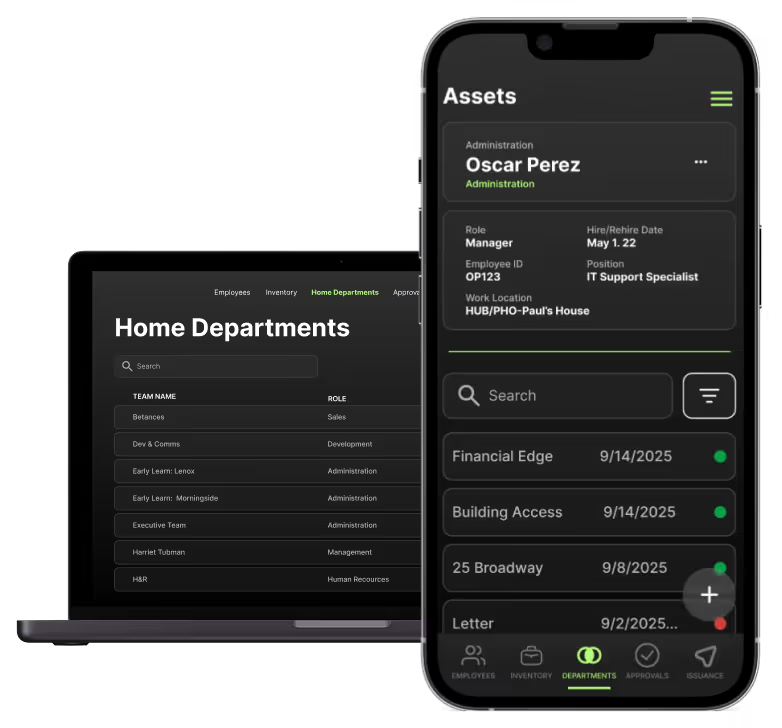
At LOW/CODE Agency, we design and build scalable enterprise software that supports structured workflows, large teams, and expanding data environments.
- Architecture before execution
Scalability starts with system design. We define data models, role hierarchies, reporting structures, and integration layers before development begins. - Structured governance and access control
Enterprise systems require strict permission management, audit logs, and secure data segmentation. We design accountability into the core of the platform. - Integration-first approach
Enterprise software must connect with ERPs, CRMs, finance systems, APIs, and automation platforms. We align integrations intentionally to avoid fragmentation. - Performance-aware system design
As user numbers and datasets grow, performance must remain stable. We design scalable backend architecture and optimized workflows from day one. - Built for continuous evolution
Enterprise systems expand over time. New modules, AI capabilities, dashboards, and automation layers should integrate smoothly without full rebuilds.
We are not here to ship enterprise software quickly and move on.
lowcode.agency/services/business-apps" target="_self">enterprise business systems that evolve with your organization.

Related Articles
- Enterprise Software Examples and Use Cases
- Enterprise Software Development Tools & Stack
- Enterprise Software Development Tips (2026 Guide)
- Enterprise Software Development Process: Complete Guide
- Enterprise Software Development Planning: Complete Guide
- What Is Google Opal? (Complete Guide)
Looking to build a mobile app? Our mobile app development services handle everything from design to deployment.
Ready for a custom-built app? Our custom app development services are built around your requirements.
Last updated on
September 24, 2026
.

Jesus is a visionary entrepreneur and tech expert. After nearly a decade working in web development, he founded LOW/CODE Agency to help businesses optimize their operations through custom software solutions.


FAQs
How much does enterprise software development cost?
Should you build custom enterprise software or buy packaged solutions?
Can offshore development work for enterprise software projects?
How do you protect intellectual property in enterprise software development?
What ongoing support costs should you plan after launch?
How can you reduce vendor lock-in risk in enterprise software development?
Related Articles
Custom App Development
No-code/Low-code
Low-code Real Estate App Development Guide
Low-code real estate app development guide covering app types, core features, workflows, integrations, costs, and scalability for modern property platforms.
Custom App Development
Telehealth App Development | Guide for Startups
Learn how to build a telehealth app from scratch. Explore features, cost, tech stack, and steps to create a secure, scalable telehealth solution
Custom App Development
Enterprise Software Development Planning: Complete Guide
Learn how to plan enterprise software development projects effectively. Covers roadmapping, resource planning, risk management, and governance frameworks.
AI
Custom App Development
How to Build an AI Customer Service App | 24/7 Support
Build an AI customer service app without code to deliver 24/7 support, answer FAQs, and handle chats or calls—boosting response speed and customer satisfaction
Why customers trust us for no-code development


