

Enterprise Software Development Planning: Complete Guide
13 min
read
Learn how to plan enterprise software development projects effectively. Covers roadmapping, resource planning, risk management, and governance frameworks.

Planning enterprise software development requires balancing ambition with realism, stakeholder needs with technical constraints, and speed with quality. Poor planning leads to cost overruns, missed deadlines, and failed projects. Good planning creates clarity, alignment, and a foundation for successful execution.
Strong planning only makes sense when aligned with the broader custom enterprise software benefits your organization expects to realize.
This guide covers how to plan enterprise software projects from initial concept through detailed project plans, including roadmapping, resource planning, risk management, and governance.
How Do You Start Planning an Enterprise Software Project?
Beginning with the right foundation.
What comes before detailed planning?
Before detailed planning, establish business case justification, executive sponsorship, high-level scope and objectives, preliminary budget range, and organizational readiness assessment.
Pre-planning essentials:
- Business case: Why are we doing this?
- Executive sponsor: Who owns this strategically?
- Objectives: What will success look like?
- Preliminary scope: What's in and out?
- Budget range: What can we invest?
- Timeline constraints: Any hard deadlines?
- Readiness assessment: Can we execute this?
Without these foundations, detailed planning is premature. Clear early alignment also improves budget accuracy, as explained in our detailed enterprise software development cost breakdown guide.
How do you define project scope?
Define scope by identifying business capabilities needed, user groups served, key features required, systems to integrate, and boundaries that clarify what's excluded.
Scope definition elements:
Clear scope boundaries prevent creep and misalignment. Applying structured enterprise software development best practices during scope definition significantly reduces downstream rework and conflict.
Who should be involved in planning?
Planning requires business stakeholders who understand needs, technical stakeholders who understand feasibility, and executive sponsors who can make decisions and remove obstacles.
Planning participants:
- Executive sponsor: Provides strategic direction and commits required enterprise resources.
- Business owners: Define requirements, set priorities, and approve delivered functionality.
- IT leadership: Ensures technical alignment with enterprise architecture and security standards.
- Subject matter experts: Contribute domain knowledge to validate processes and workflows.
- Project management team: Manages planning structure, timelines, coordination, and governance.
- Development leads: Assess feasibility, provide technical estimates, and guide implementation strategy.
- Change management leaders: Plan user adoption, communication, and training activities.
Exclude any group at your peril.
How Do You Create a Project Roadmap?
Planning the journey from start to launch.
What should a roadmap include?
A roadmap shows major phases, key milestones, release points, dependencies, and critical path items, providing strategic overview without overwhelming detail.
Roadmap components:
- Phases: Organize work into logical groupings aligned with business objectives.
- Milestones: Define major checkpoints to validate progress and stakeholder alignment.
- Releases: Establish clear delivery points for deploying usable enterprise software increments.
- Dependencies: Identify which tasks must be completed before others can begin.
- Critical path: Determine tasks that directly impact the overall project timeline.
- Decision points: Include formal approval gates before advancing to the next phase.
Roadmaps communicate strategy; project plans detail tactics. A roadmap should align with your overall enterprise software development process explained so planning transitions smoothly into execution.
How do you phase enterprise projects?
Phase projects to deliver value incrementally, manage risk, and accommodate learning, typically starting with foundation capabilities and adding sophistication over releases.
Common phasing approaches:
By capability:
- Phase 1: Core functionality. Deliver essential enterprise features required for initial business value.
- Phase 2: Extended features. Introduce additional capabilities that improve efficiency and usability.
- Phase 3: Advanced capabilities. Implement complex automation, analytics, and optimization features.
By user group:
- Phase 1: Pilot group. Launch with a small user group to validate performance and adoption.
- Phase 2: Department rollout. Expand access to a full department after successful pilot results.
- Phase 3: Enterprise rollout. Deploy the system organization-wide with structured change management.
By geography:
- Phase 1: Primary location. Implement the solution at the main operational site first.
- Phase 2: Regional expansion. Extend deployment to additional regional offices or branches.
- Phase 3: Global deployment. Roll out the enterprise system across all international locations.
Choose phasing based on risk and value delivery.
How long should planning take?
Enterprise software planning typically takes 8-16 weeks before development begins, including discovery, requirements, design, and detailed project planning.
Planning timeline:
Overlap these activities where practical, but do not skip them. Skipping structured planning often increases long-term expenses, undermining broader enterprise software cost reduction strategies focused on efficiency and waste prevention.
How Do You Plan Resources?
Getting the right people in place.
What roles are needed?
Enterprise projects need project management, business analysis, architecture, development, quality assurance, change management, and executive sponsorship with specific mix depending on project characteristics.
Typical role requirements:
Scale based on project size and complexity.
How do you plan internal versus external resources?
Balance internal resources (organizational knowledge, long-term ownership) with external resources (specialized skills, capacity) based on availability, capability gaps, and strategic importance.
Resource sourcing considerations:
Internal resources:
- Organizational knowledge: Deep understanding of internal processes and enterprise systems
- Long-term ownership: Greater accountability for maintenance and future enhancements
- Lower incremental cost: Reduced direct billing compared to external enterprise vendors
- Limited availability: Compete with other priorities and internal project commitments
- Skill gaps risk: May lack specialized expertise required for complex implementations
External resources:
- Specialized expertise: Access to experienced enterprise software professionals and niche skills
- Flexible capacity: Scale team size based on project phase and workload demands
- Higher direct cost: Increased upfront expense compared to internal development teams
- Faster ramp-up: Experienced vendors begin productive work quickly with structured processes
- Knowledge transfer requirement: Internal teams must receive documentation and training for continuity
Most enterprise projects use hybrid teams. Understanding whether to build internally or externally often depends on the differences between standard vs enterprise software development approaches and their operational implications.
How do you estimate effort accurately?
Estimate effort using reference class data from similar projects, bottom-up analysis of work breakdown, expert judgment, and appropriate contingency for uncertainty.
Estimation approaches:
- Analogous estimation: Base enterprise software estimates on similar completed projects
- Parametric estimation: Use measurable metrics like cost per story point or feature
- Bottom-up estimation: Estimate each task individually using detailed work breakdown structures
- Three-point estimation: Calculate optimistic, pessimistic, and most likely cost scenarios
Use multiple approaches and reconcile differences. Reviewing real-world enterprise software examples can improve estimation realism by comparing scope, complexity, and delivery timelines.
How Do You Plan for Risk?
Anticipating and preparing for challenges.
What are common enterprise software risks?
Common risks include requirements instability, integration complexity, resource availability, organizational resistance, technology challenges, and vendor dependencies.
Risk categories:
Identify risks specific to your project context.
How do you assess and prioritize risks?
Assess risks by probability and impact, then prioritize using a risk matrix that focuses attention on high-probability, high-impact risks requiring active mitigation.
Risk assessment matrix:
Focus mitigation efforts on upper-right quadrant.
How do you plan risk responses?
For each significant risk, plan responses: avoid (eliminate the risk), mitigate (reduce probability or impact), transfer (insurance or contracts), or accept (budget contingency).
Response strategies:
- Risk avoidance: Adjust project approach to eliminate high-impact enterprise risks entirely
- Risk mitigation: Implement actions that reduce the probability or impact of potential issues
- Risk transfer: Shift financial or operational risk through contracts, insurance, or partnerships
- Risk acceptance: Allocate contingency budgets and response plans for manageable risks
Document triggers, responses, and owners for key risks. Many risks can be reduced by selecting the right enterprise software development tools and platforms that minimize infrastructure complexity and integration exposure.
How Do You Establish Governance?
Creating structure for decisions and oversight.
What governance is needed?
Enterprise projects need decision rights clarity, escalation paths, change control process, status reporting structure, and phase gate reviews appropriate to project size and risk.
Governance elements:
- Steering committee: Provide strategic oversight and align enterprise software initiatives with business goals
- Decision rights clarity: Define who makes technical, financial, and scope decisions
- Escalation path: Establish clear steps for resolving issues quickly and effectively
- Change control process: Manage scope and requirement changes through formal approval mechanisms
- Status reporting structure: Specify what is reported, to whom, and how often
- Phase gate reviews: Conduct major checkpoint evaluations before moving to the next stage
Right-size governance to project complexity.
How do you structure a steering committee?
Steering committees should include executive sponsor, business owners, IT leadership, and project leadership, meeting monthly or at major milestones to provide direction and remove obstacles.
Steering committee structure:
Keep committee small enough for decisions.
What decisions need what level of approval?
Define decision rights upfront: project manager handles tactical decisions, steering committee handles strategic changes, and executive sponsor handles major scope, budget, or timeline changes.
Decision rights example:
Clear decision rights prevent bottlenecks. Strong governance is reinforced by practical enterprise software development tips that ensure decision-making remains efficient without sacrificing oversight.
How Do You Create Detailed Project Plans?
Moving from roadmap to executable plan.
What should detailed plans include?
Detailed project plans include work breakdown structure, task dependencies, resource assignments, milestone dates, deliverable definitions, and risk response plans.
Plan components:
- Work Breakdown Structure (WBS): Break enterprise software scope into clear, hierarchical task groups
- Project schedule: Sequence tasks with realistic dates and defined delivery timelines
- Resource allocation: Define who is responsible for each enterprise development activity
- Task dependencies: Identify relationships between tasks to prevent delays and bottlenecks
- Milestone checkpoints: Establish key review points to validate progress and alignment
- Defined deliverables: Clarify what enterprise outputs are produced at each stage
- Budget allocation: Assign cost estimates to tasks and track enterprise software spending
Plans should enable execution and tracking.
How detailed should initial plans be?
Plan near-term work in detail, future work at higher level—"rolling wave" planning that provides enough structure for execution while acknowledging future uncertainty.
Planning horizon guidance:
- Next 2–4 weeks: Define detailed tasks, clear deliverables, and specific team assignments
- Next 1–3 months: Plan at sprint or iteration level with prioritized features and goals
- Beyond 3 months: Focus on high-level milestones, phases, and strategic enterprise objectives
Detail emerges as work progresses.
What planning tools work for enterprise projects?
Enterprise projects typically use project management tools (MS Project, Jira, Monday) combined with collaboration tools, documentation systems, and reporting dashboards.
Common tool categories:
- Project management tools: Use MS Project, Jira, Asana, or Monday to plan and track work
- Collaboration platforms: Leverage Slack, Microsoft Teams, and Confluence for team communication
- Documentation systems: Store requirements and decisions in SharePoint, Confluence, or Google Docs
- Development platforms: Manage code and workflows using Jira, Azure DevOps, or GitHub
- Reporting and analytics: Track progress through Power BI, Tableau, or custom enterprise dashboards
Choose tools your organization will actually use. If you're preparing for a significant initiative, experienced enterprise software development services can help structure planning, estimation, and governance to reduce execution risk.
Want to Build Scalable Custom Business Apps?
Custom business apps should simplify operations. Not add another layer of complexity.
If your team is stuck between spreadsheets, disconnected tools, and manual reporting, the real problem is structure. Scalable custom business apps replace that chaos with a system built around how your company actually works.
At LOW/CODE Agency, we design and build scalable custom business apps that support daily workflows and evolve as your operations grow.
- Workflow mapping before development
We start by understanding approvals, handoffs, reporting needs, and data movement. Business apps fail when teams skip operational clarity. - Modular system architecture
Your business will expand. New departments, new processes, new integrations. We design modular systems so growth adds layers instead of forcing rebuilds. - Role-based access and governance
Scalable apps require permission control, audit logs, and structured user roles. We build security and accountability into the foundation. - Backend and integration planning
Custom business apps often connect to CRMs, accounting tools, ERPs, payment systems, and automation platforms. We align integrations intentionally to avoid fragmentation. - Low-code + AI as accelerators
We use low-code platforms and AI to move efficiently, but architecture always comes first. Speed supports clarity, not shortcuts.
We are not a feature factory.
lowcode.agency/services/business-apps" target="_self">building custom business apps that become part of your daily operations and scale with you.
Conclusion
Enterprise software planning requires attention to scope definition, resource planning, risk management, governance, and detailed scheduling. Good planning creates alignment, manages expectations, and provides foundation for successful execution.
Do not skip or rush planning phases despite pressure to "just start building." The time invested in planning pays dividends throughout the project by preventing scope creep, resource conflicts, and surprise risks.
Planning is not a one-time activity, plans evolve throughout projects. Create initial plans rigorous enough to guide work while remaining flexible enough to accommodate learning and change.

Related Articles
- Enterprise Software Development Tips (2026 Guide)
- Enterprise Software Development Services
- Enterprise Software Development Process: Complete Guide
- What Is Google Opal? (Complete Guide)
- What Is AI-Assisted Development? (2026 Guide)
- Enterprise Software Development Cost: Complete Guide
Explore our mobile app development services to build powerful apps for any platform.
See how our custom app development services deliver exactly what your business needs.
Last updated on
September 24, 2026
.

Jesus is a visionary entrepreneur and tech expert. After nearly a decade working in web development, he founded LOW/CODE Agency to help businesses optimize their operations through custom software solutions.


FAQs
How do you plan enterprise software development in agile projects?
What should you do if enterprise software requirements are unclear?
How do you manage enterprise software development planning with multiple vendors?
How often should enterprise software development plans be updated?
What is the biggest mistake in enterprise software development planning?
How do you balance detailed planning with flexibility in enterprise projects?
Related Articles

AI
Custom App Development
Top 11 AI Development Agencies (2026) | Hire the Best One
Find the best AI Development agency for your startup. Our 2026 list features fast, trusted teams that help you launch and grow fast
Custom App Development
Lawyer Consulting App Development | Complete Guide
Build a secure and feature-rich lawyer consulting app with no-code tools. Learn about key features, compliance, costs, and the role of AI in modern legal tech

Custom App Development
Best Startup MVP Development Companies
Discover the best startup MVP development companies in 2026. Compare top firms by expertise, pricing, and results to find the right partner for your launch.
Custom App Development
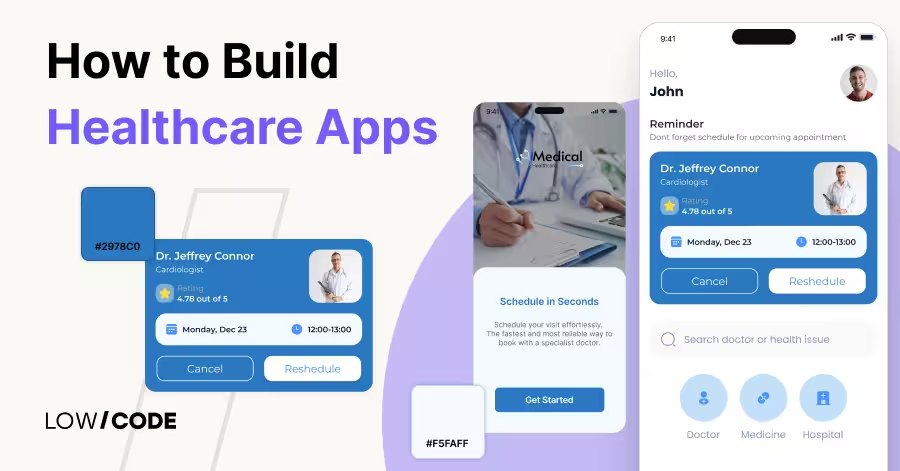
How to Build Healthcare Apps | Complete 2026 Guide
Learn how to build secure healthcare apps in 2026. Explore costs, compliance, features, and trends in our complete healthcare app development guide
Why customers trust us for no-code development


