

Custom Enterprise Software Benefits: Complete Guide
10 min
read
Learn the benefits of custom enterprise software over off-the-shelf solutions. Understand competitive advantages, efficiency gains, and when custom development makes sense.

Custom enterprise software builds exactly what your organization needs rather than adapting to what vendors offer. While packaged software works for many standard processes, custom development provides unique advantages for differentiated operations, specific requirements, and competitive positioning.
This guide explores the benefits of custom enterprise software, helping you understand when custom development provides value that off-the-shelf solutions cannot match.
If you're still evaluating the broader decision, you should first understand the difference between standard vs enterprise software development and where custom development actually creates strategic value.
What Are the Core Benefits of Custom Software?
Understanding the fundamental advantages.
How does custom software provide competitive advantage?
Custom software enables proprietary processes, unique workflows, and differentiated capabilities that competitors using standard software cannot replicate.
Competitive advantage through custom software:
- Proprietary processes: Your unique way of doing things
- Speed and efficiency: Optimized for your operations
- Customer experience: Differentiated interactions
- Data capabilities: Custom analytics and insights
- Flexibility: Adapt faster than competitors
- Integration: Unified operations competitors can't match
When your process IS your advantage, custom software protects it. If you're unsure what that looks like in practice, reviewing real enterprise software examples can clarify how custom systems create operational leverage.
How does custom software improve efficiency?
Custom software eliminates workarounds, automates your specific processes, integrates your actual systems, and removes the friction of forcing operations into generic software.
Efficiency benefits:
Efficiency gains often justify custom investment. In many cases, those efficiency improvements directly translate into measurable savings. Here’s a deeper look at how enterprise software reduces operational costs across departments.
How does custom software reduce long-term costs?
Custom software can reduce long-term costs by eliminating license fees, reducing manual workarounds, improving productivity, and avoiding expensive customization of packaged solutions.
Cost benefit analysis:
- No per-user licensing: Pay once, use unlimited
- Reduced workarounds: Less manual work
- Higher productivity: Optimized workflows
- Lower training: Intuitive for your processes
- No forced upgrades: Update on your schedule
- Avoided customization: Built right from start
Calculate total cost of ownership over 5-10 years. Before deciding, it’s critical to understand the real numbers. This detailed enterprise software development cost breakdown explains budgeting, hidden expenses, and long-term ROI.
What Specific Business Benefits Does Custom Software Provide?
Detailed advantages across business dimensions.
How does custom software improve customer experience?
Custom software enables unique customer interactions, faster service, personalized experiences, and seamless integration across touchpoints that generic systems cannot provide.
Customer experience benefits:
- Personalization: Tailored to your customer segments
- Speed: Optimized processes serve faster
- Consistency: Unified experience across channels
- Differentiation: Unique interactions competitors can't copy
- Integration: Complete customer view
Customer experience drives revenue and retention.
How does custom software improve operational efficiency?
Custom software automates your specific workflows, eliminates data re-entry, integrates your actual systems, and removes the compromises required by generic solutions.
Operational benefits:
- Process automation: Your workflows, automated
- Data integration: Single source of truth
- Eliminated re-entry: Data flows automatically
- Reduced errors: Automated validation
- Faster processing: Optimized for your volume
- Reporting: Your metrics, your way
Operations efficiency translates directly to margin.
How does custom software support growth?
Custom software scales with your business, adapts to new requirements, integrates acquisitions, and avoids the constraints that packaged software imposes on growth.
Growth support:
- Scalability: Built for your growth trajectory
- Flexibility: Adapt as needs change
- Acquisition integration: Incorporate new operations
- New products/services: Support business expansion
- Geographic expansion: Handle new requirements
Growth often breaks packaged software limitations.
How does custom software improve data and analytics?
Custom software captures the specific data you need, structures it for your analysis requirements, and enables proprietary insights that generic analytics cannot provide.
Data benefits:
- Complete capture: All relevant data collected
- Custom structure: Organized for your analysis
- Proprietary insights: Your unique analytics
- Real-time visibility: Current state awareness
- Predictive capability: Your-specific forecasting
Data advantages compound over time.
When Does Custom Software Make Sense?
Understanding appropriate use cases.
When should you build custom?
Build custom when your process is a competitive differentiator, when no suitable packaged option exists, when packaged customization would be extensive, or when integration requirements are complex.
Build custom when:
- Process is differentiating: Your way of doing things matters
- No fit exists: Market lacks suitable options
- Excessive customization: Package would require >30% modification
- Integration complexity: Many system connections needed
- Control required: Vendor dependence unacceptable
- Scale/performance: Specific requirements exceed packages
These scenarios favor custom development. If you identify with multiple scenarios above, the next step is structured enterprise software development planning to define scope, architecture, and delivery roadmap.
When should you buy packaged?
Buy packaged software when standard processes work, when proven solutions exist, when best practices would benefit adoption, or when you cannot justify custom investment.
Buy packaged when:
- Standard process: Your process isn't unique
- Proven solutions: Market has excellent options
- Best practices: Package embeds industry knowledge
- Limited budget: Cannot justify custom investment
- Fast deployment: Need solution quickly
- Commodity function: Non-differentiating capability
Not everything needs custom development.
How do you evaluate build vs buy?
Evaluate build vs buy based on strategic importance, fit of existing solutions, customization required, total cost of ownership, and organizational capability to develop and maintain.
Evaluation framework:
Consider all factors holistically. Once you lean toward building, it helps to understand the full enterprise software development process explained — from requirements to deployment and maintenance.
What Are the Benefits of Low-Code Custom Development?
Modern approaches that combine benefits.
How does low-code change the build vs buy equation?
Low-code dramatically reduces custom development cost and time, making custom software practical for projects that previously couldn't justify traditional custom development.
Low-code advantages:
- Faster delivery: Weeks instead of months
- Lower cost: 60-90% less than traditional
- Easier maintenance: Simpler to modify
- Quality: Proven platform foundations
- Integration: Built-in connectors
Modern custom development often relies on proven platforms. Explore the leading enterprise software development tools and platforms that reduce cost and accelerate delivery.
At LOW/CODE Agency, we help clients get custom software benefits at near-packaged-software cost and speed.
What can low-code build?
Low-code can build most business applications including internal tools, customer portals, workflow systems, data applications, and mobile apps—covering 80%+ of enterprise software needs.
Low-code capabilities:
- Internal business applications
- Customer-facing portals
- Workflow and approval systems
- Data collection and reporting
- Mobile applications
- Integration automation
- MVPs and prototypes
Most custom software needs fit low-code capabilities.
What are the trade-offs?
Low-code trades some flexibility for speed and simplicity—highly specialized algorithms, extreme performance requirements, or unique technical needs may still require traditional development.
Low-code limitations:
- Complex algorithms or ML
- Extreme performance requirements
- Highly specialized integrations
- Platform vendor dependency
- Some customization constraints
Evaluate specific requirements against platform capabilities.
How Do You Maximize Custom Software Benefits?
Getting the most from custom investment.
How do you ensure successful custom development?
Successful custom development requires clear requirements, appropriate methodology, user involvement, quality focus, and organizational readiness for adoption.
Success factors:
- Clear requirements: Know what you're building
- User involvement: Regular feedback
- Iterative delivery: Value throughout
- Quality practices: Testing, code review
- Change management: Prepare organization
Custom software is only beneficial if adopted and used. Following established enterprise software development best practices significantly increases adoption, stability, and long-term return on investment.
How do you protect custom software investment?
Protect investment through good documentation, maintainable code, knowledge retention, appropriate vendor relationships, and ongoing improvement.
Investment protection:
- Documentation: Enable future maintenance
- Code quality: Sustainable over time
- Knowledge retention: Multiple people understand
- Vendor management: Clear ownership, exit options
- Continuous improvement: Evolve with business
Plan for the software's full lifecycle. If you’re seriously considering a tailored solution, professional enterprise software development services can help translate business requirements into scalable, maintainable systems without overengineering.
Want to Build Custom Enterprise Software?
Enterprise software is not about features.
It is about reliability, structure, and long-term stability.
If you are replacing legacy systems or building a new internal platform, the biggest risk is not technical complexity. It is poor architecture and unclear ownership.
At LOW/CODE Agency, we design and build enterprise software that supports daily operations at scale. Not quick builds. Structured systems that teams depend on.
- Operational alignment first
We map workflows, approvals, compliance needs, and reporting structure before writing a single line of logic. Enterprise systems fail when discovery is rushed. - Role-based access and governance
Enterprise environments require strict permissions, audit trails, and accountability. We design clear user roles, approval flows, and data visibility controls. - Backend architecture and integrations
Enterprise software rarely stands alone. We integrate with ERPs, CRMs, accounting tools, data warehouses, and APIs to create a unified system. - Scalability and performance planning
High user volume, large datasets, and complex workflows demand careful data modeling and performance optimization from day one. - Long-term product partnership
Enterprise systems evolve. New departments, new modules, new automations. We stay involved to refine and expand the platform as your organization grows.
Conclusion
Custom enterprise software provides competitive advantage, operational efficiency, and long-term cost benefits for organizations with unique processes, specific requirements, or differentiation needs that packaged software cannot address.
Low-code development has dramatically changed the economics of custom software, making custom development practical for many situations that previously couldn't justify the investment. Organizations can now get custom benefits at near-packaged costs.
Evaluate custom development based on strategic importance, alternative fit, total cost of ownership, and organizational capability. When custom is appropriate, the benefits can be substantial and lasting.

Related Articles
- Enterprise Software Development Cost: Complete Guide
- Enterprise Software Development Best Practices
- Enterprise Software Cost Reduction Strategies
- Cursor AI vs Abacus AI: Enterprise AI Compared
- Cursor AI vs WebStorm: Which AI Tool Is Better?
- Cursor AI vs Windsurf AI: Full Comparison Guide
Explore our mobile app development services to build powerful apps for any platform.
See how our custom app development services deliver exactly what your business needs.
Last updated on
September 28, 2026
.

Jesus is a visionary entrepreneur and tech expert. After nearly a decade working in web development, he founded LOW/CODE Agency to help businesses optimize their operations through custom software solutions.


FAQs
Is custom enterprise software more cost-effective than SaaS?
How do you manage security and maintenance with custom software?
What are the trade-offs between control and maintenance when choosing custom software?
How can businesses mitigate shadow IT risks with custom software development?
What strategies can be implemented to avoid unnecessary features in SaaS solutions?
Can no-code platforms support custom enterprise software development?
Related Articles
Custom App Development
No-code/Low-code
How to Build Workforce Management Apps Using Low-code
Learn how to build workforce management apps using low-code, covering features, workflows, integrations, costs, and best practices for scalable teams.
AI
Custom App Development
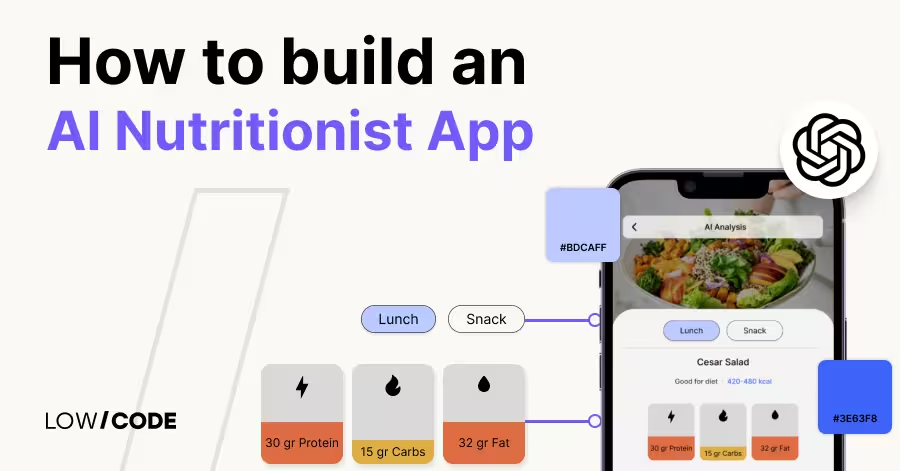
How to Build an AI Nutritionist App (2026) | Guide for Founders
Build an AI nutritionist app without coding using tools like Bubble or Glide. Automate meal tracking, GPT advice, and food analysis with no-code platforms
AI
Custom App Development
Top 11 AI Development Agencies (2026) | Hire the Best One
Find the best AI Development agency for your startup. Our 2026 list features fast, trusted teams that help you launch and grow fast
Custom App Development
Enterprise Software Development Tools & Stack
Explore enterprise software development tools and technology stacks. Learn about development platforms, frameworks, DevOps tools, and how to select the right stack.

Why customers trust us for no-code development


