

Enterprise Software Development Tools & Stack
9 min
read
Explore enterprise software development tools and technology stacks. Learn about development platforms, frameworks, DevOps tools, and how to select the right stack.

Enterprise software development requires a coordinated set of tools spanning development, collaboration, deployment, and operations. Choosing the right tools affects development speed, team productivity, software quality, and long-term maintainability.
This guide covers the categories of tools enterprise development requires, popular options in each category, and how to evaluate and select tools for your technology stack.
Tool selection decisions should always align with your broader enterprise software development strategy and lifecycle.
What Tools Do Enterprise Development Teams Need?
Understanding the essential tool categories.
What are the main tool categories?
Enterprise development requires tools for development (IDEs, frameworks), collaboration (communication, documentation), DevOps (CI/CD, infrastructure), and management (project, quality)—all working together.
Tool category overview:
Each category has multiple tool options. Selecting across these categories requires structured enterprise planning discipline to avoid fragmentation.
How do tools work together?
Enterprise development tools form an integrated toolchain where code flows from development through testing, deployment, and monitoring—with collaboration tools connecting people throughout.
Typical toolchain flow:
- Development tools: IDE integrates with version control for structured code management.
- Team collaboration: Communication platforms align teams with shared documentation systems.
- Build automation: CI/CD pipelines trigger controlled and repeatable build processes.
- Automated testing: Test suites validate functionality, security, and performance continuously.
- Deployment automation: Infrastructure tools provision and configure environments consistently.
- Operational monitoring: Monitoring systems generate alerts for performance and system failures.
Integration between tools is as important as individual tool quality. Poor integration often increases the true cost dynamics of enterprise software initiatives.
Development Platforms and Frameworks
Tools for building software.
What development platforms do enterprises use?
Enterprises use a mix of traditional development (Java, .NET, Python) and modern low-code platforms (Bubble, OutSystems, Microsoft Power Platform) depending on project requirements.
Platform categories:
Traditional development:
- Java/Spring Boot
- .NET/C#
- Python/Django/FastAPI
- Node.js/Express
- Go
- Ruby on Rails
Low-code/no-code platforms:
- Microsoft Power Platform
- OutSystems
- Mendix
- Salesforce
- Bubble
- FlutterFlow
Understanding when to choose custom builds over packaged systems depends on the broader benefits of enterprise-grade custom software.
At LOW/CODE Agency, we primarily use Bubble for web applications, FlutterFlow for mobile apps, and Glide for internal tools delivering enterprise-grade solutions faster than traditional development.
How do you choose frontend frameworks?
Frontend framework choice depends on team expertise, performance requirements, ecosystem needs, and long-term support with React, Vue, and Angular being the dominant enterprise options.
Frontend framework comparison:
React dominates enterprise frontend development currently. Framework decisions should reflect established enterprise engineering best practices rather than short-term trends.
How do you choose backend frameworks?
Backend framework choice depends on scalability needs, team expertise, ecosystem requirements, and integration patterns with language choice often driven by existing organizational capabilities.
Backend considerations:
Choose based on team capability and project requirements.
DevOps and Infrastructure Tools
Tools for building, deploying, and operating software.
What CI/CD tools do enterprises use?
Enterprise CI/CD typically uses Jenkins (self-hosted), GitHub Actions (cloud-native), GitLab CI, Azure DevOps, or CircleCI with choice depending on existing infrastructure and preferences.
CI/CD platform comparison:
Modern approaches favor cloud-hosted CI/CD over self-managed. Strong automation maturity also improves long-term enterprise cost efficiency and sustainability.
What container and orchestration tools are used?
Docker is the standard for containerization, with Kubernetes being the dominant orchestration platform for enterprises though managed Kubernetes (EKS, GKE, AKS) is preferred over self-managed.
Container ecosystem:
- Docker: Container runtime standard
- Kubernetes: Orchestration standard
- Helm: Kubernetes package management
- Managed K8s: EKS (AWS), GKE (Google), AKS (Azure)
- Alternatives: ECS, Cloud Run, Azure Container Apps
Not all applications need Kubernetes complexity.
What cloud platforms do enterprises use?
AWS, Azure, and Google Cloud dominate enterprise cloud, with choice often driven by existing vendor relationships, specific service needs, or multi-cloud strategies.
Cloud platform comparison:
Multi-cloud is common in large enterprises. Cloud strategy complexity is one of the key factors that differentiates enterprise systems from standard business software builds.
Collaboration and Communication Tools
Tools for team coordination.
What collaboration tools do enterprise teams need?
Enterprise development teams need real-time communication (Slack, Teams), documentation (Confluence, Notion), and knowledge management tools working together.
Collaboration stack:
Tool selection often follows existing enterprise standards.
How do you manage technical documentation?
Technical documentation requires version-controlled approach using docs-as-code (Markdown in repos), wiki platforms (Confluence), or dedicated documentation tools (GitBook, ReadTheDocs).
Documentation approaches:
- Docs-as-code: Markdown files in repositories
- Wiki platforms: Confluence, Notion
- API documentation: Swagger/OpenAPI, ReadTheDocs
- Architecture: C4 model diagrams, ADRs
Document at the right level, enough to enable maintenance without excessive overhead.
Project and Quality Management Tools
Tools for planning, tracking, and quality.
What project management tools are used?
Enterprise software development commonly uses Jira (dominant), Azure DevOps, Monday.com, or Asana—with agile-focused tools being most common for development work.
Project management tools:
Jira dominates enterprise development project management. Tooling decisions should always reinforce your overall enterprise delivery model and execution approach.
What testing and quality tools are essential?
Enterprise testing requires unit testing frameworks, API testing tools, UI automation, performance testing, and security scanning—integrated into CI/CD pipelines.
Testing tool categories:
Automate testing in CI/CD for consistent quality.
How Do You Select Tools?
Making technology decisions.
What criteria should drive tool selection?
Select tools based on team capability, integration requirements, scalability needs, total cost of ownership, vendor stability, and organizational standards—not just features.
Selection criteria:
How do you avoid tool sprawl?
Avoid tool sprawl by establishing standards, requiring justification for new tools, periodically auditing tool usage, and consolidating where overlap exists.
Sprawl prevention:
- Establish standards: Default tool for each category
- Justify additions: Business case for new tools
- Regular audits: Review tool usage and value
- Consolidation: Reduce redundant tools
- Integration requirements: New tools must integrate
Some diversity is healthy; excessive fragmentation is costly.
Should you build or buy tools?
Build internal tools only for truly unique needs; buy or adopt for standard capabilities. The market has mature options for almost every development tool need.
Build vs buy guidance:
- Build: Unique competitive processes
- Buy: Standard development tooling
- Open source: Often best value
- Custom integration: Connecting existing tools
Focus internal development effort on business software, not tooling. Organizations without internal capacity often rely on experienced enterprise software development partners to rationalize and optimize their stack.
Want to Build Low-code Enterprise Software?
Low-code is not just for small tools.
When designed properly, low-code enterprise software can support large teams, complex workflows, and long-term growth. The difference is not the platform. It is the architecture behind it.
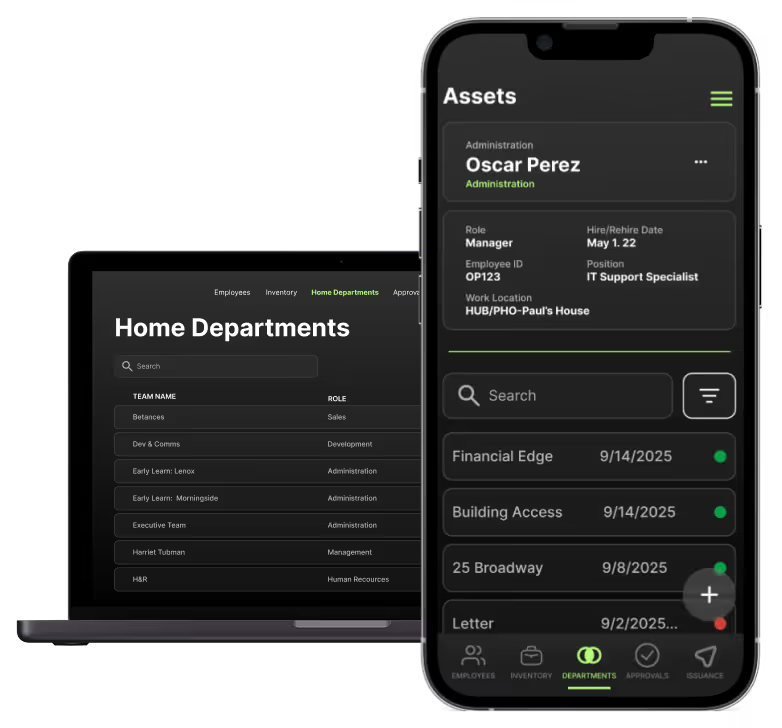
At LOW/CODE Agency, we design and build low-code enterprise software that replaces fragmented systems with structured, scalable platforms.
- Enterprise architecture before building
We define data models, permissions, reporting structures, and integration layers first. Low-code accelerates development, but enterprise stability depends on system design. - Role-based governance and compliance
Enterprise environments require layered access control, audit logs, and secure data segmentation. We build structured governance directly into the platform. - Integration with core business systems
Low-code enterprise software must connect with ERPs, CRMs, finance tools, APIs, and automation systems. We align integrations carefully to avoid silos. - Performance-aware scalability
As usage grows, performance must remain stable. We optimize database logic, workflows, and automation to handle increasing data and users. - Continuous evolution and expansion
Enterprise systems change. New departments, new modules, AI layers, and reporting dashboards should integrate smoothly without full rebuilds.
We are not a dev shop shipping features quickly.
Conclusion
Enterprise software development requires a coordinated toolchain spanning development, DevOps, collaboration, and management. Tool selection should prioritize team capability, integration, and total cost of ownership over features alone.
Standardize where possible to reduce cognitive load and training costs. Allow flexibility where team needs genuinely differ. Regularly evaluate whether tools are delivering value. Real-world enterprise implementation examples show that simpler, well-integrated stacks often outperform overly complex architectures.

Related Articles
- Cursor AI vs Aider: Terminal AI vs Full IDE
- Standard vs Enterprise Software Development
- Enterprise Software Examples and Use Cases
- Enterprise Software Development Tips (2026 Guide)
- Enterprise Software Development Services
- Enterprise Software Development Process: Complete Guide
Explore our mobile app development services to build powerful apps for any platform.
See how our custom app development services deliver exactly what your business needs.
Last updated on
September 28, 2026
.

Jesus is a visionary entrepreneur and tech expert. After nearly a decade working in web development, he founded LOW/CODE Agency to help businesses optimize their operations through custom software solutions.


FAQs
How do we standardize enterprise software development tools across teams?
How should enterprises manage legacy development tools?
Are AI-powered tools safe for enterprise software development?
How do we evaluate new enterprise software development tools effectively?
How do we train teams on new enterprise software tools?
How often should we review our enterprise software development stack?
Related Articles
Custom App Development
SaaS Application Development Guide for Startups (2026)
Learn the full SaaS application development process, from idea to launch. Discover costs, tech stack, timelines, and best practices for startups in 2026

Custom App Development
How to Hire Developers for Your Startup (2026 Guide)
Skip slow hiring and expensive dev teams. Learn how startups are building faster with no-code agencies instead of traditional developers
Custom App Development
Lawyer Consulting App Development | Complete Guide
Build a secure and feature-rich lawyer consulting app with no-code tools. Learn about key features, compliance, costs, and the role of AI in modern legal tech
Custom App Development
Enterprise Software Examples and Use Cases
Explore enterprise software examples across industries and functions. Learn about ERP, CRM, HR systems, and custom solutions that power large organizations.


Why customers trust us for no-code development


