

How to Build a Referral Management App with FlutterFlow
14 min
read
Learn how to create a referral management app using FlutterFlow with step-by-step guidance and best practices for smooth app development.

Referral programmes fail when the tracking is broken, the rewards are delayed, or users find ways to game the system. A well-built FlutterFlow referral management app prevents all three, but only if the server-side logic is architected correctly from the start.
FlutterFlow handles the UI and tracking experience well. The reliability of your programme depends on Cloud Functions handling attribution, qualifying action validation, and fraud prevention server-side, not on client-side FlutterFlow logic.
Key Takeaways
- FlutterFlow builds the referral UI cleanly: Unique link generation, referral dashboards, and reward status displays are all achievable in the visual builder.
- Attribution must be server-side: Cloud Functions handle referee sign-up detection, qualifying action validation, and reward disbursement, not FlutterFlow client logic.
- Fraud prevention is mandatory: Self-referral blocking, duplicate account detection, and IP and device fingerprinting all need backend validation rules.
- Deep linking requires a third-party service: Branch.io or Firebase Dynamic Links handle referral link routing on iOS and Android. FlutterFlow has no native deep link generation.
- Custom builds break even against SaaS tools at around 1,000 monthly referrals.

What Can FlutterFlow Build for Referral Management?
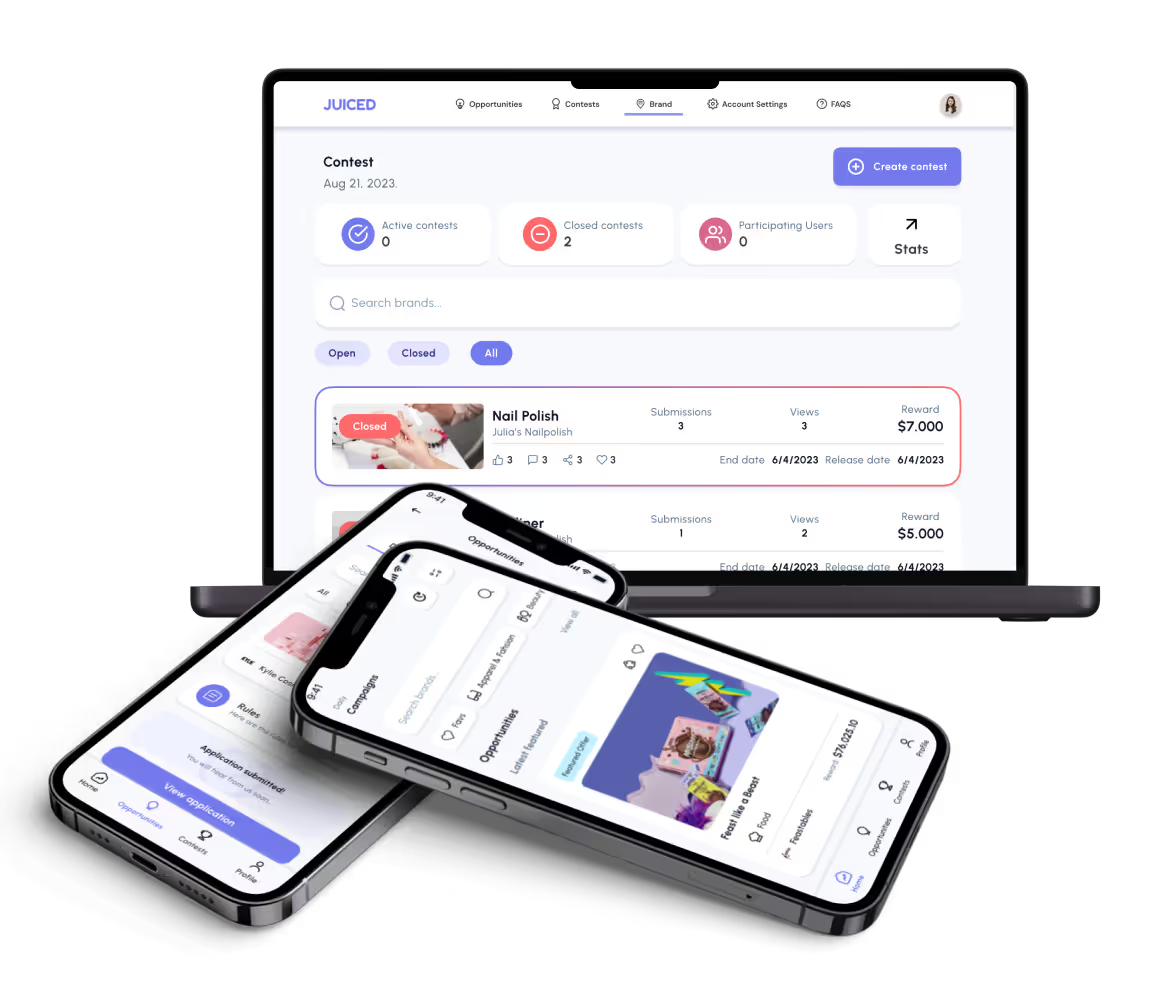
FlutterFlow builds the full user-facing referral experience: unique code and link generation, referee tracking, reward dashboards, and admin analytics. Attribution logic, qualifying action validation, and fraud prevention all run in Cloud Functions, not the FlutterFlow layer.
FlutterFlow referral app examples show how growth teams have shipped referral mechanics in production apps that handle attribution and reward disbursement correctly.
Unique Referral Link and Code Generation
Generate personalised referral codes or deep links per user via a Cloud Function. The app displays each code with a one-tap share sheet for social and messaging distribution.
Code generation runs server-side to prevent duplication and ensure each code maps uniquely to a single user record in Firestore.
- Server-side code generation: Personalised codes generate in a Cloud Function, writing to Firestore before displaying in the user's app dashboard.
- One-tap share sheet: Users share their referral link via any messaging, social, or email app with a single tap, removing friction from the sharing flow.
- Deep link via Branch.io: Branch.io or Firebase Dynamic Links wrap the referral code in a link that survives app install on iOS and Android.
Referee Registration Tracking
New sign-ups attribute to a referrer using deep link parameters or referral code entry on registration. Attribution records write to Firestore via a Cloud Function triggered by the sign-up event.
Attribution runs server-side to ensure accuracy even when the referee installs the app without tapping the referral link directly.
- Deep link parameter attribution: When a referee taps the referral link, the deep link service passes the referrer code to the app on first open.
- Referral code entry on registration: Referees who install without tapping the link can enter the referral code manually during the sign-up flow.
- Server-side attribution record: A Cloud Function triggered by sign-up completion writes the referee-to-referrer relationship to Firestore with timestamp.
Qualifying Action Validation
Define what constitutes a successful referral, such as a first purchase, account verification, or subscription activation. Reward disbursement triggers only when the qualifying event occurs, validated server-side.
Qualifying action logic in Cloud Functions prevents manipulation from the client side, which is critical for any programme with real monetary rewards.
- Configurable qualifying events: First purchase, account verification, and subscription activation each trigger different Cloud Function reward conditions.
- Server-side validation only: Qualifying action detection runs in Cloud Functions triggered by the relevant backend event, never based on client-reported data.
- Reward gate enforcement: Rewards write to the user record only after the Cloud Function confirms the qualifying event against authoritative backend data.
Referral Dashboard and Status Tracking
Each user sees their total referrals, pending referrals (referred but not yet qualified), and confirmed referrals with reward status in a personal dashboard.
Dashboard data reads directly from the user's Firestore referral collection, so counts update in real time as qualification events process.
- Total referral count: Users see the total number of people who have registered using their referral code or link in their dashboard.
- Pending vs confirmed split: Referrals display separately as pending until the qualifying action completes and the reward confirms.
- Reward status per referral: Each referred user shows their current status and whether the associated reward has been issued to the referrer.
Reward Disbursement and Notification
Credits, discounts, or points disburse automatically when a referral qualifies. Both the referrer and the referee receive push notifications confirming the reward.
Reward values are configurable in Firestore, so marketing teams can update reward amounts without a developer deployment.
- Automatic reward credit: Cloud Function confirmation triggers immediate credit or discount issuance to the referrer's account balance.
- Push notification to both parties: Referrer and referee both receive a push notification when the reward confirms, reinforcing the programme's trust.
- Configurable reward values: Reward amounts and types store in Firestore admin records, enabling marketing teams to update them without developer involvement.
Fraud Detection and Abuse Prevention
Cloud Function validation rules flag and block self-referrals, duplicate device submissions, and suspicious referral velocity patterns before rewards disburse.
Fraud detection must be designed before launch, not added after abuse patterns emerge. Retroactive fraud review is significantly more costly than proactive prevention.
- Self-referral blocking: Cloud Functions compare the referrer and referee identity at attribution time, blocking any attempt to refer one's own account.
- Duplicate device detection: Device ID and IP checks identify multiple accounts created from the same device, flagging suspicious sign-up patterns.
- Velocity pattern flagging: Referral rates that exceed a configurable threshold flag automatically for admin review before rewards disburse.
Admin Referral Analytics Portal
Marketing teams view referral volumes, top referrers, conversion rates, reward liability, and date-range filtered performance in a dedicated admin portal.
Analytics data sources from Firestore aggregations updated by Cloud Functions, keeping dashboard performance fast regardless of total referral volume.
- Volume and conversion tracking: Admins see total referrals, conversion rates from registration to qualified action, and reward disbursement totals by period.
- Top referrer leaderboard: High-performing referrers surface in a ranked view, enabling VIP reward programmes for the platform's most active advocates.
- Reward liability view: Outstanding unredeemed reward balances display in real time, giving finance teams visibility into the programme's cost exposure.
How Long Does It Take to Build a FlutterFlow Referral Management App?
A simple referral MVP with code generation, basic attribution, and reward notification takes 4–7 weeks. A full-featured system with fraud prevention, qualifying action logic, admin analytics, and deep linking takes 8–14 weeks.
Teams adding a referral feature in FlutterFlow SaaS products should scope the deep linking and fraud prevention separately from the main app build timeline.
- Simple MVP timeline: Referral code generation, basic attribution, reward notification, and a user dashboard ship in 4–7 weeks.
- Full system timeline: Fraud prevention rules, qualifying action logic, admin analytics, and Branch.io deep linking extend the build to 8–14 weeks.
- Deep link vendor setup: Branch.io or Firebase Dynamic Links configuration adds 1–2 weeks to any phase depending on platform requirements.
- Fraud prevention complexity: Simple self-referral blocking adds 1 week; sophisticated device fingerprinting and velocity limits add 2–3 weeks more.
- Phased approach advantage: Launching code sharing and basic tracking first delivers a working programme while fraud prevention and admin analytics build in phase two.
FlutterFlow builds referral system interfaces 45–60% faster than a bespoke referral system build. That advantage applies to the UI layer; Cloud Function complexity is the same regardless of the frontend tool.
What Does It Cost to Build a FlutterFlow Referral Management App?
FlutterFlow referral management projects range from $10,000–$55,000 depending on scope. A simple referral feature sits at the lower end; a full system with fraud prevention, deep linking, and admin analytics sits at the top.
Reviewing FlutterFlow pricing for growth apps helps teams separate platform subscription cost from the deep linking and Cloud Function infrastructure that referral tracking requires.
- SaaS tool comparison: ReferralCandy and Viral Loops charge per referral. A custom FlutterFlow build eliminates those per-referral fees and breaks even at roughly 1,000–2,000 monthly referrals.
- Fraud detection API adds cost: Advanced device fingerprinting services add $50–$200/month if the built-in Cloud Function rules are insufficient for your fraud profile.
- Reward fulfilment is a separate cost: Credits and discounts require backend fulfilment logic; cash rewards require a payment disbursement integration with its own fees.
- Custom vs FlutterFlow gap: A bespoke referral system built entirely with custom code costs 40–60% more than a FlutterFlow-based build for equivalent functionality.
Budget 15–20% contingency for fraud rule complexity and deep link vendor configuration. Both consistently exceed initial scoping estimates when tested against real user behaviour.
How Does FlutterFlow Compare to Custom Development for Referral Management Apps?
FlutterFlow referral UI and tracking builds in 4–7 weeks versus 3–6 months for a fully custom system. Cost is 40–60% lower at build stage. The capability gap appears at multi-tier referral networks and ML-driven fraud detection.
For teams where referral logic complexity exceeds FlutterFlow's capability, reviewing referral platform tool alternatives maps out the custom and SaaS options available.
- Speed advantage is significant: FlutterFlow delivers a working referral UI and tracking system in weeks; equivalent custom builds take months to reach the same state.
- Maintenance advantage: Marketing teams update reward values and qualifying action thresholds via Firestore without developer involvement, which custom builds rarely support.
- When FlutterFlow wins: Direct single-tier referral programmes, consumer apps, and SaaS platforms adding referral as a feature all suit FlutterFlow's capability range.
- When custom wins: Multi-level referral networks, financial services programmes with regulatory requirements, and complex fraud prevention at national scale require fully custom architecture.
For most consumer and SaaS referral programmes, FlutterFlow's capability ceiling is never reached. It becomes relevant only with multi-tier network structures or ML-driven fraud models.
What Are the Limitations of FlutterFlow for Referral Management Apps?
FlutterFlow cannot handle server-side attribution, deep link generation, multi-tier referral chains, or sophisticated fraud detection natively. All of these require Cloud Functions and third-party services.
Understanding FlutterFlow referral fraud prevention requirements is critical before deciding how much of the fraud detection logic to build in Cloud Functions versus a dedicated third-party service.
- Attribution must be server-side: FlutterFlow client actions cannot reliably detect and attribute referrals. Attribution logic must run in Cloud Functions triggered by sign-up events.
- Deep linking requires a third-party service: Branch.io or Firebase Dynamic Links are mandatory for mobile referral links that survive app install. FlutterFlow has no native deep link generation.
- Multi-tier referral chains not supported: FlutterFlow's condition builder cannot handle recursive referral chains where A refers B who refers C, and all earn from C's actions.
- Sophisticated fraud prevention needs external APIs: Simple self-referral blocking is achievable in Cloud Functions; advanced device fingerprinting and IP velocity analysis require a dedicated fraud detection API.
- Reward timing UX requires careful design: When qualifying conditions create delays between referral and reward, the UX must communicate pending status clearly to prevent trust damage.
- Code export available: Paid FlutterFlow plans allow full codebase export for teams that need control over advanced attribution and fraud logic beyond the visual builder.
Do not treat these limitations as edge cases. Referral fraud is a real financial risk, and attribution errors undermine programme trust faster than almost any other technical failure.
How Do You Get a FlutterFlow Referral Management App Built?
Look for a team with Branch.io or Firebase Dynamic Links experience, Cloud Function expertise for server-side attribution, Firestore transaction handling for reward disbursement, and a clear fraud prevention design approach.
Selecting from top FlutterFlow development agencies that have shipped referral systems ensures the attribution and fraud prevention architecture is handled correctly from the start.
- Deep linking expertise: Any developer who does not name Branch.io or Firebase Dynamic Links in the first conversation about referral apps lacks the required experience.
- Cloud Function attribution design: Ask specifically how they handle attribution when a referee installs the app without tapping the referral link directly.
- Fraud prevention design approach: Ask what their default fraud detection rules cover and at what point they would recommend a dedicated fraud detection API.
- Firestore transaction handling: Reward disbursement requires atomic Firestore transactions to prevent double-crediting under race conditions. Ask how they handle this.
- Red flag: client-side attribution: Any developer proposing to handle referral attribution in FlutterFlow client logic with no Cloud Function validation is building a system that will be gamed immediately.
- Expected timeline: A well-scoped referral management build with fraud prevention and admin analytics takes 5–14 weeks from a team with the right experience.
Define your qualifying action and your fraud risk tolerance before approaching any developer. These two decisions shape the majority of the Cloud Function complexity in any referral build.
Conclusion
FlutterFlow is a capable platform for referral management apps. The UI, tracking dashboard, and reward notifications work well. The reliability of the entire system depends on server-side attribution and fraud prevention logic built into Cloud Functions, not left to client-side FlutterFlow actions.
Define your qualifying action and your fraud prevention requirements before scoping the project. Those two decisions shape the majority of the Cloud Function complexity and determine whether your build takes 5 weeks or 14.
Building a Referral Management App with FlutterFlow? Here Is How LOW/CODE Agency Approaches It.
Most referral app builds fail because attribution is handled client-side and fraud prevention is bolted on after the first abuse incident. Both mistakes are expensive to fix in production and both are entirely avoidable with the right architecture from day one.
As AI development experts, we at LOW/CODE Agency help SMBs ship real software — web and mobile applications, intelligent chatbots, RAG pipelines, and autonomous AI agents built for businesses that need results, not platforms. We build FlutterFlow referral management apps with the full backend behind them: Branch.io deep linking, Cloud Function server-side attribution, Firestore transaction handling for reward disbursement, fraud prevention rule design, and admin analytics from a team that understands how referral programmes succeed and fail in production.
- Deep link implementation: We configure Branch.io or Firebase Dynamic Links with proper referral parameter passing so attribution works whether the referee taps the link or installs the app directly.
- Server-side attribution: We build Cloud Function attribution logic that handles direct install, delayed tap, and manual code entry scenarios without gaps.
- Fraud prevention design: We design self-referral blocking, duplicate device detection, and velocity limit rules as part of the initial Cloud Function architecture, not as a retrofit.
- Qualifying action validation: We build server-side qualifying event detection tied to your specific conversion event, whether that is purchase, activation, or subscription.
- Reward disbursement with Firestore transactions: We implement atomic reward crediting that prevents double-disbursement under concurrent Cloud Function execution.
- Admin analytics portal: We build a real-time analytics view covering referral volume, conversion rates, top referrers, and reward liability for your marketing team.
- Full product team: Strategy, UX, development, and QA from a single team so your referral programme launches correctly and scales without architectural rebuilds.
We have built 350+ products for clients including Coca-Cola, American Express, and Sotheby's. We know exactly where referral management builds go wrong, and we design the architecture to avoid those failures before any code is written.
Related Articles
- How to Build a Rental Marketplace with FlutterFlow
- How to Build a Rental Agreement App with FlutterFlow
- How to Build a Remote Monitoring App with FlutterFlow
- How to Build a Recruitment CRM App with FlutterFlow
- How to Build a Realtor CRM Platform with FlutterFlow
- How to Build a Real Estate Agent Marketplace with FlutterFlow
Last updated on
September 24, 2026
.

Jesus is a visionary entrepreneur and tech expert. After nearly a decade working in web development, he founded LOW/CODE Agency to help businesses optimize their operations through custom software solutions.


FAQs
What are the first steps to create a referral app in FlutterFlow?
How do I track referrals and rewards in FlutterFlow?
Can FlutterFlow handle real-time updates for referral status?
What are common challenges when building referral apps with FlutterFlow?
How to integrate user authentication for a referral app in FlutterFlow?
Is FlutterFlow suitable for scaling a referral management app?
Related Articles

FlutterFlow
How to Build an Electricity Usage Dashboard with FlutterFlow
Learn how to create an electricity usage dashboard using FlutterFlow with step-by-step guidance and tips for effective data visualization.
FlutterFlow
How to Build a Membership Subscription Platform with FlutterFlow
Learn how to create a membership subscription platform using FlutterFlow with step-by-step guidance and best practices.

FlutterFlow
How to Build an AI Document Processing Tool with FlutterFlow
Learn how to create an AI document processing tool using FlutterFlow with step-by-step guidance and best practices.
Comparison
FlutterFlow
FlutterFlow vs Wappler | 10 Factors Compared (2026)
FlutterFlow vs Wappler compared across 10 key factors including scalability, backend control, pricing, and flexibility. Discover which platform suits your 2026 app build goals.


Why customers trust us for no-code development


