

How to Build a FlutterFlow AI CRM Automation App
13 min
read
Learn how to create an AI-powered CRM automation app using FlutterFlow with step-by-step guidance and best practices.


A FlutterFlow AI CRM automation app can automate note summarization, draft follow-up emails, score leads, and surface next-best-action recommendations in a mobile-first interface built without a full engineering team. Sales teams spend more time updating CRM records than actually selling.
The architecture is within reach for any team. Understanding where the AI logic must live outside FlutterFlow is what separates a working product from a prototype that reps never open.
Key Takeaways
- AI-drafted follow-ups: LLM-generated meeting notes, email drafts, and call summaries deliver immediate productivity without complex infrastructure.
- Lead scoring needs back-end: FlutterFlow displays the score and triggers updates; the scoring model runs in an external service.
- CRM integration is central: The CRM API you connect to sets the ceiling on what AI can work with.
- Workflow triggers live externally: Automated follow-up scheduling, task creation, and stage progression require a workflow engine beyond FlutterFlow.
- GDPR applies to prospect data: Contact names and communication history sent to LLM APIs need a GDPR compliance review.

What Can FlutterFlow Build for an AI CRM Automation App?
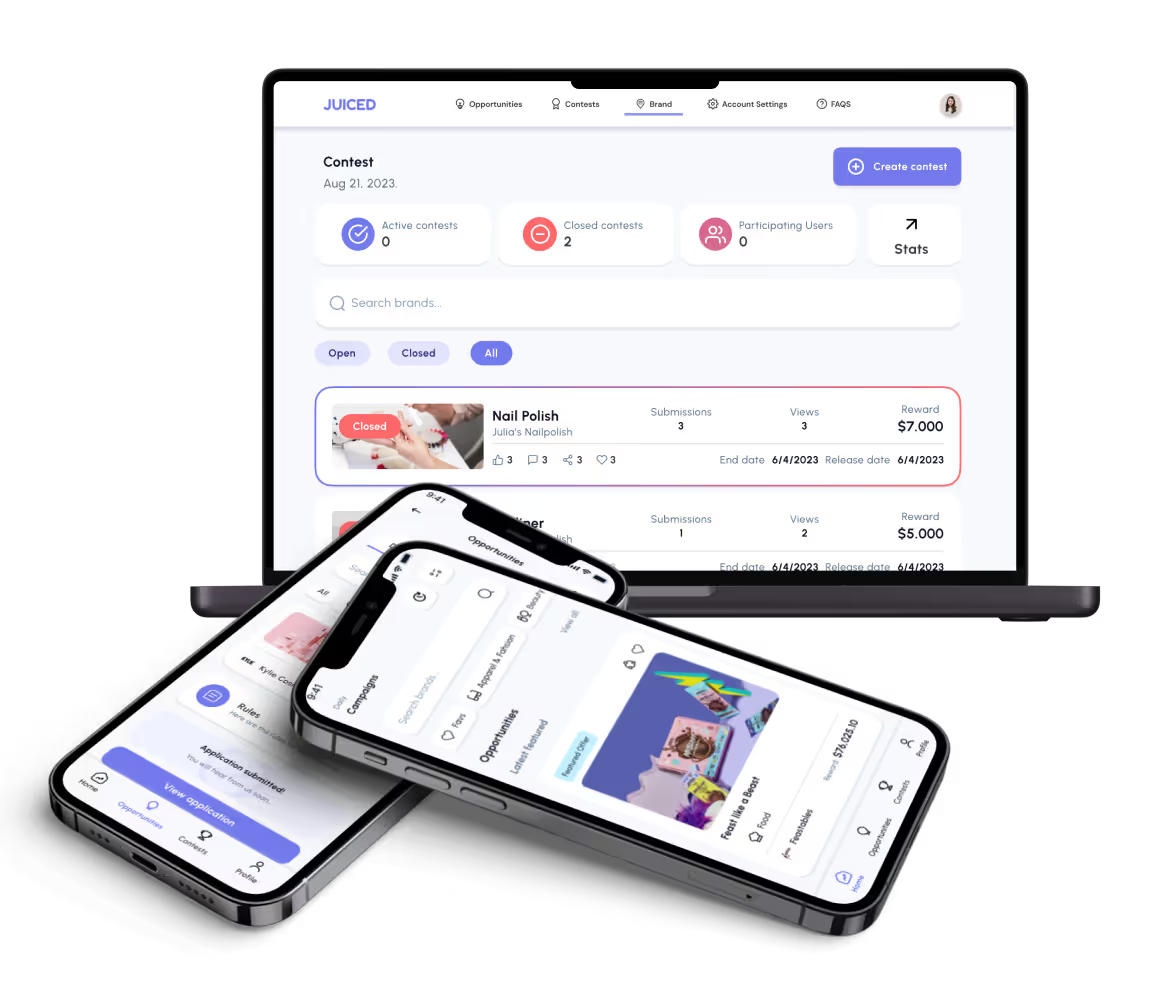
FlutterFlow builds the full mobile-first interface for an AI CRM app, including pipeline dashboards, AI-generated email drafts, lead scoring displays, and CRM sync actions. The AI processing runs via external APIs and back-end services called from inside the app.
Teams that want to build AI CRM apps FlutterFlow can handle will find the platform covers nearly every UI layer. The AI logic connects via API calls to external services.
AI Meeting Notes and Call Summary
Sales reps paste or record raw meeting notes inside the FlutterFlow app. A button triggers an LLM API call, returns a structured summary with action items, and saves it to the CRM record.
Prompt engineering determines how well the summary format matches what the sales team actually uses. Generic prompts produce generic summaries that reps stop reading within two weeks.
- Note input: Reps paste raw meeting text; FlutterFlow passes it to the LLM endpoint via a configured API action.
- Structured output: The LLM returns a formatted summary with action items that FlutterFlow writes directly to the CRM.
- Time savings: Automating this task recovers 15 to 30 minutes per meeting for most field sales teams.
The quality of AI meeting notes is a prompt engineering problem, not a FlutterFlow problem. Invest in the system prompt before building the UI.
AI Follow-Up Email Drafter
FlutterFlow sends contact history and the meeting summary to an LLM, which returns a context-aware draft. The rep reviews and sends with one tap from inside the app.
Draft quality depends on what context reaches the LLM. Contact history, deal stage, and meeting notes together produce better drafts than meeting notes alone.
- Context assembly: FlutterFlow pulls contact history and meeting summary from the CRM before sending the LLM prompt request.
- Draft display: The returned email renders inline so the rep edits it or sends immediately from the same screen.
- Token cost note: Each email draft consumes 500 to 2,000 tokens; high-volume teams should model monthly costs early.
Each email draft is a back-end API call with a cost. Build token usage tracking into the architecture from the start rather than discovering costs after launch.
Lead Pipeline Dashboard
FlutterFlow renders a Kanban or list view of the sales pipeline, pulling live data from the CRM API. AI urgency flags and next-action recommendations appear as overlays on each deal card.
The dashboard is a display layer. All data it shows comes from the CRM API and the back-end scoring service behind it.
- Pipeline view: Kanban columns map to CRM deal stages; FlutterFlow syncs deal data on load and on manual refresh.
- Urgency flags: The back-end scoring service calculates urgency; FlutterFlow displays color-coded flags on each deal card.
- Tap-through detail: Tapping a deal card opens the contact record, meeting history, and AI-generated next action recommendation.
Salespeople use dashboards that load fast and surface the right deal first. Prioritize what the rep sees on load; put everything else one tap away.
AI-Generated Next Best Action
FlutterFlow calls an LLM API with the contact's interaction history and current deal stage. The model returns a recommended next action such as call, email, or send a proposal.
Recommendation quality depends entirely on what context is passed and how the prompt encodes the sales methodology. Vague prompts return vague recommendations.
- Context input: Deal stage, last contact date, prior communication type, and lead score are passed as structured prompt context.
- Recommendation display: The returned action appears as a card with a one-tap shortcut to execute it immediately.
- Sales process alignment: Prompts should encode your actual sales steps so LLM output reflects how your team sells.
Next best action is only valuable if reps follow the recommendations. Track tap-through rates from day one to see whether the suggestions are landing.
Lead Score Display and Prioritization
FlutterFlow displays lead scores from a back-end scoring service, ranked in a prioritized contact list. Score components appear in a drill-down view so reps understand why a lead ranks where it does.
The scoring model runs externally. FlutterFlow queries the score via API and displays the result with whatever breakdown the back-end service provides.
- Score display: Each contact shows a numeric score and color tier pulled from the scoring service API on load.
- Score components: Reps drill into a breakdown of scoring factors, which builds trust in the model over time.
- Prioritized list: The contact list sorts by score by default so reps start each session with highest-priority outreach first.
A scoring model producing inaccurate rankings will be dismissed by the sales team within weeks. Calibration requires historical closed and lost deal data before launch.
CRM Data Sync Actions
FlutterFlow surfaces one-tap buttons to log calls, emails, and meetings directly to Salesforce or HubSpot via their REST APIs. No context switching to a desktop CRM is required from the field.
Reducing CRM logging friction directly improves data quality across the whole system. Reps log more when it takes one tap instead of navigating a desktop browser.
- Log call: One tap creates a completed call activity in the CRM with timestamp, contact, and optional outcome notes.
- Log meeting: The meeting log saves the AI summary alongside the activity record in the CRM automatically.
- OAuth maintenance: Token refresh logic should live in the back-end service, not inside FlutterFlow's action flows.
CRM logging actions are among the highest-adoption features in any mobile sales tool. Build them in phase one, not as an afterthought.
Automated Follow-Up Task Creator
When a meeting summary is saved, FlutterFlow triggers a back-end workflow that creates a follow-up task with an AI-suggested date and action type. The rep sees the task queued inside the app immediately.
Task creation logic should route through a workflow engine rather than FlutterFlow actions alone. Conditional routing, delays, and error handling all require an external service.
- Trigger on save: The workflow fires on summary save, passing deal stage and content to the task engine.
- AI-suggested date: The LLM recommends a follow-up date based on deal stage and urgency in the meeting summary.
- Task visibility: Created tasks appear in the rep task list and sync to the CRM task object within seconds.
Phase this feature into a later sprint. Meeting notes and email drafts deliver value first; task automation adds a second layer once adoption is established.
How Long Does It Take to Build an AI CRM Automation App with FlutterFlow?
A simple AI CRM MVP with meeting notes summarization and email drafting takes 6 to 10 weeks. A full platform with CRM API integration, lead scoring, pipeline dashboard, and workflow automation takes 14 to 24 weeks.
Build timelines are driven more by CRM API complexity and scoring service development than by the FlutterFlow UI work itself.
- Simple MVP scope: Meeting notes summarization and email drafter with manual data entry completes in 6 to 10 weeks.
- Full platform scope: CRM API integration, lead scoring, next best action, and pipeline dashboard requires 14 to 24 weeks.
- CRM API factor: Salesforce and HubSpot OAuth setup and object mapping each add 3 to 5 weeks.
- Scoring service factor: Lead scoring model development needs historical deal data, model training, and an API endpoint.
- Phased approach: Ship the AI writing assistant first, then add CRM sync and pipeline view next.
- Speed comparison: FlutterFlow delivers the sales UI 2 to 3 times faster than custom; back-end timelines are the same.
Phasing the build also phases the risk. Each stage produces a usable product and proves adoption before the next layer of complexity is funded.
What Does It Cost to Build a FlutterFlow AI CRM Automation App?
Building a FlutterFlow AI CRM app costs $15,000 to $60,000 for freelancer delivery and $25,000 to $80,000 for a full-service agency. Costs depend on CRM integration complexity, AI feature scope, and whether lead scoring infrastructure is included.
Reviewing FlutterFlow pricing plans CRM builds before scoping helps set accurate platform budget expectations alongside development costs.
- Platform subscription: FlutterFlow runs $0 to $70 per month; higher tiers unlock the API and custom code features.
- Freelance developer range: Rates run $50 to $150 per hour; full projects cost $15,000 to $60,000.
- Agency delivery cost: $25,000 to $80,000 covers CRM API integration, lead scoring service, and workflow automation in full.
- Token running costs: Email drafts and summaries consume 500 to 2,000 tokens each; model costs before picking a provider.
- Hidden costs to budget: OAuth maintenance, GDPR agreements, prompt iteration, and CRM data migration add unbudgeted time.
Custom AI CRM builds cost $200,000 to $600,000 or more. Salesforce Einstein and HubSpot AI both require expensive premium tier licenses before the AI features activate.
How Does FlutterFlow Compare to Custom Development for an AI CRM Automation App?
FlutterFlow delivers an AI CRM app in 8 to 14 weeks at 50 to 65% lower cost than custom development for the UI and basic AI integration layer. Complex enterprise features like proprietary pipeline forecasting and deep workflow branching still require a custom back-end.
The front-end speed advantage is real. The back-end complexity is the same either way.
- Speed advantage: A FlutterFlow AI CRM takes 8 to 14 weeks; custom code takes 6 to 12 months.
- Cost advantage: FlutterFlow cuts UI and AI integration costs by 50 to 65% compared to custom code.
- Capability ceiling: Proprietary predictive pipeline analytics, AI territory optimization, and complex multi-branch automation need a custom back-end.
- Maintenance difference: FlutterFlow enables rapid prompt and UI updates; custom code offers deeper CRM integration flexibility.
- FlutterFlow wins: SMB sales teams adding AI over an existing CRM, founder-led sales tools, and field sales apps.
- Custom wins: Enterprise CRM rebuilds, proprietary AI forecasting, and deep multi-territory automation logic require custom development.
For teams comparing other tools alongside FlutterFlow, reviewing FlutterFlow alternatives for CRM apps clarifies which platform fits which scope before committing.
What Are the Limitations of FlutterFlow for an AI CRM Automation App?
FlutterFlow has real limitations for AI CRM builds: CRM API complexity, workflow automation depth, LLM output quality, and GDPR compliance for prospect data all require careful architecture decisions that live outside the FlutterFlow platform itself.
Understanding FlutterFlow security for CRM data is a necessary step before handling contact records and communication history in any FlutterFlow-based sales tool.
- CRM API complexity: Salesforce and HubSpot APIs require OAuth flows, SOQL queries, and object mapping by experienced developers.
- Workflow automation depth: Multi-step conditional workflows need a workflow engine like n8n or Zapier, not FlutterFlow actions.
- LLM output quality: Meeting summaries and email drafts need significant prompt engineering before sales teams use them reliably.
- GDPR for prospect data: Contact data sent to OpenAI or Anthropic requires a valid Article 6 basis and DPA.
- Lead scoring accuracy: A model producing inaccurate rankings will be dismissed by the sales team within weeks after launch.
- Data residency: Enterprise clients often require data to stay in a specific region, affecting Firebase and LLM choices.
These are architecture decisions, not blockers. Each has a clear solution when identified during scoping rather than discovered halfway through the build.
How Do You Get a FlutterFlow AI CRM Automation App Built?
Finding the right development partner requires CRM API integration experience, LLM prompt engineering capability for sales contexts, lead scoring service development, and GDPR compliance knowledge. General FlutterFlow experience without CRM depth is insufficient.
Working with top FlutterFlow agencies CRM experience is the fastest route for teams that need Salesforce or HubSpot integration alongside AI features.
- Required expertise: CRM API integration, LLM prompt engineering for sales outputs, scoring service build, and GDPR compliance.
- Agency versus freelancer: Agencies suit Salesforce integration and scoring infrastructure; freelancers work for simpler HubSpot tools.
- Red flags: Developers who underestimate CRM API complexity or do not raise GDPR data processing questions early.
- Key vetting questions: Prior Salesforce or HubSpot integration? CRM data model mapping approach? GDPR compliance for LLM-bound contact data?
- Phase breakdown: CRM API and AI back-end 3 to 5 weeks each; FlutterFlow UI 5 to 8 weeks.
Vetting on CRM API specifics filters out unsuitable developers quickly. Ask for examples of prior Salesforce or HubSpot integrations and the specific objects they worked with.
Conclusion
A FlutterFlow AI CRM automation app is a strong fit for sales teams that need an AI productivity layer over an existing CRM. The AI writing features deliver immediate value, and deeper automation builds in phases as adoption proves the model.
Map the top three manual CRM tasks your sales team performs daily and design the AI features to eliminate those first. That prioritization ensures adoption from day one rather than building features the team does not use.
Building an AI CRM Automation App with FlutterFlow? Here Is How LOW/CODE Agency Approaches It.
Most FlutterFlow CRM builds stall because CRM API complexity and GDPR requirements surface mid-build rather than during scoping. Mapping those constraints upfront changes the entire outcome.
At LOW/CODE Agency, we build AI-powered products for SMBs — custom web apps, mobile apps, chatbots, RAG systems, and AI agents, delivered with the depth and standards of a specialist software team. We build AI-powered CRM tools on FlutterFlow with Salesforce and HubSpot API integration, LLM prompt engineering for sales contexts, and lead scoring service development built in from phase one.
- CRM API scoping: We map Salesforce or HubSpot object models and OAuth flows before any FlutterFlow UI work begins.
- Prompt engineering: We design and iterate system prompts for meeting summaries and email drafts to sales team standards.
- Lead scoring service: We build and calibrate the scoring model against your historical deal data so scores are accurate.
- GDPR compliance: We identify the legal basis and put Data Processing Agreements in place before data leaves your system.
- Workflow automation: We connect n8n or your chosen engine for conditional task creation, follow-up scheduling, and stage updates.
- Phased delivery: We structure the build so your team gets a working AI writing assistant in weeks, not months.
- Post-launch iteration: We stay through prompt refinement, CRM API updates, and scoring model recalibration as data grows.
We have built 350+ products for clients including Coca-Cola, American Express, Sotheby's, Medtronic, Zapier, and Dataiku. We know exactly where CRM automation builds go wrong and address those issues before they cost you time.
Related Articles
- How to Build an AI Recommendation App with FlutterFlow
- How to Build AI-Enabled Apps with FlutterFlow
- How to Build an AI Document Processing Tool with FlutterFlow
- How to Build an AI Chatbot App with FlutterFlow
- How to Build an Agriculture App with FlutterFlow
- How to Build an Accounting App with FlutterFlow
Last updated on
September 24, 2026
.

Jesus is a visionary entrepreneur and tech expert. After nearly a decade working in web development, he founded LOW/CODE Agency to help businesses optimize their operations through custom software solutions.


FAQs
What are the first steps to start building a CRM app in FlutterFlow?
How can AI be integrated into a FlutterFlow CRM app?
What are common automation features in a FlutterFlow CRM app?
Can FlutterFlow handle complex CRM workflows with AI automation?
What are the risks of building an AI CRM app without coding in FlutterFlow?
How do I test and deploy my FlutterFlow AI CRM automation app?
Related Articles

FlutterFlow
How to Build an Auto Service Booking App with FlutterFlow
Learn how to create an auto service booking app using FlutterFlow with step-by-step tips and best practices for smooth development.
FlutterFlow
How to Build a Route Optimization App with FlutterFlow
Learn how to create a route optimization app using FlutterFlow with step-by-step tips for efficient routing and app design.
FlutterFlow
How to Build a Home Services Marketplace with FlutterFlow
Learn how to create a home services marketplace using FlutterFlow with step-by-step guidance and best practices for success.
Comparison
Bubble
FlutterFlow
Bubble vs FlutterFlow (2026) | 16 Factors Compared
Not sure between Bubble and FlutterFlow? This guide compares 16 key differences including cost, performance, and scalability to help you decide.

Why customers trust us for no-code development


