

How to Build an Influencer Campaign Manager with FlutterFlow
10 min
read
Learn how to create an influencer campaign manager app using FlutterFlow with step-by-step guidance and best practices.


A FlutterFlow influencer campaign manager can replace the spreadsheet graveyard most brands rely on to coordinate creators across a product launch. What does it actually take to manage ten influencers across three platforms simultaneously? The answer depends entirely on what you scope before writing the first screen.
FlutterFlow delivers the workflow, approval logic, and payment automation. But social API constraints and multi-role data architecture require decisions made well before development starts. This guide covers what the platform can build, what it costs, and where it falls short.
Key Takeaways
- Campaign workflow automation is buildable: Multi-stage approval flows, brief delivery, and deliverable tracking all work within FlutterFlow's logic layer.
- Social API data is constrained: Real-time post metrics from Instagram and TikTok are subject to rate limits that affect dashboard freshness.
- Multi-creator coordination needs architecture: Managing dozens of creators across a campaign requires careful Firestore data modeling from the start.
- ROI reporting needs third-party analytics: FlutterFlow does not compute engagement analytics natively; these pull from social APIs or marketing platforms.
- Payment automation is achievable: Milestone-based creator payments via Stripe Connect can trigger on campaign stage transitions.

What Can FlutterFlow Build for an Influencer Campaign Manager?
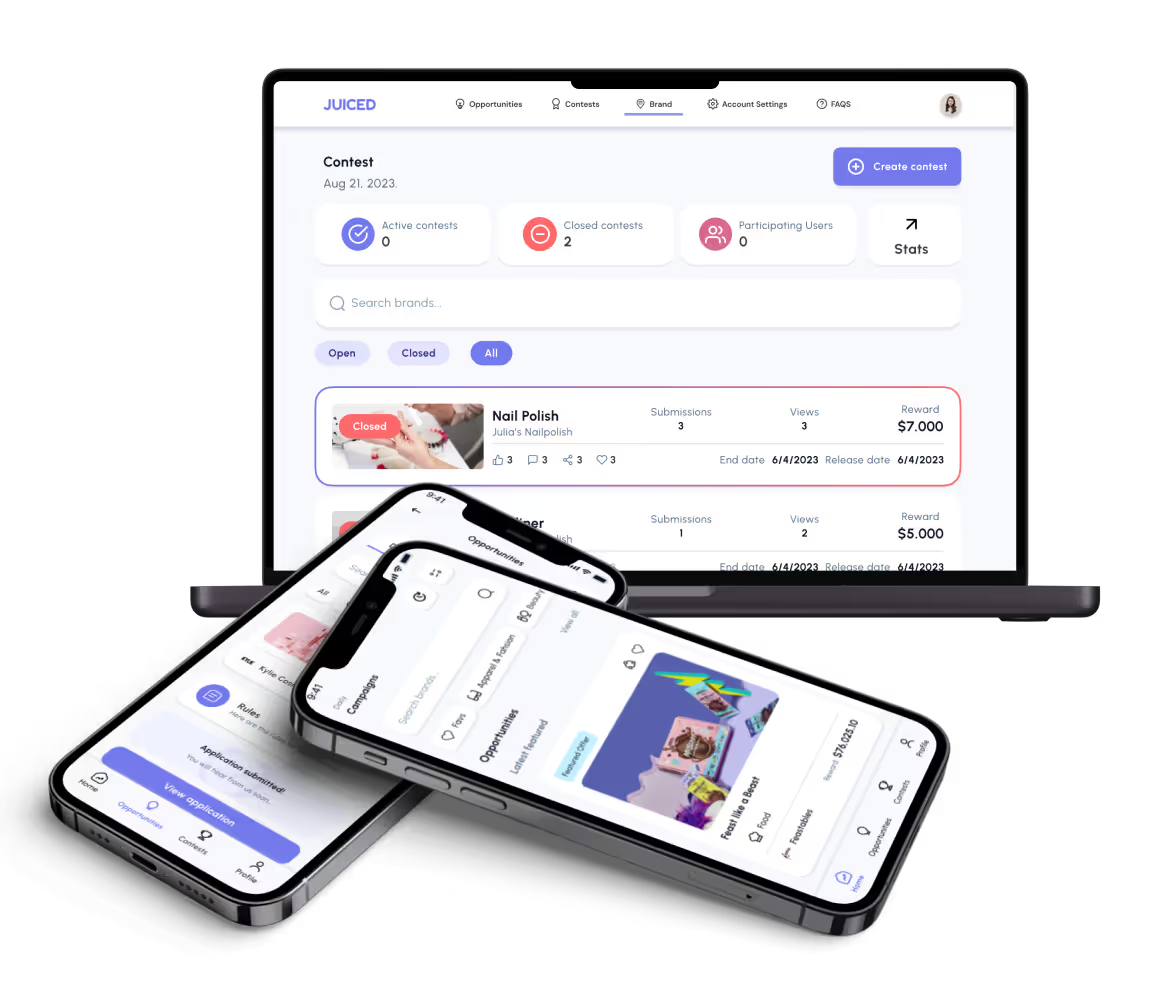
FlutterFlow can deliver the full campaign coordination layer: brief creation, creator assignment, deliverable review, payment triggers, and reporting exports. Social API data freshness is the primary constraint at dashboard level.
FlutterFlow handles the structured workflow well. The features below represent a complete campaign management toolset built in the visual environment.
Campaign Creation and Brief Builder
Brand managers define campaign objectives, deliverable requirements, target audience, and compensation terms inside a structured multi-step form workflow.
Multi-Creator Invitation and Assignment
A batch invite system lets campaign managers select creators from an internal roster and assign them to specific roles within a campaign.
Deliverable Submission and Approval Workflow
Creators upload content drafts to stage-based submission screens. Managers review and approve or request revisions, with status visible to all parties.
Campaign Timeline and Deadline Tracker
A Kanban or calendar view shows each creator's task status, upcoming deadlines, and overall campaign milestone progress.
AI-Powered Campaign Performance Insights
Analytics panels using AI campaign performance insights surface which creators and content formats drive the best ROI across active campaigns.
Creator Payment and Invoice Automation
Payment triggers release automatically on deliverable approval, with invoice generation and confirmation sent to creators via push notification.
Brand Asset Library
Centralised media storage makes brand logos, product images, messaging guidelines, and campaign assets accessible to all assigned creators.
Reporting and Export Dashboard
End-of-campaign reports pull engagement, reach, and click data into a shareable PDF or data export for brand stakeholders.
The approval workflow is the centrepiece of any campaign management tool. How well it handles revision cycles and status visibility determines whether the platform actually gets used.
How Long Does It Take to Build an Influencer Campaign Manager with FlutterFlow?
A simple campaign manager MVP takes 6–8 weeks. A full-featured platform with analytics, payments, and reporting takes 12–18 weeks. Timeline is driven by social API integrations and the number of distinct user roles.
FlutterFlow delivers campaign management tooling at roughly half the time of a custom SaaS build. The phased approach below keeps early delivery realistic.
- Role count drives complexity: Each distinct user role (brand, creator, manager, admin) multiplies the conditional logic and Firestore security rule requirements.
- Social API integrations add weeks: Each platform (Instagram, TikTok, YouTube) requires separate API authentication and rate limit handling.
- Phase 1 first: Launch brief creation and approval workflow before building analytics or payment automation.
Starting with brief delivery and creator assignment keeps the first release achievable. Payment automation and the reporting dashboard follow in phase two once the approval workflow is proven stable.
What Does It Cost to Build a FlutterFlow Influencer Campaign Manager?
Development costs run $18,000–$75,000 depending on feature scope. The largest variable is social API data integration; platform subscription costs are a minor line item.
Before budgeting your build, review FlutterFlow subscription tiers to understand how platform costs stack against your development spend.
- Social API enterprise costs add up: Real-time Instagram and TikTok data requires enterprise-tier API access, which carries significant recurring cost.
- Content moderation adds cost: If user-generated media requires moderation, a third-party moderation API adds setup cost and per-item fees.
- Firebase compute scales with campaigns: Approval logic and media storage costs grow with campaign volume and creator count.
FlutterFlow builds run at roughly a third of the cost of a comparable custom SaaS campaign tool. The gap widens when agency overhead and post-launch iteration are factored in.
How Does FlutterFlow Compare to Custom Development for an Influencer Campaign Manager?
FlutterFlow delivers the MVP in 6–8 weeks versus 4–6 months for a comparable custom build. Costs run $25,000–$55,000 versus $60,000–$200,000. Complex automated reporting pipelines push beyond FlutterFlow's visual logic layer.
FlutterFlow wins on speed and iteration for internal brand tools, agency campaign management, and early-stage SaaS validation.
- UI iteration is FlutterFlow's strongest advantage: Updating campaign brief templates, approval stage labels, and dashboard layouts takes hours, not sprint cycles.
- Custom wins at scale: Platforms processing hundreds of concurrent campaigns with multi-currency payments and compliance requirements need bespoke architecture.
- Maintenance is split: Firebase Functions logic requires standard code maintenance regardless of whether the front-end used FlutterFlow or custom Flutter.
Teams not committed to mobile-first delivery should also evaluate alternative low-code platforms before finalising their build approach.
What Are the Limitations of FlutterFlow for an Influencer Campaign Manager?
Social API rate limits, multi-role Firestore security rules, and nested approval logic are the three limitations that most affect influencer campaign management builds. Plan for all three before development starts.
These limitations are not blockers, but they require explicit architecture decisions. Discovering them mid-build adds weeks.
- Social API rate limits: Instagram and TikTok rate-limit data pulls, making real-time campaign dashboards lag behind actual post performance by hours.
- Multi-role conditional logic: Separate brand manager, creator, and admin views require complex Firebase security rules that take time to validate correctly.
- Deep approval workflow complexity: Nested multi-stage approval flows with conditional branches are hard to maintain in FlutterFlow's visual editor over time.
- Scale pressure at 50+ campaigns: Large agencies running many concurrent campaigns will stress Firestore query limits without careful pagination and indexing.
- Vendor dependency: FlutterFlow UI updates occasionally require re-testing approval workflow logic after platform changes.
- Code export as an escape valve: Agencies planning to white-label or extend beyond FlutterFlow's defaults must include code export rights in the contract.
Agencies managing high-volume campaigns should understand FlutterFlow performance at scale before designing their Firestore data model. The architecture decisions made in week one determine whether the platform survives growth.
How Do You Build a FlutterFlow Influencer Campaign Manager with the Right Team?
Finding qualified FlutterFlow developers with multi-role campaign tool or SaaS experience reduces discovery time significantly and prevents the most expensive architecture mistakes.
Freelancers can handle MVP scope. Full multi-role, multi-integration platforms warrant an agency with demonstrated experience in social API ingestion and Stripe Connect payment flows.
- Multi-role FlutterFlow experience is essential: Developers who have not built a multi-role app before will underestimate Firestore security rule complexity for brand and creator data.
- Social API integration track record: Ask for a live example of social platform API data pulled into a FlutterFlow dashboard, including rate limit handling strategy.
- Stripe Connect payment delivery: Creator payout automation requires experience with Stripe Connect's marketplace payment model, not just standard Stripe checkout.
- PDF report generation experience: End-of-campaign reporting requires Cloud Function knowledge for generating formatted output from Firestore data.
- Discovery planning matters: Plan 2–3 weeks of discovery to map all role-based workflows, data models, and approval logic before any development starts.
The right team asks what data you need from each social platform before agreeing on a timeline. Anyone who skips that conversation will underbid and underdeliver.
Conclusion
FlutterFlow is a capable foundation for an influencer campaign manager, particularly for brands and agencies needing fast delivery and iterative development.
Social API constraints and multi-role logic complexity require experienced architecture decisions early in the project. Neither issue is a deal-breaker, but both will extend timelines if discovered mid-build.
Document every user role, every workflow stage, and every data point you need from social platforms before engaging a development team.
Building an Influencer Campaign Manager with FlutterFlow? Here Is How LOW/CODE Agency Approaches It.
Most campaign manager builds stall not because FlutterFlow cannot handle the features, but because the approval workflow and social API requirements were not scoped before development started.
As AI development experts, we at LOW/CODE Agency help SMBs ship real software — web and mobile applications, intelligent chatbots, RAG pipelines, and autonomous AI agents built for businesses that need results, not platforms. We build FlutterFlow campaign management platforms with full multi-role architecture, Stripe Connect payment automation, and social API integration designed for real data volumes, not just demo scenarios.
- Workflow mapping first: We document every campaign stage, user role, and approval path before writing a single action in FlutterFlow.
- Firestore data architecture: We design the creator, campaign, and deliverable data model so multi-role access and security rules work correctly from day one.
- Social API integration: We handle Instagram, TikTok, and YouTube API connections with rate limit strategies built in, not added later.
- Stripe Connect payment automation: We build milestone-based creator payout flows with invoice generation and confirmation notifications.
- PDF report generation: We implement Cloud Functions for formatted end-of-campaign reports with metrics and stakeholder-ready output.
- Post-launch iteration: We stay involved after launch to refine approval logic and reporting as your campaign volume grows.
- Full product team: Strategy, design, development, and QA from a single team that treats your campaign manager as a product, not a project.
We have built 350+ products for clients including Coca-Cola, American Express, and Sotheby's. We know where influencer campaign management builds go wrong, and we address those issues before they become delays.
Related Articles
- How to Build an Influencer Marketplace Platform with FlutterFlow
- How to Build an Influencer Marketplace with FlutterFlow
- How to Build Influencer and Creator Apps with FlutterFlow
- How to Build HR and Operations Apps with FlutterFlow
- How to Build an HR Document Management App with FlutterFlow
- How to Build a Housing Management Platform with FlutterFlow
Last updated on
September 24, 2026
.

Jesus is a visionary entrepreneur and tech expert. After nearly a decade working in web development, he founded LOW/CODE Agency to help businesses optimize their operations through custom software solutions.


FAQs
What are the key features of an influencer campaign manager app?
How can FlutterFlow simplify building an influencer campaign manager?
What backend services work best with FlutterFlow for this app?
How do I manage influencer data securely in FlutterFlow?
Can I integrate payment processing in a FlutterFlow influencer app?
What are common challenges when building this app with FlutterFlow?
Related Articles

FlutterFlow
How to Build Social Apps with FlutterFlow
Learn how to create social apps using FlutterFlow with easy steps, tips, and best practices for smooth development and user engagement.

FlutterFlow
How to Build a Fitness Trainer Marketplace with FlutterFlow
Learn how to create a fitness trainer marketplace using FlutterFlow with step-by-step tips and best practices for a smooth app development process.
FlutterFlow
How to Build Energy and Utility Apps with FlutterFlow
Learn how to create efficient energy and utility apps using FlutterFlow with step-by-step guidance and best practices.
Comparison
FlutterFlow
FlutterFlow vs OutSystems | 10 Factors Compared (2026)
Compare FlutterFlow vs OutSystems across 10 key factors including enterprise scalability, customization, backend architecture, pricing, and long-term flexibility in 2026.


Why customers trust us for no-code development


