

How to Build Influencer and Creator Apps with FlutterFlow
15 min
read
Learn how to create influencer and creator apps using FlutterFlow with step-by-step guidance and best practices.

The creator economy has produced thousands of platforms, but most force creators into someone else's product with someone else's monetisation rules. FlutterFlow influencer and creator apps give founders a path to building a platform where creators own their audience, their content, and their revenue stream.
Building a full creator platform from scratch takes 4–6 months with custom development. FlutterFlow delivers an equivalent MVP in 6–10 weeks. The difference is significant at the early stage when speed to market and cost efficiency both matter. This guide covers what FlutterFlow can build, what it costs, and where the limits are.
Key Takeaways
- Creator app MVPs ship fast: FlutterFlow delivers a creator platform MVP in 6–10 weeks, versus 4–6 months for fully custom development.
- Social API limits are real constraints: Instagram, TikTok, and YouTube impose rate limits that affect real-time analytics refresh rates in ways that frustrate creators.
- AI recommendations are viable: FlutterFlow integrates with AI APIs to deliver personalised content feeds and AI-driven content recommendations for creator platforms.
- Stripe Connect needs careful setup: Creator payout systems via Stripe Connect are achievable but require configuration significantly more complex than standard Stripe payments.
- Scale planning starts at day one: Traffic spikes during live events and viral moments require backend infrastructure decisions made at project start, not after launch.
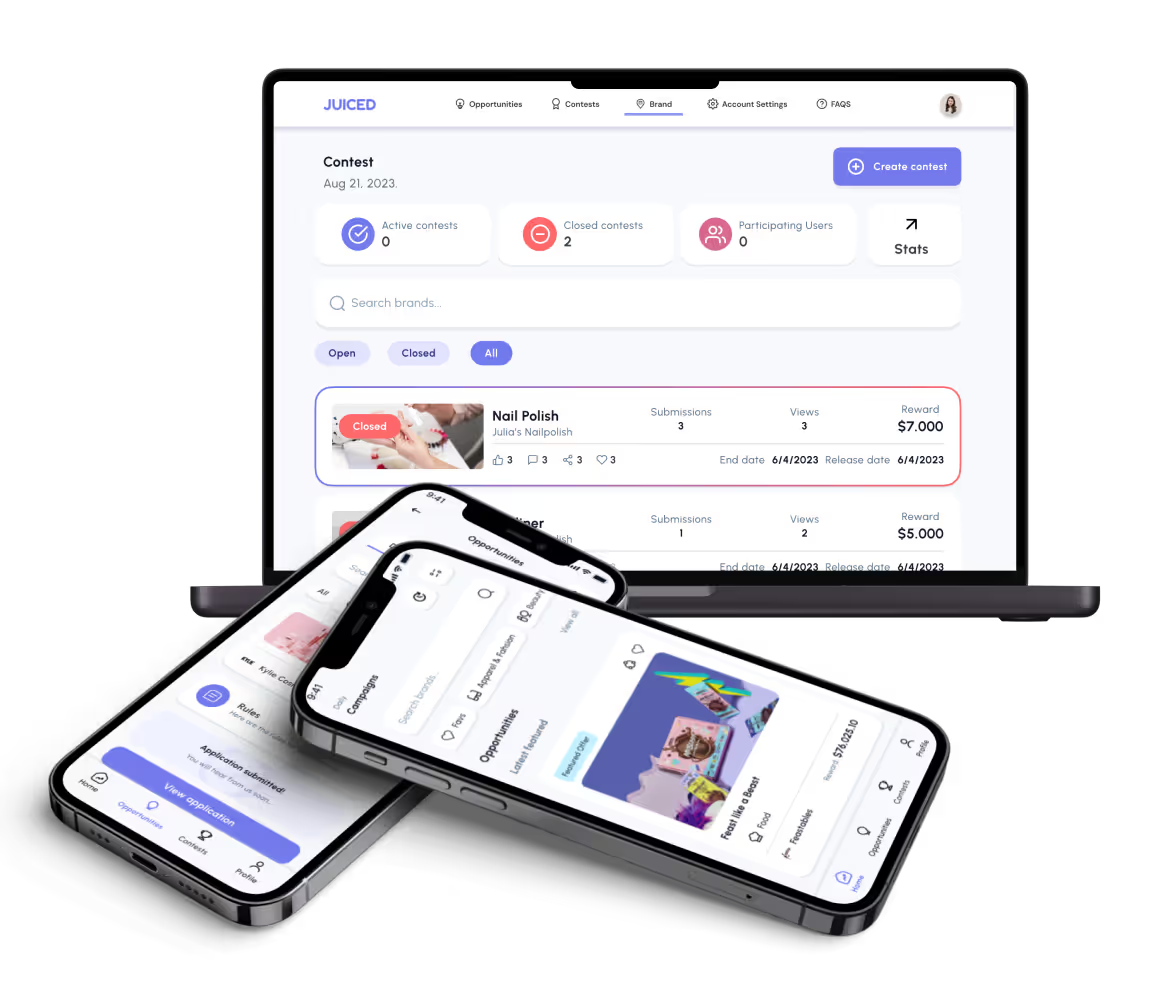

What Can FlutterFlow Build for Influencer and Creator Apps?
FlutterFlow can deliver creator profiles, content feeds with algorithmic sorting, brand deal inboxes, monetisation dashboards, analytics panels, content scheduling, audience segmentation, and media upload flows. The platform handles content-first creator features well. Real-time video processing and deeply custom recommendation engines require custom code components.
The visual builder is well-suited to the structured, workflow-driven patterns that underpin creator platforms. Content feeds, profile screens, and monetisation dashboards all fit naturally into FlutterFlow's component system.
Creator Profile and Portfolio Pages
Customisable profile screens where influencers showcase bio, media kits, niche statistics, and audience demographics to brands and followers.
- Media kit integration: Creator profiles embed reach statistics, engagement rates, and audience demographics that brands use to evaluate collaboration opportunities.
- Niche categorisation: Creators tag their content niche and audience type, making profiles discoverable within the platform's brand matching and directory features.
- Portfolio display: Past brand collaborations, content samples, and performance highlights display in a structured portfolio section visible to brands.
Profile screens are among the fastest components to build in FlutterFlow, with image handling, statistics display, and social link integration all using pre-built widgets.
Content Feed with Algorithmic Sorting
A scrollable feed pulling from Firebase or Supabase, with AI-driven content recommendations surfaced via API calls to ranking models, delivering personalised content to each user.
- Firebase-backed feed: Content posts store in Firebase with metadata tags enabling filtered, sorted, and personalised feed delivery per user.
- Algorithmic ranking: API calls to external ranking models return personalised content orderings based on user engagement history and content affinity signals.
- Infinite scroll performance: Feed pagination with lazy loading keeps the content experience smooth as content libraries grow beyond initial volume.
Content feeds with algorithmic sorting require deliberate Firestore indexing to maintain performance as creator content volume scales.
Analytics Dashboard for Creators
Real-time and historical performance data panels aggregating views, engagement rates, and follower growth from connected social accounts.
- Platform aggregation: Analytics pull from connected Instagram, TikTok, YouTube, and platform-native sources into a single performance dashboard.
- Historical trend display: Follower growth, engagement rate trends, and content performance over time display in chart components within the FlutterFlow dashboard.
- Engagement breakdown: Likes, comments, shares, and saves display per post alongside reach and impressions for content performance analysis.
Social API rate limits from Instagram Graph API and TikTok Display API cap the refresh frequency for real-time analytics, which affects how current the dashboard data can be.
Brand Deal and Collaboration Inbox
A structured messaging interface where brands send collaboration proposals, creators respond, and deal terms are tracked in one thread.
- Proposal intake structure: Brands submit collaboration requests through a structured form capturing campaign brief, budget range, deliverables, and timeline.
- Creator response workflow: Creators review proposals, counter-propose terms, accept deals, and track active collaborations all within the same inbox thread.
- Deal status tracking: Active, pending, completed, and declined deal statuses display in the creator's collaboration dashboard for portfolio and earnings tracking.
A dedicated brand deal inbox replaces the fragmented process of managing brand outreach across email, DMs, and spreadsheets with a single traceable system.
Creator Monetisation and Payout Tracking
Subscription billing, tipping, and Stripe Connect-powered payout screens showing earned amounts, pending transfers, and payment history.
- Stripe Connect integration: Creator payouts route through Stripe Connect with identity verification, payment splitting, and payout scheduling configured for each creator account.
- Subscription billing: Fan subscription tiers with recurring billing manage automatically via Stripe, with revenue displayed per tier in the creator earnings dashboard.
- Tipping and one-time payments: Fans send tips or purchase one-time content access with payment confirmation and creator earnings updating in real time.
Stripe Connect setup is meaningfully more complex than standard Stripe payments. Identity verification flows, account onboarding, and payout compliance requirements add significant configuration time beyond basic payment integration.
Content Scheduling and Publishing Queue
A calendar-style scheduling interface where creators queue posts and set publish times, with push notification reminders before each publishing slot.
- Visual scheduling calendar: Creators drag content into calendar slots, viewing their upcoming publishing schedule across the week or month in a single view.
- Publish time optimisation: Creators set optimal publish times based on their audience activity data displayed within the scheduling interface.
- Pre-publish reminder notifications: Push notifications remind creators of upcoming scheduled posts, reducing missed publishing slots and maintaining content consistency.
Content scheduling connects to social API publishing endpoints where the platform's API access level permits automated posting, or functions as a reminder system where it does not.
Audience Segmentation and Fan Management
Segmentation tools that bucket followers by engagement tier, subscription status, or geography for targeted creator broadcasts.
- Engagement tier segmentation: Followers bucket automatically into tiers based on engagement frequency, enabling creators to target their most active audience with exclusive content.
- Subscription status filtering: Paid subscribers segment separately from free followers, enabling exclusive content delivery and targeted communications per tier.
- Geographic segmentation: Audience location data enables creators to target broadcasts to specific regional fan groups for localised campaigns and events.
Audience segmentation capabilities directly increase the value creators deliver to brand partners by enabling precise audience targeting for campaign content.
Media Upload and Storage Management
Video, image, and audio upload flows connected to Firebase Storage or Cloudinary, with progress indicators and file size validation.
- Multi-format upload support: Video, image, and audio files upload through structured flows with format validation and file size limits enforced before storage.
- Progress indicator display: Upload progress bars and completion confirmations give creators real-time feedback during large video file uploads.
- Storage management dashboard: Creators see their storage usage, file counts by type, and can delete or archive content to manage storage quota.
How Long Does It Take to Build a Creator App with FlutterFlow?
A simple creator portfolio MVP takes 4–6 weeks. A full-featured creator platform with analytics, payouts, scheduling, and brand collaboration workflows takes 10–16 weeks. Social API integration complexity and the number of monetisation models are the primary timeline drivers.
The phased approach works well for creator platforms. Launch profiles and content feed first, then add analytics and Stripe Connect payouts in phase two.
- Creator portfolio MVP: Profile screens, content feed, and basic follower interactions ship in 4–6 weeks with focused scope.
- Full platform scope: Analytics dashboards, Stripe Connect payouts, brand deal inbox, and content scheduling extend the build to 10–16 weeks.
- Social API integration time: Connecting to Instagram Graph API, TikTok Display API, or YouTube Data API adds 2–4 weeks per platform depending on scope.
- Stripe Connect complexity: Identity verification flows, account onboarding, and payout routing add 2–3 weeks beyond standard Stripe payment integration.
- Speed advantage: FlutterFlow delivers in roughly one-third the time of a fully bespoke Flutter build for equivalent creator platform features.
A well-scoped discovery phase of 2–4 weeks before development begins prevents the most common timeline overruns in creator platform builds.
What Does It Cost to Build a FlutterFlow Creator App?
Before scoping your build, understanding FlutterFlow platform pricing helps set realistic expectations for the subscription layer of your total budget. The platform fee is modest. The real cost is development, social API access, and Stripe Connect configuration.
A full-scope creator platform built by an agency costs $20,000–$80,000. Equivalent custom Flutter development typically costs $60,000–$180,000 for the same feature coverage.
- Developer rate: FlutterFlow specialists bill $50–$150/hour. Creator platform projects run $15,000–$60,000 in development depending on feature scope.
- Social API access costs: Enterprise-tier social API access for higher rate limits is a separate cost from development, with pricing varying by platform and volume.
- Content moderation tooling: Automated NSFW detection via Amazon Rekognition or Google Vision adds per-image processing costs to ongoing operational budget.
- GDPR data handling: Compliance setup for user data, content storage, and deletion flows adds development time and may require legal review specific to your user jurisdiction.
Hidden costs most frequently arise from social media API enterprise access, content moderation tooling, and GDPR-compliant data handling for creator and fan data.
How Does FlutterFlow Compare to Custom Development for Creator Apps?
FlutterFlow delivers a creator app MVP in 6–10 weeks at $20,000–$60,000. Custom development for the same scope takes 4–6 months at $60,000–$180,000. The capability gap only matters at the scale where proprietary video CDN, sub-millisecond real-time features, or deeply custom recommendation algorithms are required. For a balanced view before committing, reviewing FlutterFlow strengths and trade-offs will clarify where the tool earns its place.
FlutterFlow wins decisively for content-first creator platforms at the early and growth stages. Custom wins when the platform's core differentiator is the recommendation algorithm or video infrastructure itself.
- Speed advantage: FlutterFlow delivers an MVP in 6–10 weeks. Custom development takes 4–6 months for equivalent feature coverage.
- Cost advantage: FlutterFlow projects at $20,000–$60,000 compare favourably to custom builds at $60,000–$180,000 for similar scope.
- Capability ceiling: Complex real-time video processing and fully proprietary recommendation engines require custom code beyond FlutterFlow's visual builder.
- Maintenance advantage: FlutterFlow reduces ongoing maintenance burden for standard UI and feed changes. Custom code components need separate version management outside the visual editor.
- FlutterFlow wins for: Content-first creator platforms, early-stage products, and brands launching creator tools quickly without custom infrastructure requirements.
- Custom wins for: Platforms requiring proprietary video CDN, sub-millisecond real-time features, or deeply custom recommendation algorithms as core differentiators.
What Are the Limitations of FlutterFlow for Influencer and Creator Apps?
Understanding FlutterFlow at scale is essential before designing the backend architecture for a high-traffic creator platform. Concurrent live-streaming audiences and high-volume feed refreshes require Firestore indexing and CDN configuration decisions made at project start, not after traffic arrives.
The limitations in creator apps are predictable and mostly addressable with the right backend architecture. The risk is building without planning for them.
- Social API rate limits: Instagram Graph API and TikTok Display API cap requests, limiting how frequently analytics dashboards can refresh with current data.
- Content moderation complexity: Automated NSFW detection and policy enforcement require third-party integrations like Amazon Rekognition or Google Vision, not natively supported in FlutterFlow.
- Visual logic complexity: Multi-step creator onboarding flows with extensive conditional branching can become unwieldy in the visual editor and may require custom Dart code components.
- Scale for viral events: Concurrent live-streaming audiences and sudden high-volume feed refreshes require Firestore indexing and CDN configuration that must be designed upfront.
- Vendor dependency: FlutterFlow platform changes can affect exported code compatibility. Code export on paid plans provides an exit path to pure Flutter if platform limitations become blockers.
How Do You Build a FlutterFlow Creator App with the Right Team?
Knowing how to hire skilled FlutterFlow developers before you start saves months of rework caused by mismatched expertise. Social API authentication flows, Stripe Connect identity verification, and Firebase backend design for feed performance are all specialist knowledge areas.
Freelancers suit single-feature creator tools. Agencies are better suited for full-platform scope with QA, social API integration, Stripe Connect, and project management across the full build lifecycle.
- Social API experience: The team must have navigated social API authentication flows, rate limit management, and data refresh strategies in prior projects.
- Stripe Connect expertise: Ask specifically about identity verification flows, creator account onboarding, and payout compliance. Standard Stripe experience is not sufficient.
- Firebase backend design: Feed performance at scale requires deliberate Firestore indexing and query design. Ask how they approach this for content-heavy applications.
- Creator payout compliance: Payout systems must handle tax reporting requirements and identity verification standards. Ask about their approach to creator payout compliance.
- Red flag: Developers who cannot show FlutterFlow-specific portfolio work and have no experience with social API authentication flows are learning on your project.
- Expected discovery phase: Plan for 2–4 weeks of discovery covering feature scope, social API requirements, monetisation model design, and backend architecture before development begins.
A team that understands creator platforms asks about your monetisation model and API rate limit tolerance before they ask about your feature list.
Conclusion
FlutterFlow is a strong fit for creator and influencer apps that prioritise speed to market and content-first features. The platform delivers in weeks what custom development takes months to build.
Backend architecture for scale must be planned at project start. Social API rate limits, Stripe Connect complexity, and feed performance under traffic spikes are all solvable with the right decisions made before the first line of code is written.
Map your must-have features, identify which social APIs you need, and engage a FlutterFlow specialist to scope phase one before committing to full platform development.
Building an Influencer or Creator App with FlutterFlow? Here Is How LOW/CODE Agency Approaches It.
Most creator platform builds underestimate two things: Stripe Connect configuration and social API rate limits. The payment flow looks simple until identity verification is required. The analytics dashboard looks complete until the API throttles and creators see stale data.
At LOW/CODE Agency, we help SMBs compete with AI-powered software built for them — custom web and mobile apps, RAG systems, chatbots, and intelligent agents delivered by a senior development team. We build FlutterFlow creator platforms with Stripe Connect identity verification flows, social API rate limit management, Firebase backend architecture for feed performance, and AI-powered content recommendation integration.
- Creator profile and feed design: We build profile screens, content feeds with algorithmic sorting, and media upload flows that deliver a polished creator experience from day one.
- Stripe Connect setup: We implement full Stripe Connect integration including creator account onboarding, identity verification, payout routing, and earnings dashboard display.
- Social API integration: We connect to Instagram, TikTok, and YouTube APIs with rate limit management strategies that keep analytics dashboards current within API constraints.
- Analytics dashboard build: We aggregate social platform data into creator performance dashboards showing engagement rates, follower trends, and content performance in one view.
- Brand deal inbox: We build structured collaboration proposal workflows where brands submit briefs, creators respond, and deal terms track in a single thread.
- Scale architecture planning: We design Firestore indexing, feed pagination, and CDN configuration for traffic volumes that include viral events and live-streaming peaks.
- Full product team: Strategy, UX, development, and QA from a single team that understands creator economy platform requirements, not just app development in general.
We have built 350+ products for clients including Coca-Cola, American Express, and Sotheby's. We know exactly where creator platform builds stall and how to design around those failure points from the start.
Related Articles
- How to Build an Inspection Checklist App with FlutterFlow
- How to Build an Influencer Marketplace Platform with FlutterFlow
- How to Build an Influencer Marketplace with FlutterFlow
- How to Build an Influencer Campaign Manager with FlutterFlow
- How to Build HR and Operations Apps with FlutterFlow
- How to Build an HR Document Management App with FlutterFlow
Last updated on
September 24, 2026
.

Jesus is a visionary entrepreneur and tech expert. After nearly a decade working in web development, he founded LOW/CODE Agency to help businesses optimize their operations through custom software solutions.


FAQs
What are the key features needed for influencer apps built with FlutterFlow?
Can FlutterFlow handle real-time interactions in creator apps?
How does FlutterFlow simplify app development for non-coders?
What are common challenges when building creator apps on FlutterFlow?
Is it possible to monetize influencer apps created with FlutterFlow?
How do I test and deploy my FlutterFlow influencer app effectively?
Related Articles
FlutterFlow
How to Build an SOP Documentation App with FlutterFlow
Learn how to create an SOP documentation app using FlutterFlow with step-by-step guidance and best practices for smooth app development.

FlutterFlow
How to Build a Lead Scoring AI App with FlutterFlow
Learn how to create a lead scoring AI app using FlutterFlow with step-by-step guidance and best practices for effective lead management.

FlutterFlow
How to Build an Auto Service Booking App with FlutterFlow
Learn how to create an auto service booking app using FlutterFlow with step-by-step tips and best practices for smooth development.
FlutterFlow
How to Build an Equipment Maintenance Scheduler with FlutterFlow
Learn how to create an equipment maintenance scheduler using FlutterFlow with step-by-step guidance and best practices.

Why customers trust us for no-code development


