

How to Build an Influencer Marketplace with FlutterFlow
11 min
read
Learn how to create an influencer marketplace using FlutterFlow with step-by-step guidance and best practices for success.

A FlutterFlow influencer marketplace needs more than a polished UI to work. Thousands of creators connecting with brands requires reliable matching logic, payment escrow, and search infrastructure that holds up at scale. FlutterFlow handles the interface layer well.
The success of a two-sided marketplace depends on decisions made well before a single screen is designed. This guide covers exactly what FlutterFlow can deliver, what it cannot, and what the build costs and timeline look like for a realistic influencer marketplace.
Key Takeaways
- Two-sided complexity is real: Influencer marketplaces require separate creator and brand user flows, increasing scope significantly versus single-sided apps.
- Matching logic needs external services: FlutterFlow cannot run server-side recommendation algorithms natively; these require Firebase Functions or external APIs.
- Payments require escrow design: Campaign payment holding and release logic must be built via Stripe Connect, not FlutterFlow's native widgets alone.
- Search at scale is a known gap: Algolia or Typesense integration is needed for fast creator search across large catalogues.
- Moderation is non-negotiable: Without content and profile moderation tools, fake influencer accounts erode brand trust quickly.

What Can FlutterFlow Build for an Influencer Marketplace?
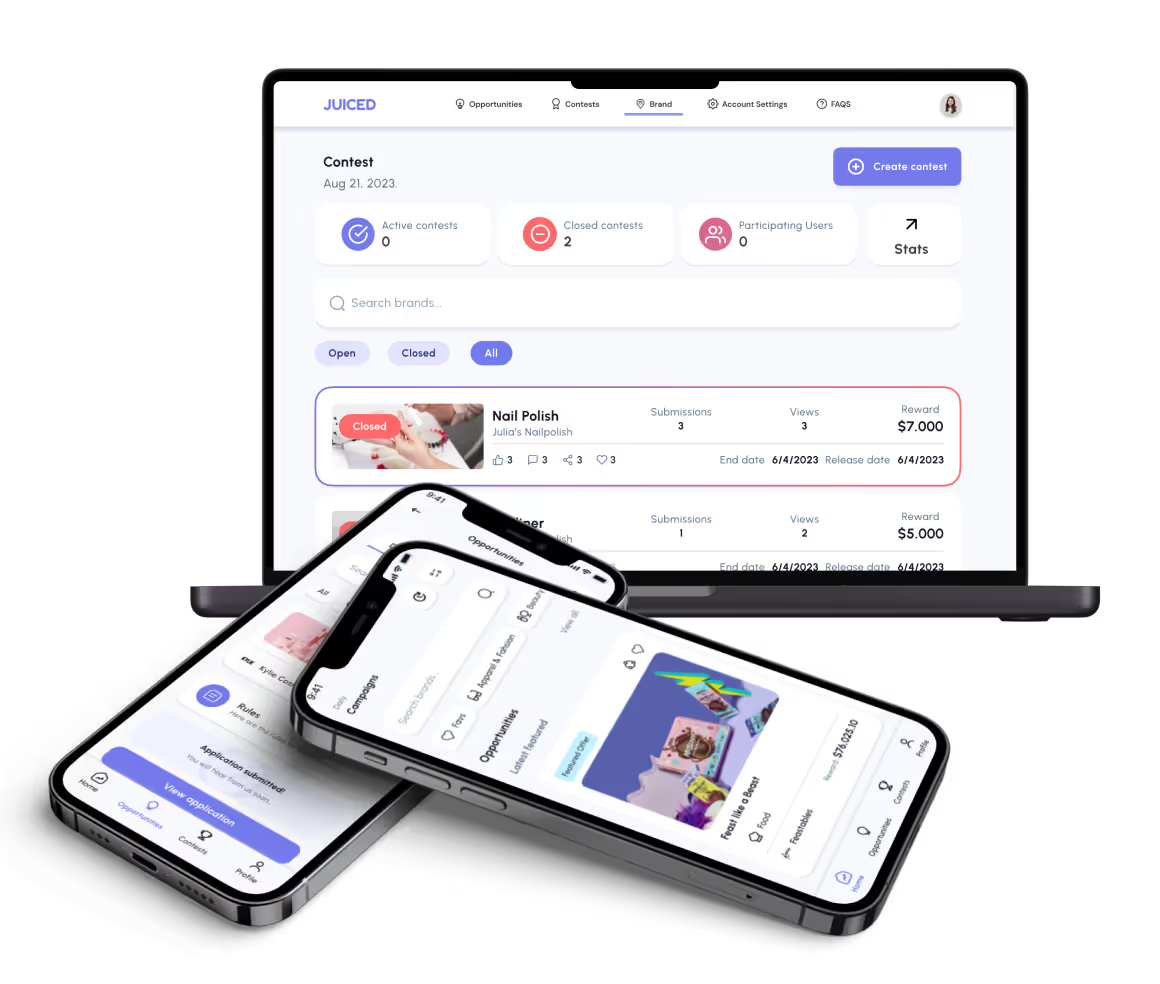
FlutterFlow can deliver the full two-sided marketplace interface: creator discovery, brand and creator onboarding, campaign briefs, proposals, escrow payments, reviews, and messaging. Matching algorithms and real-time analytics require external service integration.
Understanding FlutterFlow plan costs is the first step before scoping your total marketplace infrastructure budget. Platform fees are the smallest line item.
Creator Discovery and Search
A filterable directory of influencer profiles by niche, follower count, engagement rate, and location is built using Algolia integration for fast catalogue-scale queries.
Brand and Creator Onboarding Flows
Separate registration flows for brand accounts and creator accounts collect role-specific information and verification documents from the start.
AI-Powered Creator Matching Engine
A recommendation interface surfaces the most relevant creators for a brand's campaign brief using AI-powered creator matching via external API.
Campaign Brief and Proposal System
Structured forms let brands post campaign requirements and creators submit tailored proposals with rate cards attached for brand review.
Escrow and Payment Release System
Milestone-based payment flows built with Stripe Connect hold campaign funds until deliverable approval is confirmed by the brand.
Performance Analytics Dashboard
Post-campaign reporting panels show reach, engagement, and ROI metrics pulled from connected social account APIs after campaign completion.
Ratings and Review System
A mutual review system lets brands and creators rate each other after campaign completion, surfaced on respective profile pages in discovery rankings.
Messaging and Contract Management
An in-app messaging thread linked to each campaign includes PDF contract upload and e-signature integration via third-party providers.
Two-sided marketplace architecture is one of the more complex FlutterFlow use cases. Legal review of the escrow and payment holding flow is essential, not optional.
How Long Does It Take to Build an Influencer Marketplace with FlutterFlow?
A basic two-sided marketplace MVP takes 8–12 weeks. A full-featured marketplace with search, escrow, analytics, and reviews takes 16–24 weeks. FlutterFlow saves 40–60% of development time compared to a fully custom build.
Timeline is driven primarily by user role count, payment flow complexity, social API integration count, and search infrastructure setup.
- Phase 1 validates the core model: Launching brand and creator profiles with campaign posting proves the two-sided flow before adding payment and matching complexity.
- Algolia setup adds predictable time: Integrating Algolia for creator search requires index design and query testing, typically adding two to three weeks to phase two.
- Escrow testing takes time you cannot compress: Stripe Connect payment holds require thorough sandbox testing across multiple approval and dispute scenarios before any real funds move.
Allow three to four weeks for discovery and architecture planning before development begins. Marketplace complexity makes this the most valuable investment in the entire project timeline.
What Does It Cost to Build a FlutterFlow Influencer Marketplace?
Development costs run $35,000–$120,000 depending on marketplace complexity. Custom two-sided marketplaces typically cost $100,000–$300,000+ at equivalent feature parity. The hidden costs are legal review of payment flows and identity verification services.
- Legal review is a real cost line: Escrow and payment holding have legal implications beyond the technical build; terms of service for a two-sided platform require professional legal review.
- Identity verification services add cost: Verifying creator identities to reduce fake account risk requires third-party identity APIs not available natively in FlutterFlow.
- Firebase costs scale with marketplace volume: High concurrent searches and real-time campaign status updates generate significant Firebase read quotas at growth stage.
The cost advantage of FlutterFlow over custom development is largest in the UI and workflow layer. Social API integration, Algolia, and Stripe Connect carry comparable engineering effort on either path.
How Does FlutterFlow Compare to Custom Development for an Influencer Marketplace?
FlutterFlow builds the MVP in 8–12 weeks versus 6–12 months for a custom equivalent. Project costs run $35,000–$80,000 versus $100,000–$300,000+. Proprietary matching algorithms, escrow dispute resolution, and high-volume transaction processing require custom code.
FlutterFlow wins clearly for early-stage marketplaces validating the two-sided model before committing full investment to a custom build.
- FlutterFlow wins on iteration speed: Adding new creator categories, updating campaign brief templates, and modifying discovery filters takes hours, not development sprints.
- Custom wins on matching complexity: Proprietary ML matching, real-time auction-style bidding, and complex escrow dispute resolution logic require code that lives outside FlutterFlow's visual editor.
- Business logic maintenance is shared: Firebase Functions for matching, escrow, and analytics require standard code maintenance regardless of whether FlutterFlow was used for the UI.
For teams weighing their platform options, the Bubble versus FlutterFlow breakdown clarifies which tool suits different marketplace architectures.
What Are the Limitations of FlutterFlow for an Influencer Marketplace?
FlutterFlow has no native compute layer for matching algorithms, no built-in escrow dispute resolution, and visual logic at scale creates maintainability challenges. All three require explicit planning before development starts.
None of these limitations are blockers for a well-scoped build. They become blockers when discovered without a plan during active development.
- Server-side matching is not native: Matching algorithms must live in Firebase Functions or an external service; FlutterFlow cannot run recommendation logic in the visual editor.
- Escrow complexity requires custom code: Multi-party payment holding with dispute resolution is not a standard FlutterFlow pattern and requires significant Stripe Connect engineering.
- Visual logic at scale has limits: Managing conditional flows for two distinct user roles creates maintainability issues in the visual editor as the platform grows.
- High concurrent usage stresses Firebase: High concurrent searches and real-time campaign status updates stress Firebase read quotas without proper indexing and caching strategies.
- Social API policy changes break features: Instagram Graph API policy shifts can break analytics features without warning, requiring monitoring and rapid response.
- Code export must be in the contract: If the platform is expected to outgrow FlutterFlow's visual layer, code export rights are essential to include from the start.
Planning ahead for marketplace scaling challenges prevents the most common infrastructure failures at growth stage. This is not optional for two-sided platforms with ambitions beyond a regional niche.
How Do You Build a FlutterFlow Influencer Marketplace with the Right Team?
Engaging top FlutterFlow development agencies with marketplace experience dramatically reduces the risk of costly architecture mistakes in two-sided platform builds.
Agencies are better suited than solo freelancers for marketplace scope. Multi-discipline requirements covering backend, UX, and QA need parallel capability, not a single person working sequentially.
- Two-sided marketplace architecture experience: Teams that have not built a marketplace before will underestimate escrow design, Firestore multi-role security rules, and search infrastructure complexity.
- Stripe Connect escrow patterns: Ask specifically for an example of payment holding and conditional release built on Stripe Connect's marketplace model, not generic payment integration.
- Algolia integration experience: Fast creator search across large catalogues requires Algolia or Typesense integration; teams without this experience will reach Firestore query limits at scale.
- Firebase security rules for multi-role access: Brand and creator data must be strictly separated; underdeveloped security rules are the most common two-sided marketplace compliance failure.
- Red flags when hiring: Teams that have not built a marketplace before and no demonstrated Stripe Connect escrow experience are clear risks on a project of this complexity.
The question to ask every candidate team: how do they handle payment dispute resolution design? What is their approach to fake creator account detection? Teams that cannot answer specifically have not done this before.
Conclusion
FlutterFlow can deliver a functional two-sided influencer marketplace faster and cheaper than custom development. Campaign briefs, creator profiles, escrow payments, and discovery search are all achievable.
The matching logic, escrow dispute resolution, and search infrastructure all require architecture work beyond the visual editor. These are not surprises if you plan for them from the start.
Define your two user roles in detail, map the payment flow end to end, and bring in a FlutterFlow agency with marketplace experience before writing a line of logic.
Building an Influencer Marketplace with FlutterFlow? Here Is How LOW/CODE Agency Approaches It.
Two-sided marketplace builds are where most FlutterFlow agencies reach their limits. Escrow design, Algolia integration, social API authentication, and Firebase security rules for separate user roles require disciplines that go beyond standard FlutterFlow configuration.
As AI development experts, we at LOW/CODE Agency help SMBs ship real software — web and mobile applications, intelligent chatbots, RAG pipelines, and autonomous AI agents built for businesses that need results, not platforms. We have built two-sided marketplace platforms across multiple verticals, bringing the same structured process to influencer marketplaces: architecture first, then build.
- Two-sided architecture planning: We map brand and creator user flows, data models, and permission structures in full before any screen is designed.
- Algolia search integration: We design the influencer discovery index for niche, follower range, engagement rate, and location from the first sprint.
- Stripe Connect escrow build: We implement campaign fund holding and conditional payment release with sandbox-tested approval and dispute flows.
- Firebase security rules: We build and validate multi-role Firestore security rules so brand data and creator data stay strictly separated.
- Social API integration: We define the Instagram Graph and YouTube Data API architecture in week one, with rate limit and fallback strategy built in.
- Post-launch iteration: We stay involved through the first live campaign cycles to refine matching logic, payment flows, and discovery rankings.
- Full product team: Strategy, design, development, and QA from a single team that understands marketplace architecture, not just individual feature delivery.
We have built 350+ products for clients including Coca-Cola, American Express, and Sotheby's. We know exactly where two-sided marketplace builds go wrong and how to prevent those failures before they happen.
Related Articles
- How to Build an Insurance Claim App with FlutterFlow
- How to Build an Inspection Checklist App with FlutterFlow
- How to Build an Influencer Marketplace Platform with FlutterFlow
- How to Build Influencer and Creator Apps with FlutterFlow
- How to Build an Influencer Campaign Manager with FlutterFlow
- How to Build HR and Operations Apps with FlutterFlow
Last updated on
September 24, 2026
.

Jesus is a visionary entrepreneur and tech expert. After nearly a decade working in web development, he founded LOW/CODE Agency to help businesses optimize their operations through custom software solutions.


FAQs
What are the key features needed for an influencer marketplace app?
Can FlutterFlow handle complex backend functions for marketplaces?
How do I integrate payment gateways in a FlutterFlow app?
Is coding required to build an influencer marketplace with FlutterFlow?
What are common challenges when building a marketplace app with FlutterFlow?
How can I test my influencer marketplace app built with FlutterFlow?
Related Articles
FlutterFlow
How to Build a Production Tracking System with FlutterFlow
Learn how to create a production tracking system using FlutterFlow with step-by-step guidance and best practices.

FlutterFlow
How to Build a Policy Management Dashboard with FlutterFlow
Learn how to create a policy management dashboard using FlutterFlow with step-by-step guidance and best practices.

FlutterFlow
How to Build Construction Apps with FlutterFlow
Learn how to create construction apps using FlutterFlow with step-by-step guidance and best practices for efficient app development.

FlutterFlow
How to Build a Case Management App with FlutterFlow
Learn how to create a case management app using FlutterFlow with step-by-step guidance and best practices for efficient app development.

Why customers trust us for no-code development


