

How to Build an Influencer Marketplace Platform with FlutterFlow
10 min
read
Learn how to create an influencer marketplace platform using FlutterFlow with step-by-step guidance and best practices.


A FlutterFlow influencer marketplace platform can replace the DMs and spreadsheets that brands and creators currently rely on to make deals. The brief, content approval, and payment flow all belong inside a single platform, not scattered across email chains and Google Docs.
FlutterFlow handles the brand and influencer UI layer well. But social API authentication, content approval versioning, and Stripe Connect payment holds require architecture decisions made before a single screen is built. This guide covers exactly what is achievable and where the real complexity sits.
Key Takeaways
- Influencer profiles with media stats: Influencers connect social accounts and display follower counts, engagement rates, and audience demographics on their profile.
- Campaign brief and application: Brands post campaign briefs; influencers apply with rates and reach data, all within structured FlutterFlow forms.
- Content submission and approval: Influencers submit creative content for brand review and approval before publishing, with revision tracking in Firestore.
- Stripe payment on delivery: Brand payment releases to the influencer on content approval through Stripe Connect's marketplace payment model.
- Performance tracking has limits: Real-time social metrics require third-party social API integration with rate limits and authentication complexity.

What Can FlutterFlow Build for an Influencer Marketplace Platform?
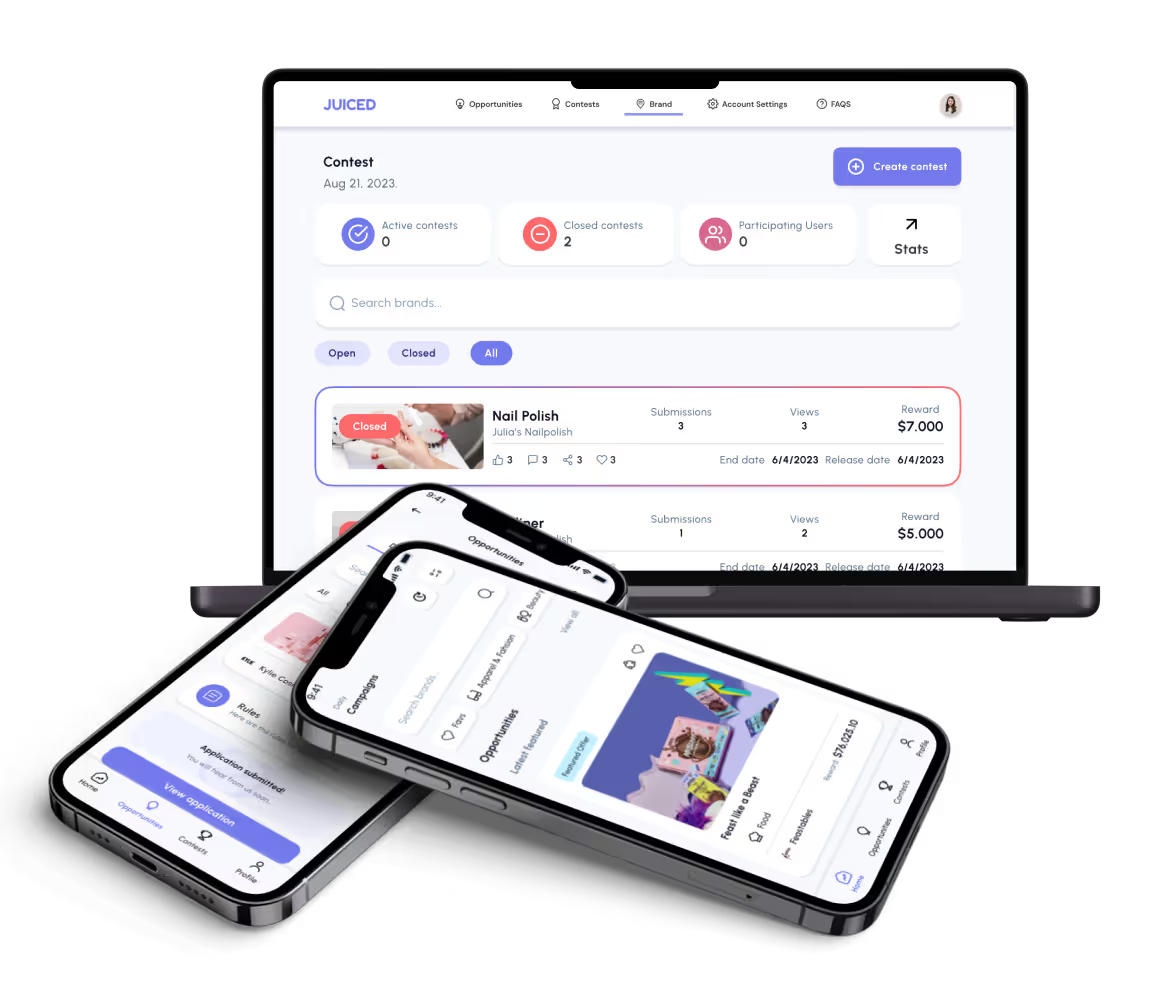
FlutterFlow can build the full brand-to-influencer transaction layer: profiles, campaign briefs, proposals, content approval, and Stripe Connect payment release. Real-time social performance analytics require external API integration.
An influencer marketplace follows SaaS platform architecture. Reviewing whether you can build a SaaS with FlutterFlow gives helpful context for what this stack supports before scoping features.
Influencer Profile with Audience Stats
Influencers build profiles listing their social platforms, follower counts, niche categories, content formats, and sample work for brand review.
Brand Campaign Brief Posting
Brands post campaign briefs with deliverable specifications, content requirements, target audience, timeline, and offered payment range.
Influencer Discovery and Filtering
Brands search influencers by niche, platform, follower range, location, and engagement rate using Firestore filter queries.
Proposal and Rate Submission
Influencers apply to campaigns with a proposal, their quoted rate, and audience demographics evidence for the brand to evaluate.
Content Submission and Approval Workflow
Accepted influencers upload draft content for the brand to review, request revisions, or approve before the influencer publishes.
Stripe Connect Payment Release
On content approval, the brand's held payment routes to the influencer's Stripe Connect account minus the platform commission.
Campaign Performance Reporting
Brands view campaign deliverables, submission status, and content links in a campaign performance overview within the platform.
Review and Reputation After Campaign
Brands and influencers rate each other after campaign completion, building trust scores that surface in discovery rankings.
The content approval workflow and Stripe Connect payment release are the two most technically demanding features in this stack. Both need explicit design before development starts.
How Long Does It Take to Build an Influencer Marketplace Platform with FlutterFlow?
An influencer marketplace MVP with profiles, briefs, and Stripe payment takes 8–14 weeks. A full platform with content approval, discovery filters, and a performance dashboard takes 18–28 weeks.
Timeline is driven by content approval workflow complexity, social API integration for audience stats, and the payment hold and release logic.
- Phased launch reduces risk: Launching profiles and campaign applications first validates the core brand-influencer matching flow before building approval complexity.
- Social API integration is consistent work: Each platform requires separate OAuth authentication flows, rate limit handling, and data normalisation.
- Payment hold logic takes time: Stripe Connect marketplace payments with held funds and conditional release require careful testing before any real money moves.
FlutterFlow handles the brand and influencer UI quickly. Social API integration and Stripe Connect payment holds take consistent engineering effort regardless of the front-end platform chosen.
What Does It Cost to Build a FlutterFlow Influencer Marketplace Platform?
Development costs run $20,000–$100,000 depending on feature scope. FlutterFlow pricing plans are the smallest cost line in an influencer marketplace build; social API integration and Stripe Connect configuration are the significant investments.
Custom development for an equivalent influencer marketplace runs $120,000–$350,000 or more for comparable feature parity.
- Instagram Graph API costs scale: Higher data pull volumes require elevated API tiers, which carry both cost and stricter rate limits to manage.
- Brand verification adds cost: Verifying brand accounts to prevent fraudulent campaign briefs requires third-party identity services not native to FlutterFlow.
- Firebase hosting scales with users: Storage, reads, and writes for large influencer catalogues and campaign data accumulate meaningfully at scale.
The cost gap between FlutterFlow and custom development narrows only when social API integration and Stripe Connect complexity are comparable on both paths.
How Does FlutterFlow Compare to Custom Development for an Influencer Marketplace Platform?
FlutterFlow builds the MVP in 18–28 weeks versus 18–36 months for a comparable custom platform. Costs run $30,000–$100,000 versus $120,000–$350,000+. AI-powered brand-influencer matching and real-time social analytics require custom integration work beyond the visual builder.
FlutterFlow wins for niche influencer verticals, regional platforms, and MVPs validating the brand-influencer matching model before full investment.
- Speed-to-market is the clearest advantage: FlutterFlow's visual builder reduces the brand and influencer UI build by 40–60% compared to custom Flutter development.
- Maintenance costs differ: Campaign category management and brief templates are easy to update in FlutterFlow; social API and payment layers require ongoing developer expertise regardless.
- Custom wins at AI matching scale: Large-scale platforms requiring proprietary ML matching, real-time social analytics, and complex multi-deliverable campaign management outgrow FlutterFlow's visual layer.
If your influencer platform requires real-time social analytics or AI matching, reviewing alternatives to FlutterFlow will surface platforms built for higher-complexity integrations.
What Are the Limitations of FlutterFlow for an Influencer Marketplace Platform?
Real-time social performance metrics, AI-powered influencer matching, and fake engagement detection all require third-party integrations not native to FlutterFlow. Content revision versioning and scale planning need explicit architecture decisions before development starts.
These limitations are predictable and manageable. Discovering them without a plan mid-build is where timelines break down.
- Real-time social metrics require API integration: Instagram Graph API and YouTube Data API carry rate limits, OAuth complexity, and authentication maintenance that go beyond FlutterFlow's visual layer.
- AI matching is not native: Recommendation logic based on audience demographics and campaign performance history requires Firebase Functions or an external ML API.
- Fake engagement detection is a gap: Follower count inflation and bot engagement require third-party fraud detection APIs that FlutterFlow cannot run natively.
- Content revision versioning is complex: Multiple review rounds with version tracking and revision history are difficult to model cleanly in Firestore without deliberate data architecture.
- Scale planning for concurrent campaigns: Platforms with hundreds of concurrent campaigns and thousands of influencer profiles need Firestore query planning and proper indexing from the start.
Understanding FlutterFlow scalability planning matters for influencer platforms expecting rapid campaign and influencer growth across multiple social categories.
How Do You Find the Right Team for a FlutterFlow Influencer Marketplace Platform?
When you hire FlutterFlow developers for an influencer marketplace, social API experience and content approval workflow design are the key screening criteria.
An influencer marketplace warrants an agency rather than a solo freelancer. The social API integration, campaign management logic, and Stripe Connect payment flows require multiple disciplines working in parallel.
- Social API integration experience is non-negotiable: Ask for a specific example of Instagram Graph API or YouTube Data API integration, including how they handle rate limits in production.
- Content approval versioning track record: Developers should be able to explain how they structure Firestore documents for multi-round content review with revision history.
- Stripe Connect payment hold experience: The ability to hold brand funds and release on approval requires specific Stripe Connect marketplace experience, not generic payment integration.
- Red flags when hiring: No social API integration examples, vague on Stripe payment hold logic, and no content approval workflow demonstration.
- Timeline from a good team: Social API architecture decision in weeks one and two; scoping in weeks two through four; build from weeks five through twenty-eight.
Allow 3–4 weeks for discovery and architecture planning before any development starts on a platform of this complexity. Skipping discovery is where most marketplace builds accumulate the most expensive rework.
Conclusion
FlutterFlow can build an influencer marketplace platform. Campaign briefs, influencer profiles, content approval, and Stripe Connect payments are all achievable within the visual builder.
Real-time social performance analytics and AI-powered matching require custom integration work that goes beyond FlutterFlow's native capabilities. Plan for these explicitly from the start.
Define your social API requirements and content approval workflow before scoping. Then engage a team with social platform API and Stripe Connect experience.
Building an Influencer Marketplace Platform with FlutterFlow? Here Is How LOW/CODE Agency Approaches It.
Most influencer marketplace builds hit problems not in the UI, but in the social API integration and payment hold logic. These are the two areas teams consistently underscope in early discovery.
At LOW/CODE Agency, we help SMBs compete with AI-powered software built for them — custom web and mobile apps, RAG systems, chatbots, and intelligent agents delivered by a senior development team. We build FlutterFlow influencer marketplace platforms with proper two-sided user flows, Stripe Connect marketplace payment architecture, and social API integration designed for real data volumes from the start.
- Two-sided user flow design: We design separate brand and influencer registration, onboarding, and dashboard flows before writing any FlutterFlow actions.
- Social API architecture: We define the Instagram, TikTok, and YouTube data pull strategy, including rate limit handling and fallback logic, in week one.
- Content approval workflow: We model the full content submission, revision, and approval cycle in Firestore before building a single screen.
- Stripe Connect payment holds: We build campaign fund holding and conditional release flows tested against real Stripe Connect sandbox scenarios.
- Discovery filtering with Algolia: We integrate Algolia for fast influencer search by niche, follower range, and engagement rate at any catalogue size.
- Post-launch support: We stay involved through the first campaign cycles to refine matching, approval logic, and payout flows based on real usage.
- Full product team: Strategy, design, development, and QA from a single team that treats your marketplace as a product, not a handoff.
We have built 350+ products for clients including Coca-Cola, American Express, and Sotheby's. We understand exactly where influencer platform builds go wrong and how to address those risks before they surface.
Related Articles
- How to Build an Insurance Quote Generator with FlutterFlow
- How to Build an Insurance Claim App with FlutterFlow
- How to Build an Inspection Checklist App with FlutterFlow
- How to Build an Influencer Marketplace with FlutterFlow
- How to Build Influencer and Creator Apps with FlutterFlow
- How to Build an Influencer Campaign Manager with FlutterFlow
Last updated on
September 24, 2026
.

Jesus is a visionary entrepreneur and tech expert. After nearly a decade working in web development, he founded LOW/CODE Agency to help businesses optimize their operations through custom software solutions.


FAQs
What are the key features needed for an influencer marketplace platform?
Can FlutterFlow handle complex backend functions for a marketplace?
How do I integrate payment systems in FlutterFlow for transactions?
What are common challenges when building a marketplace with FlutterFlow?
Is FlutterFlow suitable for launching a minimum viable product quickly?
How can I ensure data privacy and security on my platform?
Related Articles

FlutterFlow
What Is FlutterFlow? (How FlutterFlow Development Works)
Discover what FlutterFlow is and how FlutterFlow development works, including features, real use cases, limitations, and who should use it to build apps faster.

FlutterFlow
How to Build a Delivery Driver App with FlutterFlow
Learn how to create a delivery driver app using FlutterFlow with step-by-step guidance and key features for smooth development.

FlutterFlow
How to Build a Helpdesk Ticketing App with FlutterFlow
Learn how to create a helpdesk ticketing app using FlutterFlow with step-by-step guidance and best practices for efficient app development.
FlutterFlow
How to Build Automotive Apps with FlutterFlow
Learn how to create automotive apps using FlutterFlow with step-by-step guidance and best practices for seamless app development.


Why customers trust us for no-code development


