

How to Build a Menu Management System with FlutterFlow
13 min
read
Learn how to create a menu management system using FlutterFlow with step-by-step guidance and best practices for smooth app development.

A FlutterFlow menu management system centralises restaurant menu control in a single admin panel that publishes changes everywhere at once. Restaurant managers updating menus across a website, ordering app, and delivery platforms spend hours each week pushing the same changes through four different dashboards.
This guide covers what FlutterFlow can build for menu management, what it costs, how it compares to custom development, and where the technical limits are before you commit.
Key Takeaways
- Centralised menu control is buildable: FlutterFlow can deliver an admin panel that manages items, pricing, modifiers, and availability across channels.
- Real-time availability toggling works: Staff can 86 an item or update pricing live, with changes reflected in the ordering app immediately.
- Multi-channel publishing requires middleware: Pushing menu changes to Uber Eats, DoorDash, or Square requires a backend API integration layer.
- Build cost is focused: A dedicated menu management system typically costs $12,000–$35,000 depending on channel integration depth.
- Allergen and nutritional data display is supported: FlutterFlow stores and displays allergen flags and nutritional information per menu item natively.

What Can FlutterFlow Build for a Menu Management System?
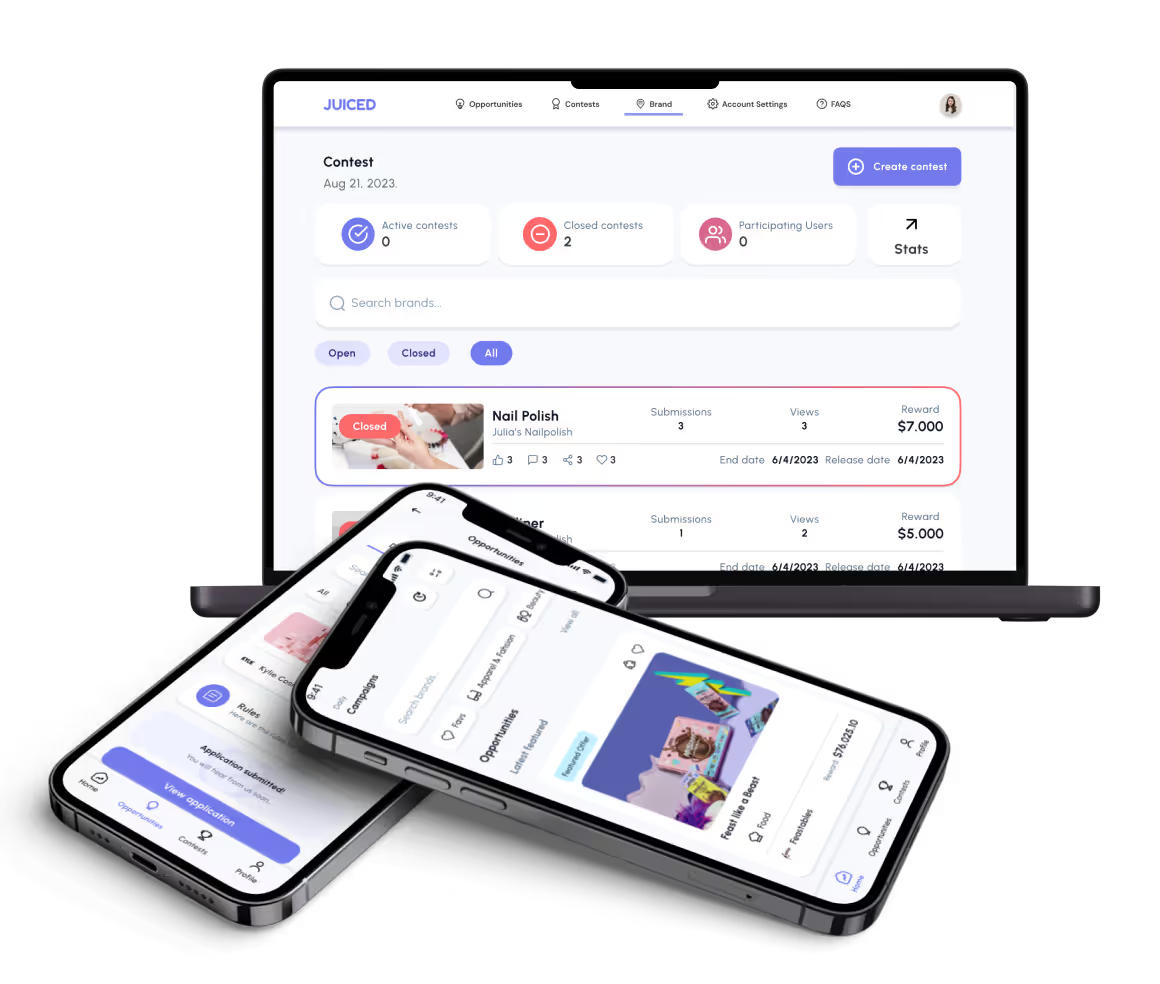
FlutterFlow delivers a fully functional menu CMS: item creation, modifier groups, real-time availability toggling, category organisation, multi-brand management, scheduled day-part switching, and allergen display. Applying FlutterFlow best practices for menus around real-time data sync and modifier group architecture prevents rework when menu complexity grows.
Each feature below is achievable within FlutterFlow's toolset, with Firestore providing real-time data sync across the admin panel and customer-facing ordering app simultaneously.
Menu Item Creation with Rich Detail Fields
Managers create menu items with name, description, pricing, photo, allergens, nutritional data, and dietary tags, all stored in a structured Firestore database with consistent field types.
- Rich item fields: Each menu item document in Firestore stores name, description, base price, photo URL, dietary tags, allergen flags, and nutritional data as typed fields.
- Photo management: Item photos upload to Firebase Storage with a URL reference stored in the Firestore item document for display in both admin and customer-facing views.
- Bulk item creation: An admin CSV import flow or batch creation UI reduces the time required to add a full menu to the system from scratch.
Modifier and Option Group Builder
Complex modifiers including size variants, topping selections, and cook preferences are configured as option groups linked to items, with pricing rules applied per selection.
- Option group structure: Modifier groups (size, toppings, sauce) are stored as Firestore sub-collections linked to the parent item document with min and max selection rules.
- Pricing per option: Each modifier option carries its own price increment or override, calculated and displayed at checkout based on the customer's selection combination.
- Required vs optional modifiers: Option groups are flagged as required or optional, with required groups blocking order submission until a selection is made.
Real-Time Item Availability Toggle
Staff set individual items as available or 86'd from a tablet or phone during service. The change propagates to the customer-facing ordering app instantly via Firestore real-time listeners.
- Instant propagation: Firestore's real-time listener on the item document pushes the availability status change to all connected ordering app sessions within seconds.
- 86 from mobile: A dedicated staff-facing screen lists all active items with a toggle for each, accessible from any authorised device during service.
- Automatic re-enable: Items can be configured to automatically return to available at a set time or at the start of the next service period without manual intervention.
Category and Section Organisation
Menu items are organised into categories and sub-sections with drag-and-drop ordering for display sequence, giving managers direct control over how the menu presents to customers.
- Category hierarchy: Top-level categories (starters, mains, desserts) contain sub-sections (vegan, gluten-free) with items assigned to one or multiple sections.
- Display order control: A sortable list in the admin panel writes an order index field to each category and item document, controlling display sequence in the customer-facing menu.
- Category availability: Categories can be toggled available or hidden independently of individual item availability, useful for seasonal or daypart-specific sections.
Multi-Brand Menu Management
Cloud kitchen operators manage separate menus for multiple virtual brands from a single admin panel, with brand-level pricing and availability overrides for each brand.
- Brand isolation: Each brand's menu data lives in a Firestore collection scoped to that brand's ID, with admin-level access controlling which brands a user can edit.
- Brand-level overrides: A virtual brand running the same item as another brand can apply its own pricing and description without duplicating the underlying item record.
- Cross-brand reporting: An admin dashboard aggregates availability status, item counts, and recent changes across all brands for operators managing multiple virtual concepts.
Scheduled Menu Switching
Day-part menus, breakfast, lunch, dinner, late night, are configured in advance and switch automatically based on time of day without requiring manual intervention from staff.
- Schedule configuration: Each day-part menu is assigned a start and end time in the admin panel, stored in Firestore as a schedule document linked to the relevant item collection.
- Automatic switching: A Cloud Function or Firestore time-based trigger activates the next day-part menu at the scheduled time, updating active item availability automatically.
- Manual override: Staff can manually activate a day-part ahead of schedule from the admin panel when service conditions require it.
Allergen and Compliance Flag Display
Allergen flags are assigned per item and displayed prominently in the customer-facing menu for regulatory compliance across relevant markets.
- Allergen assignment: Each item document stores a list of allergen flags (nuts, dairy, gluten, shellfish) configured in the admin panel and displayed as icons or text in the customer view.
- Nutritional data display: Calorie counts, macronutrient values, and portion information are stored per item and displayed in a consistent format across all menu views.
- Compliance display logic: Allergen and nutritional information displays in the format required for the relevant regulatory market, configurable per brand or location.
How Long Does It Take to Build a Menu Management System with FlutterFlow?
A simple MVP with item creation, availability toggling, and category management takes 4–7 weeks. A full-featured system with multi-brand management, modifiers, scheduled switching, and customer-facing menu display takes 10–16 weeks. FlutterFlow delivers menu admin UIs 50–60% faster than custom builds for the same feature set.
The phased build approach separates admin CMS delivery from channel integration delivery for faster operational impact.
- Phase 1 (4–7 weeks): Admin menu CMS with item creation, availability toggling, modifier groups, and category management delivers immediate operational value.
- Phase 2 (3–6 more weeks): Customer-facing menu display, multi-brand support, and scheduled day-part switching add the consumer-facing layer after admin flows are validated.
- Phase 3 (optional, 3–6 more weeks): Multi-channel API publishing to delivery platforms and POS systems adds the integration layer when backend middleware is ready.
- Multi-brand timeline factor: Each additional brand adds 1–2 weeks to the build if brand-specific pricing, branding, and availability logic are required.
- Modifier complexity factor: Simple single-level modifier groups add 1 week; complex nested modifiers with conditional pricing rules add 2–3 weeks to the build.
What Does It Cost to Build a FlutterFlow Menu Management System?
Review FlutterFlow platform plan pricing alongside your menu system's API integration requirements to confirm the right tier before starting development. Platform cost is the smallest line item, delivery platform API middleware is the largest.
A basic menu CMS costs $12,000–$25,000. A full multi-brand system with channel integrations runs $18,000–$60,000 through an agency.
- Off-the-shelf comparison: Deliverect and Otter charge $100–$400 or more per month per location with limited custom branding, a FlutterFlow build breaks even in 6–18 months for multi-location operators.
- Hidden cost: menu photo library: Professional photography, photo management workflow, and ongoing image updates add operational cost that the development budget does not cover.
- Hidden cost: delivery platform API compliance: Uber Eats and DoorDash API access requires application, compliance documentation, and ongoing maintenance as API versions update.
How Does FlutterFlow Compare to Custom Development for a Menu Management System?
FlutterFlow delivers a menu CMS in weeks at 40–60% lower cost than custom development for the admin interface. Backend channel integration costs are comparable regardless of frontend platform, multi-channel publishing requires a middleware layer whether the admin UI was built in FlutterFlow or custom code.
If you need deep POS and delivery platform sync that exceeds FlutterFlow's native capability, review menu system platform alternatives that offer more integrated backend control.
- When FlutterFlow wins: Independent restaurants, small chains, cloud kitchen operators, food halls, and any operator needing a custom-branded admin panel without per-location SaaS fees.
- When custom wins: Enterprise chains with tightly integrated POS and centralised inventory-driven menu management that requires deep API connectivity from day one.
- Maintenance advantage: FlutterFlow simplifies menu structure changes and category reorganisation; complex pricing rules and API versioning are better handled in custom code.
What Are the Limitations of FlutterFlow for a Menu Management System?
Understand FlutterFlow security for restaurant data before storing allergen and nutritional information. Data accuracy and tamper-evidence matter for compliance, and FlutterFlow's multi-channel publishing and POS sync limitations require backend middleware decisions before the build begins.
Each limitation below is specific to this use case and requires a clear plan before development starts.
- Multi-channel publishing: Pushing menu changes to Uber Eats, DoorDash, and Square requires a backend API integration layer with OAuth and platform-specific data format mapping, FlutterFlow cannot call these APIs directly in the format required.
- POS menu sync: Syncing the FlutterFlow menu database with a Toast or Square POS item library requires a backend bridge that translates between data schemas, not a native FlutterFlow capability.
- Complex pricing logic: Time-based dynamic pricing, happy hour rules, and location-specific price overrides require backend logic that the visual editor cannot manage cleanly at scale.
- Allergen compliance by jurisdiction: Displaying allergen data in formats compliant with UK, EU, or FDA regulations requires custom display logic per market rather than a single universal format.
- Scale considerations: A large multi-location chain managing thousands of items across dozens of brands requires a well-designed Firestore schema from day one, retrofitting the data model is expensive.
- Code export as escape valve: Exporting Flutter code on paid plans allows developers to implement direct POS and delivery platform API integrations natively when middleware is insufficient.
How Do You Get a FlutterFlow Menu Management System Built?
The top FlutterFlow restaurant app agencies for menu systems bring delivery platform API experience alongside FlutterFlow admin panel development skills. A skilled freelancer can build the menu CMS; agencies are better when multi-channel API publishing is required.
The first question to ask any prospective team tells you whether they understand the real complexity of the project.
- Required expertise: FlutterFlow admin panel development, restaurant tech domain knowledge, Firestore real-time data architecture, and delivery platform API integration skills are all necessary.
- Portfolio requirement: Ask for examples of restaurant admin tools or menu management systems they have built, not just general FlutterFlow portfolio pieces.
- Red flag: A team promising direct Uber Eats API integration inside FlutterFlow without mentioning backend middleware has not done this integration before.
- Key screening question: "How do you handle delivery platform menu sync between the FlutterFlow admin panel and Uber Eats or DoorDash?" The answer reveals whether they understand the middleware requirement.
- Second screening question: "What is your approach to scheduled day-part menu switching?" This tests both technical understanding and operational awareness of how restaurants actually work.
- Expected project timeline: 6–16 weeks from scope to production, depending on modifier complexity, multi-brand requirements, and channel integration scope.
Map your current menu update workflow and identify every platform where you push menu changes before briefing any developer. That list defines your integration requirements and determines the backend middleware scope.
Conclusion
FlutterFlow is an efficient platform for building a centralised menu management CMS, particularly for independent restaurants, cloud kitchens, and food halls that need real-time control without paying per-location SaaS fees.
Multi-channel publishing to delivery platforms and POS sync require backend middleware regardless of which frontend platform you use. These are integration decisions, not FlutterFlow limitations.
Map your current menu update workflow and identify every platform where you push changes. That list defines your integration requirements before any development begins.
Building a Menu Management System with FlutterFlow? Here Is How LOW/CODE Agency Approaches It.
Most menu management builds underestimate the delivery platform integration layer and discover the middleware requirement after the admin CMS is already live. Getting channel integration scoped before the build starts is the difference between a working system and a partially functional one.
At LOW/CODE Agency, we help SMBs compete with AI-powered software built for them — custom web and mobile apps, RAG systems, chatbots, and intelligent agents delivered by a senior development team. We build menu management systems on FlutterFlow with real-time Firestore architecture, modifier group design, day-part scheduling, and delivery platform middleware scoped before a single screen is built.
- Menu data model design: We design your Firestore schema for items, modifiers, categories, brands, and availability before development starts, preventing expensive rework later.
- Real-time availability system: We build the staff-facing 86 toggle and availability management flows with Firestore real-time listeners for instant propagation across all connected devices.
- Modifier group architecture: We design the option group data model to support complex modifier combinations, pricing rules, and required or optional selection logic.
- Multi-brand admin panel: We build brand-scoped admin access, brand-level pricing overrides, and cross-brand reporting for cloud kitchen and multi-brand operators.
- Delivery platform middleware scoping: We scope and build the backend integration layer required to push menu changes to Uber Eats, DoorDash, Square, or POS systems.
- Scheduled day-part switching: We implement automated menu switching via Cloud Functions with manual override capability for operational flexibility.
- Full product team: Strategy, UX design, FlutterFlow development, backend middleware engineering, and QA from a single team accountable for the full system.
We have built 350+ products for clients including Coca-Cola, American Express, and Sotheby's. We know exactly where restaurant tech builds stall and we address the integration decisions before they become blockers.
Related Articles
- How to Build an NGO Project Tracking App with FlutterFlow
- How to Build a Multi-Vendor Marketplace with FlutterFlow
- How to Build a Microfinance Platform with FlutterFlow
- How to Build a Membership Subscription Platform with FlutterFlow
- How to Build a Membership Management App with FlutterFlow
- How to Build a Medical Records App with FlutterFlow
Last updated on
September 24, 2026
.

Jesus is a visionary entrepreneur and tech expert. After nearly a decade working in web development, he founded LOW/CODE Agency to help businesses optimize their operations through custom software solutions.


FAQs
What are the first steps to create a menu management system in FlutterFlow?
How can I add dynamic data to my menu in FlutterFlow?
What user roles should I consider when building a menu management system?
How do I handle menu item updates and deletions in FlutterFlow?
Can I integrate payment options within the menu management system?
What are common challenges when building a menu system with FlutterFlow?
Related Articles

FlutterFlow
How to Build a Performance Review System with FlutterFlow
Learn how to create a performance review system using FlutterFlow with step-by-step guidance and best practices.

FlutterFlow
How to Build a Cargo Tracking App with FlutterFlow
Learn how to create a cargo tracking app using FlutterFlow with step-by-step guidance and essential features for real-time tracking.
FlutterFlow
How to Build a Ticket Reservation Tool with FlutterFlow
Learn how to create a ticket reservation tool using FlutterFlow with step-by-step tips and best practices for smooth app development.

FlutterFlow
How to Build a Gig Marketplace Platform with FlutterFlow
Learn how to create a gig marketplace platform using FlutterFlow with step-by-step tips and best practices for beginners and developers.
Why customers trust us for no-code development


