

How to Build a Beauty Services Marketplace with FlutterFlow
12 min
read
Learn how to create a beauty services marketplace using FlutterFlow with step-by-step guidance and tips for success.


A FlutterFlow beauty services marketplace can realistically reach launch in under three months. Provider profiles, portfolio images, real-time booking, and Stripe payments all map well onto FlutterFlow's visual builder, making it one of the more achievable marketplace categories for early-stage founders.
The complexity scales with your feature set. Single-city booking with a fixed provider list is fast. Multi-staff scheduling with deposit automation and in-app chat requires deliberate backend architecture. This guide covers both realities.
Key Takeaways
- Mobile-first output is a genuine advantage: Beauty clients book from phones; FlutterFlow's native mobile output gives a real edge over web-first no-code tools.
- Portfolio imagery is fully supported: Image-heavy provider profiles and before/after galleries work cleanly via Firebase Storage in FlutterFlow.
- Booking complexity scales with scope: Simple slot-based booking builds fast; multi-staff, multi-location scheduling requires backend Cloud Functions.
- Cost range is accessible: A FlutterFlow beauty marketplace built by an agency typically costs $20,000–$55,000.
- Deposit collection requires planning: Collecting deposits at booking requires Stripe PaymentIntent setup with a backend Cloud Function; plan for it from the start.
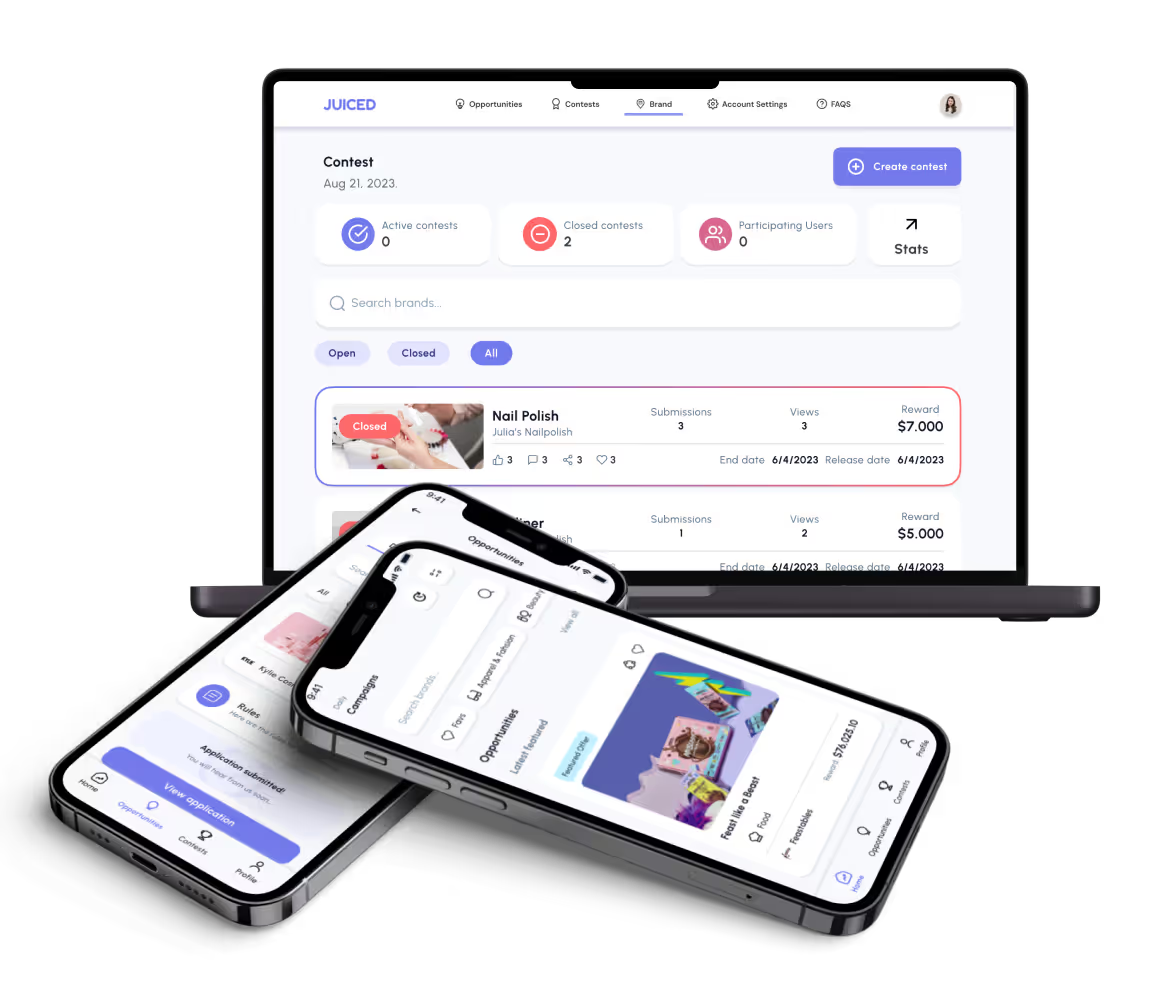

What Can FlutterFlow Build for a Beauty Services Marketplace?
FlutterFlow can build provider onboarding, portfolio galleries, real-time booking calendars, service menus, in-app messaging, Stripe payments with deposit holds, review systems, and admin dispute panels. Each feature is achievable using Firebase, Stripe, and FlutterFlow's native widget library.
Before finalising your feature set, reviewing live FlutterFlow app examples gives you a realistic benchmark for what ships in production versus what stays on the roadmap.
Beauty Professional Onboarding and Profile Setup
FlutterFlow supports multi-step provider registration with specialisation selection, service menu creation, pricing input, and portfolio image upload stored in Firebase Storage. Providers complete onboarding in a guided multi-screen flow.
Portfolio and Before/After Gallery Display
Image carousels, grid galleries, and before/after comparison sliders are built using FlutterFlow's native image widgets connected to Firebase Storage URLs. Providers manage their portfolios directly within the app.
Real-Time Availability Booking Calendar
Clients view a provider's available slots by date, select a service duration, and confirm a booking. Firestore handles availability state and prevents double-booking through structured reads and Firestore transactions.
Service Menu with Pricing and Duration
Each beauty professional maintains a configurable service menu listing treatment names, durations, and prices. Clients see the full menu before selecting a service and confirming their booking appointment.
In-App Messaging for Consultation Requests
Real-time chat between client and provider is built on Firestore listeners. Pre-appointment consultations, allergy disclosures, and style reference sharing happen before the booking is confirmed, reducing no-show risk.
Stripe Payment with Deposit Hold
Clients pay at booking with an optional deposit structure. Full payment or balance collection after service completion is handled via Stripe PaymentIntents triggered from a Cloud Function, not from within FlutterFlow directly.
Review and Star Rating System
Post-appointment review prompts with star ratings and written feedback publish to provider profiles. Quality ratings surface better providers in search results and drive organic platform trust.
Admin Panel for Dispute and Refund Management
A back-office view of booking disputes, refund requests, and provider complaint flags is built in FlutterFlow with a Firestore collection powering the case queue for your support team.
How Long Does It Take to Build a Beauty Services Marketplace with FlutterFlow?
A simple beauty marketplace MVP with provider profiles, booking, and payments takes 7–10 weeks. A full-featured platform with multi-staff scheduling, in-app chat, a review system, and an admin panel takes 14–20 weeks. Phasing the build reduces time to first launch significantly.
The largest timeline variables are Stripe Connect setup for provider payouts and the complexity of your booking conflict resolution logic.
- Phase one: profiles, booking, and payment: Launching with single-provider booking and Stripe checkout validates the marketplace model before adding scheduling complexity.
- Phase two: multi-staff and in-app chat: Adding multi-staff scheduling and Firestore-based chat in a second phase avoids the most common scope-creep failure mode in marketplace builds.
- Stripe Connect adds identity verification time: Each provider onboarded to Stripe Connect goes through identity verification; factor this into the provider launch timeline.
- FlutterFlow cuts UI development time significantly: Calendar and scheduling logic is where timelines converge between FlutterFlow and custom development; the UI layer is always faster in FlutterFlow.
Phasing the build and launching with a single-city, single-provider experience consistently produces faster time to first revenue than building the full platform before go-live.
What Does It Cost to Build a FlutterFlow Beauty Services Marketplace?
A FlutterFlow beauty services marketplace costs $15,000–$45,000 for a developer build and $20,000–$55,000 with an agency for a marketplace with profiles, booking, payments, and a review system. An equivalent custom-built marketplace costs $90,000–$200,000.
Knowing FlutterFlow subscription pricing before scoping the project ensures your platform fee fits within the overall budget alongside Firebase, Stripe, and operational costs.
- Firebase Storage egress costs accumulate: Beauty platforms are image-heavy; without a CDN layer, portfolio gallery serving costs grow unexpectedly as provider count and traffic increase.
- Stripe Connect identity verification adds per-provider cost: Each provider onboarded to Stripe Connect carries a verification fee that grows with your provider base.
- SMS appointment reminders are a separate line item: Twilio or a similar SMS gateway charges per message; reminder volume at scale becomes a meaningful operational cost.
The gap between a $45,000 FlutterFlow build and a $200,000 custom build is where marketplace validation makes sense. Prove the model with FlutterFlow, then decide whether custom infrastructure is warranted.
How Does FlutterFlow Compare to Custom Development for a Beauty Services Marketplace?
FlutterFlow delivers a beauty services marketplace in 10–16 weeks at $20,000–$55,000. A custom-built equivalent takes 5–9 months at $90,000–$220,000. The capability gap narrows at scale when multi-location scheduling complexity and platform volume exceed what FlutterFlow's visual logic layer can cleanly manage.
The comparison is most favourable to FlutterFlow for single-city launches with up to 200 active providers.
- FlutterFlow wins for single-city MVP launches: Founders validating a beauty marketplace model in one city with under 200 providers have no practical reason to start with custom development.
- Custom wins for franchise or multi-city rollout: Hundreds of staff locations with deeply custom availability logic or white-label requirements for salon chains need custom infrastructure.
- Iteration speed favours FlutterFlow post-launch: Adding new features, adjusting provider onboarding flows, and updating the UI are faster with the visual builder than with a custom codebase.
A clear view of FlutterFlow pros and cons helps you set the right expectations before briefing your development team on scope and timeline.
What Are the Limitations of FlutterFlow for a Beauty Services Marketplace?
FlutterFlow has specific limitations for beauty marketplaces: multi-staff scheduling conflict detection requires Cloud Functions, deposit and refund policy automation needs backend logic, and image serving performance without a CDN degrades at scale. Each limitation is solvable but requires deliberate architectural decisions before building.
Understanding FlutterFlow data security practices matters when your platform stores client health and allergy information alongside payment records and provider identity data.
- Multi-staff conflict detection requires Cloud Functions: When five stylists share overlapping services and equipment, FlutterFlow's visual logic cannot resolve booking conflicts without a backend Cloud Function layer.
- Deposit and refund policy automation is not native: Partial refunds based on cancellation timing, such as a 24-hour cancellation policy, require backend logic that FlutterFlow cannot execute within the visual editor.
- Image serving degrades without a CDN: Beauty platforms are image-heavy; without a CDN in front of Firebase Storage, portfolio galleries load slowly for clients in different regions at scale.
- High booking volume needs Firestore architecture planning: Platforms processing tens of thousands of bookings per month need indexed Firestore queries and caching strategies that FlutterFlow's interface cannot configure directly.
- Vendor dependency affects custom calendar components: Changes to FlutterFlow's widget library or pricing can affect custom-built calendar and scheduling components built on top of native widgets.
- Code export requires significant refactoring: Exporting Flutter code is an escape valve, but calendar and scheduling logic tied to custom actions requires meaningful refactoring before the code runs cleanly outside FlutterFlow.
Designing the Firestore data model and identifying which features require Cloud Functions before building prevents the most expensive rework scenarios in beauty marketplace development.
How Do You Find the Right Team for a FlutterFlow Beauty Services Marketplace?
Knowing how to hire skilled FlutterFlow developers with booking platform experience is the single biggest risk reducer for this project. Look for teams with Stripe Connect, Firebase Storage, and multi-sided marketplace data modelling in their portfolio.
Freelancers can handle provider profile and booking screens. Agencies are better equipped for payment logic, admin panels, and end-to-end QA on a live booking platform.
- Stripe Connect experience is mandatory: Teams without Stripe Connect provider payout experience will add significant scope and time once they encounter identity verification and payout logic.
- Firebase security rules for data isolation are critical: Provider payment data must be isolated from client data in your Firebase model; ask specifically how the team structures this separation.
- Ask booking conflict questions before hiring: "How do you handle booking conflicts when two clients book the same slot simultaneously?" reveals real experience with transactional Firestore operations.
- Red flags to watch for: No experience with Stripe Connect, portfolios showing only informational apps without transactional flows, and no discussion of Firebase security rules are all disqualifying signals.
- Expect a structured timeline from good teams: Discovery one week, design two to three weeks, build seven to twelve weeks, QA and store submission two weeks is a realistic and well-managed project structure.
A team that asks about your cancellation policy, deposit rules, and provider payout timing before writing a line of code is demonstrating the domain knowledge this project requires.
Conclusion
FlutterFlow is well-matched to beauty services marketplaces at the MVP and single-city scale. Provider profiles, real-time booking, and Stripe payments are all within reach, and the build cost is a fraction of custom development.
Define your launch feature set, provider count, and booking rules before briefing a team. Multi-staff scheduling, deposit automation, and image CDN performance each require deliberate decisions before the first screen is built.
Building a Beauty Services Marketplace with FlutterFlow? Here Is How LOW/CODE Agency Approaches It.
Most beauty marketplace builds hit problems at the Stripe Connect setup, booking conflict logic, and image performance layer. These are not surprises; they are predictable failures that architecture decisions made before building can prevent.
As AI development experts, we at LOW/CODE Agency help SMBs ship real software — web and mobile applications, intelligent chatbots, RAG pipelines, and autonomous AI agents built for businesses that need results, not platforms. We design the Firebase data model, Stripe Connect integration, and booking conflict logic before any UI work begins, so the marketplace works correctly from the first provider booking.
- Firebase data model design: We structure provider, client, and booking collections with security rules that isolate user data and prevent cross-user access from day one.
- Stripe Connect integration: We implement provider identity verification, payout logic, and deposit hold flows using PaymentIntents and Cloud Functions before building the payment UI.
- Booking conflict resolution: We design and test the Firestore transaction logic that prevents double-booking across providers before the calendar UI is built.
- Portfolio gallery performance: We configure Firebase Storage with CDN delivery for image-heavy provider profiles so gallery load times stay acceptable at scale from launch.
- Admin dispute panel: We build your back-office booking dispute and refund management tool as a core deliverable, not a post-launch addition.
- App store submission: We handle Apple App Store and Google Play submission, review responses, and compliance checks as part of every marketplace engagement.
- Full product team: Strategy, UX, development, and QA from a single team that has shipped transactional booking platforms and understands what makes them fail.
We have built 350+ products for clients including Coca-Cola, American Express, and Sotheby's. We know exactly where beauty marketplace builds go wrong and we build to prevent those failures from the start.
Related Articles
- How to Build a Bill Payments App with FlutterFlow
- How to Build a Business Intelligence Dashboard with FlutterFlow
- How to Build Beauty and Wellness Apps with FlutterFlow
- How to Build a Banking App with FlutterFlow
- How to Build a B2B Marketplace with FlutterFlow
- How to Build a B2B Ecommerce App with FlutterFlow
Last updated on
September 24, 2026
.

Jesus is a visionary entrepreneur and tech expert. After nearly a decade working in web development, he founded LOW/CODE Agency to help businesses optimize their operations through custom software solutions.


FAQs
What are the first steps to create a beauty services marketplace in FlutterFlow?
How can I integrate payment options in a FlutterFlow beauty marketplace?
What are common challenges when building a marketplace app with FlutterFlow?
Can FlutterFlow handle complex booking systems for beauty services?
How do I ensure my beauty services marketplace is user-friendly?
Is it possible to scale a FlutterFlow-built beauty marketplace app?
Related Articles

FlutterFlow
How to Build a Courier Tracking App with FlutterFlow
Learn how to create a courier tracking app using FlutterFlow with step-by-step guidance and essential features for real-time delivery tracking.

FlutterFlow
How to Build a Telehealth App with FlutterFlow
Learn step-by-step how to create a telehealth app using FlutterFlow with essential features and best practices for success.

FlutterFlow
How to Build a Membership Management App with FlutterFlow
Learn how to create a membership management app using FlutterFlow with step-by-step guidance and best practices.

FlutterFlow
How to Build a Movie Streaming Dashboard with FlutterFlow
Learn how to create a movie streaming dashboard using FlutterFlow with step-by-step guidance and best practices.


Why customers trust us for no-code development


