

How to Build a Driver Tracking Dashboard with FlutterFlow
16 min
read
Learn how to create a driver tracking dashboard using FlutterFlow with step-by-step guidance and best practices.


Fleet managers need to know where every vehicle is, whether drivers are on schedule, and when something goes wrong, in real time. A FlutterFlow driver tracking dashboard can surface all of that on mobile and web simultaneously, pulling from GPS hardware or driver apps through a structured backend.
The question is what tracking frequency and fleet size the architecture can support before costs and performance become constraints.
Key Takeaways
- Google Maps is the map layer: FlutterFlow integrates with Google Maps SDK for vehicle position display, route visualisation, and geofence boundary rendering.
- Location data comes from a backend service: GPS hardware telematics or driver device pings write to a real-time database; FlutterFlow reads and displays the data.
- Web and mobile simultaneously is a major advantage: Fleet managers on desktop and drivers on mobile can use the same FlutterFlow project with different interfaces.
- Tracking frequency drives API costs: Higher-frequency location updates generate more Google Maps API calls and Firebase reads, which must be modelled before architecture is finalised.
- Build costs range from $15,000 to $60,000: Scope depends on fleet size, tracking frequency, alerting complexity, and whether telematics hardware integration is required.

What Can FlutterFlow Build for a Driver Tracking Dashboard?
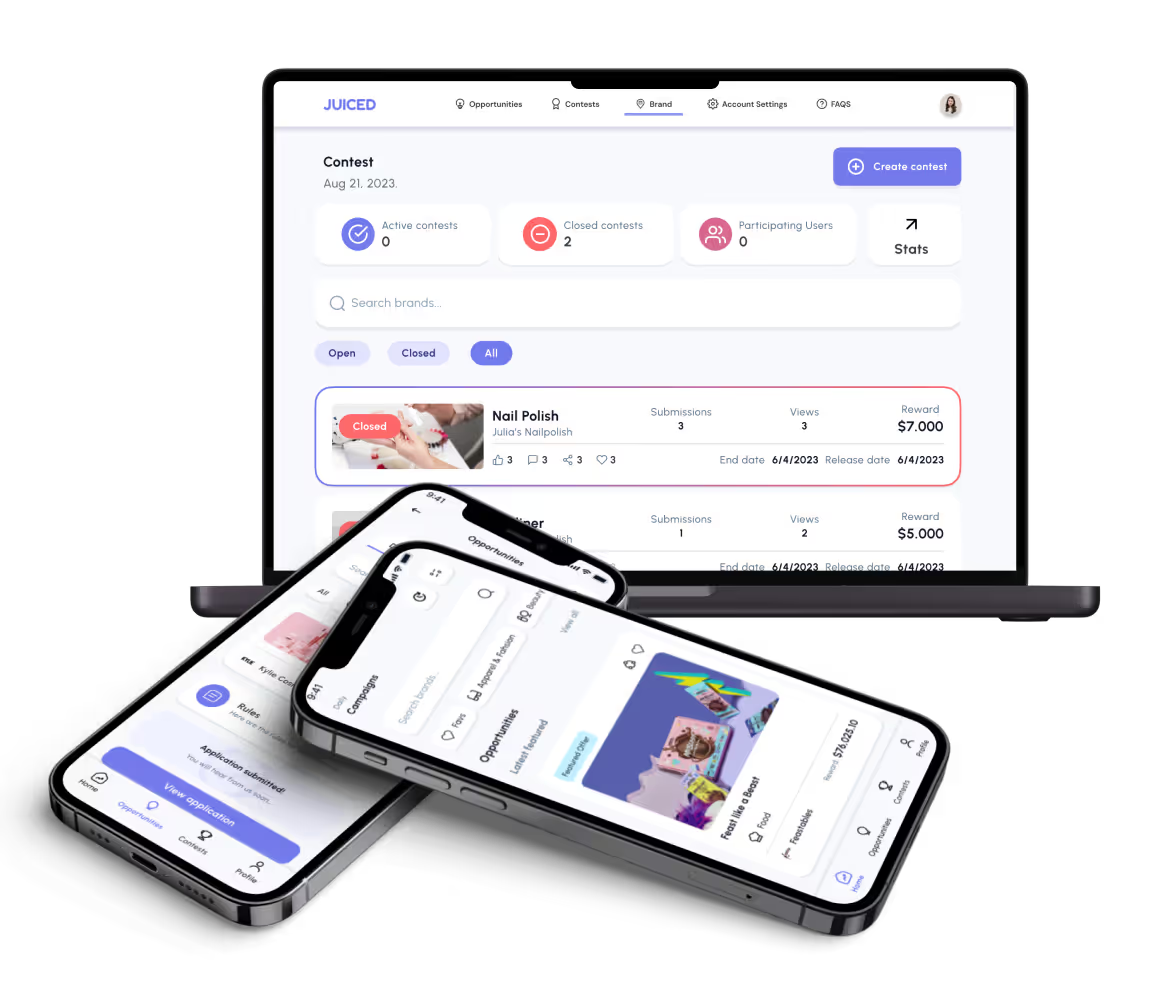
Review FlutterFlow tracking app examples to understand the visual complexity of map-heavy dashboards that teams have shipped in production. FlutterFlow delivers the complete tracking interface, from live fleet maps to historical trip replay and performance reporting.
FlutterFlow handles the full dashboard and map interface using Firebase Realtime Database or Firestore as the location data layer. Here is what the platform delivers.
Live Fleet Map View
A Google Maps view shows all active drivers as labelled markers with real-time position updates, colour-coded by status such as available, on trip, or offline. Dispatchers pan and zoom freely across the full fleet.
The live map is the primary dispatcher interface. It must update driver positions without page refresh and handle the visual complexity of multiple simultaneous markers.
- Google Maps SDK integration: FlutterFlow's Google Maps component renders the fleet map with labelled driver markers that update position from Firebase Realtime Database reads.
- Status colour coding: Driver markers display in different colours based on current status, giving dispatchers an instant visual summary of fleet availability.
- Pan and zoom control: Dispatchers zoom to specific areas, filter by driver or vehicle type, and tap individual markers to open the driver detail panel.
Marker clustering is required for large fleet views. Rendering hundreds of individual markers without clustering degrades map performance in the FlutterFlow UI layer.
Individual Driver Detail Panel
Tapping a driver marker opens a panel showing current location, trip details, speed, device battery level, estimated arrival time, and contact options. All data reads from the driver's Firestore or Realtime Database record.
The driver detail panel gives dispatchers the context they need to respond to exceptions without switching between multiple screens.
- Current trip summary: Trip origin, current location, destination, assigned load or job reference, and elapsed time display in the detail panel.
- Speed and battery indicators: Current speed and device battery level read from the driver's location record, flagging potential connectivity issues before they cause tracking gaps.
- Direct contact options: Call or message buttons in the panel connect the dispatcher to the driver without exiting the tracking dashboard.
The detail panel and map view share the same Firestore listener, so both update together when new location data arrives without double data fetching.
Geofence Zone Configuration and Alerts
Configurable geographic boundaries for depots, delivery zones, and restricted areas trigger push notifications when a driver enters or exits a defined zone. Geofence logic runs server-side in Firebase Functions, not in FlutterFlow's conditional logic.
Geofencing is one of the most operationally valuable features of a driver tracking dashboard for logistics and last-mile delivery operations.
- Admin zone configuration: Fleet managers draw geofence boundaries on the map interface, with zone type, name, and alert recipients stored in Firestore.
- Entry and exit triggers: Cloud Functions evaluate each incoming location update against active geofence boundaries and fire push notifications when a boundary is crossed.
- Restricted area alerts: Drivers entering restricted zones trigger immediate alerts to both the dispatcher and the driver, with the event logged to the trip record.
Geofence boundary logic runs in Firebase Functions because evaluating location data against multiple polygon boundaries at scale requires server-side processing, not client-side conditional logic.
Trip Route Replay
Historical replay of a completed trip's GPS path overlays on the map with timestamp markers and stop duration indicators for post-trip review and dispute resolution. Location history reads from Firebase Realtime Database and renders as a polyline on the Google Maps component.
Trip replay provides the evidence base for resolving delivery disputes, investigating incidents, and coaching drivers on route efficiency.
- GPS path polyline: The completed trip renders as a polyline on the Google Maps view, showing the exact path taken from departure to final destination.
- Timestamp and stop markers: Markers along the route indicate timestamps and stop durations, showing where the driver paused and for how long.
- Date and driver filtering: Fleet managers select any completed trip by driver, date, or job reference from the trip history list to load the replay view.
Trip replay data requires location history to be retained in Firebase Realtime Database beyond the live tracking window, which affects storage costs at high tracking frequency.
Driver Status Dashboard List
A tabular list complements the map, showing all drivers by name, status, current assignment, last location update time, and today's trip count for at-a-glance fleet status. List and map views share the same data source.
The list view is the faster-to-scan alternative to the map for dispatchers managing communication rather than route oversight.
- Status column: Each row displays the driver's current status with the same colour coding as the map markers for visual consistency.
- Last update timestamp: A timestamp column shows when the driver's location was last written to Firebase, flagging drivers whose devices have gone offline or lost connectivity.
- Today's trip count: A count of completed trips for the day gives dispatchers an overview of workload distribution without opening individual driver records.
The list and map views query the same Firebase Realtime Database node, so both reflect the same current state without independent data synchronisation.
Late Delivery and Deviation Alerts
Automated alerts fire when a driver's location indicates deviation from the assigned route beyond a configurable distance, or when estimated arrival exceeds the scheduled delivery window. Alert logic runs in Firebase Functions, not FlutterFlow conditional logic.
Proactive alerting is what separates a tracking dashboard from a tracking display. Dispatchers should be notified of exceptions, not required to watch the map for them.
- Route deviation alerts: Firebase Functions compare incoming driver location to the planned route polyline and fire an alert when deviation exceeds a configurable threshold.
- Late arrival prediction: Estimated arrival time calculations compare current location and speed to the scheduled delivery window, alerting the dispatcher when a late arrival is projected.
- Alert recipient configuration: Alerts route to the assigned dispatcher, the customer, or both depending on the alert type and configuration set by the fleet manager.
Complex multi-condition alerting, such as predictive late delivery based on current speed and remaining distance, requires server-side rule processing in Firebase Functions.
Daily and Weekly Driver Performance Reports
Summary screens show per-driver metrics including total distance, time on duty, stop count, on-time rate, and speed events, pulled from the backend trip database. Reports update at shift end or on demand.
Performance reporting turns the tracking data into management insight for fleet optimisation and driver coaching.
- Per-driver daily summary: Distance driven, time on duty, stop count, on-time delivery rate, and any speed or deviation events display per driver for the current day.
- Weekly rollup report: Aggregated weekly performance metrics for each driver support structured coaching conversations and identify chronic performance issues.
- Speed event logging: Instances where driver speed exceeded a configurable threshold are logged separately as events, with map location and timestamp for review.
A phased approach delivers the live map and driver status first, then geofencing and alerts in phase two, and historical replay with performance analytics in phase three.
How Long Does It Take to Build a Driver Tracking Dashboard with FlutterFlow?
A simple driver tracking MVP with manual check-ins, basic map display, and a small fleet takes 5 to 8 weeks. A full fleet tracking dashboard with real-time GPS, geofencing, alerts, historical replay, and performance reports runs 12 to 20 weeks depending on integration complexity.
Timeline depends on GPS hardware telematics integration, Firebase Realtime Database structure for high-frequency location writes, and alert rule engine complexity.
- Firebase architecture must be designed first: The Realtime Database structure for high-frequency location writes must be correct before any FlutterFlow dashboard screen is built.
- Telematics hardware integration adds backend scope: GPS hardware feeding location data via an OEM API requires Firebase Functions middleware to normalise and write to the tracking database.
- Google Maps API cost must be modelled: At high tracking frequency and large fleet size, Google Maps API costs scale significantly and must be budgeted before architecture is finalised.
- FlutterFlow dashboard UI is 2 to 3 times faster: The map display and dashboard interface build significantly faster in FlutterFlow than in custom code; backend location processing timelines are similar either way.
Defining tracking frequency and fleet size before scoping the build determines the Firebase architecture and Google Maps API cost model for the entire system.
What Does It Cost to Build a FlutterFlow Driver Tracking Dashboard?
With the FlutterFlow pricing plans compared to custom development costs, add Google Maps API and Firebase costs at your fleet's tracking frequency to build a realistic operating budget. Platform fees are a small fraction of the total.
Cost breaks into development, platform subscriptions, and ongoing infrastructure costs that scale with fleet size and tracking frequency.
- Custom platforms cost 3 to 5 times more: A custom fleet management platform costs $150,000 to $400,000 or more; FlutterFlow delivers equivalent dashboard functionality at a fraction of that cost.
- Off-the-shelf SaaS limits customisation: Platforms like Samsara or Verizon Connect charge per vehicle per month and do not allow the custom reason code structures or interface designs that a FlutterFlow build provides.
- Google Maps API costs spike at scale: Tracking 100 vehicles at 5-second intervals generates substantial API costs that must be modelled and budgeted before the architecture is committed.
The hidden cost that most teams underestimate is Google Maps API usage at high update frequency. Model this at your target fleet size before finalising the tracking interval in the architecture.
How Does FlutterFlow Compare to Custom Development for a Driver Tracking Dashboard?
FlutterFlow delivers a fleet map and dashboard in 5 to 12 weeks at 55 to 70 percent lower cost than a custom tracking platform for small to medium fleet sizes. Custom development wins for sub-second GPS tracking across thousands of vehicles or proprietary routing optimisation.
The comparison is most relevant for fleet operators deciding between building a tailored dashboard and subscribing to an off-the-shelf fleet SaaS.
- FlutterFlow wins for SMB fleet operators: Fleets under 500 vehicles running last-mile delivery, field service dispatch, or shuttle operations are well-served by FlutterFlow's map and dashboard capabilities.
- Custom wins at enterprise scale: National logistics operators with thousands of vehicles, proprietary routing algorithms, or enterprise ERP fleet module integration need custom development.
- Interface iteration is a sustained advantage: Adding new dashboard views, adjusting alert rules, and configuring new geofence zones is faster and cheaper in FlutterFlow after launch than in a custom codebase.
Understanding FlutterFlow pros cons for dashboards in a fleet context confirms that the platform handles the display layer well, while real-time data processing at scale requires dedicated infrastructure.
What Are the Limitations of FlutterFlow for a Driver Tracking Dashboard?
Review FlutterFlow scalability for fleet apps before finalising your Firebase architecture. High-frequency location writes from a large fleet require deliberate database structure planning that cannot be retrofitted after the dashboard is built.
Each limitation below is a technical boundary with direct operational and cost implications.
- High-frequency location costs scale fast: Tracking 100 vehicles at 5-second GPS intervals generates significant Firebase Realtime Database write costs and Google Maps API rendering load that must be modelled at target fleet size.
- Telematics hardware requires middleware: OBD-II or CAN bus data from fleet hardware covering fuel consumption, engine diagnostics, and harsh braking requires a hardware-to-API middleware layer that FlutterFlow consumes but cannot build.
- Complex routing optimisation is not in scope: Assigning efficient routes across a fleet for multi-stop deliveries requires a dedicated route optimisation engine such as Google OR-Tools or OptimoRoute; FlutterFlow displays the result, not the calculation.
- Large fleet map performance degrades without clustering: Rendering 500 or more simultaneous vehicle markers on a Google Maps view within FlutterFlow degrades UI performance without marker clustering and viewport-based filtering strategies.
- Advanced alerting requires backend rule processing: Predictive late delivery based on current speed and remaining distance, or multi-condition geofence events, requires Firebase Functions rule logic, not FlutterFlow conditional logic.
- Vendor dependency on the Maps package: FlutterFlow's Google Maps integration depends on the underlying Flutter Maps package; breaking changes in package updates require prompt maintenance to prevent map view failures in production.
The marker clustering limitation is not obvious until a fleet grows. It must be planned into the architecture before the map view is built, not added later as a performance fix.
How Do You Get a FlutterFlow Driver Tracking Dashboard Built?
The top FlutterFlow development agencies for logistics and fleet work will front-load Firebase architecture planning. The data model for real-time tracking must be designed before the first screen is built, or performance and cost problems surface after launch.
The right team asks about fleet size and tracking frequency before discussing the dashboard interface. These two numbers determine the entire architecture.
- Firebase Realtime Database optimisation experience: The developer must have structured a high-frequency write database before, not be learning the indexing and fan-out patterns on your project.
- Google Maps marker clustering experience: Ask specifically whether the developer has implemented marker clustering for large fleet map views; it is a non-trivial implementation.
- Telematics API integration: If GPS hardware is in scope, the developer needs experience normalising OEM telematics data formats into a standard location record structure.
- Geofencing logic in prior work: Ask to see a working geofence implementation; polygon boundary evaluation at scale requires Firebase Functions experience.
- Red flag to avoid: Developers who do not ask about fleet size and tracking frequency during scoping do not understand how these variables determine the database architecture and API cost model.
The backend infrastructure design, covering Firebase structure, Google Maps cost model, and telematics integration, takes 3 to 4 weeks and must be completed before any FlutterFlow canvas work begins.
Conclusion
A FlutterFlow driver tracking dashboard is a well-matched use case for the platform. The live map, status panels, geofencing, and alerting interface are native strengths. The real-time location data lives in Firebase or a telematics backend that FlutterFlow reads cleanly.
The complexity lives in the data layer, not the UI. Tracking frequency, fleet size, and telematics hardware integration determine the backend architecture and ongoing API cost model.
Define your tracking frequency and fleet size before scoping the build. These two numbers determine your Firebase and Google Maps cost model and the database structure required to support them.
Building a Driver Tracking Dashboard with FlutterFlow? Here Is How LOW/CODE Agency Approaches It.
Most fleet tracking dashboard builds hit cost or performance problems after launch because tracking frequency and fleet size were not modelled into the Firebase architecture before build began. By the time Google Maps API bills spike or map performance degrades, rearchitecting the data layer is an expensive fix.
As AI development experts, we at LOW/CODE Agency help SMBs ship real software — web and mobile applications, intelligent chatbots, RAG pipelines, and autonomous AI agents built for businesses that need results, not platforms. We build FlutterFlow driver tracking dashboards for fleet operators, logistics businesses, and transportation startups, starting with Firebase architecture design and Google Maps API cost modelling before any interface work begins.
- Firebase architecture design: We structure the Realtime Database for high-frequency location writes at your target fleet size and tracking interval before building any dashboard screen.
- Live fleet map build: We implement the Google Maps SDK integration with marker clustering, status colour coding, and real-time position updates from Firebase listeners.
- Geofencing and alert engine: We build Firebase Functions to evaluate location updates against geofence boundaries and fire configurable alerts to dispatchers and drivers.
- Telematics hardware integration: We build Firebase Functions middleware to normalise OEM telematics data formats and write structured location records to the tracking database.
- Trip replay and performance analytics: We implement historical GPS path replay, stop duration analysis, and per-driver performance reporting from the backend trip record database.
- Google Maps API cost optimisation: We model and implement update frequency strategies that balance tracking accuracy against API cost at your fleet's scale.
- Full product team: Strategy, UX, development, and QA from one team that treats your fleet dashboard as a production system, not a prototype.
We have built 350+ products for clients including Coca-Cola, American Express, and Sotheby's. We know where fleet tracking builds go wrong and we address those risks at the architecture stage, before they become production problems.
Related Articles
- How to Build an Education App with FlutterFlow
- How to Build an Ecommerce App with FlutterFlow
- How to Build a Dropshipping App with FlutterFlow
- How to Build a Driver Onboarding Platform with FlutterFlow
- How to Build a Downtime Tracking App with FlutterFlow
- How to Build a Donor Management System with FlutterFlow
Last updated on
September 24, 2026
.

Jesus is a visionary entrepreneur and tech expert. After nearly a decade working in web development, he founded LOW/CODE Agency to help businesses optimize their operations through custom software solutions.


FAQs
What are the key features of a driver tracking dashboard in FlutterFlow?
How do I integrate GPS tracking into a FlutterFlow dashboard?
Can I customize the UI of the driver tracking dashboard in FlutterFlow?
What data sources work best for driver tracking in FlutterFlow?
Are there any common challenges when building a tracking dashboard with FlutterFlow?
How can I secure driver data in a FlutterFlow tracking app?
Related Articles

FlutterFlow
How to Build a Home Services Marketplace with FlutterFlow
Learn how to create a home services marketplace using FlutterFlow with step-by-step guidance and best practices for success.

FlutterFlow
How to Build a Food Quality Inspection App with FlutterFlow
Learn how to create a food quality inspection app using FlutterFlow with step-by-step guidance and best practices.

FlutterFlow
How to Build a Donor Management System with FlutterFlow
Learn how to create a donor management system using FlutterFlow with step-by-step guidance and best practices.

FlutterFlow
How to Build an Insurance Claim App with FlutterFlow
Learn how to create an insurance claim app using FlutterFlow with step-by-step guidance and key features to include.

Why customers trust us for no-code development


