

How to Build an Online Store App with FlutterFlow
13 min
read
Learn how to create an online store app using FlutterFlow with step-by-step guidance and best practices for a smooth development process.


Most online store builders force a trade-off between flexibility and speed. A FlutterFlow online store app challenges that trade-off directly, delivering native iOS, Android, and web commerce experiences from a single visual build without a full custom development team.
This guide covers what FlutterFlow can build for an online store, what it costs, realistic timelines, and the limitations around SEO, inventory sync, and scale that matter before committing to a build.
Key Takeaways
- Commerce-ready out of the box: FlutterFlow supports product listings, cart, checkout, and Stripe payment in a single visual build.
- Native mobile advantage: FlutterFlow produces native iOS and Android apps, not wrapped web views that feel slow.
- Web support has limits: FlutterFlow can publish to web, but URL structure and SEO performance require careful planning.
- Cost efficiency: A FlutterFlow online store costs 60–80% less to build than a fully custom equivalent.
- Right fit: FlutterFlow suits direct-to-consumer brands and niche stores. It struggles with enterprise-scale SKU catalogs and complex logistics.
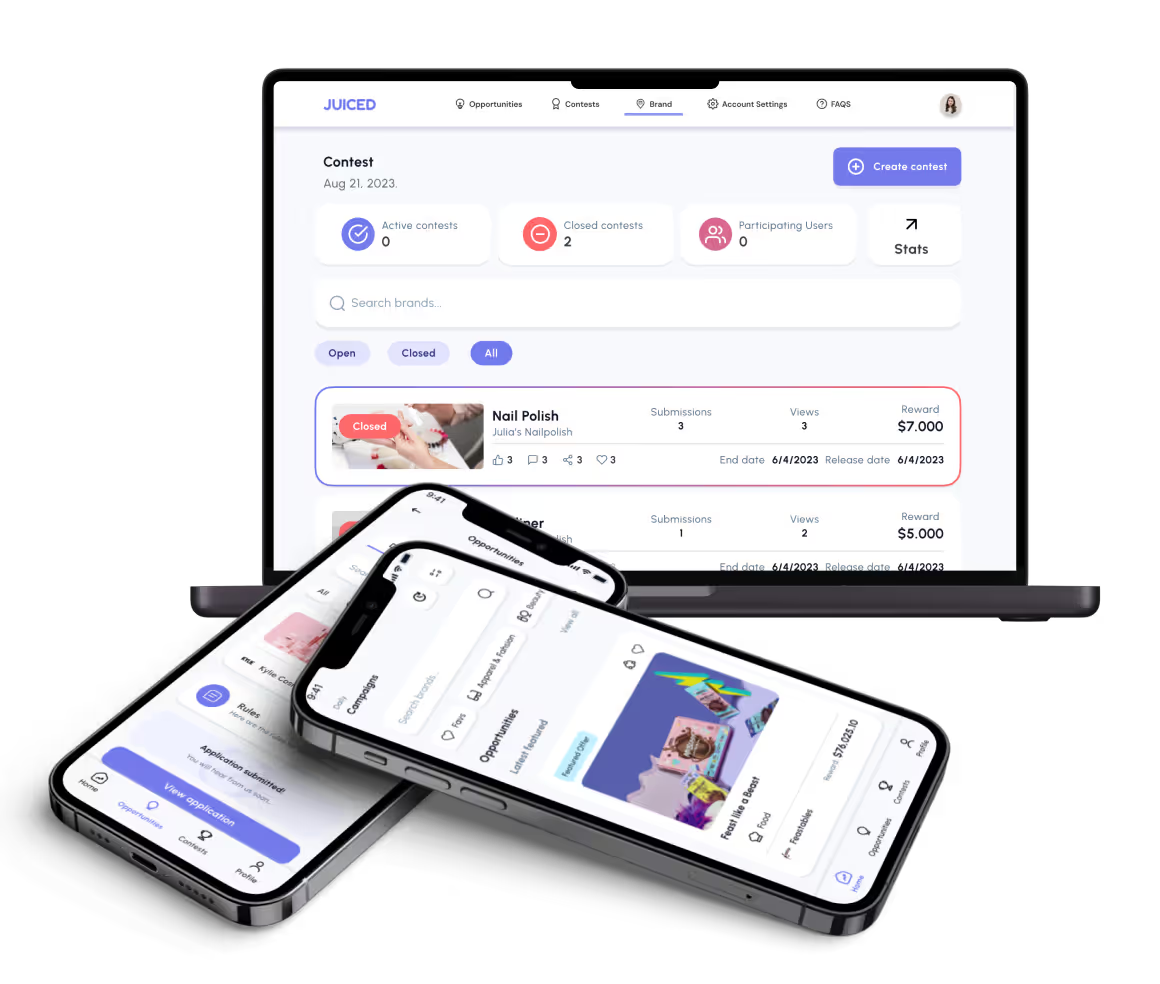

What Can FlutterFlow Build for an Online Store App?
FlutterFlow can deliver product listings, variant selection, cart management, Stripe checkout, order confirmations, customer accounts, search, and product reviews. It covers the full commerce loop for most direct-to-consumer and niche retail use cases.
If your store needs a web presence alongside the mobile app, reviewing FlutterFlow web storefront options will clarify what is achievable across both surfaces.
Product Listing Pages with Dynamic Data
Product grids and list views pull from Firestore or Supabase collections with image, price, and stock status fields rendered dynamically.
- Dynamic collection rendering: Product pages update automatically when inventory data changes in Firestore, without requiring an app update.
- Filtered browsing: Category-based product filtering queries Firestore indexes to return relevant results in real time.
- Image optimization: Product images serve from Firebase Storage or a CDN with configurable display sizes per list and detail view.
Product Detail Pages with Variant Selection
Individual product pages support image galleries, size and color selectors, and per-variant stock availability.
- Image gallery support: Multiple product images display in a swipeable gallery component with thumbnail navigation below.
- Variant data modeling: Size, color, and other attribute combinations store as subcollections in Firestore, each with its own price and stock count.
- Stock availability display: Sold-out variants display as unavailable in the selector, preventing customers from adding out-of-stock options to their cart.
Cart Management with Persistent State
The cart persists across sessions using Firestore user documents so customers never lose items between app opens.
- Cross-session persistence: Cart state saves to the authenticated user's Firestore document and restores on every app open.
- Real-time stock validation: Adding to cart checks current stock in Firestore, preventing customers from adding items that sold out during their session.
- Cart quantity management: Customers update quantities or remove items from cart with changes reflected immediately in the total.
Secure Checkout with Stripe
Stripe payment sheet integration enables card, Apple Pay, and Google Pay in a single native checkout flow.
- Stripe payment sheet: The native Stripe sheet handles card entry, validation, and payment processing without routing customers to a browser.
- Apple Pay and Google Pay support: Wallet payment options display automatically when the customer's device has them configured, reducing checkout friction.
- Webhook order confirmation: Stripe webhooks trigger a Cloud Function to create the confirmed order record in Firestore on successful payment.
Order Confirmation and Receipt Emails
Cloud Functions trigger Mailgun or SendGrid emails on successful Stripe charge events, delivering branded order receipts automatically.
- Automated receipt delivery: Customers receive a branded order confirmation email within seconds of a successful payment, with order details and line items.
- Order record creation: The Cloud Function that sends the receipt also writes the confirmed order to Firestore and decrements inventory counts.
- Transactional email provider flexibility: Mailgun, SendGrid, or Postmark connect via API within the Cloud Function, depending on existing email infrastructure.
Customer Account and Address Book
Registered users manage saved addresses, view order history, and update profile details from a dedicated account section.
- Saved address management: Customers store and select from multiple delivery addresses at checkout, reducing repeat data entry.
- Order history display: Past orders with status, items, and totals pull from the user's Firestore order subcollection and display in a chronological list.
- Profile management: Customers update name, email, and notification preferences from the account screen.
Product Search and Category Browsing
Keyword search and category-filtered browsing query Firestore indexes to return relevant products in real time.
- Full-text keyword search: Firestore search queries on product name and description fields return matching results as the customer types.
- Category navigation: Hierarchical category trees route customers from broad product groupings to specific sub-categories without page reloads.
- Search result ranking: Results order by relevance score or popularity metrics stored as fields on each product document.
Ratings and Reviews
Post-purchase review submissions store per product and display with aggregate star ratings on product detail pages.
- Verified purchase gating: Review submission is available only to customers with a confirmed order containing that product.
- Star rating aggregation: Average rating calculates from all review records and updates on each product's detail page after each new submission.
- Review moderation queue: New reviews enter a pending state visible only to admins until approved for public display.
How Long Does It Take to Build an Online Store App with FlutterFlow?
A simple MVP covering product listings, cart, and checkout takes 4–8 weeks. A full-featured store with reviews, promotions, loyalty features, and an admin panel takes 12–18 weeks. FlutterFlow eliminates the backend scaffolding that consumes the first 2–3 months of custom commerce builds.
- Phased delivery recommended: Ship the core commerce loop first: listings, cart, and checkout. Layer in loyalty and recommendations in a second phase.
- Web scope adds time: Adding a web-optimized store surface alongside the mobile apps extends design and testing cycles by 2–4 weeks.
- Payment provider complexity matters: Stripe is straightforward. Adding alternative payment gateways or regional providers adds integration time.
- App store submission adds time: iOS App Store review for commerce apps adds 1–2 weeks to the initial launch timeline.
A phased delivery approach gets the revenue-generating commerce loop live first while secondary features like reviews and loyalty programmes are built in parallel.
What Does It Cost to Build a FlutterFlow Online Store App?
Build costs range from $15,000–$80,000 depending on feature scope. A simple single-currency store with basic catalogue management sits at the lower end. A full-featured store with admin dashboard, loyalty, and promotions sits at the higher end.
Understanding FlutterFlow plan costs alongside development rates gives you the full picture before scoping your online store.
- Stripe fees are ongoing: Transaction fees apply to every sale and should be modelled against expected revenue volume before launch.
- CDN costs for product images: High-resolution product photography at scale generates meaningful CDN egress costs if not sized and cached correctly.
- Third-party review and analytics tools: Email delivery services, analytics platforms, and review management tools each add monthly subscription costs beyond the build.
Model your monthly Firebase and transaction costs at expected order volumes before finalising budget with any developer or agency.
How Does FlutterFlow Compare to Custom Development for an Online Store?
FlutterFlow builds an online store in 8–18 weeks for $20,000–$80,000. Custom development for an equivalent feature set takes 9–18 months and costs $80,000–$200,000 or more. The gap closes only when a store needs enterprise-level logistics, headless architecture, or advanced SEO.
FlutterFlow wins for new brands, MVP validation, and mobile-first stores with limited SKU counts.
- Maintenance advantage: FlutterFlow reduces long-term developer dependency for catalogue updates, promotional configuration, and product page changes.
- Custom wins for complex logistics: High-volume stores needing multi-warehouse fulfilment, advanced carrier rate shopping, or EDI integrations require a custom build.
- FlutterFlow is not Shopify: It cannot replicate a 10,000-plugin marketplace ecosystem. For stores dependent on a specific Shopify app, evaluate that dependency before switching.
If FlutterFlow does not fit your store's requirements, reviewing alternatives to FlutterFlow will surface other no-code and low-code options worth evaluating.
What Are the Limitations of FlutterFlow for an Online Store App?
The most significant limitations for online stores are web SEO, real-time inventory sync with external systems, promotional logic complexity at scale, and Firestore query limits at high traffic volumes. These are manageable for most DTC brands but real constraints for high-volume operations.
Before processing live transactions, understanding FlutterFlow payment security architecture is essential for any online store.
- Web SEO limitations: FlutterFlow's web output lacks the URL control and server-side rendering that search engines prefer for product pages. A product catalogue dependent on organic search traffic will underperform expectations.
- Real-time inventory sync requires middleware: Connecting to Shopify, a warehouse system, or an ERP for live stock updates requires custom API middleware. FlutterFlow has no native connector for external inventory systems.
- App store approval delays affect launch timing: iOS App Store review for commerce apps can take 1–2 weeks. Plan around this rather than treating it as an edge case.
- Promotional stacking rules are complex to maintain: Discount codes, tiered pricing, bundle offers, and stacking rules become difficult to manage in FlutterFlow's visual logic editor at scale.
- Firestore query limits at high traffic: Simultaneous high-traffic product browsing requires careful Firestore index planning and query optimization that not all FlutterFlow developers are equipped to deliver.
- Vendor dependency: Platform updates can affect live apps. Code export is available for teams that need full Flutter/Dart codebase ownership.
SEO limitations are the most commonly underestimated constraint for online stores. Brands expecting significant organic traffic from product pages need to evaluate this honestly before choosing FlutterFlow.
How Do You Find the Right Team for a FlutterFlow Online Store App?
Finding a top FlutterFlow agency with commerce-specific experience reduces the risk of architecture mistakes in inventory data modeling and cart state that are expensive to unwind later.
Look for proven Stripe integrations, Firestore data modeling experience for product catalogues, and an app store submission track record alongside strong FlutterFlow proficiency.
- Freelancer vs agency: Freelancers can handle simple stores with limited SKUs. Agencies suit multi-phase projects requiring admin dashboards, promotions logic, and ongoing feature development.
- Red flag: no live store examples: A developer without a live FlutterFlow commerce app in their portfolio has not solved the real-world problems that only surface in production.
- Red flag: vague inventory architecture: Product variant data modeling and cart persistence are complex decisions with long-term maintenance implications. A developer without clear answers here will create technical debt.
- Red flag: no milestone definition: Vague delivery timelines without phase checkpoints make it impossible to track progress or catch scope creep.
- Key question to ask: "How do you handle cart persistence across sessions?" The answer reveals whether the developer understands Firestore data modeling for commerce.
- Key question to ask: "Can you show a live Stripe integration with webhook order confirmation?" This validates the most critical technical piece of the checkout flow.
Expect scoping in week one, design system in weeks two and three, and the build phase running from week four through week fourteen for a full-featured store.
Conclusion
FlutterFlow is a strong fit for building an online store app. It covers the full commerce experience and delivers in a fraction of the custom development timeline.
The limitations around web SEO, inventory sync, and Firestore scale need to be understood before committing, particularly for brands expecting significant organic search traffic.
Define your product catalogue size and web versus mobile priority before evaluating FlutterFlow. An experienced team can confirm whether the platform fits your specific requirements within a single scoping call.
Building an Online Store App with FlutterFlow? Here Is How LOW/CODE Agency Approaches It.
Most FlutterFlow commerce builds go wrong in the data model, not the UI. Cart persistence breaks, inventory counts go stale, and promotional logic becomes unmanageable because the Firestore architecture was not designed for commerce from the start.
At LOW/CODE Agency, we help SMBs compete with AI-powered software built for them — custom web and mobile apps, RAG systems, chatbots, and intelligent agents delivered by a senior development team. We build FlutterFlow online stores with the inventory architecture, cart state management, and Stripe integration designed correctly from day one, so the system works under real customer behaviour, not just demo conditions.
- Commerce data modeling: We design the Firestore product, variant, cart, and order structure before writing a single screen, so the architecture supports real catalogue complexity.
- Stripe integration with webhooks: We implement the full Stripe payment sheet and webhook order confirmation flow so every successful payment creates a reliable order record.
- Cart persistence and session management: We build cart state into the authenticated user document so customers never lose items between app opens or device switches.
- Product and inventory management: We deliver the admin interface so your team manages products, variants, and stock counts without developer involvement after launch.
- App store submission: We handle iOS and Android submission including commerce-specific review requirements, reducing the risk of rejection delays.
- SEO and web strategy: We give you an honest assessment of web SEO limitations before building, and recommend the right architecture for your traffic acquisition strategy.
- Post-launch iteration: We stay engaged through the first trading period, refining search, promotions, and performance as real customer behaviour emerges.
We have built 350+ products for clients including Coca-Cola, American Express, and Sotheby's. We know exactly where commerce builds expose data modeling gaps, and we address those decisions before a single customer adds to cart.
Related Articles
- How to Build a Partner CRM Platform with FlutterFlow
- How to Build a Peer-to-Peer Payments App with FlutterFlow
- How to Build an Order Management System with FlutterFlow
- How to Build an Online Exam System with FlutterFlow
- How to Build Nonprofit Apps with FlutterFlow
- How to Build an NGO Project Tracking App with FlutterFlow
Partner with our low-code development experts to bring your app idea to life faster.
Last updated on
September 24, 2026
.

Jesus is a visionary entrepreneur and tech expert. After nearly a decade working in web development, he founded LOW/CODE Agency to help businesses optimize their operations through custom software solutions.


FAQs
What are the first steps to create an online store app in FlutterFlow?
How do I add product listings and categories in FlutterFlow?
Can I integrate payment gateways in a FlutterFlow online store app?
What is the best way to handle user authentication in FlutterFlow?
How do I test and deploy my FlutterFlow online store app?
Are there limitations when building an online store app with FlutterFlow?
Related Articles
Comparison
FlutterFlow
FlutterFlow vs Flutter | Which One Should You Use in 2026?
Compare FlutterFlow vs Flutter to see which fits your app. Learn differences in speed, scalability, control, costs, and when each makes sense in 2026.

FlutterFlow
Hire FlutterFlow Developers (Cost, Vetting & Tips)
Hiring FlutterFlow developers? See real costs, vetting checklist, red flags, and what founders often get wrong before you decide.

FlutterFlow
How to Build an Employee Onboarding App with FlutterFlow
Learn how to create an employee onboarding app using FlutterFlow with step-by-step guidance and best practices.

FlutterFlow
11 FlutterFlow Best Practices (for Building Scalable Apps)
Discover 11 FlutterFlow best practices to build scalable apps, avoid common mistakes, improve performance, and structure FlutterFlow projects correctly.


Why customers trust us for no-code development


