

How to Build a SaaS App with FlutterFlow
13 min
read
Learn step-by-step how to create a SaaS app using FlutterFlow with no coding skills required. Start building your app today.


FlutterFlow SaaS app development has moved well beyond simple consumer apps. Founders are shipping multi-tenant platforms, Stripe-billed subscription tools, and role-based dashboards in weeks, not quarters. The question is not whether FlutterFlow can handle SaaS; it is whether it can handle yours.
This guide covers what FlutterFlow actually delivers for SaaS use cases, where the platform hits real ceilings, and how to decide whether it fits your product roadmap before committing a development budget.
Key Takeaways
- Multi-tenancy requires manual design: FlutterFlow has no built-in tenant isolation; you must architect it through Firestore rules or Supabase row-level security.
- Stripe billing works via API calls: Subscription plans, webhooks, and trial periods all function but require custom action configuration to handle reliably.
- Role-based permissions need custom logic: FlutterFlow's conditional visibility handles basic RBAC but complex permission trees require backend enforcement.
- Time to MVP is 6–14 weeks: A focused SaaS MVP with auth, billing, and core workflow ships faster than any native alternative at comparable quality.
- Cost scales with complexity: Platform fees are low; developer time and backend infrastructure are where SaaS budgets expand at production scale.
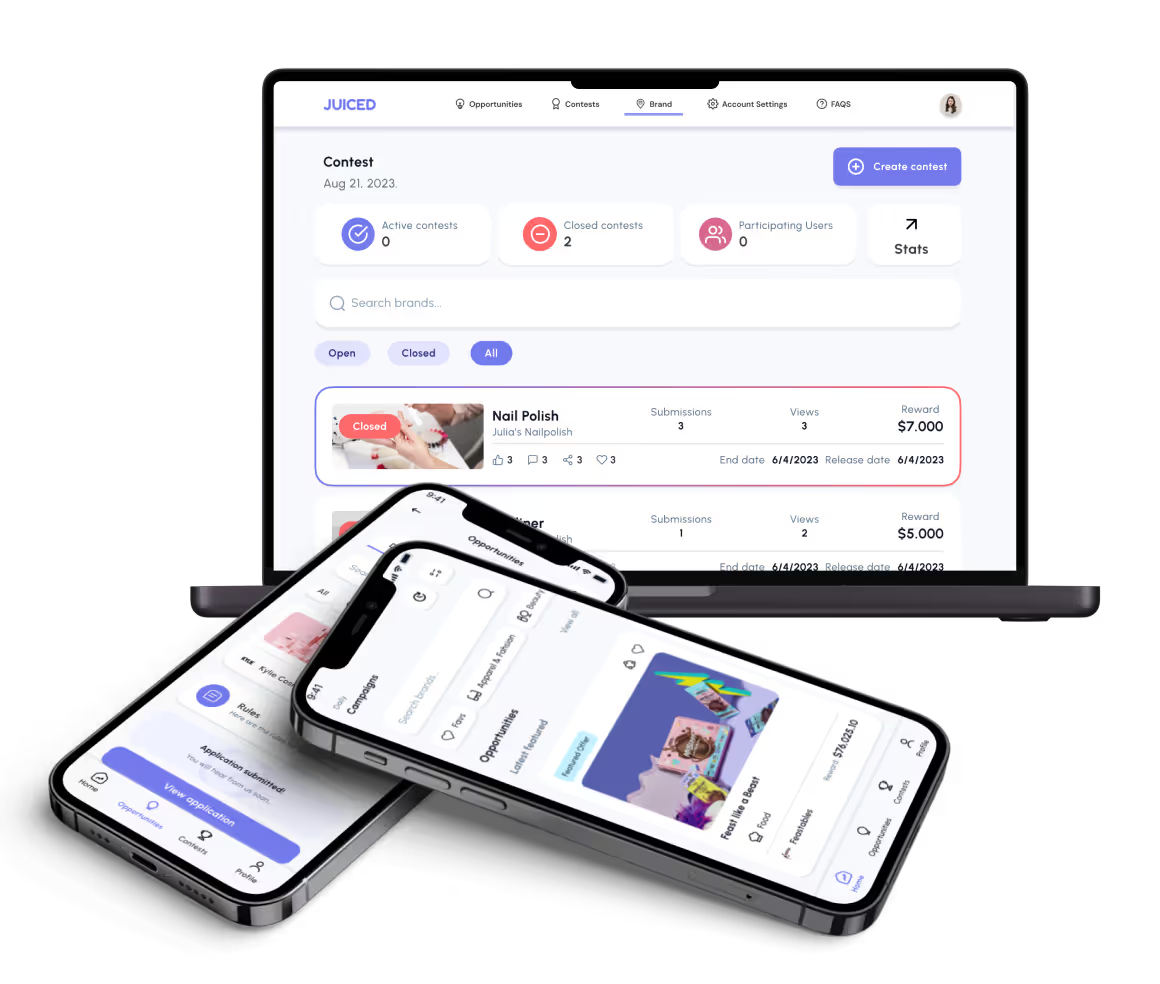

What Can FlutterFlow Build for SaaS?
FlutterFlow can build the full client-facing layer of a SaaS product: authentication, onboarding, subscription billing, role-based dashboards, team collaboration, and white-label theming. Multi-tenancy and Stripe webhook handling require deliberate backend architecture.
Before diving into specific features, it helps to understand what it means to build a SaaS with FlutterFlow at a structural level before scoping your data model.
User Authentication and Onboarding Flows
FlutterFlow's Firebase Auth and Supabase integrations cover email, Google, Apple, and SSO login out of the box. Onboarding wizard UI builds visually without custom code.
- Authentication options: Email, Google, Apple, and SSO login all work natively through Firebase Auth or Supabase, covering the majority of SaaS login requirements.
- Onboarding wizard UI: Multi-step onboarding flows with conditional branching, progress indicators, and role capture build visually in FlutterFlow without custom widget code.
- Post-auth routing: Users route to role-appropriate screens immediately after authentication, controlled by app state variables tied to the user's role field in the database.
Multi-Tenant Data Architecture
Tenant isolation is achieved by structuring Firestore collections or Supabase schemas with org-scoped records. Access is enforced via security rules tied to the authenticated user's organization ID.
- Firestore tenant scoping: Every collection query filters by organization ID, ensuring users only retrieve and modify records belonging to their own tenant account.
- Supabase row-level security: RLS policies enforce tenant isolation at the database layer, preventing cross-tenant data access regardless of application-layer logic.
- Security rule design: Firestore security rules must be explicitly written to deny cross-tenant reads and writes; default rules do not provide isolation without deliberate configuration.
Subscription Billing via Stripe
Stripe Checkout, customer portal, webhook listeners, and plan-gating logic all integrate through FlutterFlow's custom API call system. Trial periods and upgrade flows are configurable.
- Stripe Checkout integration: FlutterFlow launches Stripe Checkout via a custom API call, handling plan selection and payment capture without building a custom payment UI.
- Webhook listener configuration: Stripe subscription events, including renewals, cancellations, and failed payments, require Cloud Functions or Edge Functions to handle reliably at production volume.
- Plan gating logic: Feature access tied to subscription tier enforces via app state variables set after webhook confirmation, locking or unlocking UI elements per user plan.
Role-Based Access Control
Admin, manager, and member permission tiers enforce using app state variables and conditional widget visibility tied to user role fields in the database.
- Role field enforcement: User role data stored in Firestore or Supabase drives conditional visibility rules throughout the app, showing or hiding features per permission level.
- Backend rule backup: Critical RBAC rules enforce at the database security rule layer, preventing unauthorized data access even if the app-layer visibility logic has gaps.
- Role management UI: Admins assign and modify team member roles through a management screen without requiring developer intervention for routine permission changes.
Core SaaS Dashboard UI
KPI widgets, data tables, chart components, and navigation shells build visually with full responsiveness for web and mobile. FlutterFlow's responsive layout engine handles most SaaS dashboard patterns well.
- KPI widget design: Summary cards, metric tiles, and trend indicators build quickly in FlutterFlow's visual editor with dynamic data binding from Firestore or Supabase queries.
- Data table components: Paginated, filterable data tables for transaction history, user lists, and activity logs render cleanly on both web and mobile screen sizes.
- Chart components: FlutterFlow's built-in chart widgets handle bar charts, line graphs, and pie charts for standard SaaS analytics without third-party charting libraries.
Team Collaboration Features
Shared workspaces, activity feeds, comment threads, and real-time Firestore listeners enable lightweight collaboration. This covers the core needs of most B2B SaaS products without a custom backend.
- Real-time activity feeds: Firestore listeners update shared workspaces in real time as team members create or modify records, without requiring page refreshes.
- Comment threads: Comment collections scoped to individual records allow team discussion without leaving the workflow context inside the SaaS product.
- Shared workspace data: Records created by one team member are immediately visible to all authorized colleagues in the same organization through tenant-scoped queries.
White-Labeling Options
Custom themes, dynamic branding by tenant, and subdomain routing are configurable. Full white-label deployments require careful custom domain management outside the FlutterFlow editor.
- Dynamic tenant branding: Logo, color scheme, and brand assets load from tenant configuration records in the database, rendering the correct branding for each organization at login.
- Custom domain routing: Subdomain-based white-labeling requires configuration at the hosting and DNS level; FlutterFlow's web build supports this when deployed to Firebase Hosting.
- Theme configuration UI: Tenant admins update their brand settings through a configuration screen, applying changes to all team member sessions without redeployment.
How Long Does It Take to Build a SaaS App with FlutterFlow?
A simple SaaS MVP with authentication, billing, and two core screens takes 4–6 weeks. A full-featured SaaS with multi-tenancy, RBAC, dashboard, and third-party integrations takes 12–20 weeks.
Timeline factors include data model complexity, number of user roles, third-party API count, and custom logic requirements. FlutterFlow typically saves 40–60% of build time versus a Flutter-from-scratch team.
- Simple MVP timeline: Authentication, Stripe billing, and two core workflow screens ship in 4–6 weeks with a focused scope and experienced FlutterFlow developer.
- Full platform timeline: Multi-tenancy, RBAC, multi-screen dashboard, and two or more API integrations extend the build to 12–20 weeks depending on complexity.
- Data model complexity factor: A poorly designed Firestore or Supabase schema for multi-tenancy requires complete restructuring mid-build, adding 3–5 weeks to any timeline.
- Third-party API count: Each additional integration, including email providers, analytics tools, and CRM connections, adds 1–2 weeks per integration to the full platform build.
- Phased approach advantage: Shipping authentication and core workflow first, then layering billing and admin in phase two, reduces launch risk and generates user feedback earlier.
A phased approach also gives your team real production data to validate which features genuinely warrant the complexity before building them.
What Does It Cost to Build a FlutterFlow SaaS App?
FlutterFlow SaaS apps cost $15,000–$60,000 for a developer build and $20,000–$80,000 for an agency build. Custom Flutter development for equivalent scope typically doubles the build time and cost.
Before estimating your total budget, review FlutterFlow pricing plans to understand where platform costs sit relative to development spend and backend infrastructure.
- Platform cost is minimal: FlutterFlow's monthly subscription is a small fraction of total SaaS build cost; backend and development time drive the budget.
- Freelancer vs agency tradeoff: Freelancers suit MVPs under $30,000; agencies better for ongoing SaaS products needing architecture guidance and roadmap support.
- Stripe webhook infrastructure: Reliable webhook handling requires Cloud Functions or Edge Functions, adding backend engineering cost often omitted from initial developer quotes.
- Firestore cost spike risk: High-volume Firestore reads can generate unexpected monthly costs; plan for Supabase or a custom backend above 100,000 monthly active users.
- Hidden cost: error monitoring: Production SaaS without error monitoring generates support tickets that cost far more than the monitoring tool itself.
Budget a contingency of 15–20 percent for integration complexity and backend configuration that detailed scoping surfaces after discovery begins.
How Does FlutterFlow Compare to Bubble, Glide, and Adalo for SaaS?
FlutterFlow is faster for mobile-first SaaS and produces native app output. Bubble edges ahead for complex web-only workflows with deeply relational data. Both outpace custom development for time-to-market.
- Mobile-first advantage: FlutterFlow produces native iOS and Android apps alongside a web version from one codebase; Bubble's mobile output is a web wrapper, not native code.
- Bubble's workflow edge: Bubble's native relational database and workflow automation handle complex multi-step business logic without custom actions or backend functions.
- Predictable cost structure: Bubble charges per workflow run at scale, creating unpredictable costs; FlutterFlow's costs are more predictable because the database is external and separately priced.
- Code export as exit ramp: FlutterFlow exports Flutter code if you outgrow the platform; Bubble offers no equivalent, creating vendor dependency with no graceful exit path.
- When FlutterFlow wins: Cross-platform SaaS with iOS, Android, and web, mobile-first UX requirements, and fast MVP delivery timelines.
For a full side-by-side, the Bubble vs FlutterFlow breakdown covers pricing, workflow logic, and long-term scalability in detail.
What Are the Limitations of FlutterFlow for SaaS Development?
Multi-tenancy, Stripe webhook reliability, and Firestore cost spikes are the three limitations most likely to cause production problems. None are blockers, but all require deliberate planning before build begins.
Review the FlutterFlow scalability limits before architecting your data layer; expensive re-engineering at growth stage is preventable with early planning.
- No native multi-tenancy: Every data query and security rule must manually enforce tenant isolation; there is no platform-level tenant separation to inherit by default.
- Stripe webhook fragility: Webhook events handled purely through FlutterFlow custom actions miss reliability; Cloud Functions or Edge Functions are required for production-grade subscription management.
- Visual logic complexity: Deeply nested conditional flows become hard to debug in the canvas; complex permission trees or multi-step business logic benefit from backend function offloading.
- Firestore cost spikes: High read volume at scale generates unpredictable Firestore costs; plan for Supabase or a custom backend API layer above 100,000 monthly active users.
- Vendor dependency risk: FlutterFlow platform updates can break existing project configurations; code export mitigates but does not eliminate this risk for production SaaS products.
- Code export cleanup required: Exported Flutter code is functional but requires cleanup and refactoring before a native development team can maintain it efficiently.
How Do You Get a FlutterFlow SaaS App Built?
You need a developer with Firebase or Supabase data modeling experience, Stripe API integration knowledge, and a demonstrable SaaS portfolio. General FlutterFlow developers without backend and multi-tenant experience will create technical debt.
Knowing how to hire FlutterFlow developers with real SaaS experience is the difference between a clean architecture and a rebuild six months later.
- Required expertise: Firebase or Supabase data modeling, Stripe webhook integration, FlutterFlow custom actions, and demonstrated multi-tenant architecture experience are baseline requirements.
- Freelancer vs agency: Freelancers suit MVPs under $30,000 with limited integration scope; agencies are better for ongoing SaaS products needing roadmap support beyond initial launch.
- Red flag: no live SaaS references: A developer without a verifiable live SaaS product built in FlutterFlow has not encountered the multi-tenancy and webhook reliability challenges that matter most.
- Key question on multi-tenancy: Ask specifically how they have structured Firestore or Supabase security rules for tenant isolation in a previous project before committing to a contract.
- Expected discovery timeline: A credible team delivers a scoping proposal within 1–2 weeks of an initial call, covering data model, integration plan, and phased build timeline.
Interview at least two developers or agencies and request references from SaaS clients before committing to a build contract.
Conclusion
FlutterFlow is a legitimate SaaS development platform for founders who need cross-platform reach and speed to market, provided the data architecture is designed correctly from day one. Multi-tenancy and Stripe webhooks require deliberate planning, but neither is a blocker.
Map your SaaS requirements against the feature and limitation list above, then check whether FlutterFlow's ceiling aligns with your 18-month product roadmap before committing a development budget.
Building a SaaS App with FlutterFlow? Here Is How LOW/CODE Agency Approaches It.
SaaS builds on FlutterFlow fail most often at multi-tenancy design, Stripe webhook reliability, and Firestore scaling. Getting these right from the start is the difference between a product that grows and one that needs rebuilding at 10,000 users.
SMBs do not need a no-code tool. They need an AI product team. At LOW/CODE Agency, we build custom web apps, mobile apps, chatbots, and AI agents — software that actually scales with your business. We build FlutterFlow SaaS applications with production-ready architecture behind them: multi-tenant data models, Stripe subscription integration, role-based access control, and scalable backend configuration from a team that has delivered SaaS products across industries.
- Multi-tenant architecture design: We structure Firestore or Supabase schemas with tenant isolation enforced at both the database security rule layer and the application query layer.
- Stripe billing integration: We configure Checkout, customer portal, webhook handling via Cloud Functions, and plan-gating logic so subscription management works reliably from day one.
- RBAC implementation: We build role-based permission systems with backend enforcement so feature access is controlled at the data layer, not just the UI visibility layer.
- SaaS dashboard build: We design KPI dashboards, data tables, chart components, and admin screens across web and mobile from a shared FlutterFlow codebase.
- Scalability planning: We architect your Firebase or Supabase backend with indexing, caching, and query optimization that prevents cost spikes and performance degradation as your user base grows.
- Phased delivery: We scope and ship your authentication and core workflow MVP first, then layer in billing, admin, and integrations so you get user feedback at each stage.
- Full product team: Strategy, UX, development, and QA from a single team so your SaaS product is production-ready, not just technically functional at demo stage.
We have built 350+ products for clients including Coca-Cola, American Express, and Sotheby's. We know how to scope and deliver FlutterFlow SaaS applications that scale past launch.
Related Articles
- How to Build a Savings Tracker App with FlutterFlow
- How to Build a Salon Booking App with FlutterFlow
- How to Build a Sales CRM App with FlutterFlow
- How to Build a Route Optimization App with FlutterFlow
- How to Build a Ride Sharing App with FlutterFlow
- How to Build a Points Rewards App with FlutterFlow
Partner with our low-code development experts to bring your app idea to life faster.
Last updated on
September 24, 2026
.

Jesus is a visionary entrepreneur and tech expert. After nearly a decade working in web development, he founded LOW/CODE Agency to help businesses optimize their operations through custom software solutions.


FAQs
What is the first step to create a SaaS app in FlutterFlow?
Can FlutterFlow handle user authentication for SaaS apps?
How do I integrate payment processing in a FlutterFlow SaaS app?
Is FlutterFlow suitable for building scalable SaaS applications?
What are common challenges when building SaaS apps with FlutterFlow?
How can I test and deploy my SaaS app built with FlutterFlow?
Related Articles

FlutterFlow
How to Build a Brand Collaboration App with FlutterFlow
Learn how to create a brand collaboration app using FlutterFlow with step-by-step guidance and expert tips for smooth app development.

FlutterFlow
How to Build a Dropshipping App with FlutterFlow
Learn how to create a dropshipping app using FlutterFlow with step-by-step guidance and tips for beginners.

FlutterFlow
How to Build an Insurance Claim App with FlutterFlow
Learn how to create an insurance claim app using FlutterFlow with step-by-step guidance and key features to include.

FlutterFlow
How to Build a Stock Trading Dashboard with FlutterFlow
Learn how to create a stock trading dashboard using FlutterFlow with step-by-step guidance and tips for beginners.


Why customers trust us for no-code development


