

How to Build Customer Loyalty Apps with FlutterFlow
14 min
read
Learn how to create customer loyalty apps using FlutterFlow with step-by-step guidance and best practices for success.


Monthly SaaS fees for loyalty platform software eat into the margin that loyalty programmes are supposed to protect. FlutterFlow customer loyalty apps let businesses own the platform and the customer data outright.
A custom-built loyalty app means no per-customer licensing fees, no constraints on your reward catalogue, and a branded experience your customers associate with you rather than a third-party tool. This guide covers what FlutterFlow can build, what it costs, and where the limitations are.
Key Takeaways
- Core loyalty mechanics work natively: Points earning, reward catalogues, tier progression, and push notifications are all achievable without custom code.
- Points calculation must be server-side: Accurate, tamper-resistant points balances require Firestore transactions and Cloud Functions, not client-side arithmetic.
- POS integration is the most complex element: Connecting to Square, Toast, or Lightspeed to earn points on in-store purchases requires API integration or middleware.
- Gamification is a strong fit: Badges, streaks, challenges, and leaderboards work well within FlutterFlow's data and UI capabilities.
- Break-even is typically 6–12 months: A custom FlutterFlow app eliminates ongoing per-customer licensing fees that SaaS loyalty platforms charge.

What Can FlutterFlow Build for Customer Loyalty?
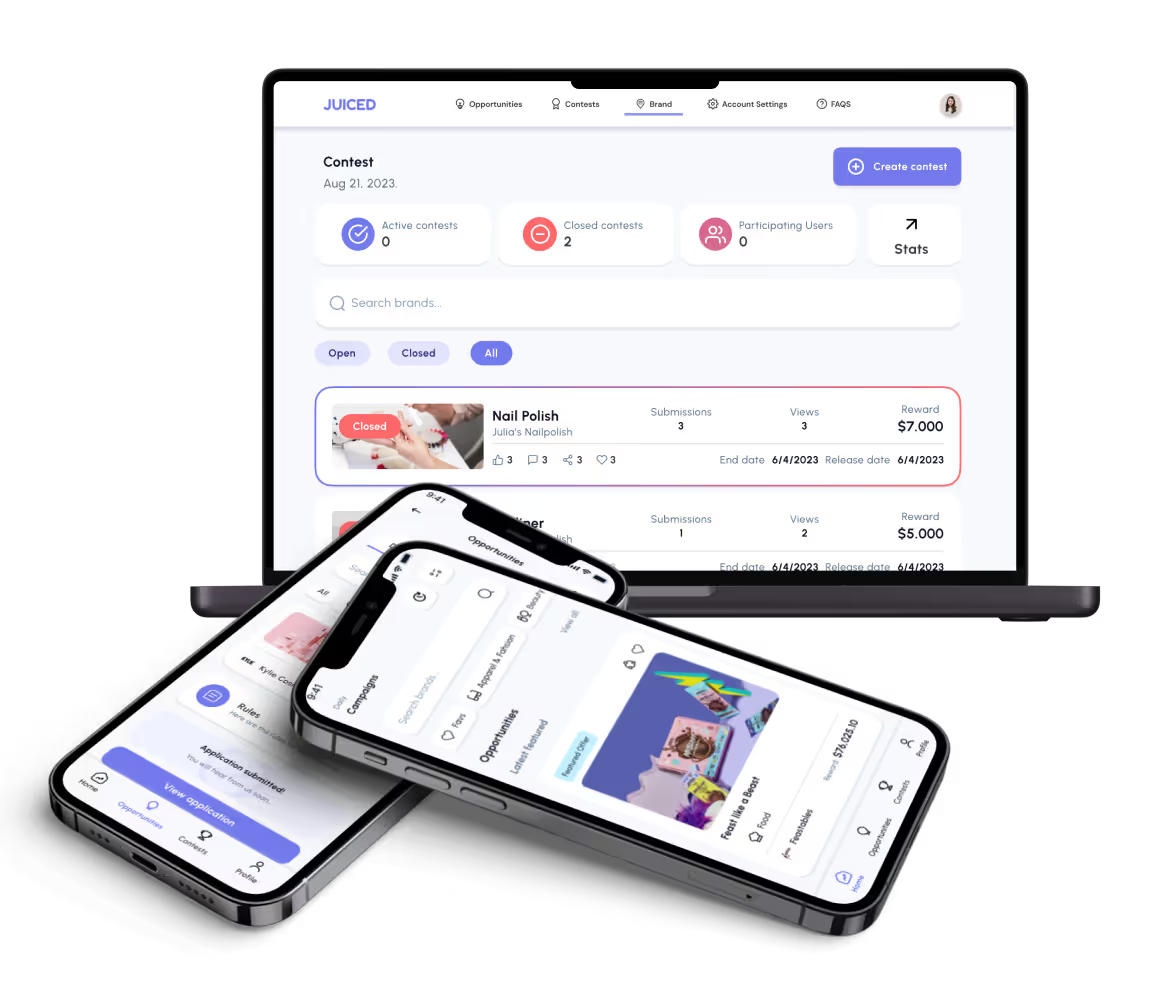
FlutterFlow can build all the core mechanics of a customer loyalty app: points earning and redemption, reward catalogues, tier progression, digital stamp cards, gamification challenges, push notification campaigns, and a business admin dashboard. The platform handles the full customer-facing and manager-facing experience.
FlutterFlow loyalty app examples from retail and hospitality show how these mechanics translate into production customer programmes.
Points Earning and Balance Tracking
Award points for purchases, referrals, check-ins, and engagement actions, displaying a live running balance per customer on their loyalty dashboard.
- Multiple earning triggers: Points award automatically for purchases, referrals, app check-ins, social shares, and custom engagement actions defined in the backend logic.
- Live balance display: The customer's current points balance updates in real time after each earning event, confirming the transaction was recorded.
- Earning history log: A transaction log shows each points-earning event with date, action type, and points awarded for full customer transparency.
Reward Catalogue and Redemption
Build a browsable reward catalogue where customers spend points on discounts, free products, or experiences, with redemption confirmation and receipt.
- Browsable catalogue layout: Rewards display as cards with point cost, description, and availability status so customers can browse and compare options easily.
- Redemption confirmation flow: A multi-step redemption confirms the customer's intent, deducts points from their balance, and generates a redemption code or receipt.
- Server-side redemption validation: All redemption logic runs through Cloud Functions to prevent double-spend and replay attacks, client-side redemption is a fraud risk.
Loyalty Tier Progression
Create Gold, Platinum, and VIP tiers that unlock automatically when point thresholds are reached, with tier-specific benefits and visual status indicators.
- Automatic tier upgrades: When a customer crosses a tier threshold, their status updates automatically without manual intervention from store staff.
- Tier-specific benefit display: Each tier shows its exclusive benefits clearly, bonus point multipliers, early access, free delivery, so customers understand the value of progressing.
- Visual tier indicators: Progress bars and tier badges display on the customer's profile to motivate continued engagement toward the next tier level.
Digital Stamp Cards
Implement digital punch card experiences with QR code or in-store scan validation, nine coffees earn the tenth free, for example.
- QR code validation: Each stamp generates from a unique QR code displayed at the point of sale, preventing manual manipulation of the stamp count.
- Configurable stamp goals: The number of stamps required for a reward is set in the admin dashboard and can be changed per campaign without a code deployment.
- Multi-card support: Customers can hold separate stamp cards for different product types or locations within the same loyalty app.
Gamification and Engagement Challenges
Build time-limited challenges, double points weekends, referral bonus weeks, with progress trackers, badges, and streak counters to drive repeat visits.
- Time-limited challenge engine: Challenges run for a defined period with a countdown timer, driving urgency and concentrated visit frequency during the campaign window.
- Badge and streak system: Customers earn badges for completing challenges and maintain streaks for consecutive visit days, both display prominently on their profile.
- Leaderboard display: An opt-in leaderboard shows top-earning customers within a tier or location, adding social engagement to the programme.
Push Notification Campaigns
Send personalised offers, reward expiry reminders, and tier upgrade congratulations through Firebase Cloud Messaging segmented by loyalty tier.
- Tier-segmented campaigns: Push notifications target specific loyalty tiers so Gold members receive different messages from Platinum or VIP members.
- Triggered notification types: Automated notifications fire on reward expiry, tier upgrade, challenge completion, and points milestone events without manual send.
- Campaign scheduling: Store managers schedule push campaigns through the admin dashboard for specific dates and times without developer involvement.
Business Admin Dashboard
Provide store managers with a portal to view customer loyalty data, run point promotions, and export campaign performance reports.
- Customer loyalty overview: Managers see total active members, tier distribution, redemption rates, and campaign performance metrics in one view.
- Point promotion tools: Managers activate bonus point multipliers and limited-time challenges from the admin dashboard without touching code.
- Data export capability: Customer loyalty data and campaign performance reports export as CSV for use in external analytics or marketing tools.
The admin dashboard gives marketing teams direct control over promotions and campaigns without needing developer involvement after launch.
How Long Does It Take to Build a Customer Loyalty App with FlutterFlow?
A simple loyalty MVP with points balance, basic reward catalogue, and push notifications takes 5–8 weeks. A full-featured loyalty platform with tiers, gamification, POS integration, and an admin dashboard takes 10–18 weeks. POS integration is consistently the most time-consuming single feature in the build.
The phased approach gets the core loyalty mechanics into customers' hands faster while POS integration is built in parallel.
- POS integration timeline: Connecting to Square, Toast, or Lightspeed for real-time in-store points earning typically adds 3–6 weeks to the build depending on the POS API complexity.
- Multi-location support adds time: Supporting multiple store locations with separate staff codes, location-based analytics, and manager access roles adds complexity to both data architecture and UI.
- Phased delivery works best: Launch the mobile-first points earning and catalogue app first; integrate POS for in-store earning in phase two once the core programme is validated.
- 40–55% faster than custom: FlutterFlow delivers a loyalty app significantly faster than a bespoke custom build for the same feature set.
Founders building a loyalty SaaS built in FlutterFlow to serve multiple client businesses should plan the data isolation architecture before the first line of development.
What Does It Cost to Build a FlutterFlow Customer Loyalty App?
A FlutterFlow customer loyalty app typically costs $15,000–$55,000 for a developer build. Agency builds for full loyalty platforms with POS integration run $22,000–$70,000. The break-even against third-party loyalty SaaS platforms typically falls within 6–12 months of programme operation.
The FlutterFlow plan cost overview is the first number to nail down, as it determines which API and integration features are available at your subscription level.
- Ongoing Firebase costs scale with your member base: Firestore read/write costs grow as your loyalty programme gains members and transaction volume, design your data queries efficiently from the start.
- POS middleware cost: If your POS system does not offer a direct API, a middleware service for integration adds a recurring monthly cost that must be factored into the programme economics.
- SaaS break-even: Custom FlutterFlow apps eliminate per-customer licensing fees charged by platforms like Stamp Me, Loyalty Lion, and Yotpo, break-even typically arrives within 6–12 months.
- Reward fulfilment tracking: If your reward catalogue includes physical products, a fulfilment tracking system is an additional cost that third-party loyalty platforms typically handle natively.
For most independent retailers, restaurant groups, and hospitality businesses, the 12-month break-even makes a compelling case for a custom build over perpetual SaaS fees.
How Does FlutterFlow Compare to Custom Development for Customer Loyalty Apps?
FlutterFlow delivers a loyalty MVP in 5–8 weeks versus 4–8 months for a fully custom build. Build cost is 40–60% less at the development stage. The capability ceiling falls on complex multi-currency points systems, coalition loyalty networks, and real-time POS sync at enterprise scale.
For independent retailers, restaurant groups, boutique hotel chains, and service businesses, FlutterFlow covers the full requirements without hitting that ceiling.
- FlutterFlow wins for: Independent retailers, restaurant groups, boutique hotel chains, and service businesses with straightforward loyalty mechanics.
- Custom wins for: Multi-brand coalition programmes, enterprise retail with complex POS ecosystems, and financial services rewards platforms requiring real-time transaction sync at scale.
- Marketing team autonomy: FlutterFlow's admin dashboard lets marketing teams update challenges, rewards, and campaigns without involving a developer, a significant operational advantage.
For businesses where FlutterFlow's integration ceiling is a constraint, reviewing FlutterFlow loyalty platform alternatives helps identify purpose-built or custom-coded paths.
What Are the Limitations of FlutterFlow for Customer Loyalty Apps?
Points balances cannot be calculated client-side in FlutterFlow without creating a fraud risk. All balance updates must go through Cloud Functions with Firestore transactions. POS integration for in-store earning is outside FlutterFlow's native capability and requires API integration or middleware. These are real constraints that must be scoped and budgeted before the build begins.
Planning for FlutterFlow loyalty programme scale from the outset prevents the Firestore architecture mistakes that surface when a loyalty base grows rapidly.
- Server-side points are mandatory: Points awarded by client-side FlutterFlow logic can be manipulated by users, all balance updates must go through Cloud Functions with Firestore transactions for integrity.
- POS integration requires API work: Connecting to in-store point-of-sale systems like Square, Toast, and Lightspeed is outside FlutterFlow's native capability and requires dedicated API integration or middleware.
- Redemption fraud prevention: High-value reward redemptions need server-side validation to prevent double-spend and replay attacks, client-side redemption handling is not sufficient.
- Coalition loyalty complexity: Sharing points across multiple brands or business entities requires a data architecture that exceeds FlutterFlow's visual logic builder capability.
- Real-time POS sync at scale: Large retail chains with thousands of daily transactions need a robust event-driven backend, not direct Firestore client writes from in-store events.
- Code export available: On paid FlutterFlow plans, exporting the Flutter code allows developers to extend the app with custom logic when platform limits are reached.
None of these limitations are blockers for typical independent business loyalty programmes, but they must be on the project specification before a developer is briefed.
How Do You Get a FlutterFlow Customer Loyalty App Built?
Look for a team with Firestore transaction handling expertise, Cloud Functions experience for server-side award logic, POS API integration capability, and gamification data modelling knowledge. Points integrity is a trust issue for your customers, the team you hire must treat server-side validation as non-negotiable from the first design decision.
Knowing how to hire a FlutterFlow developer with loyalty and points architecture experience prevents the trust-destroying bugs that appear when points balances are calculated incorrectly.
- Firestore transaction expertise required: The team must know how to use Firestore transactions and Cloud Functions for points updates, not just FlutterFlow's visual data layer.
- POS integration experience matters: Ask directly whether the team has integrated with your specific POS system, or one with a comparable API complexity level.
- Fraud prevention is non-negotiable: A team that proposes client-side points calculation without server-side validation has not built a production loyalty app before.
- Freelancer vs agency: A freelancer can build a single-location loyalty app; agencies are better suited for multi-location chains or loyalty SaaS platforms with complex data architecture requirements.
- Key questions to ask: "How do you ensure points balances cannot be manipulated client-side?" and "Have you integrated with our POS system or one with a similar API?"
Red flag: a team that does not raise the server-side validation requirement unprompted. Any experienced loyalty app developer will address points integrity before you ask about it.
Conclusion
FlutterFlow is a genuinely capable platform for customer loyalty apps. Points earning, tier progression, gamification mechanics, and push notification campaigns all work well within the platform.
Server-side points validation and POS integration must be treated as separate technical workstreams with the right expertise. Define your POS system and whether real-time in-store earning is required in phase one before briefing a developer, that single decision determines the most technically demanding integration in the entire project.
Building a Customer Loyalty App with FlutterFlow? Here Is How LOW/CODE Agency Approaches It.
Most loyalty app projects underestimate two things: server-side points integrity and POS integration complexity. Both are trust issues, if points balances are wrong, customers leave. If in-store earning does not work, the programme fails at its most important moment.
At LOW/CODE Agency, we help SMBs compete with AI-powered software built for them — custom web and mobile apps, RAG systems, chatbots, and intelligent agents delivered by a senior development team. We build FlutterFlow loyalty apps with Cloud Functions and Firestore transaction architecture for points integrity, and we scope POS integration as its own workstream from day one, not an afterthought added in phase two.
- Points architecture design: We design the Cloud Functions and Firestore transaction model for points earning and redemption before any FlutterFlow screens are built.
- Reward catalogue and tiers: We build the browsable reward catalogue, tier progression logic, and benefit display within FlutterFlow's visual builder.
- POS integration scoping: We evaluate your POS system's API, identify the right integration approach, and scope the in-store earning workstream separately from the app build.
- Gamification build: We implement challenges, badge systems, streak counters, and leaderboards using FlutterFlow's data layer and conditional logic.
- Admin dashboard: We build the business admin portal for managing promotions, viewing loyalty metrics, and scheduling push campaigns without developer involvement.
- Fraud prevention layer: We implement server-side redemption validation and audit logging to protect the integrity of high-value reward redemptions.
- Full product team: Strategy, UX, development, and QA from a single team that understands loyalty programme design alongside FlutterFlow architecture.
Related Articles
Last updated on
September 24, 2026
.

Jesus is a visionary entrepreneur and tech expert. After nearly a decade working in web development, he founded LOW/CODE Agency to help businesses optimize their operations through custom software solutions.


FAQs
What are the key features of a customer loyalty app built with FlutterFlow?
How does FlutterFlow simplify building loyalty programs compared to traditional coding?
Can I integrate third-party payment systems in a FlutterFlow loyalty app?
What are common challenges when creating loyalty apps with FlutterFlow?
How can I test and deploy a FlutterFlow loyalty app effectively?
Is FlutterFlow suitable for scaling a customer loyalty app as user base grows?
Related Articles

FlutterFlow
How to Build a Service Marketplace App with FlutterFlow
Learn how to create a service marketplace app using FlutterFlow with step-by-step tips and best practices for smooth development.

FlutterFlow
How to Build a Workflow Automation Tool with FlutterFlow
Learn how to create workflow automation tools using FlutterFlow with step-by-step guidance and best practices for efficient app development.
FlutterFlow
Comparison
FlutterFlow vs Mendix | 9 Factors to Decide the Best One
Compare FlutterFlow vs Mendix on design, backend, scalability, and enterprise features to choose the best low-code or no-code platform for your next app

FlutterFlow
How to Build an Electricity Usage Dashboard with FlutterFlow
Learn how to create an electricity usage dashboard using FlutterFlow with step-by-step guidance and tips for effective data visualization.


Why customers trust us for no-code development


