

How to Build Property Management Software with FlutterFlow
14 min
read
Learn how to create property management software using FlutterFlow with step-by-step tips and best practices for efficient app development.


FlutterFlow property management software is replacing spreadsheets for landlords and boutique managers handling rent, maintenance, and tenant communication manually. That administrative load has a measurable cost in time, errors, and missed lease renewals.
The question is whether FlutterFlow genuinely fits your portfolio size and workflow complexity. This guide covers what it builds, what it costs to deliver, and where the platform falls short before you commit.
Key Takeaways
- Core workflows are covered: Rent collection, maintenance tracking, lease management, and tenant communication are all buildable without custom code.
- Multi-property data modeling is critical: Unit-building-portfolio hierarchies must be designed in Firestore or Supabase before any visual logic is written.
- Build timeline is 9 to 20 weeks: A basic property management MVP ships in 9 to 12 weeks; full software with accounting integration takes longer.
- Costs range from $20,000 to $100,000: Accounting integrations and multi-property role management are the biggest cost drivers above a basic build.
- Off-the-shelf tools exist as alternatives: AppFolio and Buildium serve large portfolios; FlutterFlow wins when custom workflows and white-label branding are required.

What Can FlutterFlow Build for Property Management Software?
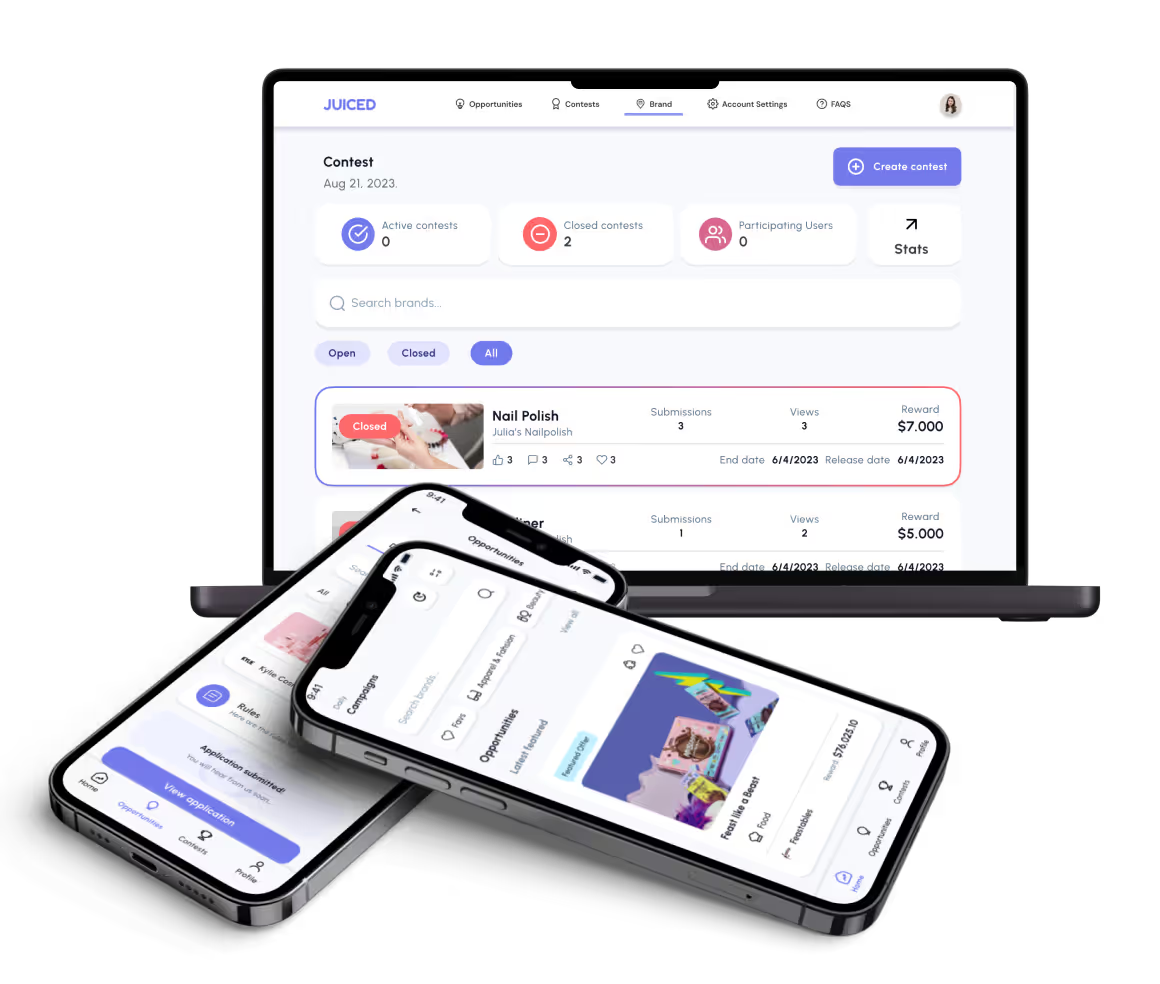
FlutterFlow can build the full operational layer of property management software: rent collection, maintenance workflows, lease tracking, tenant communication, vendor management, financial dashboards, and inspection records. Understanding property management tool capabilities in FlutterFlow, and where its limits sit, is the starting point for any realistic scoping conversation.
FlutterFlow covers the workflows that matter most to small and mid-portfolio managers. Here is what each module delivers.
Multi-Property and Unit Management
Properties, buildings, and units are structured in a relational data model. Managers assign tenants to units and track occupancy status across the portfolio from a single dashboard.
The data hierarchy requires deliberate design: portfolio contains properties, properties contain units, units contain leases and tenants.
- Portfolio overview: A dashboard view shows occupancy rate, active maintenance requests, and overdue rent across all properties at a glance.
- Unit status tracking: Each unit record shows current tenant, lease status, rent amount, and open maintenance items in a single view.
- Vacancy management: Vacant units surface in a filtered list, enabling managers to prioritise leasing outreach and track days-on-market.
Rent Collection and Payment Tracking
Stripe integration enables online rent collection with automatic receipts, late fee triggers, and payment history per tenant and unit.
Payment records write to both the unit document and a portfolio-wide ledger, keeping financial summaries accurate without manual entry.
- Online rent collection: Tenants pay directly in the app via Stripe; receipts generate automatically and store against the lease record.
- Late fee triggers: A Cloud Function checks payment dates against lease terms and applies configured late fees when payment is overdue.
- Payment history: Full payment history per tenant and unit is accessible to both managers and tenants, reducing disputes over payment status.
Maintenance Request Workflow
Tenants submit requests with descriptions and photos. Managers assign to vendors, track status, and close tickets with completion notes.
The maintenance workflow is a distinct process with its own status flow: submitted, assigned, in progress, completed, and verified.
- Tenant submission: Tenants describe issues and attach photos from their device camera, creating a structured record at the point of report.
- Vendor assignment: Managers assign open requests to vendors from the contractor directory, triggering a notification to the assigned vendor.
- Status tracking: Request status updates propagate to both the tenant and manager views, keeping all parties informed without phone calls.
Lease Management and Renewal Tracking
Lease start and end dates, rent amounts, and renewal status are tracked per unit. Automated reminders alert managers to upcoming lease expirations via push notification or email.
Lease documents can be stored as PDF attachments against the lease record, accessible to both manager and tenant.
- Expiry alerts: A Cloud Function sends renewal reminders to managers 90, 60, and 30 days before each lease expires, preventing unplanned vacancies.
- Rent escalation tracking: Scheduled rent increases record against the lease, with the new amount applying automatically on the effective date.
- Lease document storage: Signed lease PDFs attach to the lease record in Firebase Storage, accessible to both the manager and the tenant.
Vendor and Contractor Directory
Maintenance vendors are catalogued with trade category, contact information, job history, and ratings. This enables faster dispatch for recurring work orders without searching contact lists.
Vendor records link to completed maintenance requests, building a performance history over time.
- Trade category filtering: Managers filter vendors by plumbing, electrical, HVAC, and other trade categories when assigning maintenance requests.
- Job history: Completed maintenance requests link to the assigned vendor record, creating a searchable history of past work and response times.
- Vendor ratings: Managers rate completed jobs, surfacing consistently high-performing vendors at the top of assignment lists over time.
Financial Reporting Dashboard
Income, expense, vacancy rate, and maintenance cost reports display per property and portfolio-wide. Data pulls from payment records and expense entries in Firestore.
The reporting dashboard is a display layer. Double-entry accounting and ledger management must live in QuickBooks, Xero, or a dedicated accounting backend.
- Income and expense summary: Rent collected and maintenance costs display per property for the selected period, with portfolio totals in the header.
- Vacancy rate tracking: Vacant units and days-on-market track per property, surfacing where occupancy performance is lagging across the portfolio.
- Maintenance cost breakdown: Costs by trade category and vendor display for the period, helping managers identify recurring expense patterns.
Tenant Communication Hub
Managers send announcements, notices, and direct messages to individual tenants or building-wide groups from within the platform. Messages log against the tenant and property record.
The communication hub replaces email threads and phone logs with a structured, searchable record of all landlord-tenant correspondence.
- Building-wide announcements: Managers broadcast maintenance notices, policy updates, or community messages to all tenants in a selected building.
- Direct messaging: One-to-one messaging between manager and tenant records the conversation against the tenancy for compliance and reference.
- Message history: Full message history per tenant and property is searchable, reducing disputes about whether notices were sent or received.
Inspection and Move-Out Documentation
Property condition is documented with structured checklists and photo attachments at move-in and move-out. Records store against the lease for deposit dispute resolution.
Digital inspection records with timestamps and photos significantly reduce the time spent on deposit disputes compared to paper-based documentation.
- Structured checklists: Move-in and move-out inspections follow the same template per property type, ensuring consistent condition documentation across the portfolio.
- Photo evidence: Condition photos attach to each checklist item, providing timestamped visual evidence for deposit dispute resolution.
- Lease record linkage: Completed inspections link to the relevant lease record, making pre- and post-tenancy comparisons accessible in one place.
How Long Does It Take to Build Property Management Software with FlutterFlow?
A basic property management MVP covering rent collection, maintenance tracking, and lease management takes 9 to 12 weeks. Full-featured software with multi-property hierarchy, vendor management, financial reporting, and a tenant portal takes 16 to 20 weeks.
Timeline extends most when accounting integration, complex role hierarchies, or multi-jurisdiction lease templates are required.
- Simple MVP timeline: Rent collection, maintenance requests, lease tracking, and basic tenant messaging ship in 9 to 12 weeks with focused scope.
- Full software timeline: Multi-property hierarchy, vendor directory, financial reporting, inspection records, and a tenant portal extend builds to 16 to 20 weeks.
- Accounting integration: Connecting to QuickBooks or Xero adds 3 to 5 weeks depending on API complexity and the depth of two-way sync required.
- Role hierarchy complexity: Designing four distinct roles across owner, property manager, maintenance staff, and tenant adds 2 to 3 weeks to any build phase.
- Speed advantage: FlutterFlow pre-built components reduce build time by 40 to 60 percent compared to an equivalent custom Flutter or React Native project.
The phased approach is strongly recommended. Launch rent collection and maintenance tracking first, then add financial reporting and vendor management in phase two.
What Does It Cost to Build Property Management Software with FlutterFlow?
Reviewing FlutterFlow software pricing tiers early ensures the right plan is in place to support the backend API calls that multi-property management requires. The full cost of property management software ranges from $20,000 to $100,000 depending on scope.
- Accounting integration is the biggest cost driver: Two-way sync with QuickBooks or Xero requires middleware and API work that significantly increases build cost.
- PDF generation adds ongoing cost: Lease documents, financial statements, and inspection reports require a PDF generation service with per-document pricing.
- Data migration adds to initial cost: Moving existing tenancy records, lease terms, and payment history from spreadsheets adds time that depends on data quality.
- Custom comparison: Equivalent property management software built from scratch costs $120,000 to $300,000; enterprise tools like AppFolio cost $1.40 or more per unit monthly.
- Hidden cost: security rule design: Complex role hierarchy across four user types requires Firebase security rule engineering that many initial quotes omit.
Budget a 15 to 20 percent contingency for data migration complexity and accounting API edge cases that emerge during integration testing.
How Does FlutterFlow Compare to Custom Development for Property Management Software?
FlutterFlow delivers property management software in 9 to 20 weeks at $20,000 to $100,000. Custom development of the same scope takes 9 to 18 months at $120,000 to $400,000 or more. The capability ceiling sits at general ledger accounting and enterprise-scale portfolio analytics.
- Speed advantage is decisive: FlutterFlow delivers working property management software in weeks; equivalent custom builds take months to reach the same state.
- Cost advantage is clear: Custom property management development starts at $120,000; FlutterFlow full builds run $30,000 to $100,000 for the same operational scope.
- When FlutterFlow wins: Boutique property managers, real estate investors with small to mid portfolios, and white-label property management SaaS startups.
- When custom wins: Enterprise property management with hundreds of properties, complex accounting integrations, or regulatory compliance requirements at scale.
Before finalising a build decision, evaluating property software build tradeoffs honestly ensures teams choose the path that matches their portfolio size and growth trajectory.
What Are the Limitations of FlutterFlow for Property Management Software?
Property data security standards are non-negotiable. Tenant financial records, lease terms, and personal data require Firebase security rules designed with role isolation from day one, not added after build.
Accounting and complex role hierarchies are the two limits that matter most for property management software buyers evaluating FlutterFlow.
- No general ledger: Double-entry bookkeeping must live in QuickBooks or Xero; FlutterFlow displays and collects financial data but cannot post ledger entries.
- Complex role hierarchy: Owner, portfolio manager, property manager, maintenance staff, and tenant roles each require distinct Firestore security rule sets designed before any UI work begins.
- Scale limits for large portfolios: Managing thousands of units across multiple properties generates Firestore read volumes that require caching and query optimisation.
- FlutterFlow API call limits: High-frequency operations like automated rent reminders on the Standard plan can hit API call limits; the Pro plan or custom backend logic is required.
- Complex reporting logic: Portfolio-level analytics with cross-property aggregations push beyond what FlutterFlow's visual logic layer handles cleanly.
- Code export as escape valve: Exporting Flutter code gives teams a path to implement accounting logic and complex reporting beyond the visual builder's limits.
Knowing these limits before scoping prevents expensive structural rebuilds when the product reaches a portfolio size or workflow complexity the platform cannot sustain.
How Do You Find the Right Team to Build FlutterFlow Property Management Software?
Knowing how to hire property software developers with FlutterFlow experience ensures the data model is architected correctly before the first screen is built. Multi-tenant data hierarchies and role-based security rules are the hardest parts of property management software.
Look for developers who have designed multi-tenant Firestore schemas and role-based access models for property or rental applications.
- Multi-property data model experience: Your developer must have designed Firestore hierarchies for portfolio, property, building, and unit collections before scoping begins.
- Stripe recurring billing: Monthly rent collection with automatic receipts, late fee triggers, and payment history requires specific recurring billing integration experience.
- Firebase security rule design: Four user roles across owners, managers, maintenance, and tenants each require correctly scoped security rules from day one.
- Accounting API integration: If QuickBooks or Xero sync is required, prioritise developers who have completed two-way accounting integrations in previous projects.
- Red flags: No experience with relational data hierarchy, no questions about portfolio size or role complexity, generic template demos without role-based access examples.
- Key questions to ask: How have you structured multi-property data hierarchies in Firestore? How do you handle role-based data access for owners versus managers versus tenants?
Expect a 2 to 3 week discovery phase focused on data model design and role hierarchy before any UI work begins. Teams that skip this produce a product that cannot scale.
Conclusion
FlutterFlow is a viable path to custom property management software for small to mid portfolios. It suits investors and boutique managers who need more than a spreadsheet but cannot justify enterprise software costs.
Before scoping, document your property hierarchy, your four role types, and the three workflows you most want to automate. That gives any development team enough to produce a realistic estimate.
Building Property Management Software with FlutterFlow? Here Is How LOW/CODE Agency Approaches It.
Property management software fails most often not because of the UI layer, but because the multi-role data hierarchy and Firebase security rule design were not completed before the first screen was built.
At LOW/CODE Agency, we help SMBs compete with AI-powered software built for them — custom web and mobile apps, RAG systems, chatbots, and intelligent agents delivered by a senior development team. We build FlutterFlow property management applications with production-grade Firestore architecture, Stripe rent collection, multi-role security rules, accounting API integration, and tenant portal design as a complete system before any visual build begins.
- Multi-property data architecture: We design the portfolio, property, building, and unit hierarchy in Firestore before writing a single line of visual logic.
- Role-based security design: We implement owner, manager, maintenance, and tenant security rules at the Firestore level before the first UI screen is built.
- Stripe rent collection: We build automated receipt generation, late fee triggers, and full payment history with correct webhook handling from day one.
- Maintenance workflow design: We build the full request-to-completion workflow including tenant submission, vendor assignment, status tracking, and closure verification.
- Accounting API integration: We connect FlutterFlow property software to QuickBooks or Xero with proper two-way sync, error handling, and webhook management.
- Financial reporting layer: We build income, expense, vacancy, and maintenance cost dashboards with correct data aggregation across properties and portfolio.
- Full product team: Strategy, UX, development, and QA from a single team so your property management software is production-ready, not just a prototype.
We have built 350+ products for clients including Coca-Cola, American Express, and Sotheby's. We know what separates property management software that scales from builds that break at 50 units.
Related Articles
- How to Build a Real Estate App with FlutterFlow
- How to Build a Quality Inspection Checklist App with FlutterFlow
- How to Build a Purchase Order Automation App with FlutterFlow
- How to Build a Property Listing App with FlutterFlow
- How to Build a Project Management SaaS with FlutterFlow
- How to Build a Production Tracking System with FlutterFlow
Last updated on
September 24, 2026
.

Jesus is a visionary entrepreneur and tech expert. After nearly a decade working in web development, he founded LOW/CODE Agency to help businesses optimize their operations through custom software solutions.


FAQs
What are the first steps to create property management software in FlutterFlow?
Can FlutterFlow handle complex property management features?
How do I integrate payment processing in a FlutterFlow property app?
Is FlutterFlow suitable for multi-user property management apps?
What are common challenges when building property management software with FlutterFlow?
How can I test and deploy my FlutterFlow property management app?
Related Articles
FlutterFlow
How to Build Energy and Utility Apps with FlutterFlow
Learn how to create efficient energy and utility apps using FlutterFlow with step-by-step guidance and best practices.

FlutterFlow
How to Build a FlutterFlow AI CRM Automation App
Learn how to create an AI-powered CRM automation app using FlutterFlow with step-by-step guidance and best practices.

FlutterFlow
How to Build an Itinerary Planning Tool with FlutterFlow
Learn how to create an itinerary planning tool using FlutterFlow with step-by-step guidance and best practices.
FlutterFlow
How to Build a Realtor CRM Platform with FlutterFlow
Learn how to create a Realtor CRM platform using FlutterFlow with step-by-step guidance and best practices for real estate professionals.


Why customers trust us for no-code development


