

How to Build an HR Knowledge Base App with Bubble
11 min
read
Build an HR knowledge base with Bubble. Centralize policies, handbooks, and FAQs in a searchable portal — no dev team, fast to update.


HR knowledge base apps replace shared drives, scattered policy PDFs, and outdated employee handbooks with a searchable, version-controlled library that employees and HR administrators can access from any device. the Bubble platform lets HR teams build a custom knowledge base without writing code, covering policy management, onboarding guides, compliance documentation, FAQ libraries, and structured search in one platform.
Key Takeaways
- Policy access replaces document chaos: A Bubble HR knowledge base gives every employee a single searchable source of truth for policies, guides, and compliance documents.
- Data model supports versioning and structure: Article, Category, PolicyVersion, AcknowledgmentRecord, FAQEntry, and SearchLog types power the full knowledge management platform.
- Search is buildable natively: Bubble's built-in search across text fields delivers keyword-based document discovery without requiring external search infrastructure for most use cases.
- Version control requires careful data design: Maintaining a full policy history with effective dates and rollback capability needs a deliberate PolicyVersion data architecture from the start.
- Build costs start around $14,000: MVP HR knowledge base apps on Bubble range from $14,000 to $22,000 depending on content volume and acknowledgment workflow requirements.
- Access control protects sensitive policies: Role-based visibility rules ensure confidential compensation policies and compliance documents are only accessible to authorized employee segments.

What Data Architecture Does a Bubble HR Knowledge Base App Need?
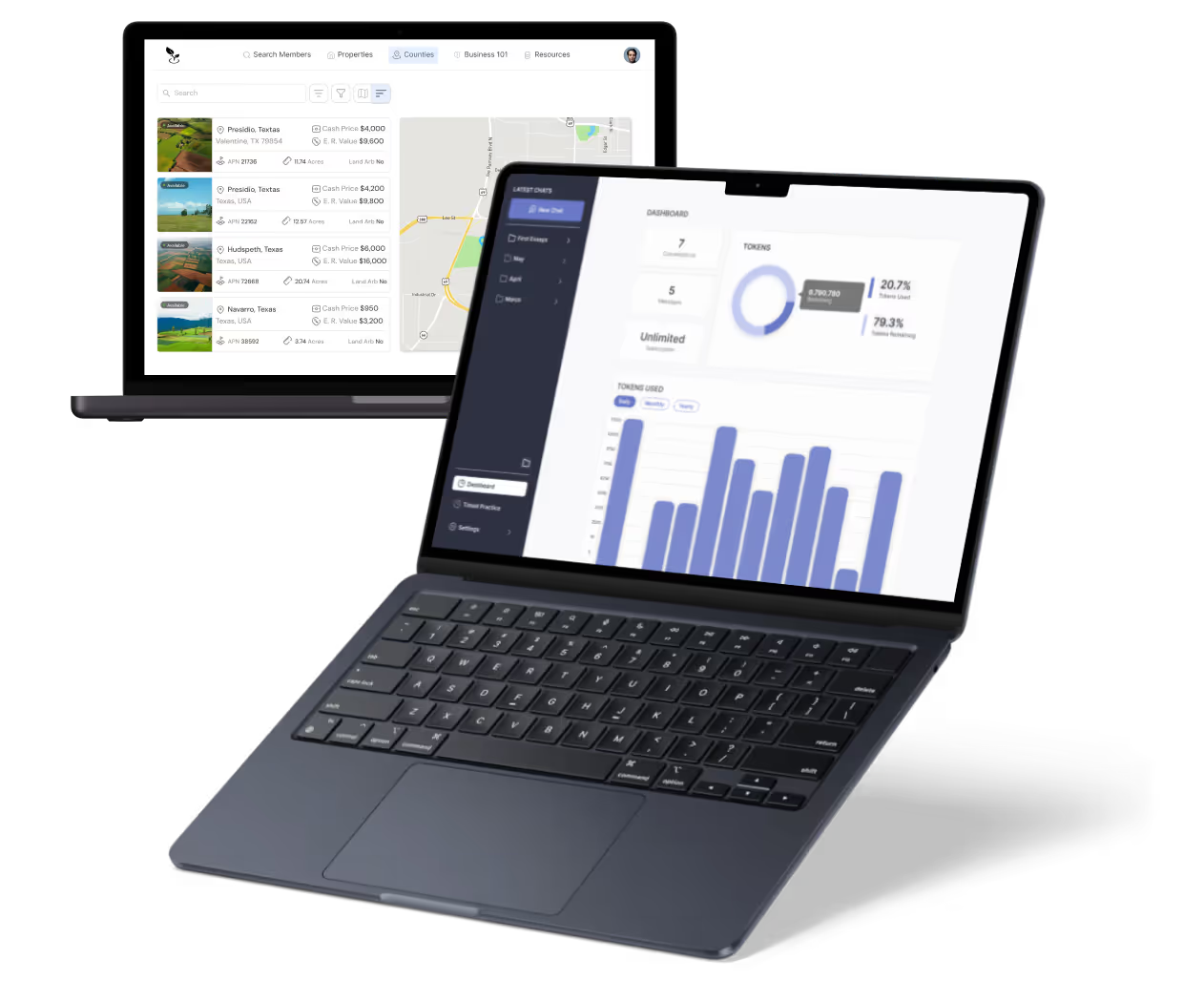
An HR knowledge base app needs a data model that connects articles, categories, policy versions, acknowledgment records, FAQ entries, and search activity. Core types are Article, Category, PolicyVersion, AcknowledgmentRecord, FAQEntry, and SearchLog.
This architecture separates current content from version history, which allows the app to serve the latest policy to employees while preserving every previous version for compliance and audit purposes.
- Article type: Stores title, body content, category link, publication date, last updated date, author, visibility scope, and a link to the current active PolicyVersion record.
- Category type: Holds the category name, description, parent category link for nested navigation, display order, and a list of linked Article records for that section.
- PolicyVersion type: Stores version number, effective date, expiry date, content snapshot, change summary, and the linked Article record it belongs to for full version history.
- AcknowledgmentRecord type: Links an Employee to a specific PolicyVersion with a timestamp confirming they have read and accepted the policy content at that point in time.
- FAQEntry type: Stores question text, answer text, category link, helpful vote count, and a related Article link so FAQ answers can point employees to full policy detail.
- SearchLog type: Logs each search query with the user ID, query text, results count, and a click-through link if the user selected a specific result for search quality analysis.
Keeping PolicyVersion records as separate objects rather than overwriting the Article record means HR can always retrieve, display, or export any previous policy version on demand.
How Do You Build Policy Management and Version Control in Bubble?
Policy management covers creating, editing, publishing, and versioning HR documents so employees always see the current policy while the full history remains intact. Bubble handles this through a structured Article and PolicyVersion workflow.
Every time a policy is updated and published, a workflow creates a new PolicyVersion record, archives the previous version, and updates the Article record to point to the new active version.
- Draft and publish workflow: A policy editor creates or edits an Article record in draft state; clicking publish creates a new PolicyVersion record with the current content and sets the effective date.
- Version archiving: On publish, a workflow updates the previous active PolicyVersion record to set an expiry date, preserving the full content for compliance reference and audits.
- Change summary field: Each PolicyVersion record includes a change summary field where HR authors describe what changed, displayed in a version history panel on the policy detail page.
- Effective date scheduling: A scheduled workflow can publish a PolicyVersion record on a future date by checking for PolicyVersion records where the effective date equals today and status is pending.
- Rollback capability: An admin action on the version history panel can reactivate a previous PolicyVersion record and update the Article's active version link to restore a prior state.
- Notification on publish: Publishing a new PolicyVersion triggers an email or in-app notification to all employees in the policy's visibility scope alerting them to review the updated document.
Bubble's data privacy and security rules control which employees can view sensitive policy categories and which HR administrators can create, edit, or publish Article and PolicyVersion records.
How Do You Build Employee Acknowledgment Tracking in Bubble?
Acknowledgment tracking ensures HR can prove that every employee has read and accepted current policy versions. Bubble manages the full acknowledgment lifecycle from required policy assignment through completion reporting.
Each time a new PolicyVersion is published for a policy that requires acknowledgment, a workflow creates pending acknowledgment tasks for all employees in the required scope.
- Acknowledgment requirement flag: A boolean field on the Article record marks whether a new PolicyVersion triggers a required acknowledgment for all employees in the visibility scope.
- Pending acknowledgment creation: On publish of a required policy, a workflow creates a pending AcknowledgmentRecord for each in-scope employee linked to the new PolicyVersion.
- Employee acknowledgment portal: A dashboard section on the employee portal lists all policies requiring acknowledgment with a read and confirm button that timestamps the AcknowledgmentRecord on click.
- Forced read confirmation: A workflow can display the full policy text in a modal and require the employee to scroll to the bottom before enabling the acknowledge button.
- Completion reporting: An HR dashboard shows acknowledgment completion rate per policy with a list of employees who have not yet confirmed, filterable by department or team.
- Reminder workflows: Scheduled workflows send reminder emails to employees with outstanding acknowledgments at configurable intervals until the acknowledgment deadline passes.
How Do You Build Search and Navigation in Bubble?
Search and navigation help employees find the right policy or FAQ answer quickly without browsing through every category. Bubble builds keyword search, category navigation, and related content suggestions through native search operators and dynamic filtering.
- Keyword search: A search input on the knowledge base home page queries Article and FAQEntry titles and body text using Bubble's built-in search operator and displays matching results instantly.
- Category navigation: A sidebar or top navigation menu displays Category records in a hierarchical repeating group; clicking a category filters the main content area to show only linked Articles.
- Search results ranking: Results are sorted by a relevance proxy such as title match priority over body text match, using conditional sorting logic on the search query.
- Search logging: Each search query and its result count is saved to a SearchLog record so HR administrators can identify common searches with zero results and create missing content.
- Related articles: Each Article detail page displays a repeating group of other Articles in the same Category, giving employees a natural path to adjacent policy content.
- Popular content: A homepage section displays the most-viewed Article records using a view count field updated by a workflow each time an employee opens a policy page.
See examples of Bubble apps in similar categories for how teams have structured searchable content libraries with category navigation and acknowledgment workflows in Bubble.
How Do You Build the Employee Handbook in Bubble?
The employee handbook is the highest-priority content in any HR knowledge base. Bubble structures the handbook as a set of categorized Article records with sequential navigation, table of contents generation, and print or PDF export.
- Handbook structure: A dedicated Category record labeled Employee Handbook contains ordered Article records for each section, with a display order field controlling the sequence.
- Table of contents: A sidebar repeating group lists all Article titles within the Handbook category in display order, with each item linking directly to that section's detail page.
- Sequential navigation: Next and Previous buttons on each Article detail page query the display order field to navigate to the adjacent Article in the Handbook category automatically.
- Print view: A dedicated print layout page renders the full Handbook content in a clean single-column format optimized for browser print or PDF save.
- Version history panel: A collapsible section on each Handbook Article page lists all previous PolicyVersion records with their effective dates and change summaries for employee reference.
How Much Does It Cost to Build an HR Knowledge Base App on Bubble?
HR knowledge base app builds on Bubble range from $14,000 for a focused MVP to $36,000 for a full platform with version control, acknowledgment tracking, advanced search, FAQ management, and HR analytics.
The main cost variables are the volume of content categories and article types, the complexity of role-based visibility rules, and whether acknowledgment workflows with compliance reporting are required from day one.
Review Bubble plan comparison and pricing to confirm the right subscription tier for your expected content volume, employee headcount, and scheduled workflow frequency for acknowledgment reminders.
What Are the Limitations of Building an HR Knowledge Base App on Bubble?
Bubble handles content management, search, versioning, and acknowledgment tracking effectively. Advanced full-text search relevance, large document file management, and deep HRIS integration are the areas that require additional architecture.
Teams expecting enterprise-grade search relevance with stemming, synonyms, and faceted filtering should plan for an Algolia or Elasticsearch integration alongside the Bubble build.
- Full-text search depth: Bubble's native search covers exact keyword matching; advanced relevance features like stemming, synonym expansion, or fuzzy matching require an external search service.
- Large file management: Storing and serving large PDF policy documents or video guides is possible but requires careful management of Bubble's file storage limits by plan tier.
- HRIS employee sync: Automatically provisioning new employee accounts and assigning their visibility scope requires an API connector to the company's HRIS or identity provider.
- Multilingual content: Managing policy content in multiple languages requires a parallel Article structure or a translation field approach that adds content maintenance overhead.
- Complex permission hierarchies: Highly granular access control with dozens of distinct visibility segments and nested role hierarchies can strain Bubble's privacy rule configuration.
Review Bubble's built-in capabilities and known limitations and scaling a Bubble app to larger user volumes. For a complete trade-off picture, the pros and cons of building on Bubble and no-code platform alternatives to Bubble are both worth reviewing before committing.
Conclusion
Bubble is a practical choice for HR teams that need a structured, searchable knowledge base without the cost of enterprise content management platforms. Policy management, version control, acknowledgment tracking, FAQ libraries, and employee handbook delivery are all achievable within the platform.
The limitations around advanced search relevance and large file management are real but addressable with external search integrations and thoughtful content architecture. A Bubble HR knowledge base gives every employee a reliable single source of truth for company policies at a fraction of the cost of legacy intranet platforms.
Build Your HR Knowledge Base App with Bubble
At LOW/CODE Agency, we build HR knowledge base applications on Bubble that handle policy management, version control, acknowledgment tracking, search, and FAQ management as one complete platform.
- Data architecture: Purpose-built knowledge base data model with Article, Category, PolicyVersion, AcknowledgmentRecord, FAQEntry, and SearchLog types.
- Policy management: Draft and publish workflows, version archiving, change summaries, effective date scheduling, and rollback capability for every policy record.
- Acknowledgment tracking: Required policy assignment, employee confirmation portal, forced read flows, completion reporting, and automated reminder sequences.
- Search and navigation: Keyword search across all content, category navigation, search logging, related article suggestions, and popular content surfacing.
- Admin tooling: HR editor dashboard with content management, visibility scope controls, acknowledgment completion reports, and search analytics views.
We have delivered 450+ products for clients including Coca-Cola and American Express. Bubble development services cover HR knowledge base app builds from architecture through production launch; most engagements start around $14,000 USD.
Last updated on
September 28, 2026
.

Jesus is a visionary entrepreneur and tech expert. After nearly a decade working in web development, he founded LOW/CODE Agency to help businesses optimize their operations through custom software solutions.


FAQs
Can you build an HR knowledge base with Bubble?
How do you structure content in a Bubble HR knowledge base?
How do you build search in a Bubble HR knowledge base?
How do you keep an HR knowledge base up to date in Bubble?
How do you measure HR knowledge base effectiveness in Bubble?
How do you restrict sensitive HR content in a Bubble knowledge base?
Related Articles

Bubble
How to Build a CMMS Platform with Bubble
Create a cloud kitchen management app with Bubble no coding needed. Manage orders, inventory, and kitchen workflows step-by-step fast.
Bubble
How to Build an Event Lead Capture App with Bubble
Capture more leads at events with Bubble. Build a no-code lead capture app step-by-step collect, qualify & follow up on contacts without coding.

Bubble
How to Build a Training Management App With Bubble
Build a training management app with Bubble. Schedule sessions, track completion, and manage certifications — a custom L&D tool, no code needed.

Bubble
How to Build a Product Catalog App With Bubble
Build a product catalog with Bubble. Searchable listings, rich media, and role-based access — a custom catalog without enterprise PIM software costs.

Why customers trust us for no-code development


