

How to Build a CMMS Platform with Bubble
14 min
read
Create a cloud kitchen management app with Bubble no coding needed. Manage orders, inventory, and kitchen workflows step-by-step fast.


Building a CMMS platform with Bubble gives operations teams a full Computerized Maintenance Management System covering assets, preventive schedules, corrective work orders, inventory, and reporting.
Bubble's visual builder and workflow engine handle the multi-module complexity of a CMMS at a fraction of the cost of commercial maintenance management software.
Key Takeaways
- Asset is the shared anchor record: Every module in a CMMS, from PM schedules to corrective work orders to inventory draws, links back to the Asset data type as the common reference.
- Scheduled workflows power preventive maintenance: Bubble's "Schedule API Workflow" auto-generates work orders from active maintenance schedules without manual manager input each day.
- Inventory deduction happens at completion: Linking parts used on a work order to InventoryItem records with automatic quantity updates prevents phantom inventory and parts shortages.
- Multi-role privacy rules are the hardest part: A CMMS with technicians, supervisors, managers, and admins requires layered privacy rules that are designed and tested before any user data enters the system.
- Phased delivery de-risks the build: Building the asset registry and PM module first, then adding corrective maintenance, inventory, and reporting in later phases reduces risk and delivers value faster.
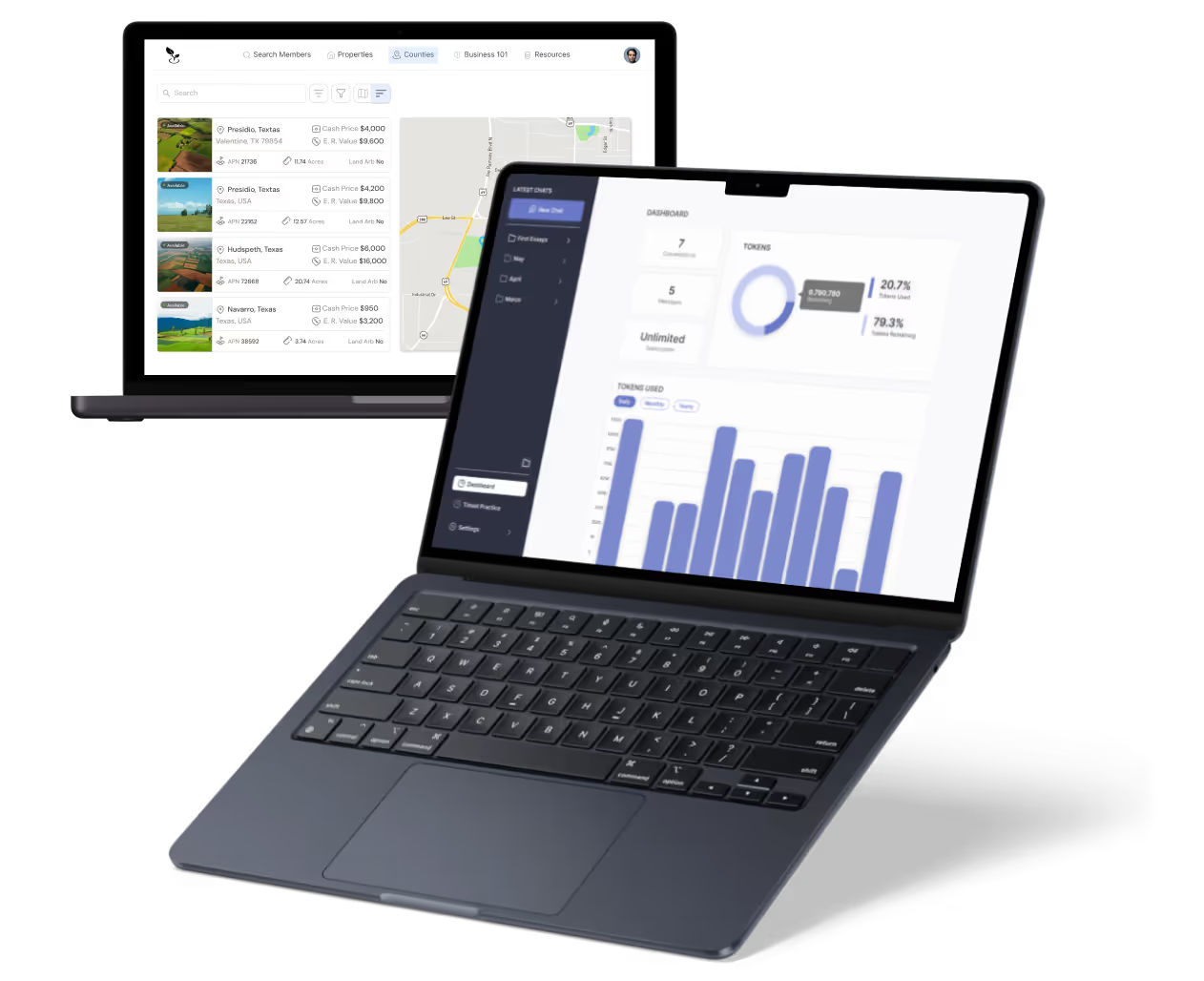

What Is a CMMS Platform — and Why Build It with Bubble?
A CMMS (Computerized Maintenance Management System) is a software platform that centralizes asset management, maintenance scheduling, work order tracking, inventory control, and reporting for facilities and operations teams.
Bubble can handle CMMS functionality for mid-market organizations that do not need SAP-level complexity but do need more than a spreadsheet. Bubble's scalability supports growing asset registries and increasing work order volume when the data architecture is designed correctly from the start.
- Asset lifecycle management: Maintain a complete record of every asset from procurement through maintenance history to decommissioning, with all linked work orders and costs.
- Preventive maintenance automation: Scheduled workflows generate PM work orders automatically based on interval rules so no planned maintenance task falls through the cracks.
- Corrective maintenance tracking: Fault reports convert to tracked corrective work orders with technician assignment, parts requests, and root cause analysis capture.
- Inventory management: Track spare parts and consumables with stock levels, reorder points, parts usage per work order, and automatic reorder alert triggers.
- Vendor and procurement management: Maintain vendor records, purchase orders, and delivery tracking linked to specific work orders and inventory replenishment needs.
Bubble's development speed and lower total cost make it a viable alternative to commercial CMMS platforms like UpKeep, Limble, or Maintenance Connection for teams with specific workflow requirements.
What Features Should a CMMS Platform Include?
A complete CMMS platform spans five functional modules: asset registry, preventive maintenance, corrective maintenance, inventory management, and operations reporting.
Each module must share a common data foundation so queries across modules produce accurate, unified operational intelligence.
- Asset registry: A searchable database of all assets with categories, locations, manufacturers, model numbers, warranty details, QR codes, installation dates, and full maintenance history.
- Preventive maintenance module: Configurable maintenance schedules per asset with interval types, task checklists, assigned technicians, and automatic work order generation on due dates.
- Corrective maintenance module: Fault reporting for any staff member, automatic work order creation, technician dispatch, parts request handling, repair completion forms, and root cause analysis.
- Inventory management: Spare parts and consumables tracking with current stock levels, minimum stock thresholds, reorder alerts, parts usage per work order, and vendor sourcing links.
- Vendor management: Vendor profiles with contact details, supplied parts catalogs, purchase order history, and delivery tracking linked to inventory replenishment and work order parts requests.
- Reporting and analytics dashboard: KPI panels showing mean time to repair (MTTR), planned maintenance compliance (PMC), work order backlog, asset downtime, and parts spend per asset or category.
Add a mobile-optimized technician interface that surfaces only today's assigned work orders, asset QR scanning, and completion forms without the full admin dashboard overhead.
How Do You Structure the Database for a CMMS Platform in Bubble?
A CMMS data model requires ten or more data types organized into module groups that all reference a shared Asset and TechnicianProfile as common records.
Reviewing the best backends for Bubble helps teams assess whether Bubble's native database meets their asset scale and query performance requirements or whether an external backend is warranted.
- Asset data type: Fields include name (text), asset-id (text), category (option set), facility (text), location (text), manufacturer (text), model (text), serial-number (text), installation-date (date), warranty-expiry (date), status (option set: Active, Inactive, Decommissioned), and qr-code (text).
- WorkOrder data type (unified): Fields include type (option set: Preventive, Corrective, Emergency), asset (Asset), title (text), status (option set), priority (option set), assigned-to (TechnicianProfile), due-date (date), estimated-hours (number), actual-hours (number), and total-cost (number).
- MaintenanceSchedule data type: Fields include asset (Asset), interval (option set), last-completed (date), next-due (date), task-list (list of text), assigned-tech (TechnicianProfile), and active (yes/no).
- FaultReport data type: Fields include asset (Asset), reported-by (User), severity (option set), description (text), photos (list of files), report-date (date), and linked-work-order (WorkOrder).
- InventoryItem data type: Fields include name (text), part-number (text), category (option set), current-stock (number), minimum-stock (number), unit-cost (number), vendor (Vendor), location (text), and reorder-quantity (number).
- WorkOrderPart data type: Fields include work-order (WorkOrder), inventory-item (InventoryItem), quantity-used (number), unit-cost (number), and total-cost (number). Links parts consumption to the work order for cost tracking and inventory deduction.
- Vendor data type: Fields include name (text), contact-name (text), phone (text), email (text), parts-supplied (list of InventoryItem), active-POs (list of PurchaseOrder), and notes (text).
- PurchaseOrder data type: Fields include vendor (Vendor), items (list of POLineItem), total-value (number), status (option set: Draft, Submitted, Received, Partial), order-date (date), and expected-delivery (date).
- TechnicianProfile data type: Fields include user (User), employee-id (text), specializations (list of option sets), facility (text), active-work-orders (list of WorkOrder), and availability (option set).
- RootCauseAnalysis data type: Fields include work-order (WorkOrder), asset (Asset), failure-category (option set), description (text), preventive-recommendation (text), and analyst (User).
Use a single WorkOrder data type for both PM and CM records. The type option set field (Preventive, Corrective, Emergency) differentiates them while keeping all work orders in one queryable table.
How Do You Build the Core Workflows for a CMMS Platform in Bubble?
A CMMS platform requires six to eight distinct workflow groups: PM work order generation, fault-to-work-order conversion, technician dispatch, parts deduction, inventory reorder alerting, and cost rollup.
Build the PM generation and inventory deduction workflows as backend API workflows first. They are the highest-frequency automations and the ones most likely to cause performance issues if built incorrectly.
- PM work order generation workflow: Scheduled backend workflow runs daily. Searches MaintenanceSchedules where next-due is today and active is yes. Creates a WorkOrder for each match with type set to Preventive, assigns to the schedule's default technician, sends notification.
- Fault-to-work-order workflow: Triggered when a manager reviews and approves a FaultReport. Creates a WorkOrder with type Corrective, copies asset and severity data from the fault report, links the FaultReport to the WorkOrder via linked-work-order field.
- Technician dispatch notification workflow: Triggered on WorkOrder assignment. Sends SMS via Twilio for Critical and High priority work orders. Sends email via SendGrid for all work order types with full job details.
- Parts deduction workflow: Triggered when a technician submits the completion form. Creates a WorkOrderPart record for each part listed. Deducts quantity-used from the corresponding InventoryItem's current-stock field. Checks if current-stock falls below minimum-stock threshold.
- Inventory reorder alert workflow: Triggered by the parts deduction workflow when current-stock drops below minimum-stock. Creates a draft PurchaseOrder linked to the item's vendor, sends an alert email to the inventory manager with item name and reorder quantity.
- Cost rollup workflow: Triggered on WorkOrder status change to Completed. Calculates total-cost as the sum of all linked WorkOrderPart totals plus actual-hours multiplied by the technician's hourly rate. Updates the WorkOrder's total-cost field and the Asset's lifetime-maintenance-cost calculated field.
Use Bubble's "Schedule API Workflow on a list" for the PM generation step to process large asset registries without triggering timeouts on workflows that iterate over many records.
What Security and Data Requirements Apply to a CMMS Platform?
A multi-module CMMS has the most complex privacy rule structure of any maintenance app. Technicians, supervisors, facility managers, inventory managers, and admins all require different data access scopes.
Privacy rules must be designed at the start of the build, not added after. Retrofitting privacy rules onto a CMMS with live data and active workflows is time-consuming and error-prone.
- WorkOrder privacy rule: Technicians see work orders assigned to them. Supervisors see all work orders for their facility. Managers see all work orders across their portfolio. Admins have unrestricted access.
- Asset privacy rule: Technicians see assets they have active work orders for. Facility managers see all assets at their facility. Admins see the full asset registry. Restrict asset creation and decommissioning to Manager and Admin roles.
- InventoryItem privacy rule: Inventory managers and Admins see and edit all inventory records. Technicians see item names and availability but not cost data. Restrict stock level editing to Inventory Manager and Admin roles.
- PurchaseOrder privacy rule: Restrict to Inventory Manager, Finance, and Admin roles. PO data contains vendor pricing that should not be visible to technicians or general supervisors.
- RootCauseAnalysis privacy rule: Restrict to Manager and Admin roles. RCA data contains operational failure analysis that is management-sensitive.
- Cost field restrictions: Apply field-level privacy to unit-cost, total-cost, and hourly-rate fields across WorkOrder, WorkOrderPart, and TechnicianProfile data types. Exclude these from all roles except Manager, Finance, and Admin.
Create a privacy rule testing checklist with one test scenario per role and data type combination before allowing any real users or data into the production environment.
What Plugins and Integrations Does a CMMS Platform Need?
A production CMMS requires the widest plugin and integration stack of any maintenance app type, spanning scheduling, notifications, asset scanning, document generation, and external system connectors.
Prioritize plugins that are actively maintained and have large install counts. A CMMS is a mission-critical system where plugin failures have direct operational impact.
- FullCalendar plugin: Displays PM and corrective work orders in a unified calendar view with technician filtering, color coding by work order type, and drag-and-drop rescheduling for managers.
- Twilio plugin: Sends SMS for urgent corrective dispatch and overdue PM alerts. Configure separate alert templates for PM and corrective work order types to give technicians clear context.
- SendGrid plugin: Handles all transactional email including work order assignments, completion summaries, inventory reorder alerts, and daily maintenance digest reports.
- QR Code Generator and Scanner plugins: Creates unique QR codes per asset for physical labeling. Technicians scan codes to open asset profiles, active work orders, or start new fault reports.
- Documint or Air PDF plugin: Generates work order printouts, maintenance completion certificates, inventory reorder summaries, and monthly PM compliance reports in PDF format.
- Zapier or Make connector: Integrates with accounting systems like QuickBooks or Xero for cost data, with ERP systems like NetSuite for asset and procurement data, and with HR systems for technician data sync.
Test the FullCalendar plugin with your expected work order volume before go-live. Calendar rendering performance in Bubble degrades with very large repeating data sets if not properly filtered.
How Long Does It Take and What Does It Cost to Build a CMMS Platform with Bubble?
A full CMMS platform is the most complex build in the maintenance management category, typically requiring twelve to twenty weeks for a complete multi-module production system.
Reviewing Bubble's pricing plans is essential before scoping a CMMS build. The Team or Enterprise plan is typically required for a CMMS given multi-editor development, staging environments, and higher workflow execution volume.
- Phased MVP approach: Build asset registry plus PM module first (six to eight weeks). Add corrective maintenance in phase two (four to six weeks). Add inventory and reporting in phase three (four to six weeks).
- DIY timeline: Sixteen to twenty-four weeks for an experienced Bubble builder completing all modules. Most solo builders underestimate the privacy rule and workflow complexity significantly.
- Agency timeline: Twelve to eighteen weeks for a Bubble development team with dedicated phases, QA, and go-live support for each module.
- Bubble plan requirement: Team plan at approximately $349 per month for multi-editor builds with staging environments. Enterprise plan for large-scale deployments with dedicated infrastructure.
- Development cost (agency): A complete CMMS platform ranges from $35,000 to $90,000 depending on module count, integration depth, asset types, and multi-site configuration requirements.
- Third-party API and SaaS costs: Twilio per-SMS charges, SendGrid volume tiers, Google Maps API usage, and PDF generation plan costs all factor into the ongoing operational budget.
Phasing the delivery is not just a timeline strategy. It validates the core data model with real users before building the inventory and reporting modules on top of it.
Conclusion
Bubble gives mid-market operations teams enterprise-grade maintenance management without enterprise-level licensing costs, built on a shared Asset data type that anchors every module.
Build in phases: validate the asset registry and PM module with real users before adding inventory and reporting. Layered privacy rules designed before the first element is placed on the canvas are the difference between a system that works and one that requires constant patching.
Build Your CMMS Platform With Expert Bubble Developers
A CMMS platform involves ten or more data types, multi-module workflow logic, inventory deduction automation, and multi-role privacy rules that must all function correctly before the first technician is assigned a work order.
ERP integrations and the inventory deduction chain are the two areas where architectural errors are most costly to fix after data is live in the system.
At LOW/CODE Agency, we started as builders and that has not changed. Today we build AI-powered products — web apps, mobile apps, RAG systems, chatbots, and AI agents — specifically for SMBs that want real software, not a SaaS subscription. We scope the architecture, engineer the workflows, and stay involved through launch and beyond.
- Data architecture: We design your data types, option sets, and privacy rules before writing a single element on the canvas.
- Workflow engineering: We build backend workflows, scheduled jobs, and API integrations with proper logic and error handling.
- Plugin configuration: We select and configure the right Bubble plugins for your feature set without unnecessary bloat.
- Role-based access: We implement privacy rules at the database level, not just conditional UI visibility.
- Integration setup: We connect your Bubble app to Stripe, SendGrid, Twilio, and other services correctly from day one.
- Pre-launch testing: We test against real data before deployment so every workflow performs correctly under live conditions.
- Post-launch support: We stay involved after go-live to optimize as real usage data shapes the app.
We have built 350+ products for clients including Coca-Cola, American Express, Sotheby's, and Medtronic. We know exactly where Bubble builds fail and we address those problems before they surface.
Related Articles
- How to Build a Cold Chain Management App with Bubble
- How to Build a Coaching Platform App with Bubble
- How to Build a Co-living Management App with Bubble
- How to Build a Cloud Kitchen Management App with Bubble
- How to Build a Clinical Trials Management App with Bubble
- How to Build a Client Portal Legal App with Bubble
Last updated on
September 28, 2026
.

Jesus is a visionary entrepreneur and tech expert. After nearly a decade working in web development, he founded LOW/CODE Agency to help businesses optimize their operations through custom software solutions.


FAQs
Can you build a cloud kitchen management app without coding using Bubble?
How do you manage multiple brand menus in a Bubble cloud kitchen app?
How do you build a kitchen display system in Bubble?
How do you coordinate delivery dispatch in a Bubble cloud kitchen app?
How do you track ingredient inventory across brands in Bubble?
How do you analyze revenue by brand in a Bubble cloud kitchen app?
Related Articles

Bubble
How to Build an Event Marketing App with Bubble
Boost event promotion with Bubble. Build a no-code event marketing app step-by-step manage campaigns, track signups & grow attendance without coding.

Bubble
How to Build a Nutrition Tracker App with Bubble
Launch a nutrition tracker app with Bubble without coding. Log meals, track macros, and help users reach health goals with this easy no-code guide.

Bubble
How to Build a Crowdfunding Platform App with Bubble
Launch a crew management app with Bubble without writing code. Schedule shifts, track hours, and manage crew members step-by-step fast.
Bubble
Comparison
Bubble vs Thunkable | 9 Factors to Decide the Best One
Compare Zapier vs Workato across ease of use, automation power, integrations, and security to find the best no-code platform for your automation needs


Why customers trust us for no-code development


