

How to Build an Event Marketing App with Bubble
10 min
read
Boost event promotion with Bubble. Build a no-code event marketing app step-by-step manage campaigns, track signups & grow attendance without coding.


Event marketing teams lose hours every week stitching together landing pages, email tools, and spreadsheets that never quite sync. The data is scattered, the follow-up is inconsistent, and post-event ROI is impossible to measure cleanly.
Building a custom event marketing app with Bubble changes that. You get one system for registrations, email campaigns, check-ins, and reporting, with your data structure, your branding, and your workflow logic built in from day one.
Key Takeaways
- Full stack in one tool: Bubble handles landing pages, registration forms, email sequences, and attendee tracking without a separate backend.
- Core data types: Event, Attendee, Registration, Campaign, and EmailLog form the foundation of any event marketing app.
- Workflow automation: Bubble's backend workflows replace custom code for confirmation emails, campaign sends, and check-in logic.
- Realistic build cost: An MVP runs $8,000–$15,000 and takes 6–8 weeks; a full multi-event product runs $18,000–$30,000.
- Key plugins: SendGrid, Stripe, BarcodeScanner, and Zapier cover the core integration layer for most builds.
- Privacy rules matter: Role-based access and GDPR consent fields must be configured at the database level, not just the UI.
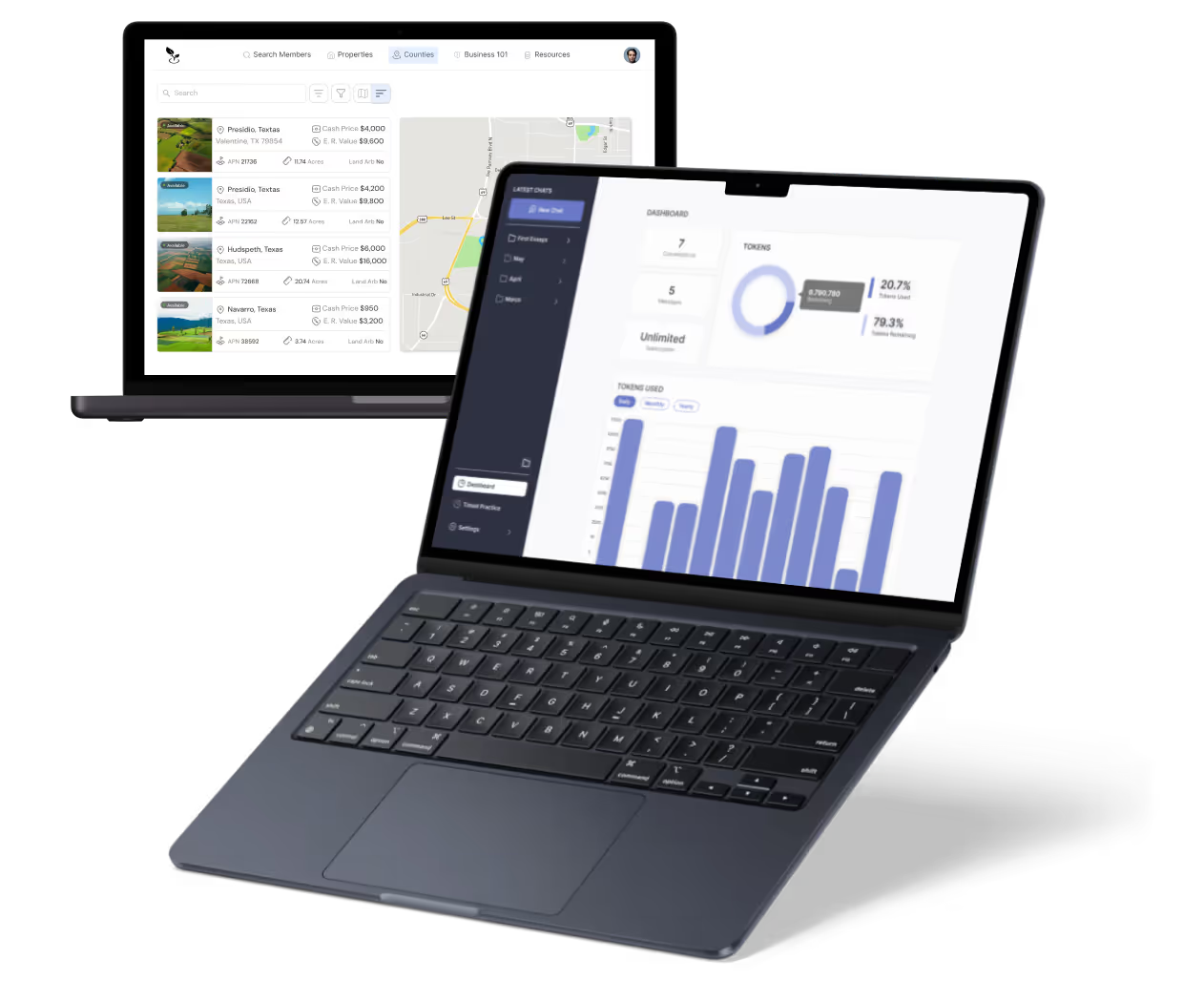

What Is an Event Marketing App — and Why Build It with Bubble?
An event marketing app is a platform that manages the full attendee journey: landing page, registration, email campaigns, check-in, and post-event follow-up. Bubble is a strong fit because its visual workflow builder, native database, and plugin ecosystem eliminate the need for a separate backend.
Most off-the-shelf event tools force you into fixed templates, shared data environments, and limited integrations. A custom Bubble build gives you full data ownership and multi-event support in one product.
- Custom branding: Every page, form, and email reflects your brand without third-party watermarks or template constraints.
- Owned data: Attendee records, campaign stats, and registration history live in your Bubble database, not a vendor's silo.
- Multi-event architecture: One app can manage dozens of events with shared attendee records and campaign history.
- No separate backend: Bubble's built-in database and workflow engine handle logic that would otherwise require a Node.js or Python backend.
If you want a broader sense of the apps you can build with Bubble before committing to this build path, that overview covers the full range of use cases.
What Features Should an Event Marketing App Include?
A functional event marketing app needs five capability areas: event management, attendee registration, email campaigns, analytics, and role-based access for staff and sponsors.
Scope these features against your actual event volume before building. A team running two events a year needs a different product than one running 20.
- Event management: Create and edit events with fields for title, date, venue, capacity, ticket types, and published status.
- Registration forms: Customizable intake forms with required field validation, confirmation email triggers, and duplicate attendee detection.
- Email campaign module: Build invite sequences, reminder emails, and post-event follow-up campaigns with scheduled send logic.
- Analytics dashboard: Track registrations over time, email open rates, ticket revenue, and check-in counts per event.
- Sponsor portal: A separate role-based view where sponsors see only their assigned event data, lead scans, and booth metrics.
A clean feature scope prevents scope creep during the build. Lock in the must-haves before the first workflow is written.
How Do You Structure the Database for an Event Marketing App in Bubble?
The database needs five core data types: Event, Attendee, Registration, Campaign, and EmailLog. Each data type maps to a distinct object in the system and connects to the others through relational fields.
Getting this structure right before building any pages saves significant rework. Data types that carry the wrong fields force workflow rewrites later.
- Event data type: Fields include name (text), date (date), venue (text), capacity (number), status (option set: Draft/Published/Completed), and organizer (User).
- Attendee data type: Fields include name (text), email (text), phone (text), company (text), source (text), GDPR consent (yes/no), and unsubscribe token (text).
- Registration data type: Fields include event (Event), attendee (Attendee), ticket type (option set), payment status (option set: Pending/Paid/Refunded), and check-in status (yes/no).
- Campaign data type: Fields include name (text), linked event (Event), subject (text), body (text), send date (date), status (option set: Draft/Scheduled/Sent), and open count (number).
- EmailLog data type: Fields include campaign (Campaign), attendee (Attendee), sent at (date), opened (yes/no), and clicked (yes/no).
Option sets for status fields keep your data consistent and make filtering in workflows and search queries straightforward.
How Do You Build the Core Workflows for an Event Marketing App in Bubble?
The four workflows that do the most work are: registration submission, campaign send, check-in processing, and post-event follow-up. Each runs as a backend workflow or triggered client-side action.
Capacity enforcement and duplicate detection must be built into the registration workflow before launch. These are the two failure points that break real events.
- Registration workflow: On form submit, check if an Attendee with that email already exists. If yes, link the existing record. If no, create a new Attendee. Then create a Registration record and trigger the SendGrid API to send a confirmation email.
- Capacity enforcement: Before creating a Registration, run a count of existing Registrations for that Event and compare it to the Event's capacity field. If the count equals capacity, block the submission and show an error message.
- Campaign send workflow: A scheduled backend workflow runs at the campaign's send date. It searches for all Attendees linked to the campaign's event, iterates through the list, calls the SendGrid API for each, and creates an EmailLog record per send.
- Check-in workflow: The Bubble BarcodeScanner plugin reads a QR code tied to the Registration ID. The workflow finds that Registration record and sets check-in status to yes. A confirmation state updates the UI immediately.
- Post-event follow-up: A scheduled backend workflow triggers 24 hours after the Event's end date. It finds all checked-in Registrations and sends a follow-up email via the campaign module.
Test capacity enforcement and the email iteration loop against real data volumes before launch. These are the two places most event app builds fail in production.
What Security and Data Requirements Apply to an Event Marketing App?
An event marketing app handles personal data: names, emails, company details, and payment records. Privacy rules in Bubble must restrict who can read and modify Attendee and Registration records at the database level.
GDPR consent is not optional for apps with EU attendees. The consent field on the registration form must be required, and the opt-out workflow must function before the first campaign send.
- Organizer-scoped records: Privacy rules on the Attendee data type should restrict visibility to the User who created the record or is listed as the event organizer.
- Role-based access: Use Bubble's User roles (Organizer, Staff, Sponsor) to control which pages and data each role can access. Sponsor accounts should never see other sponsors' leads.
- Unsubscribe handling: Store a unique unsubscribe token on each Attendee record. Before every campaign send, check that the Attendee's unsubscribe status is false. Update the record immediately when a token URL is visited.
- Payment data: Never store raw card data in Bubble. Stripe handles all payment information. Store only the Stripe payment intent ID and status on the Registration record.
Review Bubble's security configuration before setting privacy rules. The privacy rule logic for multi-user apps requires careful setup to avoid unintended data exposure.
What Plugins and Integrations Does an Event Marketing App Need?
Six plugins and connectors cover the core functional requirements. Keep the plugin list lean. Every additional plugin adds maintenance overhead and potential points of failure.
Evaluate each plugin against your actual feature scope before installing. Unused plugins slow down your app's load time and complicate future upgrades.
- SendGrid plugin: Handles transactional confirmation emails and bulk campaign sends. Configure a verified sender domain before sending any live emails.
- Stripe plugin: Processes ticket payments. Use Stripe's webhook connector to update Registration payment status automatically when a payment confirms.
- BarcodeScanner plugin: Reads QR codes for event check-in. Pair with Bubble's API Connector to generate QR codes from Registration IDs at confirmation time.
- Zapier or Make connector: Pushes new Registration records to your CRM (HubSpot, Salesforce) in real time. Set this up as a triggered Zap on the Registration data type.
- Google Analytics connector: Tracks landing page views, registration form completions, and campaign click-throughs for attribution reporting.
- Air Date/Time Picker plugin: Provides a clean date and time selection UI for event creation forms. The default Bubble date input is functional but poor UX for organizers.
How Long Does It Take and What Does It Cost to Build an Event Marketing App with Bubble?
A single-event MVP with registration, confirmation emails, and a basic dashboard takes 6–8 weeks and costs $8,000–$15,000. A full multi-event product with campaign management, sponsor portals, and analytics runs 10–14 weeks and $18,000–$30,000.
These ranges assume a competent Bubble developer with event app experience. A less experienced builder will take longer and produce more technical debt.
- Growth plan sufficiency: For a single-organizer setup with low traffic, Bubble's Growth plan at $29/month handles the load comfortably.
- Team plan threshold: Once you have multiple staff users and concurrent event management, the Team plan ($529/month) is the right hosting tier.
- Maintenance hours: Expect 5–10 hours per month for plugin updates, workflow adjustments, and new feature additions after launch.
Review Bubble's pricing plans to match your hosting tier to your user volume and workflow complexity before you launch.
Conclusion
Bubble gives event marketing teams a single system for the full attendee lifecycle. The five data types and workflow patterns above cover what any event team needs to run registrations, campaigns, and check-in.
Start with registration and campaign workflows first, then layer in analytics and the sponsor portal. Get the privacy rules right before go-live.
Ready to Build Your Event Marketing App on Bubble?
Getting the data architecture and email workflow logic right from the start prevents the expensive rebuilds that most self-built event apps run into by month six. Email campaign iteration over large attendee lists and GDPR-compliant unsubscribe handling are the two areas that fail most commonly without expert setup.
At LOW/CODE Agency, we build AI-powered products for SMBs — custom web apps, mobile apps, chatbots, RAG systems, and AI agents, delivered with the depth and standards of a specialist software team. We scope the architecture, engineer the workflows, and stay involved through launch and beyond.
- Data architecture: We design your data types, option sets, and privacy rules before writing a single element on the canvas.
- Workflow engineering: We build backend workflows, scheduled jobs, and API integrations with proper logic and error handling.
- Plugin configuration: We select and configure the right Bubble plugins for your feature set without unnecessary bloat.
- Role-based access: We implement privacy rules at the database level, not just conditional UI visibility.
- Integration setup: We connect your Bubble app to Stripe, SendGrid, Twilio, and other services correctly from day one.
- Pre-launch testing: We test against real data before deployment so every workflow performs correctly under live conditions.
- Post-launch support: We stay involved after go-live to optimize as real usage data shapes the app.
We have built 350+ products for clients including Coca-Cola, American Express, Sotheby's, and Medtronic. We know exactly where Bubble builds fail and we address those problems before they surface.
Related Articles
Last updated on
September 24, 2026
.

Jesus is a visionary entrepreneur and tech expert. After nearly a decade working in web development, he founded LOW/CODE Agency to help businesses optimize their operations through custom software solutions.


FAQs
Can you build an event marketing app without coding?
How do you build event landing pages in a Bubble event marketing app?
How do you run email marketing campaigns in a Bubble event marketing app?
How do you implement referral tracking for event marketing in Bubble?
How do you track event marketing funnel performance in Bubble?
How do you manage social media content scheduling in a Bubble event marketing app?
Related Articles

Bubble
How to Build a Cleaning Services Marketplace App with Bubble
Build a cleaning services marketplace with Bubble. Connect cleaners with customers, handle bookings and payments — launched in weeks, not months.

Bubble
How to Build an Employee Directory App With Bubble
Build an employee directory with Bubble. Searchable profiles, org charts, and contact info in one internal tool — no dev team needed.
Bubble
How to Build a Recruiting CRM App with Bubble
Build a recruiting CRM with Bubble. Track candidates, manage pipelines, and automate outreach — a custom tool for internal and agency recruiters.
Comparison
Webflow
Bubble
Bubble vs Webflow | 11 Factors to Decide the Best One
Compare Bubble vs Webflow across 11 key factors, including use cases, flexibility, backend needs, scalability, pricing, and which platform suits your project.

Why customers trust us for no-code development


