

Website Redesign Cost for Large Enterprises
Real cost ranges for large enterprise website redesigns — what drives pricing, what's included at each tier, and how to budget accurately.

Website redesign cost for large enterprise spans from £75,000 to over £1 million, a range that only makes sense once you understand what enterprise actually means.
Multiple audience types, deep system integrations, content at scale, accessibility compliance requirements, and procurement processes that add months to every phase are standard elements of any enterprise redesign project.
The other number most enterprise buyers miss is internal cost. Staff time for stakeholder management, content creation, approval cycles, and project oversight adds 30-50% to the total investment beyond what appears in any agency proposal.
A complete budget picture requires total cost of ownership thinking from the first planning conversation.
Key Takeaways
- £75K-£300K is the typical enterprise range: For a complex multi-section corporate site with integrations, this range covers design, build, accessibility compliance, and content migration.
- Platform choice is the largest budget variable: Sitecore, Drupal via Acquia, Adobe Experience Manager, and Contentful carry dramatically different licensing, implementation, and ongoing maintenance costs.
- Internal costs often exceed agency fees: Staff time for governance, content creation, approval cycles, and oversight adds 30-50% to the total investment beyond agency fees alone.
- Phased delivery is standard enterprise practice: Enterprise redesigns rarely launch everything at once; phased delivery over 12-24 months is the norm and the safest delivery approach.
- Post-launch costs are substantial: Hosting, licensing, maintenance, SEO monitoring, and ongoing optimization add £2,000-£15,000 per month to the total cost of site ownership.


Enterprise Redesign Cost Ranges
For a complete redesign cost guide across all business sizes, the enterprise section represents the top tier of investment.
Understanding what drives the difference between the lower and upper ends of the enterprise range requires familiarity with the scope elements that add cost at each level.
Mid-Size Corporate Site: £75,000-£150,000
A corporate site with three to five primary sections, 100-500 pages, one or two integrations, and custom design sits at the lower end of the enterprise range.
This budget covers discovery, UX design, visual design, CMS build, content migration, and an accessibility audit.
- 100-500 pages is manageable content migration scope: At this page count, content migration can be planned and executed by a dedicated project workstream without requiring specialist content migration tooling or large-scale automation.
- One or two integrations is standard at this budget: CRM integration, typically Salesforce or HubSpot, and a marketing automation connection are the most common single integration at this budget level.
- Custom design does not mean unlimited design iterations: A £75,000-£150,000 project budget accommodates custom design but with a defined number of design rounds specified in the scope document.
Large Multi-Division Corporate: £150,000-£400,000
Sites with multiple product lines, regional variations, multilingual capability, deep CRM and ERP integration, and extensive custom functionality sit in this range.
These projects are typically delivered over 12-18 months in phased releases rather than a single launch.
- Regional variations multiply content and design scope: Each regional variant of a corporate site adds design, content, and potentially CMS configuration work that compounds the base project cost significantly.
- Multilingual capability adds technical and content cost: Language routing, translation management, and CMS configuration for multilingual content each add substantial development and configuration scope to any enterprise project.
- Deep ERP integration is among the most expensive scope items: Custom ERP or enterprise finance system integration requires extended discovery, API development, testing, and security review that drives costs toward the upper end of this range.
Global Enterprise Flagship: £400,000-£1,000,000+
Major global corporations with complex content governance, multiple regional instances, headless CMS architecture, digital experience platform implementation, and extensive localization represent multi-year programs at the highest end of the enterprise investment range.
- Headless architecture adds front-end build cost: A headless CMS approach requires a separate front-end build on a framework like Next.js or Gatsby, adding development scope that a traditional CMS build does not require.
- DXP implementation is a multi-year program: Platforms like Adobe Experience Manager and Sitecore are not website projects. They are enterprise software implementations that happen to include a website as one component.
- Multi-year programs require phased budget approval: At this investment level, budget approval typically requires a phased release plan with defined ROI milestones that justify each successive budget request.
What These Ranges Exclude
Agency fees are one component of total enterprise redesign investment. Platform licensing, photography and videography, copywriting at scale, internal staff time, and ongoing maintenance contracts are typically outside agency fees and require separate budget allocation.
- Sitecore licensing can exceed £100,000 per year: Enterprise CMS platform licensing is a recurring annual cost separate from the one-time implementation fee and is frequently the single largest line item in the total investment.
- Photography and videography are significant production investments: Enterprise sites require professional brand photography and video at a scale that can add £20,000-£80,000 to the total project investment beyond the agency scope.
- Internal staff time is rarely budgeted accurately: The most consistently underestimated cost in enterprise redesign projects is the time senior staff spend on stakeholder management, content creation, and approval processes.
What Enterprise Redesigns Include
Understanding corporate redesign scope at enterprise scale is essential for evaluating proposals and building a realistic budget before any RFP process begins.
Discovery and UX Research at Scale
Enterprise discovery is substantially larger than SME discovery. It includes stakeholder interviews across multiple divisions, customer research programs, accessibility audits, analytics deep-dives, and information architecture workshops that may take 8-12 weeks to complete properly.
- Stakeholder interviews across divisions is a significant time investment: Conducting structured interviews with stakeholders from marketing, sales, IT, legal, HR, and multiple business units takes 4-6 weeks minimum at most enterprise organizations.
- Customer research at enterprise scale requires specialist resources: Recruiting enterprise buyer personas, running usability sessions, and synthesizing research from multiple audience types is a specialist capability with associated cost.
- Analytics deep-dives reveal the most actionable redesign priorities: Enterprise sites with mature analytics stacks produce insights about user behavior, content performance, and conversion architecture that smaller sites cannot access.
Design System and Component Library
Enterprise sites require a comprehensive design system, not a collection of individual page designs.
A design system includes a component library, interaction patterns, accessibility specifications, and brand guidelines integration that make the site maintainable and extensible over time.
- Design systems reduce long-term maintenance cost: An enterprise site built from a documented component library can be extended and maintained by multiple teams without requiring the original agency, reducing long-term dependency cost.
- Component libraries require extensive accessibility documentation: Every component in an enterprise design system needs documented accessibility specifications including ARIA labels, keyboard interaction patterns, and contrast requirements.
- Design system delivery is a separate workstream from page design: Building the design system and designing individual page templates are parallel workstreams that require different specialists and different timelines in the project plan.
Content Strategy and Migration
Moving hundreds of pages to a new CMS, with content governance processes, editorial workflows, training programs, and structured content migration tooling, is a significant project component that is frequently underestimated during initial budget planning.
- Content audit before migration is non-negotiable: Migrating every page from an old site without auditing and rationalizing the content first is a missed opportunity to improve content quality alongside the design and architecture.
- Content governance documentation prevents post-launch decay: Enterprise sites without documented governance policies typically see content quality degrade within 12 months as different teams add content without standards.
- CMS training adds cost and is frequently excluded from quotes: Training programs for editorial staff, content owners, and IT administrators who will manage the site after launch are a real project component that many proposals omit.
Multiple Environment Setup and Integration
Enterprise sites require staging, pre-production, and production environments with specific security configurations. Integration with Salesforce CRM, Marketo marketing automation, CDN, DAM, and analytics platforms adds significant development and testing scope to every enterprise project.
- Three-environment setup is a security and testing requirement: Enterprise sites require a development environment, a staging environment with production-quality content, and a production environment that requires change management to deploy to.
- Each integration requires its own discovery and testing: API integrations with enterprise platforms like Salesforce or Marketo each require discovery, development, and extensive testing that should be scoped individually, not bundled as a single line item.
- CDN and performance infrastructure is an enterprise budget item: Content delivery network configuration, caching strategy, and performance optimization for globally distributed traffic are enterprise-specific technical requirements with associated implementation cost.
Platform Choices for Enterprise Sites
Reviewing Sitecore enterprise redesign and Acquia Drupal redesign options alongside other enterprise CMS platforms is the most important budget-shaping decision in any enterprise project. Platform choice affects every subsequent cost.
Sitecore: The Premium Enterprise DXP
Sitecore combines CMS, personalization, and digital experience management in a single platform. Licensing runs £80,000-£200,000 per year. Implementation typically costs £150,000-£500,000. It is best suited to global enterprises requiring deep personalization and omnichannel experience management.
- Sitecore licensing is a significant annual commitment: At £80,000-£200,000 per year, Sitecore licensing represents a multi-year financial commitment that must be approved alongside the implementation budget.
- Sitecore implementation requires certified specialist partners: Not all agencies are equipped to implement Sitecore. Selecting a Sitecore partner with certified practitioners and documented implementation experience is essential.
- Personalization capability justifies the premium for the right use case: For enterprises with the content and data resources to operate personalization at scale, Sitecore's personalization capability can produce measurable revenue improvements that justify the licensing premium.
Acquia/Drupal: Open Source at Enterprise Scale
Acquia provides managed Drupal hosting with enterprise support, SLAs, and security tooling. Platform costs run £30,000-£100,000 per year. Implementation typically costs £80,000-£300,000. It suits organizations that want open-source flexibility with enterprise-grade support infrastructure.
- Open-source core reduces vendor lock-in risk: Drupal's open-source foundation means the codebase is not proprietary. Organizations that exit Acquia's managed hosting can continue operating their Drupal site on alternative infrastructure.
- Acquia's developer tools accelerate enterprise delivery: Acquia's cloud platform, security scanning, and site factory tools reduce DevOps overhead significantly compared to self-managed Drupal hosting at enterprise scale.
- Drupal community and module ecosystem add long-term value: The extensive Drupal module ecosystem provides pre-built solutions for common enterprise requirements that reduce custom development cost compared to proprietary platforms.
Contentful/Sanity: Headless CMS Approach
Headless CMS architectures separate content management from presentation, enabling multi-channel content delivery. Contentful enterprise licensing runs £30,000-£100,000 per year. Implementation requires a separate front-end build but delivers greater flexibility for multi-channel use cases.
- Headless architecture suits multi-channel content distribution: Organizations distributing the same content across a website, mobile app, digital signage, and email benefit most from the channel-agnostic content model that headless CMS provides.
- Front-end framework choice adds a technical decision layer: Headless implementations require selecting and maintaining a front-end framework, adding technical decision-making and long-term maintenance considerations beyond standard CMS deployments.
- Developer experience advantages accelerate delivery timelines: Modern front-end frameworks used with headless CMS platforms provide development workflow benefits that can reduce delivery timelines compared to traditional monolithic CMS architectures.
WordPress VIP: Enterprise WordPress
WordPress VIP provides enterprise-grade WordPress hosting with guaranteed SLAs, security hardening, and dedicated support. Platform costs run £20,000-£80,000 per year.
Build costs range from £50,000-£200,000. It is best suited to enterprises that want WordPress editorial familiarity at production scale.
- Editorial familiarity reduces training overhead significantly: Organizations with content teams already familiar with WordPress benefit from lower training costs and faster editorial adoption compared to transitioning to an unfamiliar enterprise platform.
- WordPress VIP's security infrastructure addresses enterprise requirements: Enterprise-grade security scanning, malware removal, and compliance tooling address the most common objections to WordPress in regulated industries.
- WordPress ecosystem provides the widest plugin compatibility: The WordPress plugin ecosystem is larger than any other CMS platform, providing pre-built integrations and functionality that reduce custom development requirements.
What Drives Enterprise Redesign Cost
Understanding redesign pricing factors at the enterprise level means understanding which variables have the greatest multiplicative effect on total project cost.
Stakeholder Complexity and Governance Overhead
Enterprise projects involve legal review, IT security sign-off, brand governance, accessibility compliance review, and multiple business unit approvals. Each layer adds project management time, waiting periods, and revision cycles that compound throughout the project.
- Legal review cycles add 4-8 weeks to enterprise projects: Data processing agreements, security questionnaires, and contract review by in-house or external legal counsel add time before a line of design work begins.
- IT security requirements add technical scope: Penetration testing requirements, security architecture review, and SSO integration are security requirements that add cost but are frequently excluded from initial agency proposals.
- Brand governance review at each phase extends timelines: Enterprise organizations with centralized brand governance teams require review and approval at each phase, adding structured waiting periods that must be built into every project timeline.
Accessibility and Compliance Requirements
WCAG 2.1 AA compliance for a large site with hundreds of pages, interactive components, and multimedia content requires specialist accessibility audit, remediation, and testing that adds £15,000-£50,000 to most enterprise projects.
- Accessibility audits must cover all content types: An enterprise site with video, interactive tools, downloadable documents, and dynamic content types requires accessibility review across each content type, not just page templates.
- Remediation cost depends on current compliance state: Organizations with existing sites that have never been accessibility-audited typically have significantly higher remediation costs than those with an existing accessibility baseline to build from.
- Ongoing accessibility monitoring is a post-launch cost: New content published after launch must maintain WCAG compliance. Enterprise organizations need an ongoing monitoring tool and editorial training program as post-launch budget items.
Custom Functionality and Integration Depth
Enterprise sites often require bespoke functionality: product configurators, personalization engines, gated content portals, multi-language routing, and complex search implementations. Each custom component adds substantial development cost beyond the base site build.
- Product configurators are among the most expensive components: A custom product configuration tool with real-time pricing, multi-variable selection, and CRM integration can represent £30,000-£100,000 of a project's total budget on its own.
- Gated content portals require identity management: Enterprise gated portals require integration with identity and access management systems, adding authentication development that is distinct from and additional to the CMS build.
- Custom search implementation adds specialist cost: Enterprise search powered by Elasticsearch or Algolia requires specialist configuration, content modeling, and relevance tuning that adds a dedicated workstream to any project of this scale.
Content Volume and Migration Complexity
Migrating 500 or more pages with structured content, metadata, relationships, and embedded assets is a substantial program requiring dedicated resourcing, migration tooling, and content quality assurance throughout the process.
- Migration tooling is a budget item for large content volumes: At 500+ pages, automated migration tooling and scripted content transformation reduce the manual effort required but add technical setup cost to the migration workstream.
- Content quality assurance at scale requires a dedicated resource: Verifying that 500 migrated pages retained their metadata, relationships, and content integrity requires systematic QA that cannot be absorbed into the development team's bandwidth.
- Archived content decisions require governance input: Enterprise sites typically have significant volumes of archived or outdated content. Decisions about what to migrate, archive, or delete require stakeholder input and add governance overhead to the migration workstream.
Governance, Procurement, and Approval
For a B2B redesign cost benchmark that accounts for procurement realities, enterprise buyers need to understand that formal tender and legal review add cost and timeline that appear nowhere in an agency's project proposal.
Formal Tender and RFP Processes
Most enterprise organizations must run a competitive RFP process before selecting a vendor.
A well-structured RFP that defines scope clearly, specifies evaluation criteria, and gives agencies enough information to respond accurately produces comparable proposals that can be evaluated on substance.
- RFP quality determines proposal quality: Agencies responding to vague RFPs produce vague proposals. A detailed RFP with specific scope, integration requirements, and success criteria generates proposals that can be compared on equal terms.
- Selecting on price alone is a governance failure: Enterprise procurement processes that select the lowest bid without evaluating capability, process, and references produce the highest rates of project failure and cost overrun.
- Reference checking is a formal procurement step: Enterprise RFPs should require vendor references from projects of comparable scale, and procurement should conduct reference calls as a formal evaluation step, not an optional courtesy.
Legal and Security Review Requirements
IT security audits, data processing agreements, penetration testing requirements, and legal contract review add 4-8 weeks and £10,000-£30,000 to enterprise projects before any design work begins.
- DPA negotiation is a procurement prerequisite: Any agency handling personal data, including analytics data, on behalf of an enterprise client requires a Data Processing Agreement reviewed and signed by both legal teams before project kickoff.
- Security questionnaires require agency preparation time: Enterprise IT security questionnaires can run to 200+ items covering data handling, infrastructure security, personnel screening, and incident response. Completion requires dedicated time from both teams.
- Penetration testing timelines must be planned: If the contract requires a penetration test of the new site before launch, that test must be scheduled as part of the project timeline, not added as a post-go-live requirement.
Internal Approval Chains and Their Cost
Executive approvals, brand committee sign-offs, and legal review cycles extend project timelines in ways that are difficult to predict but entirely normal at enterprise scale.
Building buffer into the project timeline for approval cycles prevents them from becoming critical path blockers.
- Approval cycles must appear in the project timeline: Every known approval requirement should be mapped to the project schedule with a realistic duration estimate, creating visibility of where timeline risk is concentrated.
- Executive approval for visual design is typically the longest: Design sign-off involving board-level stakeholders or brand committees routinely takes 2-4 weeks in enterprise environments where design has significant brand equity implications.
- Provisional approvals create rework risk: Treating a preliminary "this looks good" from a stakeholder as formal approval produces rework when formal approval reveals unresolved objections. Only documented formal approvals count.
Conclusion
Enterprise website redesign costs are large because enterprise requirements are large. The investment is justified when it is tied to documented revenue, lead generation, and brand impact outcomes that are measurable against the total cost.
Underfunded enterprise redesigns produce the same problem they were meant to solve, just with a newer coat of paint.
Build a total cost of ownership model before finalizing a budget.
Include platform licensing, internal staff time for the full project duration, and ongoing maintenance and monitoring costs to get an accurate picture of the three-year investment you are making when you commission an enterprise redesign.
Enterprise redesign costs are driven by integration complexity that most agencies price wrong
Large enterprise websites cost more than smaller ones because of what sits behind them: Salesforce integrations, SSO requirements, multi-brand governance, CDN architecture, and legal review processes that add weeks to every phase. Agencies that quote on page count alone will miss every one of those costs until they are mid-project and cannot absorb them.
LOW/CODE Agency scopes enterprise engagements at the integration and governance layer, not the page layer. Our web development practice maps your technical environment before we price anything, so the quote reflects your actual situation.
For enterprise organizations with complex B2B buyer journeys, multiple business units, and a sales cycle measured in months, our B2B website development team is purpose-built for the level of complexity you are managing.
With 450+ projects completed for clients like Medtronic, American Express, and Coca-Cola, we have the enterprise track record to back up every commitment we make. Get a scoped enterprise proposal.
Last updated on
September 25, 2026
.

Daniel is a Web Developer at LowCode Agency who has been building websites in Webflow since 2022. With a background in graphic design, he turns the design team's concepts into fast, responsive sites built to scale.


FAQs
Related Articles

Webflow
How to Transfer SEO During a Website Redesign
How to transfer SEO equity correctly during a website redesign — redirect strategy, content mapping, and what to verify before launch.

Webflow
Website Redesign Kickoff Meeting Agenda
What to cover in a website redesign kickoff meeting — agenda items, questions to answer, decisions to make, and how to run it well.
Webflow
Comparison
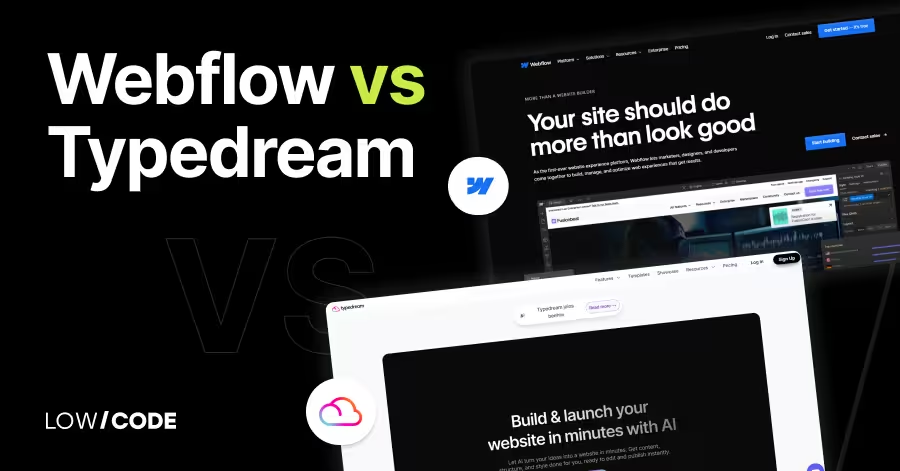
Webflow vs Typedream | 9 Factors to Decide the Best One
Compare Webflow vs Typedream on design, SEO, CMS, and speed. Learn which no-code builder suits your website goals, full control or fast publishing

Webflow
Website Redesign Agency Red Flags To Watch For
Some red flags from a website redesign agency are easy to miss. Here are the specific warning signs that predict poor project outcomes before you sign anything.
Why customers trust us for no-code development


