

Benefits of a Website Redesign
The real business benefits of a website redesign — more leads, better SEO, stronger brand, and faster performance explained clearly.


The benefits of a website redesign extend well beyond appearance. Businesses that redesign with defined goals convert more leads, rank higher in organic search, and close deals faster.
The ones that do it without defined goals look better and see no measurable improvement in the metrics that drive revenue.
This guide makes every benefit commercially concrete. Vague claims about "brand perception" are not business outcomes. More leads, stronger conversion rates, and lower cost-per-acquisition are.
Key Takeaways
- Conversion Improvement Is the Primary Benefit: A well-executed redesign improving UX and messaging typically delivers measurable lift in leads and sales.
- SEO Gains Are Structural: Technical fixes, page speed improvements, and better content architecture produce significant organic traffic increases.
- Brand Credibility Compounds Across Touchpoints: A professionally redesigned site makes downstream interactions including sales calls and proposals more effective.
- Operational Benefits Are Underrated: A better CMS, faster editorial workflow, and cleaner integrations reduce ongoing operational cost significantly.
- Benefits Must Be Measured: Without pre-redesign baselines and post-launch KPI tracking, the value of any redesign remains anecdotal and undefendable.


Why Benefits Must Be Grounded in Business Goals
For context on the business reasons to redesign, our dedicated guide covers the triggering conditions that make redesign investment most justified. This section focuses on how to frame benefits in terms leadership will act on.
Redesigns With Defined Goals Outperform Redesigns Without Them
When the redesign brief includes specific targets, including a conversion rate increase, traffic growth target, or lead volume goal, design decisions align to those targets rather than aesthetic preference.
A brief that says "we want to increase demo requests by 30%" produces a fundamentally different site than a brief that says "we want a more modern look."
- Goal-Aligned Design Decisions: CTA placement, page hierarchy, and content structure are decided by conversion requirements when goals are defined upfront.
- Measurability From Day One: Defined goals create a measurement framework before launch, making post-launch ROI evaluation straightforward.
- Stakeholder Alignment: Shared goals prevent the subjective stakeholder disagreements that derail projects when the only criterion is "does it look good."
Every Benefit Should Map to a Business Metric
More leads, faster sales cycles, lower cost-per-acquisition, higher organic rankings, and reduced operational cost are all measurable outcomes. "Better brand perception" is not a KPI.
The discipline of mapping every claimed benefit to a measurable metric prevents redesign investments from being evaluated on subjective criteria alone.
- Lead Volume Metric: Inbound lead volume from the site, tracked by source, measured against a pre-launch baseline across matched time periods.
- Conversion Rate Metric: Contact form submission rate, demo request rate, and quote request rate on primary service pages.
- Organic Traffic Metric: Organic sessions to key service and landing pages, measured against pre-launch baseline at 30, 60, and 90 days post-launch.
The ROI Case Requires a Pre-Redesign Baseline
To demonstrate that a redesign delivered value, conversion rates, traffic volumes, and lead quality must be documented before the project begins. Without a baseline, improvement cannot be proven.
This is one of the most consistently overlooked steps in redesign planning and one of the most commercially important.
- Baseline Data Set: Document conversion rates by page, organic traffic by landing page, bounce rates, and average session duration before briefing any agency.
- Lead Quality Baseline: Record MQL volume, SQL rate, and average lead quality score from the 90 days before the redesign begins.
- Benchmark Comparison Method: Plan a like-for-like comparison of the same 90-day period in the previous year to control for seasonality in post-launch analyzis.
Conversion and Lead Generation Benefits
The improving conversions through redesign guide covers conversion architecture in depth. Here is the commercial headline version.
Improved Conversion Architecture Increases Lead Volume
Redesigns that restructure CTAs, simplify conversion flows, and align page messaging to audience intent routinely produce 20-50% increases in lead form completion rates.
The mechanism is straightforward: remove friction, clarify the offer, and place the conversion trigger where intent is highest.
- CTA Placement Optimization: Moving primary CTAs above the fold and adjacent to social proof consistently improves contact form completion rates.
- Form Field Reduction: Reducing form fields from seven to three typically increases completion rate by 30-50% without reducing lead quality significantly.
- Messaging to Intent Alignment: Pages where the headline directly addresses the visitor's specific intent convert at 2-3x the rate of generic messaging pages.
Reduced Friction in Key User Journeys
Navigation confusion, excessive form fields, and unclear CTAs are the silent conversion killers on most underoptimized sites. Removing them is the fastest path to conversion improvement.
Users who cannot find what they need within three clicks leave. Most leave without contacting you, and most never return.
- Navigation Simplification: Reducing primary navigation from seven items to five and creating clear category hierarchy significantly reduces decision paralysis.
- Mobile Friction Elimination: Mobile-specific friction points including small tap targets, horizontal scrolling, and pinch-zoom requirements all suppress mobile conversion rates.
- Page Load Speed: Every additional second of page load time reduces conversion rate by 7-12% based on industry benchmarks. Speed is a conversion tool.
Better Targeting Through Segmented Messaging
Modern redesigns create audience-specific landing pages and content pathways that deliver the right message to different visitor types. Generic one-size messaging converts poorly compared to segmented approaches.
A visitor who found you by searching "enterprise HR software" and a visitor who searched "HR software for small business" have different needs. Serving the same page to both converts neither well.
- Audience-Specific Landing Pages: Dedicated pages for each major buyer segment allow messaging, proof points, and CTAs to be tailored to specific intent.
- Segmented Content Pathways: Navigation pathways that route visitors by role, company size, or industry reduce time-to-relevant-content and increase conversion probability.
- Personalization Layer: Advanced redesigns add behavioral personalization that adapts content based on traffic source, returning visitor status, and on-site behavior.
SEO and Organic Traffic Benefits
For the evidence of signs performance needs fixing on your current site before a redesign, our audit guide covers the diagnostic process. The organic benefits of a well-executed redesign are structural and lasting.
Page Speed and Core Web Vitals Improvements
Moving to a modern platform with optimized code, proper image handling, and minimal render-blocking scripts produces measurable Core Web Vitals gains. These metrics are a direct Google ranking signal.
A site moving from a Largest Contentful Paint of 5.2 seconds to 1.8 seconds is not just faster for users. It is demonstrably more likely to rank.
- LCP Improvement Impact: Achieving LCP under 2.5 seconds moves a site into Google's "good" Core Web Vitals category, which correlates with ranking improvement.
- CLS Reduction: Eliminating layout shift caused by poorly sized images and injected content prevents the frustration that increases bounce rates.
- Modern Platform Advantage: Rebuilding on Webflow or a modern, optimized WordPress stack typically produces a 40-60% improvement in page speed scores.
Better Content Structure and Internal Linking
Redesigns that restructure page hierarchy, implement proper header structure, and build logical internal linking directly improve crawl efficiency and keyword relevance signals.
Googlebot understands content hierarchy through heading structure and navigates site architecture through internal links. Both improve dramatically in a well-planned redesign.
- H1-H3 Hierarchy: Clear heading hierarchy with target keywords at H1 and supporting terms at H2 and H3 positions improves both crawler comprehension and user navigation.
- Internal Link Architecture: A redesign is an opportunity to rebuild internal linking deliberately, with high-authority pages linking to conversion pages.
- Breadcrumb Implementation: Breadcrumb navigation adds schema-supported site structure signals that improve both rankings and SERP appearance.
Technical SEO Fixes That Unlock Ranking Potential
Crawl errors, duplicate content, missing schema markup, and poor URL structure suppress ranking potential on sites that have never had a technical SEO audit. A redesign addresses all of these.
Many sites that have invested in content marketing are ranking below their potential because technical SEO issues are limiting indexation or diluting relevance signals.
- Crawl Error Elimination: Fixing 404 errors, redirect chains, and blocked resources removes indexation barriers that have been suppressing rankings.
- Schema Markup Implementation: Adding Organization, Article, Service, and FAQ schema gives search engines structured data signals that can improve SERP appearance and click-through rates.
- Duplicate Content Resolution: Canonical tag implementation and URL parameter handling resolve the duplicate content issues that dilute ranking signals across multiple URLs.
Brand Credibility and Trust Benefits
For timing redesign for maximum impact, the brand credibility benefit compounds most strongly when you redesign before entering a new market or competitive situation rather than after credibility has already been damaged.
Higher Close Rates on Sales Conversations
When prospects have visited a professional, credible website before a sales call, the qualification conversation starts from a stronger position. The salesperson does not need to recover from a credibility deficit.
This effect is particularly significant in B2B sales where the website is typically reviewed by multiple stakeholders before any first conversation.
- Pre-Call Credibility Establishment: Prospects who found your website credible are already pre-sold on talking to you when the first sales conversation begins.
- Pricing Conversation Impact: Prospects impressed by a professional site are measurably less likely to open with a price objection as their first statement.
- Multi-Stakeholder Influence: In B2B buying committees, each stakeholder who views the site independently needs to feel confident. Professional design reduces quiet vetoes.
Referral and Word-of-Mouth Quality Improvement
Clients refer more confidently when the site they are sending referrals to accurately represents the business at its current quality level. A poor site makes referrers uncomfortable and actively suppresses referral rates.
Your most satisfied clients are your most powerful marketing channel. A poor website undermines that channel.
- Referrer Confidence: Clients who are proud of the vendor they use share that vendor more freely. Clients embarrassed by a vendor's website do not refer.
- Referral Conversion Rate: Referred prospects who visit a credible site before contacting you convert at 2-3x the rate of cold traffic from the same referrer.
- Referral Frequency: Satisfied clients who actively recommend you do so more frequently when the site they're sending people to reinforces the quality they experienced.
Reduced Price Sensitivity From New Prospects
A site that communicates professionalism, expertise, and credibility reduces the frequency with which prospects use price as their primary decision criterion.
Price objections are often credibility objections in disguise. A prospect who doubts quality defaults to price. A prospect who is confident in quality evaluates value.
- Credibility-Price Correlation: Research consistently shows that perceived professionalism and credibility reduce price sensitivity in both B2B and B2C buying contexts.
- Value Framing Support: A site that communicates expertise through case studies, thought leadership, and client evidence makes the premium pricing conversation easier.
- Competitive Differentiation Effect: When a prospect has evaluated three similar vendors and yours is the most professionally presented, you have a negotiating advantage that is not about price.
Operational and Technical Benefits
Post-redesign KPI tracking with KPIs for post-redesign tracking should include the operational metrics that reflect these benefits, not just the marketing metrics.
Faster, Easier Content Management
A redesign onto a modern CMS with an intuitive editorial interface reduces the time and cost of content updates. It also increases the frequency of updates because publishing no longer requires developer involvement.
Sites that are easy to update get updated more often. Sites that are difficult to update go stale.
- Editorial Speed Improvement: A modern CMS like Webflow or Craft CMS reduces the time to publish a new blog post or update a service page from hours to minutes.
- Developer Dependency Reduction: Eliminating the need for a developer to make routine content updates saves £200-£500 per month in a typical small to mid-size business.
- Content Frequency Impact: Teams that previously published monthly because publishing was difficult often move to weekly publishing after switching to a modern CMS.
Better Integration With Marketing Tools
Modern platforms integrate cleanly with CRM, email marketing, analytics, and ad platforms. This reduces data fragmentation and improves marketing attribution accuracy significantly.
Fragmented data produces bad decisions. Clean integrations produce accurate attribution that allows marketing budget to be optimized based on actual performance data.
- CRM Integration Quality: Modern platforms connect to HubSpot, Salesforce, and Marketo with consistent lead data, source tracking, and behavior history.
- Analytics Data Integrity: Rebuilding the site creates an opportunity to implement a clean GA4 setup with proper goals, events, and attribution windows.
- Ad Platform Integration: Pixel and tag management through Google Tag Manager eliminates the data gaps that cause ad platform under-reporting.
Reduced Security Risk and Maintenance Cost
Moving off legacy platforms eliminates recurring security vulnerabilities, plugin conflicts, and the ongoing developer cost of maintaining a fragile codebase.
The cost of a security incident, in reputation damage and remediation time, typically exceeds the entire cost of the redesign that could have prevented it.
- Legacy Plugin Elimination: Every WordPress plugin is a potential vulnerability. Reducing plugin count by 60-80% through a redesign reduces the attack surface significantly.
- Platform Security Updates: Modern hosting platforms including Webflow, Squarespace, and managed WordPress apply security updates automatically without manual developer intervention.
- Maintenance Cost Reduction: Sites rebuilt on modern, well-maintained platforms typically reduce ongoing maintenance costs by 40-60% compared to legacy plugin-heavy builds.
Measuring the Benefits After Launch
Measuring redesign ROI accurately requires a measurement plan that is built before launch, not after the project team has moved on.
Establish a 90-Day Measurement Window
Significant data requires time to accumulate. Evaluate conversion rate changes, traffic trends, and ranking shifts at 30, 60, and 90-day intervals.
Evaluating a redesign at seven days and concluding it failed is as misleading as evaluating a seven-day-old investment portfolio.
- 30-Day Initial Read: First conversion rate data and early traffic trends become visible at 30 days. Check for obvious technical issues and early wins.
- 60-Day SEO Trendline: Google's crawling and indexation of the new site becomes substantial at 60 days, making SEO trend analyzis more reliable.
- 90-Day Full Assessment: The 90-day mark provides the most reliable baseline for conversion rates, SEO performance, and lead quality comparison.
Use a Pre/Post Comparison With Matched Traffic Periods
Comparing the same 90-day period in the previous year controls for seasonality. Traffic mix changes at launch can distort conversion rate comparisons without this control.
A site that launches in Q4 for a retail business will show dramatically different traffic patterns than the same site measured in Q1. Seasonality control is essential for honest measurement.
- Year-on-Year Comparison: Compare July-September after launch against July-September of the previous year for a seasonality-controlled view.
- Traffic Mix Control: If the redesign includes a new paid channel or a campaign launch, separate the organic and paid conversion rates to avoid mixing attribution.
- Cohort Analyzis: Analyzing returning visitor behavior separately from new visitor behavior reveals whether the redesign improved retention as well as acquisition.
Report Benefits to Leadership in Revenue Terms
Convert conversion rate improvements into lead volume and pipeline value. Frame SEO gains as a reduction in cost-per-acquisition equivalent. Translate every benefit into a number leadership cares about.
"We improved our conversion rate from 1.2% to 1.8%" becomes "we generated 42 additional leads last month at zero additional marketing cost."
- Lead Volume to Pipeline Translation: Multiply monthly lead improvement by average deal size and close rate to produce a monthly pipeline impact figure.
- SEO Value Equivalent: Calculate the cost of acquiring equivalent traffic through paid search to frame organic improvement as cost savings.
- Operational Cost Savings: Reduced maintenance hours, fewer developer requests, and faster content publishing all have calculable monthly cost savings.
Conclusion
The most valuable benefits of a website redesign, including more leads, better rankings, and stronger brand credibility, are fully measurable when the project is approached with clear goals and proper tracking in place.
Define the three business metrics your redesign must improve before briefing any agency.
Without those targets, there is no way to verify the investment paid off, no way to hold the project team accountable, and no way to make informed decisions about what to improve next.
LOW/CODE Agency Delivers Redesigns You Can Measure
Every LOW/CODE Agency redesign begins with defined KPIs agreed at the brief stage, tracked post-launch, and reported as revenue impact at 30, 60, and 90 days.
We build measurement into the project from day one because a redesign that cannot be measured cannot be improved.
We operate as a strategic product team, not a dev shop. That means we are accountable for outcomes, not just deliverables. Our clients know what success looks like before the first design review.
- KPI Definition at Brief Stage: We agree on three to five measurable goals with every client before design work begins.
- Pre-Launch Baseline Documentation: We capture baseline metrics across conversion, traffic, and lead quality before launch so post-launch comparison is possible.
- Conversion Architecture Design: Every page we design has a defined primary conversion goal and a CTA structure built to achieve it.
- SEO Foundation Standard: Technical SEO, Core Web Vitals optimization, schema markup, and redirect mapping are standard deliverables on every project.
- CRM and Analytics Integration: We configure GA4, Search Console, and CRM integrations with full source tracking before launch.
- Post-Launch Reporting: We deliver formal performance reports at 30, 60, and 90 days post-launch comparing results against defined baselines.
- Optimization Recommendations: Post-launch reports include specific recommendations for the next round of improvements based on actual performance data.
We are the redesign agency with measurable results trusted by 350-plus products and brands including Coca-Cola, American Express, Sotheby's, Medtronic, Zapier, and Dataiku. Start with a scoping call to discuss your redesign goals.
Partner with our no-code development experts to build your next digital product.
Last updated on
September 24, 2026
.

Daniel is a Web Developer at LowCode Agency who has been building websites in Webflow since 2022. With a background in graphic design, he turns the design team's concepts into fast, responsive sites built to scale.


FAQs
Related Articles
Webflow
Comparison
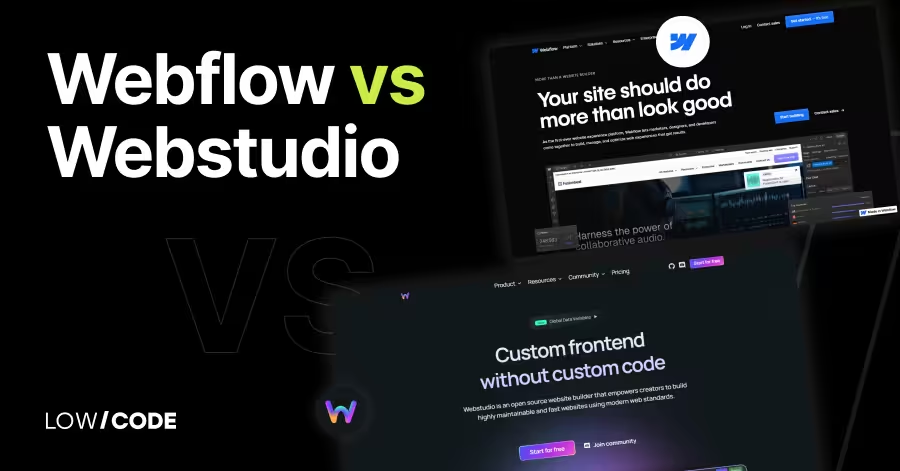
Webflow vs Webstudio | 9 Factors to Decide the Best One
Compare Webflow vs Webstudio across 9 key factors like design, CMS, pricing, and performance to find the right builder for your next project

Webflow
Should You Build Your Webflow Site Yourself?
When DIY Webflow makes sense and when it costs more than hiring an agency. Honest breakdown for business owners.

Webflow
Webflow Development Cost Breakdown (2026)
Line-by-line breakdown of Webflow development costs — design, build, CMS, integrations, and what inflates the final number.
Webflow
CPA Website Redesign Guide
How CPA firms redesign their websites to attract better clients, build trust, and convert visitors into consultations more reliably.

Why customers trust us for no-code development


