

Mobile App Ideas That Solve Real Problems
13 min
read
Looking for a mobile app idea worth building? Learn how to identify real user problems that lead to apps people actually want to use.


Most mobile app ideas fail because they solve imaginary problems. The apps that succeed start with a genuine pain point and build the simplest solution around it.
This guide covers proven mobile app ideas across industries, with practical advice on evaluating and validating each concept. Whether you are a founder or product leader, these ideas are worth exploring.
Key Takeaways
- Problem-first thinking wins because the best mobile app ideas solve specific pain points real users experience daily.
- Industry-specific apps outperform generic ones since targeted solutions attract loyal users who pay for specialized value.
- Validation before building saves money by confirming market demand before investing in full mobile app development.
- Revenue models shape the idea because your monetization strategy influences which features you prioritize from the start.
- Low-code accelerates testing by letting you build functional prototypes in weeks instead of months.
- Timing matters more than originality since executing well on a proven concept often beats inventing something entirely new.

What Makes a Mobile App Idea Worth Pursuing?
A mobile app idea is worth pursuing when it solves a frequent, painful problem for a clearly defined audience willing to pay for the solution.
Not every idea deserves development resources. The strongest mobile app ideas share common traits that separate viable products from expensive experiments that go nowhere.
- Frequency of use determines stickiness because apps people open daily have far higher retention than occasional-use products.
- Willingness to pay validates demand since users who currently spend money solving the problem will pay for a better solution.
- Clear target audience exists when you can describe exactly who uses the app and why without vague generalizations.
- Technical feasibility is realistic meaning the core features can be built within your budget and timeline constraints.
- Competition gaps reveal opportunity because existing solutions with poor reviews or missing features signal room for improvement.
- Regulatory barriers create moats because industries with compliance requirements discourage casual competitors from entering the market.
Before you fall in love with any mobile app idea, run it through these filters. The goal is not to find a perfect idea but to find one that clears every basic viability threshold.
What Are the Best Mobile App Ideas for Small Businesses?
Small business mobile app ideas focus on automating daily operations, improving customer engagement, and reducing manual work. Think scheduling, invoicing, loyalty programs, and field service management.
Small businesses waste hours on tasks that a simple mobile app could handle automatically. The best mobile app ideas for this segment turn repetitive workflows into streamlined digital experiences.
- Appointment scheduling apps replace phone tag and manual calendars with self-service booking that syncs across devices.
- Invoice and payment apps let service providers send invoices, accept payments, and track cash flow from their phones.
- Customer loyalty apps reward repeat purchases and keep your brand visible on customers' home screens every day.
- Inventory management apps track stock levels in real time so small retailers never oversell or run out unexpectedly.
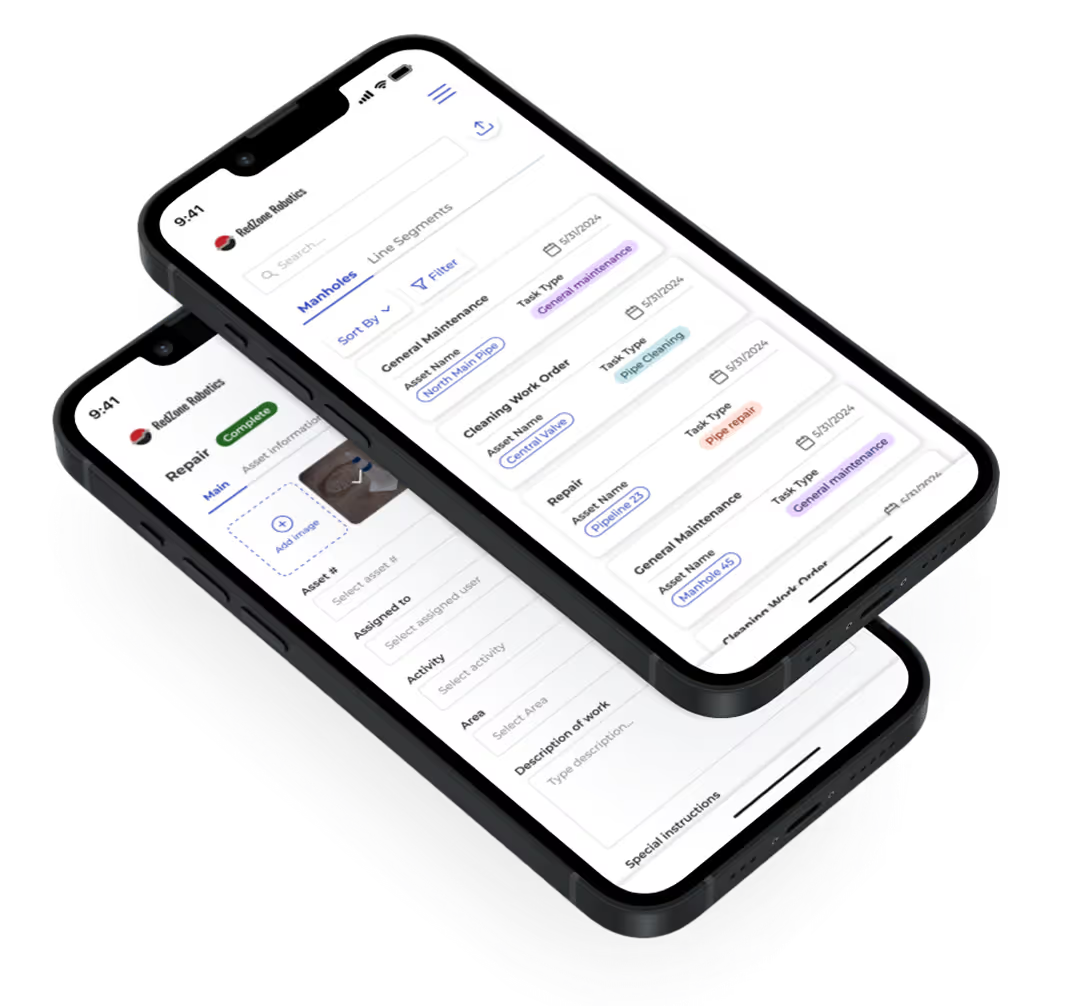
- Field service dispatch apps assign jobs, optimize routes, and collect signatures without paperwork or phone calls, often serving as lightweight field operations software for businesses managing mobile teams and on-site work.
- Review and reputation management apps prompt satisfied customers for reviews and alert owners to negative feedback immediately.
Small business owners do not need complex enterprise software. They need mobile apps built around their actual workflow that save time and reduce errors without requiring a technical background.
What Mobile App Ideas Work Best for Healthcare?
Healthcare mobile app ideas include patient portals, telehealth platforms, medication tracking, remote monitoring, and clinical workflow tools. Compliance with HIPAA and data security is essential.
Healthcare is one of the fastest-growing sectors for mobile app development. Patients expect digital access, and providers need tools that reduce administrative burden while improving care quality.
- Telehealth consultation apps connect patients with providers through video calls, reducing no-shows and travel barriers.
- Medication reminder apps send timely alerts and track adherence, improving outcomes for chronic disease management patients.
- Patient intake apps digitize paperwork so patients complete forms before appointments, saving staff time at check-in.
- Remote monitoring apps collect vitals from connected devices and alert care teams when readings fall outside normal ranges.
- Mental health apps provide therapy tools, mood tracking, and crisis resources that extend care beyond clinical settings.
Healthcare mobile app ideas carry higher compliance requirements but also higher willingness to pay. If you understand the regulatory landscape, this sector offers durable mobile app ideas with strong revenue potential.
What Are Trending Mobile App Ideas in Education?
Education app ideas include microlearning platforms, skill assessment tools, virtual tutoring marketplaces, classroom management systems, and interactive study aids powered by AI.
Education technology has permanently shifted toward mobile-first experiences. Students, parents, and educators now expect learning tools that work anywhere, adapt to individual pace, and provide instant feedback.
- Microlearning apps deliver short lessons that fit into busy schedules and improve knowledge retention through spaced repetition.
- AI tutoring apps personalize instruction by identifying knowledge gaps and adjusting difficulty in real time for each student.
- Classroom management apps streamline communication between teachers, students, and parents with assignments, grades, and announcements.
- Language learning apps use gamification to keep users engaged through streaks, challenges, and social competition features.
- Professional certification apps help working adults prepare for industry exams with practice tests and progress tracking.
Education mobile app ideas benefit from recurring revenue models since learners subscribe monthly or annually. The mobile app development cost for education platforms varies widely based on content complexity and AI integration.
What Mobile App Ideas Generate Recurring Revenue?
Mobile app ideas with recurring revenue use subscription models, in-app purchases, or transaction fees. Fitness, productivity, finance, and content platforms are among the strongest categories for predictable income.
Recurring revenue transforms a mobile app from a one-time product into an ongoing business. The most sustainable mobile app ideas build habits that users pay to maintain month after month.
- Fitness and wellness apps charge monthly for workout plans, nutrition tracking, and progress analytics that users rely on daily.
- Personal finance apps earn through premium tiers offering budgeting tools, investment insights, and transaction categorization.
- Content subscription apps deliver exclusive articles, videos, or courses behind a paywall that refreshes with new material regularly.
- SaaS companion apps extend desktop business tools to mobile, where users pay as part of their existing software subscription.
- Marketplace apps take transaction fees by connecting buyers and sellers, earning a percentage on every completed exchange.
Recurring revenue mobile app ideas require strong retention strategies. Your mobile app business strategy should prioritize features that increase daily usage and reduce churn above everything else.
What Mobile App Ideas Are Emerging in AI and Automation?
AI-powered mobile app ideas include personal productivity assistants, automated content creation tools, predictive analytics dashboards, intelligent customer service bots, and AI-driven health coaching platforms.
AI has opened entirely new categories of mobile app ideas that were not technically feasible even two years ago. The combination of on-device AI capabilities and cloud-based models creates opportunities across every industry.
- AI writing and content assistants help users draft emails, social posts, and documents from their phones using natural language prompts.
- Predictive maintenance apps for equipment use sensor data and machine learning to alert operators before machinery fails.
- AI-powered personal finance advisors analyze spending patterns and provide automated recommendations for saving and investing goals.
- Intelligent customer service apps resolve support tickets using AI chatbots trained on company knowledge bases and past interactions.
- AI health coaching platforms combine wearable data with behavioral science to deliver personalized wellness recommendations daily.
- Automated workflow apps for small teams use AI to route tasks, prioritize work, and generate status reports without manual input.
AI mobile app ideas carry higher development costs due to model integration and data requirements. Start with a focused use case where AI delivers measurable value before expanding into broader automation features.
The most successful AI-powered mobile app ideas solve one problem exceptionally well rather than trying to automate everything at once. Focused AI implementations also reduce ongoing costs since narrower models require less compute and less training data to maintain accuracy.
What Mobile App Ideas Are Best for First-Time Founders?
First-time founders should pursue mobile app ideas that are simple to build, easy to validate, and serve a niche audience. Community apps, marketplace MVPs, and productivity tools are strong starting points.
Building your first mobile app is about learning fast, not building big. The best mobile app ideas for new founders minimize technical complexity while maximizing the speed of user feedback.
- Niche community apps connect people around shared interests, generating engagement with minimal content creation from you.
- Local service marketplaces match providers with customers in a specific geography, keeping scope manageable and testable.
- Habit tracking apps solve a universal need with simple mechanics that are straightforward to build and iterate on.
- Event discovery apps curate local experiences for specific audiences, creating value through curation rather than content creation.
- Simple booking platforms let users schedule services like cleaning, tutoring, or pet care in a specific market.
Start with an MVP to test your mobile app idea before scaling. First-time founders who invest six figures in a full build before validating demand almost always regret it.
How Do You Validate a Mobile App Idea Before Building?
Validate by testing demand with landing pages, waitlists, competitor analysis, and prototype user testing. Spend weeks validating, not months building something nobody wants.
Validation is the most important step between having a mobile app idea and spending money on development. Skipping it is the single biggest reason mobile apps fail after launch.
- Landing page tests measure interest by tracking how many visitors sign up for early access before any code is written.
- Competitor analysis reveals gaps by studying app store reviews to find what existing solutions get wrong consistently.
- User interviews uncover real needs through conversations with potential users about their current pain points and workarounds.
- Prototype testing gets feedback early by putting clickable mockups in front of real users before committing to full development.
- Pre-sale campaigns prove willingness to pay when potential customers put down deposits or purchase lifetime access in advance.
The best way to build a mobile app starts with proof that people want it. Validation does not guarantee success, but it dramatically reduces the risk of building something nobody needs.
How Do You Evaluate the Revenue Potential of a Mobile App Idea?
Evaluate revenue potential by estimating total addressable market size, researching competitor revenue, analyzing willingness to pay through surveys, and modeling customer lifetime value against acquisition costs.
A mobile app idea can solve a real problem and still fail financially if the market is too small, the price point is too low, or customer acquisition costs exceed lifetime revenue.
- Total addressable market defines your ceiling by estimating the maximum number of users who could potentially pay for your solution.
- Competitor revenue benchmarks validate demand because if similar apps generate revenue, your market has proven willingness to pay.
- Customer acquisition cost modeling prevents surprises by estimating how much you will spend acquiring each user through marketing channels.
- Churn rate projections determine sustainability because high monthly churn makes subscription revenue models unsustainable over time.
- Pricing experiments with landing pages reveal the price point where conversion rates and revenue per user find their optimal balance.
Revenue potential analysis should happen during validation, not after launch. Mobile app ideas that pass the revenue test deserve investment. Those that do not should be pivoted or abandoned before development begins.
The discipline to walk away from an idea that fails the revenue test is what separates successful founders from those who spend months building products nobody will pay for.
How Do You Go From Mobile App Idea to Launch?
Going from idea to launch requires validation, planning, design, development, testing, and deployment. Each phase builds on the previous one, and skipping steps creates expensive problems later.
Turning a mobile app idea into a real product follows a predictable path. The teams that execute well on each phase ship faster and spend less than those who improvise.
- Validation confirms demand exists so you invest development resources into a mobile app idea with proven market interest.
- Planning defines scope and timeline by breaking features into prioritized phases with clear milestones and deliverables.
- Design creates the user experience through wireframes, prototypes, and visual design that align with your audience expectations.
- Development builds the product using the technology stack and app type that best match your requirements and budget.
- Testing catches issues before users do through systematic QA across devices, screen sizes, and operating system versions.
- Launch includes store submission with optimized listings, screenshots, and descriptions that drive downloads from day one.
A strong mobile app idea deserves a strong execution plan. Working with an experienced team eliminates the guesswork and keeps your project on track from concept to launch.
Ready to Turn Your Mobile App Idea Into a Real Product?
The gap between a great mobile app idea and a successful product is execution. Ideas are everywhere, but the discipline to validate, plan, and build properly is what separates winners from failures.
At LOW/CODE Agency, we help SMBs compete with AI-powered software built for them — custom web and mobile apps, RAG systems, chatbots, and intelligent agents delivered by a senior development team. We take mobile app ideas from concept through launch with a process designed to reduce risk and maximize speed to market.
- Discovery workshops refine your idea so development starts with validated assumptions, not untested guesses about user behavior.
- Design sprints create testable prototypes that put your mobile app idea in front of real users before writing production code.
- Build phase uses the right tools from FlutterFlow and Bubble to custom Flutter, matched precisely to your project needs.
- Scalable architecture supports growth so your app handles increasing users without performance degradation or costly rebuilds.
- Launch support covers both stores with full App Store and Google Play submission, optimization, and compliance handling.
- Post-launch iteration keeps momentum through analytics-driven updates that improve retention and expand feature sets over time.
- Partnership extends beyond delivery with ongoing maintenance, monitoring, and strategic guidance as your product evolves.
Over 350 projects delivered for clients including Medtronic, American Express, Coca-Cola, Zapier, and Sotheby's. We build across FlutterFlow, Bubble, Glide, Webflow, Make, n8n, and Zapier.
Our team at LOW/CODE Agency will help you validate, design, and launch with confidence.
Related Articles
Last updated on
September 3, 2026
.

Jesus is a visionary entrepreneur and tech expert. After nearly a decade working in web development, he founded LOW/CODE Agency to help businesses optimize their operations through custom software solutions.


FAQs
How do I come up with a mobile app idea that solves a real problem?
How do I know if my mobile app idea solves a real problem?
What makes a mobile app idea commercially viable?
How do I evaluate competition before building a mobile app?
What are some mobile app categories with strong growth in 2026?
Should I build a mobile app for a niche or a broad audience?
Related Articles

Mobile App Development
Flutter vs React Native for Mobile App Dev
Flutter or React Native for your mobile app? Compare performance, cost, community, and use cases to make the right call.

Mobile App Development
Why Mobile App Timelines Vary So Much
Why does mobile app development take different amounts of time? Learn what factors drive timelines and how to set realistic expectations.

Mobile App Development
Employee Communication Mobile App: What to Build
Thinking of building an employee communication mobile app? Learn what features matter most and what to avoid before you start.

Mobile App Development
Top Mobile App Development Agencies
Find the top mobile app development agencies in 2026. Compare leading firms by expertise, pricing, and client results to choose the right partner for your app.


Why customers trust us for no-code development


