

Mobile App Development Trends to Watch in 2026
13 min
read
What's shaping mobile app development in 2026? Discover the biggest trends changing how apps are built, launched, and scaled.


The mobile app development landscape shifts faster than most teams can adapt. In 2025, AI-assisted coding, cross-platform maturity, and edge computing are reshaping how apps get built, deployed, and monetized. Ignoring these mobile app development trends means building with yesterday's tools while competitors build with tomorrow's.
This guide breaks down the mobile app development trends that matter most in 2025 and beyond. You will learn which trends are hype, which are real, and how each one impacts your technology decisions and project timelines.
Key Takeaways
- AI is reshaping development. AI-assisted coding tools are the most impactful mobile app development trend, cutting development time by 30 to 50% for teams that adopt them.
- Cross-platform wins. Flutter and React Native maturity means cross-platform is no longer a compromise, making it the dominant mobile app development trend for new projects.
- Edge computing rises. Processing data closer to users is a mobile app development trend that reduces latency and enables real-time features previously impossible on mobile.
- Super apps expand. Mini-apps within platforms like WeChat and Apple App Clips represent a mobile app development trend toward embedded, lightweight experiences.
- Privacy-first design. Regulatory pressure and user expectations make privacy-by-design the mobile app development trend that no team can afford to ignore.

How Is AI Changing Mobile App Development?
AI is changing mobile app development by automating code generation, testing, design-to-code conversion, and user experience personalization, reducing development timelines by 30 to 50% for adopting teams.
AI is the single most transformative mobile app development trend of 2025. Tools like Cursor, Claude Code, and GitHub Copilot are not replacing developers but are fundamentally changing how fast and efficiently mobile apps get built.
- AI code generation accelerates mobile app development by producing boilerplate, UI components, and business logic from natural language descriptions in seconds
- Automated testing powered by AI creates test suites that adapt as code changes, making mobile app development quality assurance faster and more comprehensive
- Design-to-code tools convert Figma designs directly into functional Flutter or React Native code, shortening the mobile app development pipeline significantly
- Personalization engines use on-device machine learning to customize user experiences in real time without sending data to servers during mobile app development
- Bug detection through AI-powered code review catches issues before they reach production, reducing mobile app development debugging time by 40% or more
At LOW/CODE Agency, AI-assisted mobile app development is already part of our standard workflow. We use tools like Cursor and Claude Code alongside traditional development to deliver projects faster without sacrificing quality. Understanding the best way to build a mobile app in 2025 means understanding how AI fits into the development process.
The most underappreciated AI mobile app development trend is in maintenance and debugging. AI tools now analyze crash logs, suggest fixes, and even generate patches automatically. For teams maintaining live applications, this reduces mean time to resolution from hours to minutes. This mobile app development trend benefits existing apps just as much as new builds.
What Is the State of Cross-Platform Mobile App Development?
Cross-platform mobile app development has reached near-native performance parity in 2025, with Flutter and React Native handling 90% of use cases that previously required separate iOS and Android codebases.
The cross-platform versus native debate is one of the most settled mobile app development trends. Flutter 4 and React Native's new architecture have closed the performance gap that once made native development the only serious option.
- Flutter adoption has grown 200% since 2022, making it the fastest-growing mobile app development trend in cross-platform tooling with Google's continued investment
- React Native's new architecture eliminates the JavaScript bridge bottleneck, bringing mobile app development performance within 5% of fully native apps
- Kotlin Multiplatform is an emerging mobile app development trend that shares business logic across platforms while keeping native UI, appealing to teams with existing Kotlin codebases
- Single codebase economics cut mobile app development costs by 30 to 40% compared to maintaining separate iOS and Android teams and codebases
- Platform-specific features like ARKit and Material You are now accessible through cross-platform plugins, removing the last major mobile app development limitation of shared codebases
This mobile app development trend directly impacts project costs and timelines. Understanding how these frameworks compare helps you make informed decisions about your mobile app development process and technology selection.
How Are Super Apps and Mini-Apps Reshaping Mobile Development?
Super apps and mini-apps are reshaping mobile app development by creating lightweight, embedded experiences that live inside existing platforms rather than requiring standalone installations.
The super app mobile app development trend started in Asia with WeChat and Alipay but is now influencing Western markets through Apple App Clips, Google Instant Apps, and platform-specific mini-programs.
- Apple App Clips let users access mobile app development features without installing the full app, creating a new acquisition channel for lightweight experiences
- Google Instant Apps enable try-before-install mobile app development experiences that reduce the friction barrier between discovery and engagement
- WeChat Mini Programs have created a $250 billion ecosystem proving that embedded mobile app development can support full commercial applications
- Telegram bots and mini-apps represent an emerging mobile app development trend where chat platforms become distribution channels for app-like experiences
- Snap Minis and similar platform extensions demonstrate how mobile app development trends are moving toward building within existing ecosystems rather than competing for home screen space
This mobile app development trend affects how you think about distribution and user acquisition. Your mobile app growth guide should account for these lightweight distribution channels alongside traditional app store strategies.
What Role Does Edge Computing Play in Mobile App Development?
Edge computing enables mobile app development to process data closer to users, reducing latency to under 10 milliseconds for real-time features like AR, gaming, and live collaboration.
Edge computing is a mobile app development trend driven by user expectations for instant responsiveness. When processing happens at the network edge rather than in distant data centers, mobile apps can deliver experiences that feel instantaneous.
- Real-time AR becomes practical in mobile app development when edge computing processes camera feeds locally instead of round-tripping to cloud servers
- Live collaboration features in mobile app development benefit from edge-processed sync that eliminates the lag that makes real-time editing feel broken
- On-device AI inference is a mobile app development trend that keeps sensitive data on the phone while still delivering intelligent features like text prediction and image recognition
- Gaming performance improves when mobile app development leverages edge computing for multiplayer state sync with sub-10ms latency across regions
- Offline-first architecture is a related mobile app development trend where apps function fully without connectivity and sync when connection returns
Building apps that leverage edge computing requires specific architectural decisions. Making technology choices that hold up as your app scales means selecting frameworks and infrastructure that support edge deployment natively.
How Is Privacy-First Development Changing Mobile Apps?
Privacy-first development is changing mobile app development by making on-device processing, minimal data collection, and transparent consent the default architecture rather than an afterthought.
Privacy is no longer optional in mobile app development. Apple's App Tracking Transparency, GDPR enforcement, and emerging state-level US privacy laws have made privacy-by-design a business requirement, not just a best practice.
- App Tracking Transparency has reduced cross-app tracking by 80%, forcing mobile app development teams to build first-party data strategies instead of relying on third-party identifiers
- On-device processing keeps sensitive data local, making mobile app development privacy-compliant by default rather than through complex server-side anonymization
- Privacy nutrition labels on app stores require mobile app development teams to declare every data type collected, increasing transparency and user trust
- Consent management is now a required mobile app development feature, with pre-built SDKs that handle regional privacy law variations automatically
- Zero-knowledge architecture is an emerging mobile app development trend where servers never see unencrypted user data, providing the strongest possible privacy guarantees
This mobile app development trend directly impacts your mobile app business strategy. Apps that lead with privacy messaging are seeing higher conversion rates as users become more aware of data practices.
The privacy mobile app development trend is not just about compliance. It is becoming a competitive advantage. Apps that transparently communicate their data practices and minimize collection are seeing 15 to 20% higher conversion rates in app store listings compared to apps with extensive data collection disclosures. Users are making download decisions based on privacy labels.
What Are the Emerging Monetization Trends in Mobile Apps?
Emerging monetization trends in mobile app development include subscription fatigue responses, hybrid models, in-app micropayments, and AI-powered dynamic pricing that optimizes revenue per user.
Monetization models in mobile app development are evolving as users push back on subscription overload. Apps that adapt their revenue strategy to these mobile app development trends capture more value without alienating users.
- Subscription fatigue is pushing mobile app development toward hybrid models that combine free tiers with one-time purchases and optional subscription upgrades
- Micropayments for individual features or content pieces offer a mobile app development monetization alternative that feels fairer to users than all-or-nothing subscriptions
- AI-powered pricing dynamically adjusts offers based on user behavior and willingness to pay, a mobile app development trend that optimizes revenue without manual experimentation
- Creator economy features let users monetize their own content within apps, creating a mobile app development trend where platforms take a percentage of user-generated revenue
- Bundled subscriptions through Apple One, Google Play Pass, and custom bundles represent a mobile app development trend that reduces per-app subscription costs while increasing total revenue
Understanding mobile app development costs alongside monetization trends helps you build a financial model that supports sustainable growth rather than just covering build expenses.
How Will Wearables and IoT Affect Mobile App Development?
Wearables and IoT are expanding mobile app development into companion experiences, health monitoring, smart home control, and industrial applications that extend smartphone functionality to connected devices.
The wearable and IoT mobile app development trend transforms smartphones from standalone devices into hubs that coordinate an ecosystem of connected products. This creates new opportunities and new complexity for mobile app development teams.
- Health and fitness apps are the fastest-growing wearable mobile app development category, processing biometric data from watches, rings, and patches in real time
- Smart home integration through Matter protocol standardization simplifies mobile app development for connected device control across manufacturers
- Industrial IoT dashboards represent a B2B mobile app development trend where field workers monitor and control equipment through mobile interfaces
- Companion app architecture requires mobile app development to handle Bluetooth, NFC, and WiFi Direct communication protocols alongside standard internet connectivity
- Watch-first experiences for Apple Watch and Wear OS require mobile app development teams to design for screens under 2 inches with limited input methods
This mobile app development trend is expanding the definition of what a mobile app even is. Teams building mobile app development services must now consider the full ecosystem of devices users carry and interact with.
How Is Low-code Evolving as a Mobile App Development Trend?
Low-code and no-code platforms are evolving from prototyping tools into production-grade mobile app development environments capable of building and shipping apps used by millions of users.
The low-code mobile app development trend has shifted from "good enough for MVPs" to "competitive with custom code for most use cases." Platforms like FlutterFlow, Bubble, and Glide now support the complexity that previously required full custom development.
- Production-grade output from low-code platforms means mobile app development trends now include serious business applications built entirely with visual tools
- AI-enhanced builders combine visual development with AI code generation, creating a mobile app development trend where platforms write custom code automatically when visual tools hit limits
- Export and ownership options let teams take generated code out of low-code platforms, removing the vendor lock-in concern that previously slowed mobile app development trend adoption
- Enterprise adoption of low-code mobile app development is accelerating as companies realize the 3 to 5x speed advantage applies to internal tools, customer-facing apps, and everything between
- Hybrid workflows that combine low-code for standard features with custom code for specialized logic represent a mobile app development trend that optimizes both speed and capability
At LOW/CODE Agency, this mobile app development trend is core to our approach. We select the optimal tool for each project, whether that means low-code, AI-assisted development, or full custom code, based on what delivers the best outcome for the specific requirements.
How Are 5G and Connectivity Advances Affecting Mobile App Development?
5G connectivity is affecting mobile app development by enabling real-time data streaming, cloud-rendered graphics, and multi-device synchronization that were impractical on 4G network speeds and latency.
The 5G mobile app development trend unlocks capabilities that change what apps can do, not just how fast they load. With 1 to 10 millisecond latency and gigabit speeds, features that previously required local processing can move to the cloud.
- Cloud gaming on mobile becomes viable as a mobile app development trend because 5G latency is low enough to stream rendered frames without perceptible input lag
- Real-time video processing enables mobile app development for augmented reality, live translation, and collaborative video editing without local GPU limitations
- Multi-device sync improves when 5G connectivity supports simultaneous data streams across phones, watches, and earbuds as a mobile app development trend
- High-fidelity media including 4K video streaming and spatial audio becomes practical in mobile app development without lengthy buffering or quality degradation
- Remote sensor networks connect to mobile apps over 5G for industrial monitoring, agricultural tracking, and smart city applications as a mobile app development trend
Not all users have 5G yet, so this mobile app development trend requires graceful degradation strategies. Building apps that take advantage of 5G when available while remaining functional on 4G ensures the broadest possible user base.
How LOW/CODE Agency Stays Ahead of Mobile App Development Trends
LOW/CODE Agency tracks and adopts mobile app development trends continuously, ensuring every project uses the most effective tools and approaches available.
- AI-assisted development is already integrated into our mobile app development workflow using Cursor, Claude Code, and custom AI pipelines
- Cross-platform expertise in Flutter and React Native ensures clients benefit from the mobile app development trend toward single-codebase efficiency
- Privacy-first architecture builds compliance into every project from the start rather than retrofitting privacy as mobile app development regulations evolve
- Edge-ready infrastructure selects cloud and deployment configurations that support mobile app development trends in real-time and offline-first experiences
- Continuous learning means our team evaluates emerging mobile app development trends quarterly and adopts tools and patterns that deliver measurable client value
With 450+ projects completed for clients including Medtronic, American Express, Coca-Cola, Zapier, and Sotheby's, we have navigated multiple generations of mobile app development trends.
Related Articles
Last updated on
September 3, 2026
.

Jesus is a visionary entrepreneur and tech expert. After nearly a decade working in web development, he founded LOW/CODE Agency to help businesses optimize their operations through custom software solutions.


FAQs
What are the biggest mobile app development trends in 2026?
How is AI changing mobile app development in 2026?
Is augmented reality a viable feature for mobile apps in 2026?
What role does privacy play in mobile app development trends for 2026?
Are super apps becoming more common outside of Asia in 2026?
How important is cross-platform development in 2026 mobile app trends?
Related Articles

Mobile App Development
Mobile App Contract Terms You Need to Know
Before signing a mobile app development contract, know what every clause means. Learn the key terms to protect your project and IP.
Mobile App Development
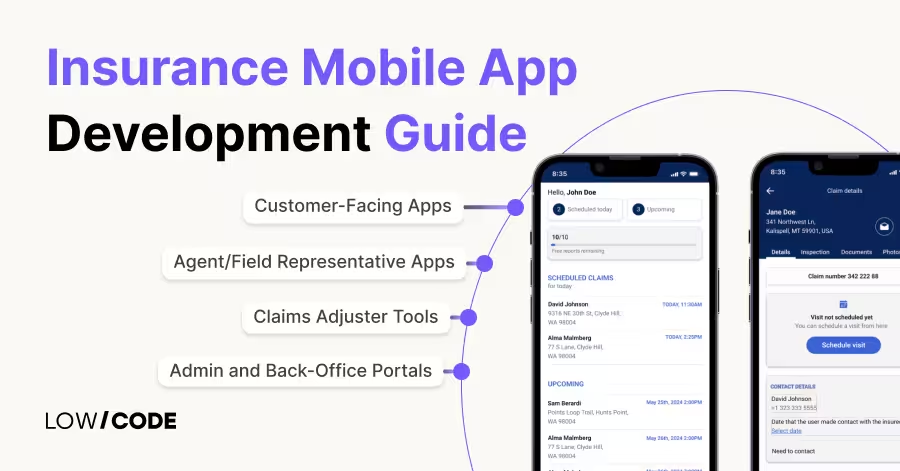
Insurance Mobile App Development Guide 2026
Discover how to build secure, user-friendly insurance apps. Learn features, costs, timelines, and key strategies to launch faster and stay ahead

Mobile App Development
Flutter Mobile App Development: Full Guide
Is Flutter right for your mobile app? Get a complete guide to Flutter development, costs, pros, cons, and when to use it.
Mobile App Development
Detailed Guide to Mobile App Development in 2026
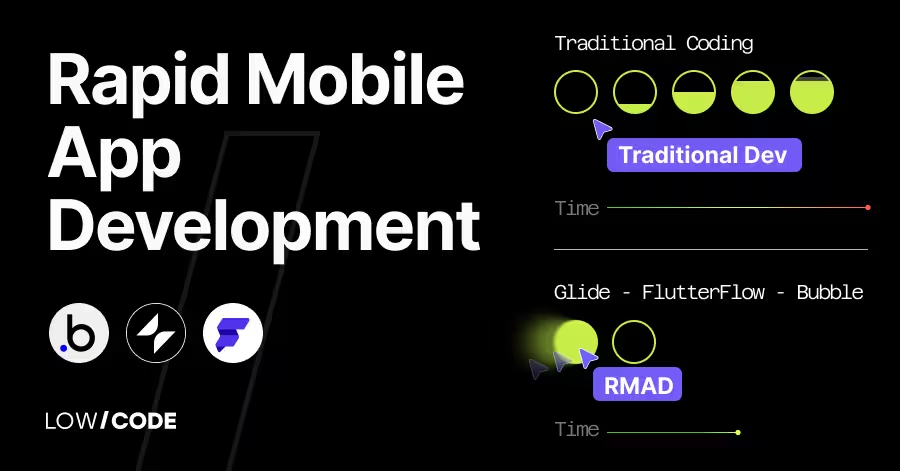
Comprehensive guide to mobile app development in 2026, covering no-code tools, processes, types of apps, and key development strategies.

Why customers trust us for no-code development


