

How to Scale Mobile App Users and Revenue
13 min
read
Built your mobile app — now what? Learn the strategies that actually grow users, improve retention, and increase revenue over time.


Getting your mobile app built and launched is only half the challenge. Mobile app growth is what determines whether your app becomes a viable business or joins the 99% of apps that never reach sustainable traction. The difference between apps that grow and apps that stall comes down to systems, not luck.
This guide covers every stage of mobile app growth, from pre-launch foundations to scaling strategies that work at 100,000 users and beyond. You will learn specific tactics, metrics, and frameworks that drive measurable mobile app growth.
Key Takeaways
- Retention drives growth. Mobile app growth is mathematically impossible to sustain when more users leave each month than you acquire.
- Measure before spending. Track activation, retention, and revenue metrics before scaling mobile app growth spend on acquisition channels.
- Compound small wins. Mobile app growth comes from dozens of 5 to 10% improvements across the funnel, not a single viral moment.
- Build growth into the product. The most effective mobile app growth mechanisms are product features like referrals and sharing, not just marketing campaigns.
- Match strategy to stage. Early mobile app growth priorities differ fundamentally from strategies that work at scale, and applying the wrong playbook wastes resources.
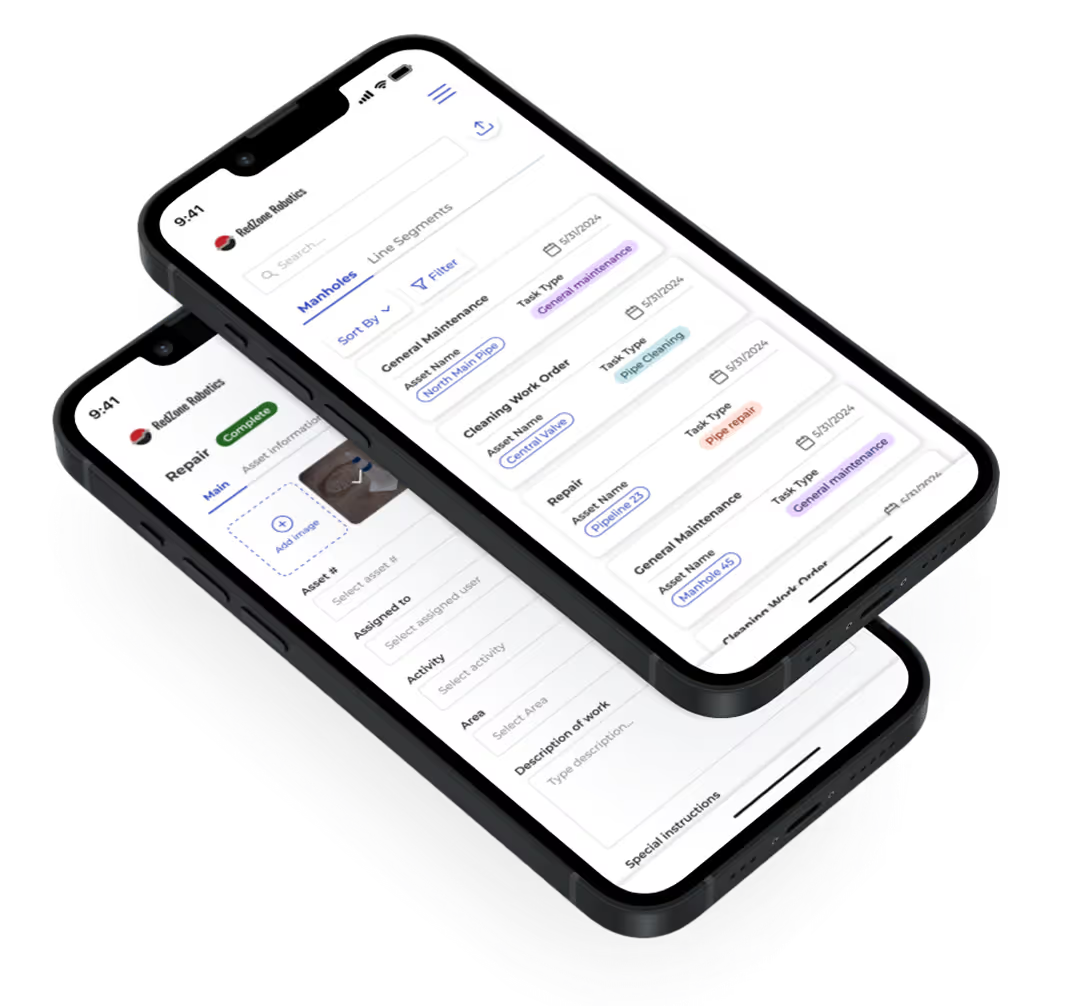

What Does Mobile App Growth Actually Mean?
Mobile app growth is the systematic process of increasing users, engagement, and revenue through a combination of acquisition, activation, retention, and monetization strategies working together.
Mobile app growth is not just about downloads. An app with a million downloads and 2% retention is failing. True mobile app growth means building a system where new users arrive, activate, stay, and eventually generate revenue or referrals.
- Acquisition brings new users to your app through organic and paid channels, forming the top of the mobile app growth funnel
- Activation converts downloads into active users by guiding them to their first meaningful experience during the mobile app growth journey
- Retention keeps users coming back daily, weekly, or monthly, which is the single most important metric in mobile app growth
- Revenue generates sustainable income through subscriptions, purchases, or ads so mobile app growth translates into business viability
- Referral turns existing users into acquisition channels when product quality drives organic mobile app growth through word-of-mouth
Understanding these stages as an interconnected system is critical. Fixing a retention problem delivers more mobile app growth impact than doubling acquisition spend because retained users compound over time.
The math behind mobile app growth reinforces this point. If your app retains 20% of users at Day 30, acquiring 10,000 users per month gives you 2,000 active users after the first month and a steadily growing base. If retention drops to 10%, you need to double acquisition spend just to maintain the same active user count. This is why the most successful mobile app growth teams obsess over retention first and acquisition second.
How Do You Build a Mobile App Growth Foundation?
Build a mobile app growth foundation by establishing analytics, defining your activation metric, achieving product-market fit signals, and creating a repeatable onboarding flow before scaling spend.
Scaling mobile app growth before the foundation is solid is the most expensive mistake teams make. Pouring users into a broken funnel accelerates losses instead of growth. The foundation must be in place first.
- Analytics infrastructure tracks every meaningful user action so mobile app growth decisions are based on data rather than intuition or anecdotes
- Activation metric definition identifies the specific action that predicts long-term retention, giving mobile app growth efforts a clear target to optimize toward
- Product-market fit signals like 40% of users saying they would be very disappointed without the app confirm that mobile app growth investment will not be wasted
- Onboarding optimization converts downloads into activated users at a rate high enough to sustain mobile app growth without excessive acquisition costs
- Baseline metrics establish current acquisition cost, activation rate, day-7 retention, and monthly revenue so mobile app growth improvements can be measured precisely
Investing in the right mobile app analytics tools is the first step. Without accurate measurement, every mobile app growth decision is a guess.
What Are the Most Effective Mobile App Growth Channels?
The most effective mobile app growth channels are App Store Optimization, content marketing, paid social ads, referral programs, and partnerships, with the optimal mix depending on your category and budget.
Channel selection for mobile app growth depends on your app category, target audience, and unit economics. What works for a consumer social app will not work for a B2B productivity tool. Test multiple channels and double down on what delivers profitable users.
- App Store Optimization drives 65% of all app discoveries, making it the highest-ROI mobile app growth channel for most apps regardless of category
- Paid social advertising on platforms like Meta, TikTok, and Google scales mobile app growth quickly but requires strong unit economics to remain profitable
- Content marketing builds organic mobile app growth through SEO, social media, and community engagement that compounds over months and years
- Referral programs turn satisfied users into mobile app growth engines by incentivizing sharing with rewards that benefit both referrer and new user
- Strategic partnerships with complementary apps or brands accelerate mobile app growth by accessing established audiences that match your target user profile
Allocating your mobile app marketing budget across channels requires constant testing and rebalancing. What works in month one may not work in month six as channels saturate and competition increases.
Most successful mobile app growth operations run 3 to 5 channels simultaneously, with one or two driving the majority of volume and the rest in test mode. The discipline is cutting channels that underperform quickly while doubling down on channels that show strong unit economics. Mobile app growth requires continuous channel portfolio management, not set-and-forget campaign strategies.
How Do You Improve Mobile App Retention?
Improve mobile app retention by optimizing onboarding, building habit loops, delivering push notifications strategically, releasing features based on usage data, and re-engaging dormant users.
Retention is the engine of mobile app growth. A 5% improvement in retention compounds into dramatically more active users over 12 months than a 5% improvement in acquisition. Yet most teams spend 10 times more on getting users than keeping them.
- Habit loop design embeds triggers, actions, rewards, and investments into your product so mobile app growth becomes self-sustaining through repeated engagement
- Push notification strategy sends relevant, timely messages that bring users back without creating annoyance that drives mobile app growth into reverse through uninstalls
- Feature adoption tracking identifies which product capabilities correlate with long-term retention so mobile app growth efforts prioritize the right improvements
- Cohort analysis compares retention curves across user segments to identify which acquisition channels bring users with the highest mobile app growth potential
- Win-back campaigns target users who have been inactive for 7 to 30 days with personalized re-engagement that recovers mobile app growth momentum before users churn permanently
Tracking the right mobile app metrics for retention tells you exactly where in the user lifecycle your mobile app growth efforts will have the most impact.
How Do You Scale Mobile App Growth Profitably?
Scale mobile app growth profitably by optimizing lifetime value to exceed customer acquisition cost by 3x or more, then gradually increasing spend on proven channels while maintaining unit economics.
Profitable mobile app growth means every dollar spent acquiring a user returns more than a dollar in lifetime revenue. Scaling unprofitable acquisition is not growth. It is spending. The math must work before you scale.
- LTV/CAC ratio above 3:1 signals that mobile app growth can scale aggressively because each acquired user generates sufficient return to fund further acquisition
- Payback period under 6 months ensures mobile app growth does not require excessive capital to fund the gap between acquisition cost and revenue recovery
- Channel diversification prevents mobile app growth from depending on a single source that could change pricing, algorithms, or policies without warning
- Organic growth investment in SEO, content, and community builds mobile app growth channels with zero marginal cost that reduce blended acquisition costs over time
- Monetization optimization through pricing experiments, upsell flows, and feature gating increases revenue per user so mobile app growth economics improve continuously
Building a sustainable mobile app growth engine is part of your broader mobile app business strategy. Short-term download spikes mean nothing if the unit economics do not support long-term operation.
What Role Does Product-Led Growth Play in Mobile Apps?
Product-led growth drives mobile app growth by making the product itself the primary acquisition, activation, and retention vehicle through features like free tiers, sharing mechanics, and viral loops.
Product-led mobile app growth reduces dependence on paid marketing by building acquisition mechanisms directly into the user experience. When users share results, invite collaborators, or create public content, they become your marketing channel.
- Viral loops create compounding mobile app growth when each user's normal product usage naturally exposes new potential users to the app
- Free tiers lower the barrier to adoption so mobile app growth benefits from users who would never commit to a paid product without trying it first
- Share mechanics let users export or display content created in the app, embedding mobile app growth into social media, messaging, and email naturally
- Collaboration features require inviting other users to unlock full value, driving mobile app growth through team expansion and network effects
- Public profiles or content make user-generated assets discoverable through search engines, adding an SEO-driven mobile app growth channel at zero marginal cost
At LOW/CODE Agency, we build product-led mobile app growth features into the product architecture from day one. Post-launch maintenance includes ongoing optimization of these growth mechanisms based on real usage data.
The key to product-led mobile app growth is measuring which features drive organic sharing. Most teams assume they know which features users share, but analytics consistently reveal surprises. The feature that generates the most screenshots, the workflow that prompts the most invitations, and the achievement that triggers the most social posts are rarely the ones teams predict. Data-driven mobile app growth identifies these organic amplifiers and builds on them.
How Do You Increase App Downloads Quickly?
Increase app downloads quickly through ASO optimization, launch campaigns, influencer partnerships, press coverage, and cross-promotion with complementary apps or platforms.
Quick mobile app growth in downloads requires concentrated effort across multiple channels simultaneously. A single channel rarely delivers breakthrough results on its own, but coordinated launches create momentum that algorithms amplify.
- ASO sprints optimize your app store listing's title, subtitle, keywords, screenshots, and description to capture mobile app growth from existing search demand
- Launch campaigns coordinate press outreach, social media, email lists, and community posts to concentrate mobile app growth momentum within a tight window
- Influencer partnerships place your app in front of engaged audiences through creators whose followers match your target user profile for mobile app growth
- Cross-promotion with non-competing apps that share your target audience drives mobile app growth through warm referrals from trusted sources
- Paid acquisition bursts boost download volume to trigger app store algorithm visibility, creating organic mobile app growth momentum that outlasts the ad spend
For a deeper tactical breakdown, our guide on how to increase app downloads covers specific execution steps for each of these mobile app growth channels.
How Do You Build a Mobile App Growth Team?
Build a mobile app growth team by combining product management, data analysis, user acquisition marketing, and engineering resources focused on experiment velocity rather than feature output.
Mobile app growth requires dedicated people. Teams that treat growth as everyone's responsibility in addition to their core job end up treating it as nobody's responsibility. The most effective mobile app growth operations have dedicated resources.
- Growth product manager owns the mobile app growth roadmap, prioritizes experiments, and holds the team accountable to acquisition and retention metrics
- Data analyst builds dashboards, runs cohort analysis, and interprets experiment results so mobile app growth decisions are based on evidence
- User acquisition specialist manages paid and organic channels that drive mobile app growth through new user acquisition at sustainable unit economics
- Growth engineer builds and tests product experiments quickly, prioritizing mobile app growth features like referral flows, onboarding variants, and engagement triggers
- Content marketer creates organic discovery assets that contribute to mobile app growth through SEO, social media, and community building over time
For early-stage apps, these mobile app growth roles may be covered by 1 to 2 people wearing multiple hats. As scale increases, specialization becomes necessary. What matters most is that someone wakes up every morning thinking about mobile app growth as their primary job.
What Role Does Data Play in Mobile App Growth?
Data drives every effective mobile app growth decision by revealing which users are most valuable, which features drive retention, which channels deliver profitable acquisition, and which experiments produce real improvements.
Mobile app growth without data is gambling. Teams that rely on intuition instead of measurement consistently invest in the wrong features, channels, and user segments. Data turns mobile app growth from guesswork into a repeatable process.
- User segmentation identifies which cohorts generate the most value so mobile app growth resources target the highest-potential audiences
- Funnel analysis pinpoints exactly where users drop off so mobile app growth improvements focus on the highest-impact bottlenecks first
- Experiment tracking measures whether changes actually improve metrics or just feel like improvements, keeping mobile app growth grounded in results
- Revenue attribution connects downstream revenue to upstream acquisition channels so mobile app growth spending optimizes for value, not just volume
- Predictive modeling forecasts which users are likely to churn so mobile app growth teams can intervene before losing valuable users permanently
Investing in mobile app analytics tools is the prerequisite. Without measurement infrastructure, mobile app growth teams cannot learn from their experiments or prove which strategies work.
How LOW/CODE Agency Builds Mobile Apps Designed for Growth
LOW/CODE Agency builds mobile apps with growth architecture baked in from the start, not bolted on after launch.
- Analytics-first development instruments every user action from day one so mobile app growth decisions start with data, not assumptions
- Growth feature architecture builds referral systems, sharing mechanics, and viral loops into the product foundation rather than retrofitting them later
- Retention-optimized onboarding designs first-run experiences that measurably improve activation rates and day-7 retention metrics
- Scalable infrastructure ensures your app handles growth spikes without performance degradation that damages retention and app store ratings
- Post-launch optimization provides ongoing support for A/B testing, feature iteration, and growth experiment execution after the initial build
With 450+ projects completed for clients including Medtronic, American Express, Coca-Cola, Zapier, and Sotheby's, we have built mobile apps across every stage of the growth lifecycle.
Related Articles
- Mobile App Localization: How to Go Global
- Mobile App Infrastructure & Cloud Autoscaling
- Mobile App Ideas That Solve Real Problems
- How to Handle Mobile App Feedback & Revisions
- Mobile App Escrow, Code Ownership & Exit
- Mobile App Discovery Phase: Complete Guide
Ready for a custom mobile app? Our custom app development services handle everything end-to-end.
Need Zapier automations built properly? Our Zapier development services design and build workflows that scale.
Last updated on
October 16, 2026
.

Jesus is a visionary entrepreneur and tech expert. After nearly a decade working in web development, he founded LOW/CODE Agency to help businesses optimize their operations through custom software solutions.


FAQs
What are the most effective strategies for scaling mobile app users?
How do I improve mobile app retention to support user growth?
When should I invest in paid growth for my mobile app?
How do I increase revenue per user in my mobile app?
What infrastructure changes are needed to scale a mobile app?
How do I know when my mobile app is ready to scale aggressively?
Related Articles

Mobile App Development
Custom Mobile App Development: What to Know
Considering custom mobile app development? Learn what it involves, how much it costs, and whether it's the right choice for you.

Mobile App Development
Bubble
Bubble Mobile App Developer: Costs, Capabilities & Limitations
Everything you need to know before hiring a Bubble mobile app developer — real costs, what you can build, platform limitations, and when to consider alternatives.

Mobile App Development
Top Mobile App Development Agencies
Find the top mobile app development agencies in 2026. Compare leading firms by expertise, pricing, and client results to choose the right partner for your app.

Mobile App Development
Big vs Small Mobile App Agency: Which to Pick?
Big agency or boutique studio for your mobile app? Compare the pros and cons to choose the right partner for your project.


Why customers trust us for no-code development


