

Mobile App Localization: How to Go Global
13 min
read
Want to take your mobile app global? Learn how localization works, what it costs, and how to avoid the mistakes that kill adoption.


Launching a mobile app in one language limits your market to a fraction of potential users. Mobile app localization adapts your product for different languages, cultures, and regional expectations so it feels native in every market you enter. The apps that scale globally treat localization as a product strategy, not a translation project.
This guide walks through every stage of mobile app localization, from planning and implementation to testing and ongoing maintenance. You will learn how to localize effectively without breaking your codebase or your budget.
Key Takeaways
- Localization is not translation. Mobile app localization adapts design, content, date formats, currencies, and cultural context beyond just swapping text strings.
- Plan early. Retrofitting mobile app localization into a finished app costs 3 to 5 times more than building with localization-ready architecture from the start.
- Prioritize markets. Data-driven market selection for mobile app localization focuses resources on regions with the highest revenue potential and lowest competition.
- Automate workflows. Mobile app localization platforms that sync with your codebase eliminate manual file management and reduce update delays by weeks.
- Test with natives. Native speakers catch mobile app localization errors that automated tools and non-native reviewers consistently miss.
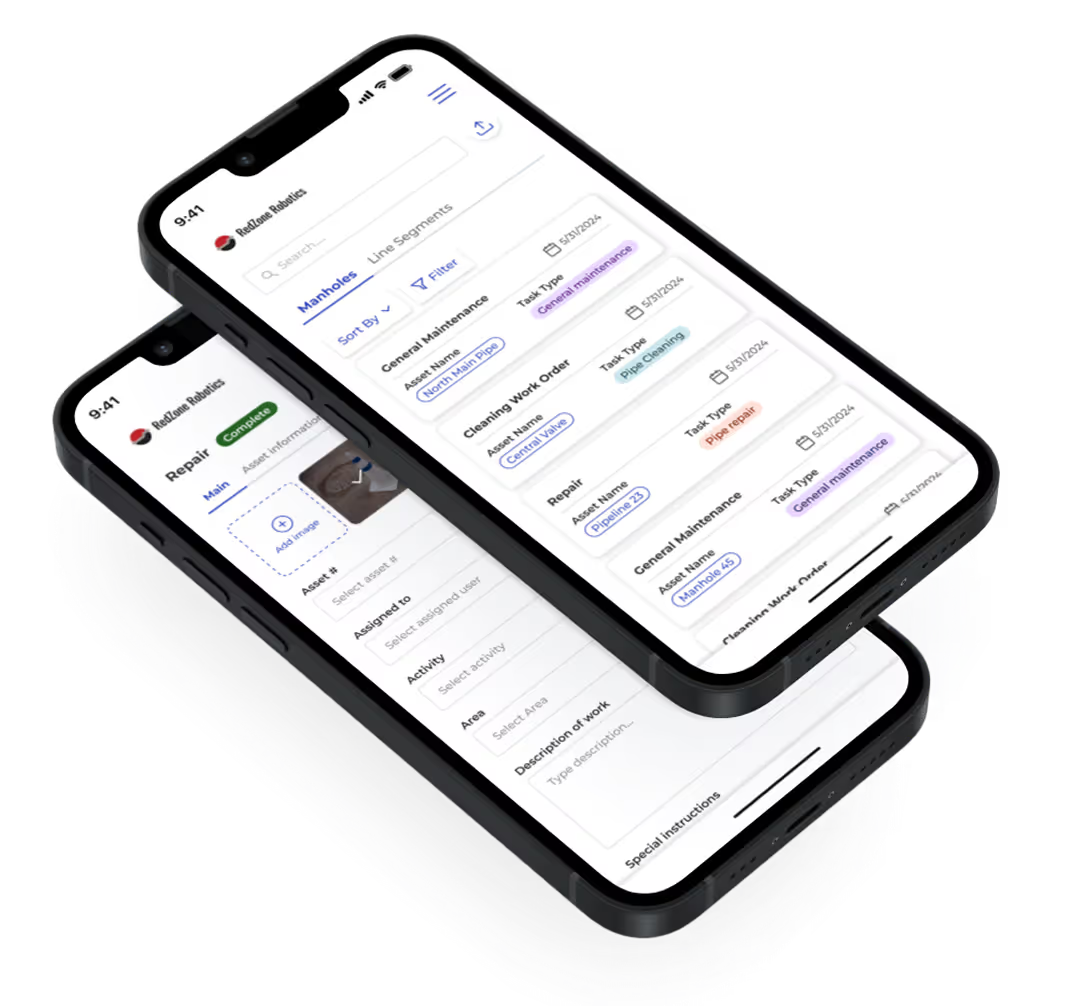

What Is Mobile App Localization?
Mobile app localization is the process of adapting a mobile application's language, design, content, and functionality to meet the cultural, linguistic, and regulatory expectations of specific target markets.
Mobile app localization goes far beyond running text through a translation tool. It involves adapting every user-facing element so the app feels like it was built specifically for each market. This includes text, images, date formats, number formats, currencies, color choices, and cultural references.
- Linguistic adaptation translates and contextualizes all user-facing strings so mobile app localization reads naturally rather than sounding like machine output
- Cultural customization adjusts imagery, color symbolism, and content examples so mobile app localization respects local norms and avoids offensive missteps
- Format localization converts dates, times, currencies, measurements, and phone numbers so mobile app localization matches local conventions automatically
- Legal compliance ensures mobile app localization meets regional data privacy laws, age restrictions, and content regulations in each target market
- UX adaptation adjusts layouts for text expansion, right-to-left languages, and varying reading patterns that mobile app localization must accommodate
Understanding your target audience in each market is the foundation of effective mobile app localization. Without audience research, localization efforts solve the wrong problems.
Why Should You Localize Your Mobile App?
Mobile app localization increases your addressable market by reaching the 75% of global smartphone users who prefer apps in their native language, directly boosting downloads and revenue.
The business case for mobile app localization is straightforward. Only 25% of internet users speak English, yet most apps launch in English only. Apps that localize into the top 10 languages reach over 80% of global smartphone users.
- Download increases of 30 to 100% in new markets are common within 90 days of mobile app localization according to app store optimization research
- Revenue per user rises by an average of 26% in localized markets because mobile app localization removes friction from the purchase and subscription flows
- App store visibility improves when mobile app localization includes localized metadata, keywords, and screenshots that rank in regional search results
- User retention increases when mobile app localization makes the entire experience feel native rather than a translated afterthought
- Competitive advantage grows because most competitors in emerging markets have poor or no mobile app localization, creating opportunity for quality-first entrants
Investing in mobile app localization is part of a broader mobile app growth guide strategy. Expanding into new languages is one of the fastest ways to grow your user base without increasing acquisition spend in saturated markets.
The timing of mobile app localization also matters. Apps that localize during the growth phase, rather than waiting until the domestic market saturates, capture international users while the competitive landscape in those regions is still forming. Early movers in mobile app localization build brand recognition and accumulate reviews that late entrants struggle to overcome.
How Do You Choose Which Markets to Localize For?
Choose mobile app localization markets by analyzing existing organic traffic, app store search demand, competitor presence, revenue potential, and localization complexity for each region.
Market selection is the highest-leverage decision in mobile app localization. Localizing for the wrong markets wastes budget and spreads your team thin. Data should drive every market expansion decision.
- Analytics data reveals which countries already generate organic downloads, showing where mobile app localization will convert existing interest into engagement
- App store keyword research measures search volume by language and region so mobile app localization targets markets with proven demand
- Competitor analysis identifies regions where competitors have weak mobile app localization, creating gaps you can fill with a superior local experience
- Revenue potential combines market size, smartphone penetration, and in-app spending data to rank mobile app localization priorities by expected ROI
- Localization difficulty factors in text expansion ratios, right-to-left support, and cultural adaptation complexity to estimate mobile app localization effort realistically
Allocating your mobile app marketing budget across localized markets requires the same data-driven approach. Spread too thin and no market gets enough investment to gain traction.
How Do You Prepare Your App for Localization?
Prepare your mobile app for localization by externalizing all strings, supporting Unicode, building flexible layouts that accommodate text expansion, and implementing a locale-aware architecture.
Technical preparation is where mobile app localization succeeds or fails. Apps built without internationalization (i18n) support require expensive refactoring before any translation work can begin. The earlier you prepare, the lower the cost.
- String externalization moves all user-facing text into resource files so mobile app localization can swap languages without modifying application code
- Unicode support ensures your codebase handles characters from every writing system, preventing mobile app localization display bugs in non-Latin scripts
- Flexible layouts accommodate text expansion of 30 to 40% in languages like German and French so mobile app localization does not break your interface
- Right-to-left support requires mirroring navigation, alignment, and reading direction for Arabic and Hebrew mobile app localization markets
- Locale detection automatically serves the correct language, date format, and currency based on device settings when mobile app localization is active
Building with localization-ready architecture from day one is part of smart mobile app design. Retrofitting these capabilities later costs 3 to 5 times more than including them in the initial build.
Right-to-left language support deserves special attention in mobile app localization preparation. Arabic, Hebrew, Farsi, and Urdu require mirroring the entire interface layout, not just swapping text direction. Navigation elements, progress indicators, and swipe gestures all need to reverse. Testing right-to-left mobile app localization on physical devices is essential because emulators often render mirrored layouts incorrectly, hiding bugs that real users will encounter immediately.
What Tools and Platforms Support Mobile App Localization?
Mobile app localization platforms like Lokalise, Phrase, and Crowdin manage translation workflows, sync with codebases, and provide quality assurance tools that streamline the entire process.
Manual mobile app localization through spreadsheets and email chains breaks down quickly. Modern localization platforms automate file management, translation memory, and quality checks so your team focuses on quality instead of logistics.
- Lokalise integrates directly with GitHub and mobile SDKs, making mobile app localization updates part of the normal development workflow
- Phrase offers translation management with in-context editing so translators see exactly how mobile app localization text appears on screen
- Crowdin supports community translation alongside professional workflows, reducing mobile app localization costs for apps with engaged user communities
- Translation memory reuses previously translated segments across updates so mobile app localization of new content leverages existing work automatically
- Machine translation post-editing uses AI to generate first drafts that human translators refine, cutting mobile app localization turnaround time by 40 to 60%
The right tooling depends on your team size, update frequency, and budget. Tracking mobile app metrics and retention by locale helps you measure whether your localization investments are generating returns.
How Do You Test Mobile App Localization Quality?
Test mobile app localization quality through linguistic review by native speakers, functional testing for layout and format issues, and in-market beta testing with target users.
Testing is where mobile app localization quality becomes visible. Automated checks catch obvious issues like missing translations and truncated text, but cultural nuance and contextual accuracy require human review.
- Linguistic testing by native speakers catches awkward phrasing, incorrect idioms, and cultural missteps that automated mobile app localization tools miss entirely
- Functional testing verifies that localized text fits within UI elements and that mobile app localization does not break layouts, buttons, or navigation flows
- Pseudo-localization replaces strings with expanded character sets during development to expose mobile app localization layout issues before real translations arrive
- In-market beta testing with 50 to 100 target users per locale validates that mobile app localization feels authentic and meets local expectations
- Screenshot testing compares every screen in every language to ensure mobile app localization maintains visual quality and readability across all supported locales
Thorough testing prevents embarrassing launches. A single poorly localized screen can damage your brand perception in an entire market and generate negative reviews that suppress downloads.
Automated testing pipelines for mobile app localization should include screenshot comparison tests that flag visual regressions across all supported languages after every update. This catches truncation issues, overlapping elements, and font rendering problems before they reach users. Combining automated checks with periodic native speaker reviews creates a quality assurance process for mobile app localization that scales without sacrificing accuracy.
What Are the Biggest Mobile App Localization Mistakes?
The most costly mobile app localization mistakes are treating localization as an afterthought, relying solely on machine translation, ignoring cultural context, and failing to localize app store listings.
Mobile app localization mistakes range from technical oversights to cultural blunders. Each one costs time, money, and user trust. Knowing the common pitfalls helps you avoid them before they become expensive problems.
- Machine-only translation produces grammatically awkward mobile app localization that native speakers immediately recognize as low-quality automated output
- Hardcoded strings embedded in code rather than resource files make mobile app localization impossible without developer intervention for every text change
- Ignoring app store optimization means mobile app localization of the in-app experience gets undermined by English-only store listings that target users never find
- One-size-fits-all design assumes every language fits the same layout, but mobile app localization for German, Arabic, and Japanese each require different spacing approaches
- Forgetting ongoing updates treats mobile app localization as a one-time project rather than a continuous process that must keep pace with feature releases
Your mobile app business strategy should account for localization as an ongoing operational cost, not a one-time project expense. Budget for continuous translation updates alongside feature development.
How Much Does Mobile App Localization Cost?
Mobile app localization costs between $0.08 and $0.25 per word for professional translation, with total project costs ranging from $5,000 for a simple app in 3 languages to $100,000 or more for complex apps in 20 or more languages.
Budgeting for mobile app localization requires understanding the multiple cost components beyond translation. Words are just one input. Cultural adaptation, testing, project management, and ongoing updates all factor into the total investment.
- Translation costs for mobile app localization range from $0.08 per word for common language pairs to $0.25 per word for specialized or rare languages
- Cultural adaptation adds 20 to 30% on top of translation costs when mobile app localization requires market-specific imagery, content examples, and UX adjustments
- QA and testing typically costs $1,000 to $3,000 per language for mobile app localization to verify functionality, layout integrity, and linguistic accuracy
- Ongoing updates require budget for translating new features, which adds recurring costs to mobile app localization at roughly 15 to 20% of the initial investment annually
- Tool licensing for mobile app localization platforms like Lokalise or Phrase costs $50 to $500 per month depending on team size and project volume
Calculating mobile app localization ROI means comparing these costs against the revenue potential of each new market. Languages with large addressable markets and low competition typically deliver the fastest payback on mobile app localization investment.
How Do You Localize Your App Store Listing?
Localize your app store listing by translating and culturally adapting your app name, subtitle, description, keywords, screenshots, and preview video for each target market separately.
App store localization is where mobile app localization directly impacts discoverability and download conversion. A perfectly localized in-app experience delivers zero value if potential users never find your app because the store listing is only in English.
- Keyword research per market identifies the search terms local users actually type, which often differ from direct translations of your English mobile app localization keywords
- Screenshot localization replaces text overlays and adapts visual examples to show locally relevant content so mobile app localization of the store listing converts browsing users
- Description adaptation rewrites your app description for each market rather than translating word-for-word, improving mobile app localization quality and conversion rates
- Preview video localization adds voiceover or subtitles in each target language so mobile app localization extends to the most persuasive element of your store listing
- Category and tag optimization selects the most relevant app store categories per market because mobile app localization audiences may discover your app through different browsing paths
- Rating display varies by region, so mobile app localization of your store strategy should account for building reviews separately in each market
App store localization is the highest-ROI component of mobile app localization because it directly determines how many users in each market even discover your app exists. A 10% improvement in store conversion rate compounds across every visitor from that locale.
How LOW/CODE Agency Supports Mobile App Localization
LOW/CODE Agency builds mobile apps with localization-ready architecture from day one, eliminating the costly retrofitting that derails most global expansion plans.
- Internationalization-first architecture structures every project with externalized strings, flexible layouts, and locale-aware systems from the initial build
- Multi-market expertise draws on experience building apps for diverse audiences across North America, Latin America, Europe, and beyond
- Platform-optimized approach selects development frameworks that support mobile app localization natively, reducing the technical overhead of multi-language support
- Integrated QA process tests localized builds across devices and locales as part of the standard quality assurance workflow, not as a separate phase
- Continuous delivery support maintains localization workflows through post-launch updates so new features reach all markets simultaneously
Related Articles
Last updated on
September 3, 2026
.

Jesus is a visionary entrepreneur and tech expert. After nearly a decade working in web development, he founded LOW/CODE Agency to help businesses optimize their operations through custom software solutions.


FAQs
What is mobile app localization?
What is the difference between mobile app translation and localization?
How much does mobile app localization cost?
How do I prioritize which languages to localize my mobile app for first?
What are common mistakes in mobile app localization?
Should localization be planned during mobile app development or added later?
Related Articles

Mobile App Development
Mobile App Onboarding Best Practices in 2026
Your mobile app onboarding can make or break retention. Learn the best practices that turn new installs into long-term active users.

Mobile App Development
Best Mobile App Design Software in 2026
Which design tool is best for your mobile app in 2026? Compare the top options for prototyping, UI design, and team collaboration.

Mobile App Development
Is the Mobile App Discovery Phase Worth It?
Should you pay for a mobile app discovery phase? Learn what it includes, what it costs, and whether it's worth it for your project.

Mobile App Development
Mobile App Agency Red Flags to Watch For
Don't hire the wrong mobile app agency. Learn the biggest red flags to spot early before you sign a contract or pay a deposit.


Why customers trust us for no-code development


