

How to Build a Professional Services Marketplace
Learn key steps to create a successful professional services marketplace with expert tips on design, technology, and user engagement.

Right now, businesses hire consultants through referrals, agency relationships, and LinkedIn searches. That process takes weeks, provides almost no quality signal, and charges a 20–40% agency markup for the privilege.
A professional services marketplace compresses this to days and eliminates the intermediary. Building one that professionals and buyers actually trust requires a fundamentally different approach than a general freelancer platform.
Key Takeaways
- Credentials beat price: Buyers are hiring experts, not the cheapest available resource. The platform must surface the signals that justify premium rates.
- Vetting is the core product: A professional services marketplace where anyone can list is a directory. One where credentials are verified and track records are transparent is a marketplace buyers trust.
- Milestone billing is mandatory: Professional engagements rarely close in one upfront transaction. The platform needs milestone releases, retainer billing, and dispute-triggered holds.
- Specificity builds trust: Generic star ratings do not differentiate professional service providers. Outcome-based reviews and verified credentials do.
- Category depth before breadth: Strategy consultants, legal advisors, and HR professionals all have different credential requirements and buyer expectations. One category first.
- Commission plus subscription is the standard model: High-value transactions support commission. Recurring engagement models reward subscription-based platform access for providers.

What Type of Marketplace Is a Professional Services Platform?
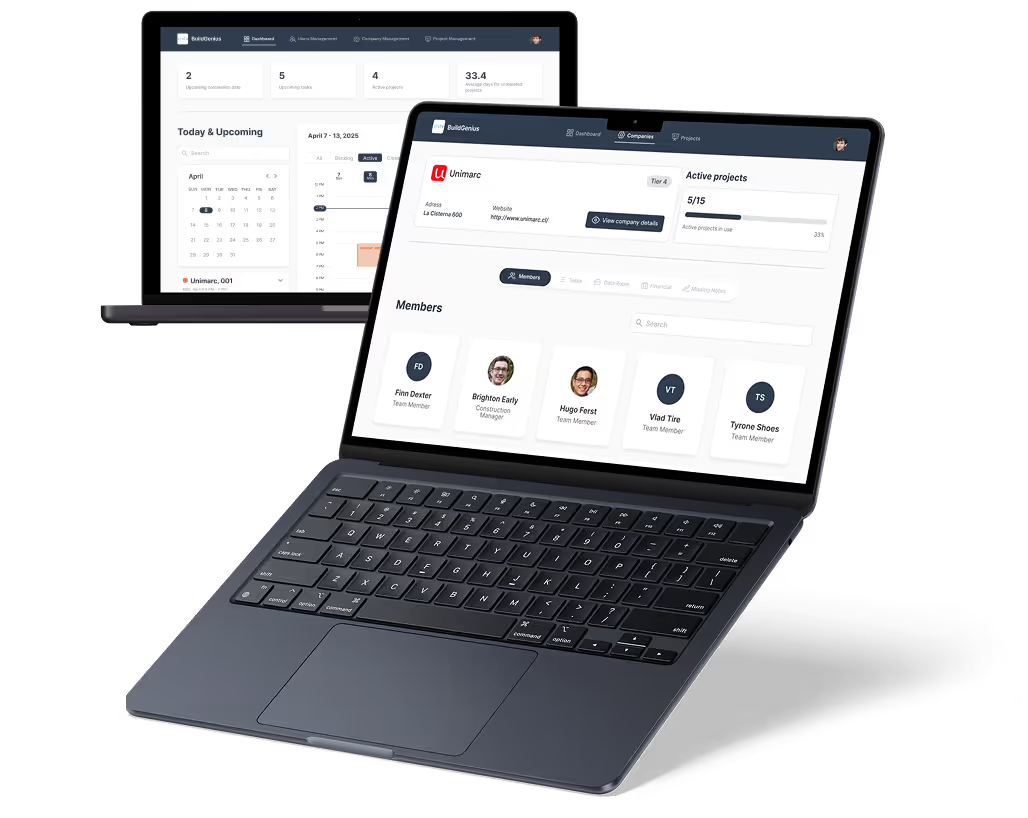
Professional services marketplaces are B2B two-sided platforms connecting organizations with qualified consultants, advisors, specialists, and subject-matter experts. The transaction model is fundamentally different from a general freelancer platform.
Understanding the distinction before building prevents designing the wrong features.
- Not a task platform: Professional services transactions are higher-value, longer-duration, and credential-dependent. Buyers are hiring for domain expertise that produces business outcomes, not hourly output.
- Multiple engagement models: Project-based engagements with defined scope and fee, retainer-based recurring access, and advisory or fractional executive arrangements all require different booking, payment, and review flows.
- Why generic platforms underserve this market: Fiverr and Upwork were designed for task completion. Professional services buyers need credential verification, NDA management, portfolio review, and milestone-based payment, features that generic platforms tack on poorly.
- The trust threshold is higher: A business hiring a consultant for a six-month strategy engagement is taking a greater risk than hiring a freelancer for a logo. The platform must match the trust infrastructure to that risk level.
The principles behind B2B marketplace design and architecture, particularly around trust mechanisms and transaction complexity, apply directly to professional services platforms before any feature is designed.
What Features Does the Platform Need?
The must-have features for marketplaces, search, profiles, payments, and reviews, apply here, but each one needs to be built to the standard a professional services buyer expects, not a consumer marketplace.
Every feature on a professional services platform must be calibrated to high-value, credential-dependent transactions.
Provider Profiles and Credential Display
Professionals list qualifications, certifications, professional memberships, industry experience, engagement history, and service specialization. Verified credentials displayed with verification badges are the conversion signals for B2B buyers. A profile without verified credentials is a profile buyers cannot trust for serious engagements.
- Verification badges carry weight: "Law Society registered solicitor" or "CMC-certified management consultant" displayed with verified status converts buyers. Self-reported claims do not.
- Engagement history as a trust signal: Past engagement types, client industries, and project outcomes give buyers the pattern-matching data they need to make confident hiring decisions.
- Availability transparency: Visible availability status prevents the common frustration of contacting a provider who cannot start for three months, keeping buyers in the funnel.
Service Listings and Scope Templates
Providers create structured service listings with defined scope, engagement duration, deliverables, pricing model, and availability. Scope templates for common engagement types reduce back-and-forth and accelerate buyer decision-making.
- Scope clarity reduces pre-engagement friction: Buyers who understand exactly what they are purchasing convert faster than those who must negotiate scope before committing.
- Pricing model transparency: Project fee, daily rate, and retainer options displayed upfront let buyers self-select the engagement model that fits their needs and budget.
- Template-based listings for common engagements: Pre-built scope templates for typical engagements in each professional category reduce the time providers spend creating listings and increase listing quality.
Search and Matching
Buyers search by expertise area, industry specialization, engagement type, budget range, and availability. A matching or recommendation layer surfaces best-fit providers based on stated engagement requirements, not just keyword matches.
- Faceted filtering for B2B buyers: Filters must reflect how professional buyers actually search: by industry, engagement type, methodology, credentials, and availability.
- Matching logic improves quality: An algorithm that surfaces providers based on stated engagement requirements, past buyer industry, and credential match outperforms keyword search in conversion rate.
- Search quality is a supply utilization metric: Good search surfaces relevant providers to buyers. Poor search lets qualified providers sit undiscovered while buyers leave the platform without finding a match.
Proposal and Contract Management
Providers submit proposals; buyers review, negotiate, and accept. Digital contract generation with e-signature closes the engagement formally inside the platform. On-platform contracts create an audit trail and reduce off-platform displacement.
- On-platform proposals prevent displacement: If the engagement moves to email at the proposal stage, the platform loses the relationship and the next transaction.
- E-signature requirement at award: A signed contract inside the platform creates a documented engagement record, clarifies accountability, and reduces post-engagement disputes.
- NDA management at proposal stage: Many professional engagements involve sensitive business information. The platform must support NDA upload and signing as part of the pre-engagement flow.
Communication and Collaboration Tools
Secure in-platform messaging, document sharing, video call scheduling, and milestone tracking keep the engagement inside the platform throughout delivery. A platform that forces providers and buyers off-platform for communication loses the relationship and the repeat transaction.
- Async communication threading: Professional engagements involve ongoing communication across time zones and working patterns. Structured async threading is more appropriate than consumer-style chat.
- Document version control: Proposal documents, working drafts, and final deliverables should have version history that both parties can reference without email hunting.
- Milestone tracking visibility: Both parties should see the current milestone status, upcoming milestones, and payment triggers in a shared view.
How Do You Manage Service Provider Supply?
The systems for managing professional service providers, vetting workflows, performance dashboards, and tiering, need to be designed as operational infrastructure from the start, not added when the provider base grows too large to manage manually.
Supply quality is the defining factor in whether a professional services marketplace attracts serious buyers.
- Curated listing beats open listing: Professional services marketplaces that require providers to pass a vetting process consistently attract higher-value buyers than those with open listing access.
- Vetting criteria by category: Credential verification, professional body memberships, previous engagement reference checks, portfolio or case study review, and optionally a competency conversation for senior roles.
- Profile completeness enforcement: Incomplete profiles convert poorly and drag down search quality. Minimum completeness standards should be enforced before a provider appears in results.
- Performance monitoring: Client ratings, repeat engagement rate, proposal acceptance rate, engagement completion rate, and dispute rate should be tracked from the first engagement and used to surface the best providers in search.
- Provider retention levers: Consistent inquiry volume, transparent analytics, priority listing for high-performing providers, and lower commission for proven track records keep experienced professionals from going direct.
Professional service providers with established networks will leave any platform that does not deliver consistent deal flow.
How Should Professional Services Payments Work?
The technical implementation of milestone holds and escrow release, as covered in the guide to payment systems for services marketplaces, is the foundation the entire payment architecture is built on.
Professional engagements are structured differently from consumer transactions. The payment system must reflect that structure.
- Milestone-based payment: The platform holds buyer funds in escrow and releases them as milestones are confirmed, not before. This protects buyers from non-delivery and gives providers certainty that payment is secured.
- Retainer billing: Monthly recurring retainer engagements require automatic billing, clear renewal terms, and a structured cancellation process. One-time payment systems cannot handle retainers without custom configuration.
- Escrow and dispute holds: When a client disputes a milestone delivery, the payment must be held pending resolution. A defined dispute process with timelines and escalation must exist before the first dispute arrives.
- Platform commission structure: 10–20% on project fees is the standard range. Above 20%, experienced professionals go direct. Below 10%, the platform cannot sustain quality operations.
- Invoice and tax document generation: B2B buyers require formal invoices. The platform must generate these automatically with correct business details in a format compatible with the buyer's accounts payable process.
How Do You Build Trust in a Professional Services Marketplace?
Designing the professional marketplace trust through reviews system requires more structure than standard star ratings. The prompt design and verification layer both affect the quality of signal buyers actually use to make decisions.
Trust in a professional services marketplace is built through specificity, not volume. The quality of each trust signal matters more than how many there are.
- Credential verification as the primary trust signal: Meaningful trust requires confirmation of educational credentials, professional body memberships, and previous client references against the stated experience. A LinkedIn badge is not sufficient.
- Outcome-based reviews: "This consultant reduced our time-to-hire by 40% over a six-month engagement" is more useful to a professional services buyer than a five-star rating. Structure the review prompt to elicit outcome-specific feedback.
- Reference checks and case studies: Allow buyers to request references before committing; allow providers to publish anonymised case studies of past work. Both signals reduce the risk perception of hiring an unfamiliar professional.
- Dispute track record transparency: Show providers' dispute rate alongside positive metrics. A provider with 100 positive reviews and zero disputes signals more strongly than one with the same reviews and three unresolved disputes.
- Case study as conversion content: Anonymised case studies showing scale, complexity, challenges, and outcomes are the content buyers most actively evaluate when shortlisting professional services candidates.
How Do You Monetize and Launch a Professional Services Marketplace?
A professional services marketplace is won or lost at the supply quality stage, not the marketing stage.
Ten outstanding profiles convert better than a hundred mediocre ones, and the right buyer acquisition follows from that quality signal.
- Commission model: 10–20% on project fee is the standard range. Above 20%, experienced professionals with their own networks go direct. Below 10%, platform quality becomes difficult to sustain.
- Subscription for providers: Monthly or annual subscription for platform access, priority listing, analytics, and proposal tools is most effective as a second revenue layer once providers have experienced platform-generated value.
- Launch supply strategy: Recruit 20–50 deeply vetted professionals in one category before opening to buyers. Quantity at this stage is the enemy of quality.
- Demand acquisition: Direct outreach to mid-market companies with known consulting spend, content marketing demonstrating platform professional quality, and case study publication from early engagements.
- Anti-leakage mechanisms: In-platform communication, escrow-based payment, and milestone tracking create reasons to keep transactions on-platform even after provider and buyer have built a direct relationship.
Conclusion
A professional services marketplace is won or lost at the vetting layer. Buyers do not trust a platform that lets anyone list as a consultant. They trust one that has done the verification work so they do not have to.
Build the vetting process before you build the search interface, and the search results will justify themselves. Define your professional category, the credentials that matter to buyers in that category, and the vetting process that confirms them before designing a single feature.
Building a Professional Services Marketplace? The Vetting Architecture Comes First.
Most professional services marketplace builds prioritize the search interface and buyer experience before the vetting and trust infrastructure is solid. That sequence produces a platform buyers browse but do not book on.
We are LOW/CODE Agency — an AI product development company for SMBs. We build across the full stack: web apps, mobile apps, AI chatbots, RAG pipelines, and autonomous agents. Custom software, built by experts. We scope professional services marketplace builds from the vetting architecture outward, designing the credential verification process, payment flows, and trust signals that give buyers the confidence to hire through the platform for serious engagements.
- Vetting workflow design: We design the credential verification process, professional body registration checks, reference workflows, and profile completeness standards that make the supply directory credible.
- Payment architecture: We build milestone escrow, retainer billing, and dispute hold logic for professional engagement payment flows that one-time payment systems cannot handle natively.
- Trust signal infrastructure: We design outcome-based review prompts, credential verification display, dispute track record transparency, and case study frameworks that convert buyers making high-value decisions.
- Proposal and contract management: We build on-platform proposal flows, e-signature, NDA management, and scope change tracking that keep engagements on-platform through delivery.
- Search and matching: We build provider search with the filters and matching logic that surfaces the right professional for each engagement type, not just keyword matches.
- Monetization design: We configure commission extraction, retainer billing, and provider subscription tiers into the platform architecture before launch.
- Full product team: Strategy, design, development, and QA from a single team invested in the outcome, not just the delivery.
We have built 350+ products for clients including Coca-Cola, American Express, and Sotheby's. We know exactly where professional services marketplace builds lose buyer trust, and we address those points before they affect your platform's credibility.
Professional services marketplaces need credentialing and scoping workflows that generic platforms skip
Lawyers, consultants, accountants, and other professionals require more trust infrastructure than a freelance gig platform. Credential verification, engagement letter generation, retainer billing, and conflict-of-interest screening all have to work before a client feels safe booking through your platform.
LOW/CODE Agency builds professional services marketplace platforms designed for high-trust categories. Our web app development practice covers credential verification, structured intake flows, contract generation, milestone billing, and the secure document exchange professionals and clients both need.
If your platform monetizes through subscriptions or needs multi-tier access for firms versus individual practitioners, we also build SaaS marketplace foundations with the billing, access control, and analytics your operations team will use.
After 450+ projects for teams like Medtronic, American Express, and Coca-Cola, we know how to build for regulated professional services. Book a 30-minute call to scope your platform.
Last updated on
September 28, 2026
.

Jesus is a visionary entrepreneur and tech expert. After nearly a decade working in web development, he founded LOW/CODE Agency to help businesses optimize their operations through custom software solutions.


FAQs
What are the first steps to create a professional services marketplace?
How do I attract service providers to my marketplace?
What features are essential for a professional services marketplace?
How can I ensure secure payments on my marketplace?
What are common challenges when building a services marketplace?
How do I market a new professional services marketplace effectively?
Related Articles

Marketplace
How to Build a Mortgage Consultant Marketplace
Learn step-by-step how to create a successful mortgage consultant marketplace with key features and strategies for growth.

Marketplace
How to Build a Language Teacher Marketplace
Learn key steps to build a successful language teacher marketplace with effective features and strategies for growth and user engagement.

Marketplace
How to Build a Vacation Home Marketplace
Learn key steps and tips to create a successful vacation home marketplace platform from scratch.

Marketplace
How to Build a Telehealth Specialist Marketplace
Learn key steps to create a telehealth specialist marketplace with expert tips on platform design, compliance, and user experience.
Why customers trust us for no-code development


