

Effective Vendor Management for Marketplace Apps
9 min
read
Learn key strategies for managing vendors in marketplace apps to improve partnerships, compliance, and user experience.


Vendor management in marketplace apps is not a support function. It is a growth function. Marketplace operators consistently over-invest in buyer acquisition and under-invest in the supply side, then discover that vendor quality is the reason buyers do not return.
The quality, reliability, and experience of your vendors determines your buyer NPS, repeat purchase rate, and competitive defensibility. This guide gives you the operational system to manage it.
Key Takeaways
- Vendor quality is retention infrastructure: A buyer's repeat purchase decision is driven primarily by the vendor experience. Vendor management is buyer retention by another name.
- Onboarding decides churn early: The 30-day window between vendor sign-up and first transaction is when most vendor attrition occurs. A structured onboarding programme reduces this by 30-50%.
- Tiered programmes protect top GMV: The top 20% of vendors typically represent 60-80% of GMV. A formal vendor tier programme with meaningful benefits reduces top-vendor churn by 20-40%.
- Self-service tooling reduces operator cost: Every action a vendor takes through their dashboard is a support ticket that is never raised. Tooling investment pays back in reduced support overhead.
- Performance thresholds must be enforced consistently: Marketplaces with defined and consistently applied performance standards have higher buyer NPS than those managing performance ad hoc.
- Payment reliability is the top trust factor: Vendors who trust that payments arrive on schedule are more engaged, more likely to invest in listing quality, and less likely to seek off-platform transactions.
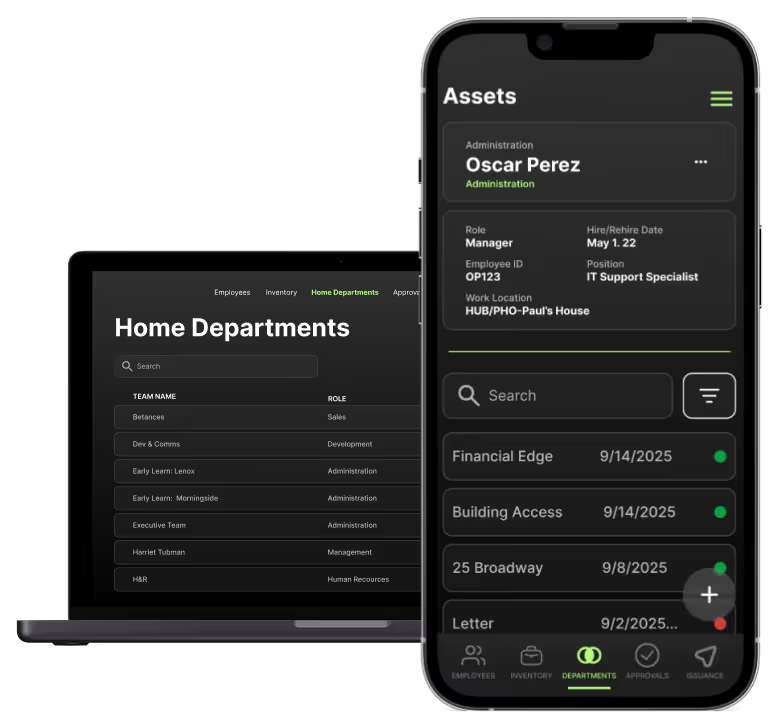

What Does Vendor Management Actually Cover in a Marketplace?
Vendor management is a five-component operational system covering onboarding, performance monitoring, communication and support, payments, and vendor retention. It is not an onboarding checklist or a support queue.
Vendor NPS is a leading indicator of supply quality, and supply quality drives buyer NPS, which drives repeat purchase rate and GMV growth. Vendor management sits three steps upstream of revenue, which is why it is routinely underinvested until the symptoms appear in buyer metrics.
- Onboarding: Getting vendors from sign-up to their first successful transaction, with structured interventions at each drop-off point in the funnel.
- Performance monitoring: Tracking quality, response rates, and completion rates against defined thresholds so underperformance is addressed before it reaches buyers.
- Communication and support: The tools and processes for vendor queries, disputes, and escalations, designed to resolve issues without consuming disproportionate operator time.
- Payments and financials: Commission processing, payout scheduling, and tax documentation, operating reliably and transparently at every transaction volume.
- Retention and development: Tier programmes, educational resources, and proactive engagement that reduce churn among vendors who are already performing well.
Without systematic vendor management tooling, each 100 active vendors typically generates 20-40 support interactions per month. Tooling investment reduces this ratio by 50-70%.
How Do You Build a Vendor Onboarding System That Scales?
A scalable vendor onboarding system is designed around a single metric: the percentage of vendors who complete their first transaction within 7 days of account activation. Vendors who transact within 7 days have 60-70% 90-day retention. Vendors who do not transact within 30 days have below 20% retention.
Onboarding system design connects directly to vendor acquisition and onboarding strategy. The smoother the path from sign-up to first transaction, the lower the acquisition cost per active vendor.
- Profile completion incentives: Vendors with complete profiles (photo, bio, verified credentials, minimum three listings) transact at 3-5x the rate of incomplete profiles. Progress indicators and featured placement incentives accelerate completion.
- Listing quality standards at upload: Define minimum listing standards (description length, image count, pricing clarity) and enforce them at upload, not post-publication. Rejected listings at upload require less remediation than published listings that fail to convert.
- First-transaction compression: Every onboarding intervention, every email, every in-app prompt should have one goal: reducing the time between sign-up and first completed transaction.
- Structured email sequence: Day 1 prompts profile completion. Day 3 sends listing optimisation tips. Day 7 offers a first-transaction incentive. Day 14 shares a success story. Day 30 re-engages inactive vendors with a specific action prompt.
- Drop-off tracking by funnel stage: Track the funnel from sign-up to profile completion, first listing, listing quality review, first transaction, and post-transaction review. Each drop-off stage requires a specific intervention, not a generic reminder.
Onboarding system quality is the clearest lever for 90-day vendor retention. Platforms that compress the path to first transaction see compounding supply quality improvements as the vendor base grows.
How Do You Measure Vendor Quality and Performance?
Tracking vendor health requires a dedicated set of vendor performance analytics that sit alongside your buyer-facing KPIs. Both sides of the marketplace need measurement infrastructure.
Defining what good vendor performance looks like, and managing to it consistently, is the difference between a platform with improving supply quality and one with chronic buyer satisfaction problems.
- Review score threshold: 4.0/5.0 is the minimum for continued active listing. Below 3.5 triggers manual intervention. Review score is a lagging indicator reflecting past performance.
- Response time target: Under 2 hours is the target for first message response. Above 24 hours triggers an automated prompt. Response time is a leading indicator predicting future conversion.
- Order completion rate: Above 95% is the target. This is the percentage of accepted orders completed without cancellation. Persistent underperformance here indicates a capacity or reliability problem.
- Dispute rate ceiling: Below 2% of transactions should result in a buyer-raised dispute. Above this threshold, the vendor's listing quality or fulfilment reliability requires investigation.
- GMV-weighted segmentation: Segment vendors by GMV contribution. The top 20% warrant proactive engagement and account management. Bottom-tier vendors in a grace period need automated nudges and clear performance expectations.
The enforcement process matters as much as the metrics. Define thresholds, trigger automated warnings at breach, conduct manual review for persistent underperformance, progress to listing suspension, then account review. Every step should be documented, communicated in advance, and applied consistently across all vendors.
What Tools Do Vendors Need to Manage Their Marketplace Presence?
The tooling that makes vendor management scalable starts with well-designed vendor dashboard features. What vendors can self-serve directly determines how much operator time vendor support consumes.
Vendor tooling investment is not a cost. It is a support cost offset that scales with vendor volume.
- Bulk listing management: Bulk listing creation, editing, and duplication become essential once any vendor manages more than 50 active listings. Without this, high-volume vendors generate disproportionate support requests.
- Real-time order management: Order notification, acceptance workflow, status tracking, and buyer communication within the platform keep transactions on-platform and reduce off-platform circumvention.
- Earnings and payout visibility: A real-time earnings dashboard showing gross transaction value, commission deducted, pending payout, and payment history is the most direct vendor trust tool available.
- Performance dashboard: Vendors who can see their own review score, response time, and completion rate alongside platform averages self-correct more effectively than those who only receive reactive notifications.
- Integrated messaging: Keeping buyer-seller communication within the platform prevents off-platform transactions and creates an audit trail for dispute resolution without manual investigation.
Platforms that invest in vendor self-service tooling consistently see lower support costs per vendor and higher vendor engagement metrics. The ROI on tooling investment is measurable within three to six months of deployment.
How Do You Manage Vendor Payments and Commission at Scale?
The operational complexity of vendor payments multiplies with scale. Order and commission management systems need to handle split payments, tiered commissions, and payout scheduling without manual intervention.
Payment reliability is not an infrastructure detail. It is the single most important vendor trust factor on the platform.
- Commission structure options: Flat percentage commission is simplest to operate. Tiered commission (lower rates for higher-volume vendors) rewards loyalty and reduces top-vendor churn. Category-specific rates reflect different margin profiles across product or service types.
- Payout schedule clarity: Weekly payouts are the standard expectation for service marketplaces. Bi-weekly works for product marketplaces with return windows. Unclear or delayed payout schedules are the most cited vendor frustration on every marketplace that has measured it.
- Automated split payment logic: For marketplaces with referral affiliates or multiple vendor types in a single transaction, split payment logic must be automated. Manual split calculations at scale produce errors and disputes that damage vendor trust.
- Tax documentation automation: US 1099-K generation, EU VAT documentation, and UK Making Tax Digital requirements all create obligations above threshold transaction volumes. Automate document generation before the thresholds are reached, not after.
The payout schedule must be communicated clearly to vendors during onboarding and hit without exception. A single missed or delayed payout generates a disproportionate volume of support tickets and churn signals that take months to recover.
What Operator Tools Are Required for Vendor Management?
Effective vendor management at scale depends on admin panel design that gives operators the visibility and controls to intervene when vendor quality or compliance falls below threshold.
Without operator tooling, vendor management overhead scales linearly with vendor growth. Every additional vendor is another manual process.
- Single-view vendor account management: Operators need one screen showing any vendor's full transaction history, review score trajectory, payout history, and compliance status. One-click suspension, reinstatement, and account deletion with audit logging are non-negotiable.
- Bulk operations capability: Applying category policy changes, commission rate adjustments, or compliance prompts to all vendors in a segment simultaneously. Manual individual communications at scale are not operationally viable.
- Queue-based dispute management: Dispute queues with SLA tracking, with full buyer-vendor transaction history, communications, and listing details accessible from within the dispute interface.
- Compliance and verification dashboard: Centralised view of vendor identity verification status, document expiry dates, and compliance requirement completions, with automated alerts for upcoming expirations.
- Segmented communication tools: Ability to send targeted emails from the admin panel to all vendors in a category, all vendors below a performance threshold, or all vendors in a specific geography.
Operator tooling is infrastructure, not a nice-to-have. Platforms that launch without it scale their operational cost linearly with vendor growth instead of improving operational leverage over time.
Conclusion
Vendor management is the operational foundation of marketplace quality. Marketplace quality is the mechanism that drives buyer retention.
Audit your current onboarding funnel against the seven-day first-transaction target. If fewer than 40% of vendors complete their first transaction within seven days of activation, redesign the onboarding sequence before investing further in vendor acquisition. That single metric is the most reliable leading indicator of long-term supply quality.
Building Vendor Management Into Your Marketplace From the Start
Most marketplace platforms retrofit vendor management tooling after launch, when churn is already showing up in the metrics. Rebuilding onboarding flows, payout systems, and admin tooling post-launch costs more and disrupts vendors who are already on the platform.
At LOW/CODE Agency, we build AI-powered products for SMBs — custom web apps, mobile apps, chatbots, RAG systems, and AI agents, delivered with the depth and standards of a specialist software team. We design vendor dashboards, admin panels, and onboarding workflows as a connected system before development begins, so vendor management is built into the platform architecture rather than added after the fact.
- Onboarding funnel design: We map the full vendor journey from sign-up to first transaction, with defined interventions at each drop-off stage, before any development begins.
- Performance threshold definition: We help you define your review score, response time, and completion rate thresholds so enforcement policies are ready at launch, not reactive.
- Payment and commission architecture: We design split payment logic, tiered commission structures, and payout scheduling using Stripe Connect or equivalent infrastructure from day one.
- Vendor dashboard scoping: We specify all four vendor tooling layers (listing management, order operations, earnings visibility, performance data) as a connected product rather than a list of features.
- Admin panel design: We build the operator controls for vendor account management, bulk operations, dispute queues, and compliance tracking as a dedicated product layer.
- Tax documentation planning: We design tax document generation into the payment architecture before transaction volumes make it a compliance emergency.
- Full product team delivery: Strategy, UX, development, and QA from a single team invested in the platform outcome, not just feature delivery.
We have built 450+ products for clients including Coca-Cola, American Express, and Sotheby's.
Related Articles
- How to Build an Accounting Freelancer Marketplace
- How to Build a 3D Model Marketplace
- Claude for Small Business Explained (2026 Launch)
- Top Vendor Dashboard Features in Marketplace Apps
- Vendor Agreements & Terms for Marketplace Apps
- Effective Vendor Acquisition Strategy for Marketplace Apps
Our mobile app development team delivers production-ready apps for iOS, Android and web.
Last updated on
September 28, 2026
.

Jesus is a visionary entrepreneur and tech expert. After nearly a decade working in web development, he founded LOW/CODE Agency to help businesses optimize their operations through custom software solutions.


FAQs
What is vendor management in marketplace apps?
How can marketplace apps improve vendor onboarding?
What are common challenges in managing marketplace vendors?
How does vendor management impact customer satisfaction?
What tools help automate vendor management in marketplaces?
How to handle vendor disputes in marketplace apps?
Related Articles

Marketplace
Solving Chicken-and-Egg Problem in Marketplaces
Learn effective strategies to overcome the chicken-and-egg problem in marketplaces and grow your platform successfully.

Marketplace
How to Build a Mental Health Therapist Marketplace
Learn key steps to build a successful mental health therapist marketplace platform efficiently and effectively.

Marketplace
How to Build a UX/UI Designer Marketplace
Learn key steps to create a successful UX/UI designer marketplace with essential features and strategies for growth and user engagement.

Marketplace
Best Tech Stack for Marketplace Apps in 2026
Discover the ideal technology stack for building scalable and secure marketplace apps with top tools and frameworks.


Why customers trust us for no-code development


