

How to Build a Procurement Marketplace
Learn key steps to build a procurement marketplace, from platform design to vendor management and payment integration.

Most organizations still manage 60–80% of their purchasing through email chains, spreadsheets, and phone calls. That inefficiency costs procurement teams significant time and exposes businesses to compliance gaps and maverick spending.
A well-built procurement marketplace centralises supplier discovery, approval, and purchase into one auditable system. The platforms that succeed are not the ones with the most suppliers. They are the ones that make compliant purchasing faster than going around the platform.
Key Takeaways
- Compliance tools first: Approval workflows, spend controls, and audit trails are core features, not optional add-ons for enterprise clients.
- Supplier vetting drives value: Buyers use procurement marketplaces because every listed supplier has already been validated by the platform.
- Native PO workflows matter: Redirecting buyers off-platform for purchase order issuance destroys the efficiency case for the marketplace.
- Role-based access is table stakes: Department-level purchasing limits, multi-level approvals, and budget tracking must be built in from day one.
- Commission infrastructure must scale: Manual commission tracking breaks at volume; automated systems that calculate and reconcile supplier payouts are essential.
- Low-code reduces time to market: Procurement workflow frameworks can cut build time by 40–60% compared to building from scratch.
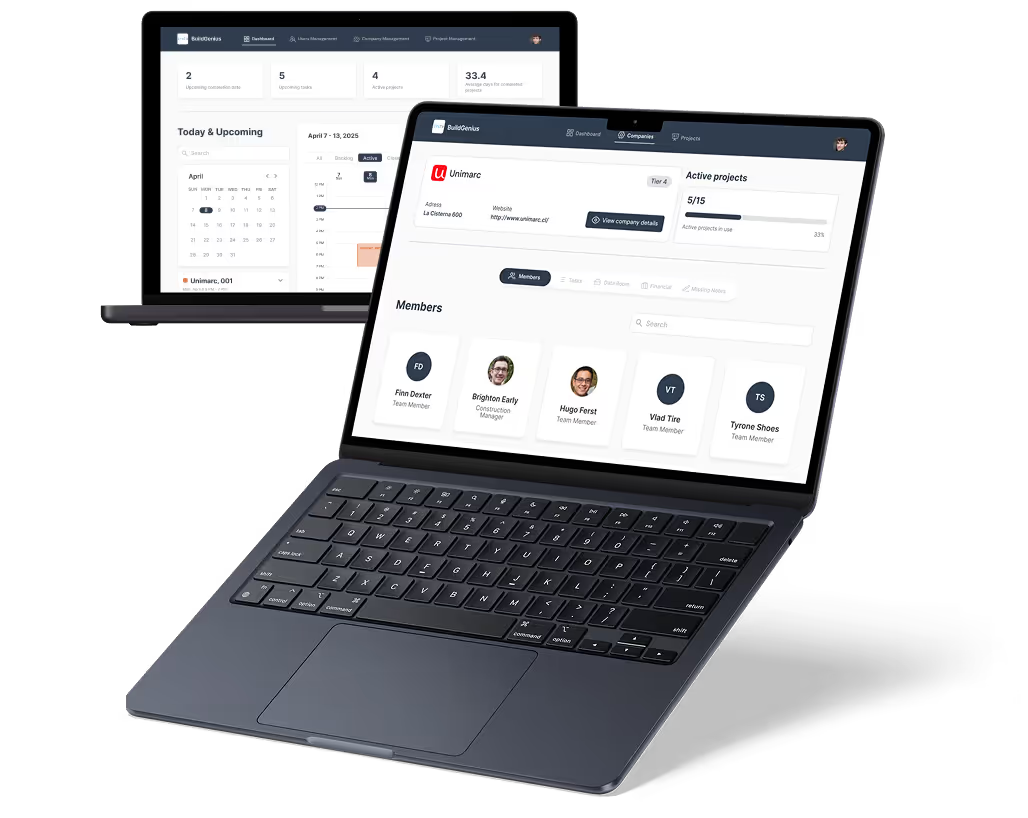

What Makes a Procurement Marketplace Different From a Standard B2B Platform?
A procurement marketplace is not a supplier directory with a buy button. It is a spend control and compliance system that organizations must trust before their procurement teams will use it.
The compliance-first design requirement sets procurement marketplaces apart from every other B2B platform category.
- Approval workflow complexity: Organizational procurement involves department heads, finance approval, budget verification, and sometimes legal review, all of which the platform must orchestrate.
- Preferred supplier list management: Many organizations operate closed environments where only pre-approved suppliers appear to buyers, requiring curated catalog support.
- Spend analytics as core infrastructure: Procurement managers need real-time visibility into category spend, supplier concentration, and budget utilization from day one.
- Contract and SLA management: Negotiated terms, volume commitments, and service level agreements must live inside the platform, not in email attachments.
- Audit trail requirements: Every purchase decision, approval, and supplier interaction must produce a traceable record for internal audit and external compliance.
Before scoping your features, reviewing B2B marketplace development fundamentals clarifies the architectural decisions that determine whether the platform can support enterprise procurement workflows at all.
What Features Does a Procurement Marketplace Need?
Beyond procurement-specific functionality, a core marketplace features checklist covers the foundational platform infrastructure every marketplace needs before vertical workflows are layered on.
Procurement platforms require six distinct feature sets that most B2B marketplace templates do not include by default.
Pre-Vetted Supplier Directory
Every supplier must pass a baseline verification before entering the directory. Business registration, insurance, compliance certifications, and category expertise are all validated first. The directory is a curated catalog that buyers trust precisely because the platform did the vetting work.
- Directory credibility is the product: An unvetted supplier in the directory destroys the compliance value the platform was built to deliver.
- Category-specific qualification: A facilities supplier needs different certifications than an IT hardware supplier, so onboarding must be configurable by category.
- Ongoing verification required: Supplier approvals expire when certifications lapse or performance drops, requiring automated renewal alerts.
Requisition and Purchase Order Workflow
Buyers must raise purchase requisitions, route them through approval chains, and convert approved requisitions to purchase orders inside the platform. Off-platform PO processing breaks the audit trail and removes the platform's compliance value.
- Approval chain automation: The platform routes each requisition to the correct approver based on order value, category, and department budget status.
- PO generation and delivery: Purchase orders are generated automatically from approved requisitions and delivered to suppliers without manual intervention.
- Three-way matching: Purchase orders, delivery confirmations, and supplier invoices are matched automatically, with discrepancies flagged before payment is authorised.
Approval Hierarchy and Spend Controls
The platform must support configurable approval chains based on order value, category, department, and budget availability. A $500 office supplies order and a $50,000 professional services engagement should not follow the same approval path.
- Budget enforcement at purchase: The system checks available budget before routing a requisition for approval, preventing overspend at the transaction level.
- Multi-level approval chains: High-value orders require sequential approval from department head, finance, and sometimes legal without manual coordination.
- Emergency purchase handling: A defined fast-track workflow for urgent purchases that bypasses standard chains while still creating an auditable record.
Supplier Catalog and Pricing Agreements
Pre-negotiated pricing, volume discounts, and contract rates must surface in the platform so buyers see their actual contracted price, not the supplier's list price. This requires per-buyer pricing configuration at the catalog level.
- Contract rate display: Buyers see the price their organization negotiated, not a public rate, which removes the incentive to go directly to suppliers.
- Volume discount calculation: The system applies the correct tiered pricing automatically as order quantities increase within the platform.
- Catalog update management: Suppliers update pricing within agreed parameters; changes outside parameters require platform-level approval before going live.
Spend Analytics and Budget Tracking
Real-time dashboards showing committed spend, approved purchases, budget utilization by department, and supplier concentration give procurement managers what they need to operate. Without this, the platform is a purchase system, not a spend management system.
- Category spend visibility: Procurement managers see spend across every category in real time, identifying concentration risks and savings opportunities.
- Department budget tracking: Each department sees its own budget utilization against approved spend and committed purchase orders.
- Supplier concentration reporting: The platform flags when spend with a single supplier exceeds a defined threshold, signaling dependency risk.
Three-Way Matching
Automated matching of purchase orders, delivery confirmations, and supplier invoices flags discrepancies for review before payment is authorised. This is standard procurement practice and a requirement for any platform serving finance or compliance teams.
- Automated discrepancy flagging: Price, quantity, and delivery date mismatches between PO, delivery, and invoice are flagged automatically without manual review.
- Exception-based workflow: Only discrepancies route to a human reviewer; matched transactions proceed to payment without intervention.
- Audit trail generation: Every matched transaction produces a complete record linking the original requisition to the final payment, satisfying internal audit requirements.
How Do You Manage Suppliers on a Procurement Platform?
The operational requirements for supplier vetting and management on a procurement platform are more structured than most marketplace frameworks handle by default, because the directory's credibility is the platform's entire value.
Supplier management is not a one-time onboarding process. It is an ongoing operational function the platform must support continuously.
- Initial vetting workflow: Business verification, insurance certificate upload, compliance certification review, financial stability checks, and a baseline quality assessment precede any supplier entering the directory.
- Performance scoring: Delivery reliability, invoice accuracy, response time, and dispute frequency are tracked and surfaced in supplier profiles for procurement managers assessing the supply base.
- Contract renewal tracking: Supplier approvals are not permanent; the platform tracks certification expiry and contract renewal dates with automated alerts before issues affect active purchasing.
- Supplier self-service portal: Suppliers update profiles, upload documentation, view order status, and respond to RFQs without requiring platform team intervention for routine activities.
- Underperformance management: Suppliers falling below defined performance thresholds receive formal notices, with removal from active catalogs if performance does not recover within a defined period.
Supplier management at scale requires dedicated operational tooling built into the platform from the start, not managed manually and automated later.
What Payment Infrastructure Does a Procurement Marketplace Require?
The requirements for procurement payment systems are defined by the approval and control structures the platform enforces. Designing payment architecture without understanding those controls first produces a system that finance teams will not trust.
Standard checkout flows are structurally incompatible with procurement payment requirements.
- PO-linked payment authorisation: Payment triggers only after purchase order approval, delivery confirmation, and invoice matching. The platform controls payment timing based on workflow completion, not buyer discretion.
- Net payment terms management: Procurement operates on 30, 60, or 90-day terms. The platform generates scheduled payment instructions, tracks outstanding payables, and produces a payments calendar for finance teams.
- Multi-entity cost-center allocation: Enterprise buyers need purchases coded to specific cost centers, departments, or projects at order time. The payment infrastructure must carry this metadata through to invoicing and reporting.
- Cross-border and multi-currency support: Platforms serving international supplier bases must handle currency conversion, VAT and GST treatment, and cross-border payment compliance natively.
- Supplier payment reconciliation: Suppliers need automated remittance advice, payment status visibility, and dispute channels for payment discrepancies, without relying on email to resolve issues.
Payment infrastructure that cannot handle these requirements will be rejected by enterprise finance teams before the platform reaches meaningful adoption.
How Do You Handle Orders and Commission at Scale?
The infrastructure required for order and commission management at procurement scale operates differently from what most marketplace frameworks provide, because procurement transactions are linked sequences of requisition, approval, delivery, and payment, not one-off purchases.
As transaction volume grows, manual order oversight becomes operationally impossible.
- Automated status tracking: Exception flagging and supplier communication triggers operate without platform team intervention as order volume scales.
- Commission calculation automation: Platforms charging suppliers a percentage of order value must calculate, track, and reconcile payouts automatically with full auditability at high transaction volumes.
- Dispute and credit note processing: Order disputes, partial deliveries, and credit notes are handled within the order management system, with automatic impact on commission calculations and supplier payouts.
- ERP integration requirements: Enterprise procurement platforms must integrate with SAP, Oracle, Microsoft Dynamics, or NetSuite. Without these integrations, adoption at enterprise scale is impossible.
- Compliance-grade reporting: Every procurement decision must be traceable from requisition through approval, delivery, and payment, in formats that satisfy internal audit and external compliance requirements.
At scale, the platform's ability to run without manual oversight is what determines whether it can grow beyond a small buyer population.
How Do You Build and Launch a Procurement Marketplace, Stage by Stage?
A procurement marketplace is built in a deliberate sequence that prioritizes compliance infrastructure before supplier-facing features.
Each stage builds the trust foundation the next stage depends on.
Stage 1, Define the Procurement Category and Buyer Profile
Choose a specific procurement category and buyer organization type. Map the exact approval and purchase workflow for that segment. Generic procurement platforms fail because they cannot match the workflow specifics of any single buyer organization.
- Category specificity reduces complexity: A platform for facilities management procurement has different approval chains than one for IT hardware. Trying to serve both at launch produces a platform that serves neither well.
- Buyer workflow mapping: Document every step from purchase requisition to invoice payment before designing a single feature. Each step the buyer currently handles outside a system is a feature the platform must replicate.
- Decision stage identification: Understand which approvers are involved at each purchase value threshold in your target buyer organization before building the approval chain logic.
Stage 2, Build the Approval and Compliance Workflow First
Before building supplier-facing features, build the buyer-side approval chain, spend controls, and audit trail infrastructure. This is the core differentiator from a standard B2B marketplace and the first feature procurement managers will evaluate.
- Compliance infrastructure is the evaluation gate: Procurement managers will not pilot a platform that cannot demonstrate a compliant approval trail. Build this before anything the supplier sees.
- Configurable chain design: The workflow engine must support different approval chains by value, category, department, and buyer organization without requiring code changes for each configuration.
- Audit trail from day one: Every approval decision, including rejections and escalations, must be recorded with timestamp, approver identity, and rationale from the first transaction.
Stage 3, Onboard a Closed Supplier Set
Launch with 30–60 pre-vetted suppliers in the target category. Do not open supplier applications publicly until the vetting process is operational and directory quality is established.
- Unvetted directories are not recoverable: A single non-compliant supplier delivering a poor experience destroys the platform's compliance credibility with buyer organizations.
- Category depth beats breadth: Thirty fully vetted suppliers in one category provide a better buyer experience than 300 partially vetted suppliers across multiple categories.
- Supplier onboarding documentation: Every supplier in the closed set must have complete vetting documentation on file before their first buyer interaction through the platform.
Stage 4, Pilot With Three to Five Buyer Organizations
Run a closed pilot with a small number of buyer organizations before open launch. Procurement platform adoption lives and dies on whether buyers find it faster than their existing process.
- Pilot structure surfaces every gap: Real buyer organizations using the platform for real purchases reveal every workflow gap before it affects a broader population.
- Measure against existing process: If the platform is not demonstrably faster and more compliant than the buyer's current process within the pilot, it will not achieve adoption at scale.
- Iterate before expanding: Use pilot findings to refine the approval workflow, spend control configuration, and supplier catalog before adding additional buyers.
Stage 5, Integrate With Buyer Finance Systems Before Scale
ERP and finance system integration is not a phase-two feature for procurement platforms. It is the condition that determines whether enterprise buyers can adopt the platform at all.
- Integration determines adoption ceiling: Enterprise buyers cannot adopt a procurement platform that requires parallel data entry in their ERP. Integration is the adoption prerequisite, not the growth accelerator.
- Prioritize common systems first: Identify the two or three ERP systems most common in your target buyer segment and scope integration for those before addressing outliers.
- Integration testing with real data: Test integrations against the buyer's actual system configuration, not a sandbox, before declaring integration complete.
Conclusion
A procurement marketplace is not a supplier directory with a purchase button. It is a spend control and compliance system that organizations must trust before procurement teams will use it.
The platforms that reach adoption fastest make compliant purchasing demonstrably faster than going around the system. That requires getting the approval workflows, supplier vetting, and payment infrastructure right before worrying about volume.
Building a Procurement Marketplace That Buyers Will Actually Use?
Most procurement platform builds fail not because of technology, but because the compliance and approval architecture was designed around what the platform could build, not what procurement teams actually require.
We are LOW/CODE Agency — an AI product development company for SMBs. We build across the full stack: web apps, mobile apps, AI chatbots, RAG pipelines, and autonomous agents. Custom software, built by experts. We scope procurement marketplace builds from the approval workflow outward, designing the buyer-side compliance infrastructure before any supplier-facing feature is built. That sequence is what produces a platform procurement teams will adopt.
- Workflow mapping: We document the target procurement approval chain, spend control requirements, and audit trail standards before recommending any platform or build approach.
- Compliance architecture design: We design the approval hierarchy, budget enforcement logic, and three-way matching infrastructure to meet the auditability standards enterprise procurement teams require.
- Supplier vetting system: We build the onboarding workflow, certification verification, performance scoring, and contract renewal tracking that keeps the supplier directory credible at scale.
- Payment infrastructure: We design PO-linked payment authorisation, net payment terms management, and cost-center allocation logic that finance teams can trust.
- ERP integration: We scope and build integrations with SAP, Oracle, Microsoft Dynamics, and NetSuite so enterprise buyers can adopt without parallel data management.
- Commission and order management: We build the automated order tracking, commission calculation, and supplier reconciliation systems that keep the platform operable as transaction volume grows.
- Full product team: Strategy, design, development, and QA from a single team invested in your outcome, not just the delivery.
We have built 350+ products for clients including Coca-Cola, American Express, and Sotheby's. We know exactly where procurement platform builds stall, and we address those points before they cost you months.
Procurement marketplaces need approval workflows and ERP integration that most builders underestimate
Corporate procurement is not a simple two-sided transaction. Purchase requisitions, multi-level approvals, preferred vendor management, PO generation, and three-way matching with invoices and receipts all have to work before procurement teams will trust your platform with real spend.
LOW/CODE Agency builds procurement marketplace platforms designed for enterprise buying workflows. Our web app development practice covers vendor onboarding and credentialing, RFQ and bid management, approval chain configuration, PO generation, and ERP and accounting integrations for spend reconciliation.
For the approval routing and notification workflows that run across departments, we also build workflow automation systems that enforce your procurement policy without requiring manual intervention at every step.
After 450+ projects for teams like Medtronic, American Express, and Coca-Cola, we understand enterprise procurement complexity. Book a 30-minute call to scope your procurement platform.
Last updated on
September 28, 2026
.

Jesus is a visionary entrepreneur and tech expert. After nearly a decade working in web development, he founded LOW/CODE Agency to help businesses optimize their operations through custom software solutions.


FAQs
What are the essential features of a procurement marketplace?
How do I choose the right technology for a procurement platform?
What are common challenges when building a procurement marketplace?
How can I attract vendors and buyers to my procurement marketplace?
What payment options should a procurement marketplace support?
How do I ensure compliance and security in a procurement marketplace?
Related Articles

Marketplace
How to Build an Industrial Equipment Marketplace
Learn key steps to create a successful industrial equipment marketplace with expert tips on platform design, user trust, and marketing strategies.
Marketplace
How to Build a Content Creators Marketplace
Learn step-by-step how to create a marketplace for content creators with key features, platform choices, and monetization tips.
Marketplace
How to Build a Real Estate Agent Marketplace
Learn step-by-step how to create a real estate agent marketplace with key features, costs, and marketing tips for success.

Marketplace
How to Build a Luxury Resale Marketplace
Learn key steps to create a luxury resale marketplace, from sourcing products to ensuring authenticity and attracting high-end buyers.


Why customers trust us for no-code development


