

How to Build a Ticket Booking App with FlutterFlow
14 min
read
Learn how to create a ticket booking app using FlutterFlow with step-by-step guidance and essential tips for beginners.


Third-party ticketing platforms charge 5 to 15 percent per ticket sold. A FlutterFlow ticket booking app reclaims that margin entirely and gives event venues a fully branded experience they own outright, with no per-event dependency on Eventbrite or Ticketmaster.
The purchase flow, digital ticket delivery, and organiser portal all work well in FlutterFlow. This article covers features, costs, timelines, and the two technical areas that require the most attention before you build.
Key Takeaways
- Full purchase flow is achievable: Event browsing, ticket selection, Stripe payment, and digital ticket delivery are all achievable natively in FlutterFlow.
- QR codes need a third-party service: FlutterFlow does not generate barcodes or QR codes natively; API or library integration is required for every ticket delivery implementation.
- Concurrent sales need Firestore transactions: Overselling during launch-day rushes is a real risk without Firestore atomic transaction logic in place.
- Refund workflows need Cloud Functions: Stripe refund automation and cancellation policy logic require Cloud Functions to execute reliably.
- Build time is 6 to 14 weeks: Timeline depends on event complexity, ticket categories, and whether an organiser portal is included in scope.
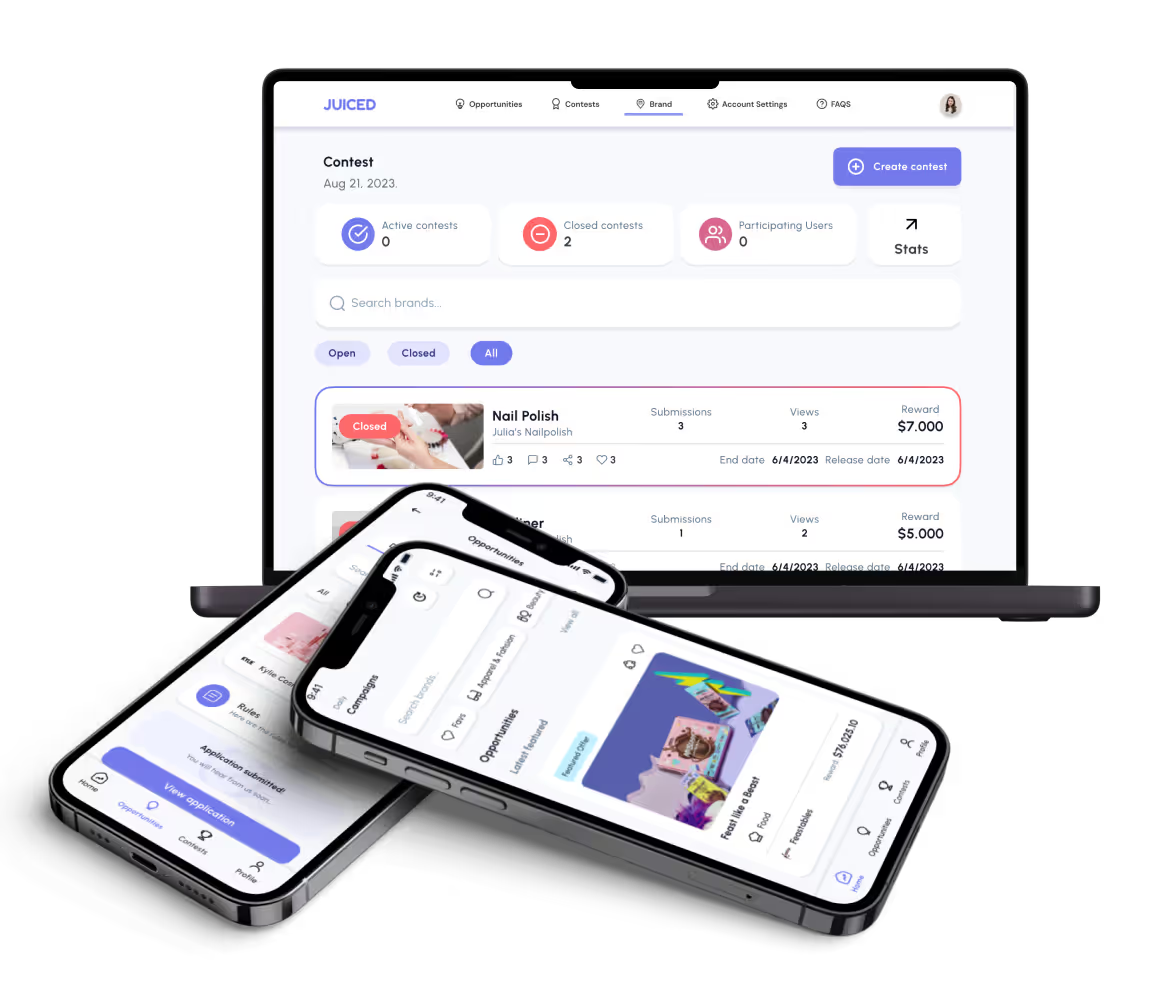

What Can FlutterFlow Build for Ticket Booking?
FlutterFlow builds the complete consumer ticket purchase experience: event discovery, ticket selection, Stripe checkout, digital ticket delivery, and an organiser management portal. Seat map visualisation and concurrent sale handling require additional technical implementation beyond FlutterFlow's native components.
FlutterFlow ticketing app examples from live productions show how these booking flows perform under real consumer use.
Event Discovery and Listings
Browsable event catalogues with category filters, date ranges, location search, and featured event promotions update from a Firestore CMS. Organisers manage listings without developer involvement after initial build.
Content updates to event details, dates, and featured placements take minutes, not days.
- Category and date filtering: Buyers filter events by type, date range, and location from a responsive catalogue that updates from Firestore in real time.
- Featured event promotion: Specific events surface as promoted listings at the top of the catalogue, controlled by the organiser through the management portal.
- Search functionality: Full-text and location-based search helps buyers find specific events quickly without browsing the full catalogue.
Ticket Selection and Quantity Management
Buyers choose ticket types including general admission, VIP, and early bird, set quantities, and see live remaining availability updated in real time from Firestore. Inventory counts decrement as tickets are reserved.
Availability display drives urgency and prevents buyers from attempting to purchase tickets that have already sold.
- Ticket type selection: Multiple ticket categories display with pricing, availability, and descriptions so buyers choose the right option before checkout.
- Real-time availability: Remaining ticket counts update live from Firestore so buyers see accurate inventory at the moment of selection.
- Quantity management: Buyers set quantities up to the per-order limit, with the total updating dynamically before they proceed to checkout.
Secure Checkout with Stripe
A multi-step checkout flow includes Stripe payment, discount code application, order summary, and booking fee calculation. Stripe handles all card data; Firestore never stores raw payment information.
The checkout sequence confirms availability before charging and creates the booking record atomically on payment success.
- Stripe payment integration: Card payment processes entirely within Stripe's hosted fields, keeping payment card data off your servers and within PCI scope.
- Discount code application: Promo codes apply at checkout with real-time validation, adjusting the order total before the buyer confirms payment.
- Booking fee calculation: Service fees, tax, and per-ticket charges calculate and display transparently on the order summary before the buyer confirms.
Digital Ticket Delivery and Wallet
Ticket confirmation with a unique QR code delivers to the buyer's in-app ticket wallet for offline access. QR code generation uses a third-party service or library integrated into the confirmation flow.
The ticket wallet screen caches after first load so buyers access their tickets without a data connection at the venue.
- QR code generation: Each booking receives a unique QR code via third-party API integration, tied to the booking record in Firestore for validation.
- In-app ticket wallet: Confirmed tickets store in the buyer's account with event details, QR code, and seat information accessible from the home screen.
- Offline access: The ticket wallet screen caches after the first load so buyers scan in at the venue without needing active mobile data.
Event-Day Scanner Interface
A companion check-in app for venue staff scans attendee QR codes and validates entry with an instant Firestore status update. Invalid or already-scanned tickets return a clear visual rejection.
The scanner app runs on any modern smartphone without specialist hardware, keeping operational costs low for smaller venues.
- QR code scanning: Staff use the device camera to scan attendee tickets, with instant validation against the Firestore booking record.
- Entry status update: Each successful scan marks the ticket as used in Firestore, preventing re-entry with the same QR code at any gate.
- Rejection feedback: Duplicate scans and invalid tickets return a clear visual rejection so staff handle exceptions confidently and quickly.
Order History and Ticket Management
Buyers access an order dashboard showing upcoming events, past bookings, and ticket management options within platform rules. Transfer and resale functionality configure based on the organiser's policy for each event.
The order history screen becomes the buyer's primary post-purchase touchpoint, reducing support volume for venues.
- Upcoming events view: Buyers see all confirmed upcoming tickets in one screen, with event details and QR code access from each listing.
- Past booking history: Completed events archive in the order history so buyers reference previous purchases and download receipts if needed.
- Ticket transfer option: Where the organiser enables transfers, buyers assign tickets to another attendee directly from the order management screen.
Organiser Event Management Portal
Event organisers access a role-gated portal to create events, set ticket types and pricing, monitor sales, and access attendee lists. The portal updates event data in Firestore directly, without requiring a developer for routine changes.
Role-gating ensures organisers access only their own events, with no cross-account data visibility.
- Event creation: Organisers create new event listings with details, date, location, ticket categories, and pricing from a structured form in the portal.
- Sales monitoring: A real-time sales dashboard shows tickets sold, revenue, and remaining inventory by ticket type as purchases come in.
- Attendee list access: Organisers download a current attendee manifest at any time, including check-in status updated from the scanner app in real time.
How Long Does It Take to Build a Ticket Booking App with FlutterFlow?
A simple ticket booking MVP covering event listings, basic ticket purchase, and digital ticket delivery takes 4 to 7 weeks. A full ticketing platform with scanner app, organiser portal, refund workflows, and resale functionality takes 10 to 16 weeks.
Timeline factors include seat map complexity, number of ticket categories, transfer and resale rules, and whether multi-organiser support is in scope from day one.
- Simple MVP timeline: Event listing, ticket purchase, and digital delivery ship in 4 to 7 weeks with a focused scope and experienced developer.
- Full platform timeline: Adding the scanner app, organiser portal, refund workflows, and resale logic extends the build to 10 to 16 weeks total.
- Seat map complexity: Interactive graphical seat selection requires a custom widget or third-party library that adds 2 to 4 weeks to any ticketing build.
- Multi-organiser support: Supporting multiple independent event organisers with separate portals and isolated data adds structural complexity that extends the build.
- Phased approach: Launching purchase and digital delivery first, then adding the scanner app and organiser analytics in phase two, is consistently 30 to 40 percent faster to initial production.
FlutterFlow builds the purchase flow 50 to 60 percent faster than a custom-coded equivalent. Scanner hardware integration timelines are comparable regardless of front-end approach.
What Does It Cost to Build a FlutterFlow Ticket Booking App?
FlutterFlow ticket booking apps cost $12,000 to $70,000 depending on scope. A single-venue MVP sits at the lower end. A multi-organiser platform with scanner app, resale functionality, and analytics sits at the top.
Reviewing FlutterFlow platform pricing options first helps event organisers budget the platform cost alongside development and ongoing infrastructure.
- Platform cost is minimal: FlutterFlow's monthly fee is a small fraction of total project cost; development time and Stripe fees drive the ongoing budget.
- Break-even vs third-party platforms: A custom build at $30,000 breaks even against Eventbrite fees at roughly 500 to 1,000 tickets per month, depending on average ticket price.
- Seat map hidden cost: Interactive seat selection requires a third-party library such as Seatsio that adds licensing fees and development time not in most initial quotes.
- Apple and Google compliance: Digital goods sold through a ticketing app may require in-app purchase compliance, adding development and platform fee considerations.
- Freelancer vs agency tradeoff: Freelancers suit a single venue or event series; agencies suit multi-organiser platforms with security review, concurrency handling, and QA.
Budget a contingency of 15 to 20 percent for concurrency and payment integration complexity discovered during build. Ticketing apps surface edge cases that simple scoping does not anticipate.
How Does FlutterFlow Compare to Custom Development for Ticket Booking Apps?
FlutterFlow is 40 to 60 percent cheaper at build stage and deploys in 4 to 16 weeks versus 3 to 6 months for a custom-coded equivalent. The trade-off is capability ceiling on seat map complexity and high-volume concurrency.
- Speed advantage is significant: FlutterFlow delivers a working purchase flow in weeks; equivalent custom builds take months to reach the same functional state.
- When FlutterFlow wins: Independent venues, festival organisers, community events, conference ticketing, and any organiser avoiding per-ticket platform fees.
- When custom wins: Stadium-scale venues with proprietary seat maps, legacy box office system integration, and broadcast-linked ticketing requirements.
- Maintenance advantage: FlutterFlow lets event operators update listings, pricing, and ticket categories without a developer after the initial build is complete.
For organisers evaluating platform options, the Bubble versus FlutterFlow ticketing comparison clarifies which no-code tool suits mobile-first event use cases.
What Are the Limitations of FlutterFlow for Ticket Booking Apps?
FlutterFlow cannot generate QR codes natively, cannot execute atomic database transactions for concurrent ticket sales, and cannot render complex interactive seat maps without a third-party library. These are the three areas that define most ticketing project failures.
FlutterFlow payment data security architecture must be correctly configured before any app accepts payment card information from buyers. PCI compliance relies entirely on Stripe's hosted fields being used correctly.
- No native QR code generation: Every ticket delivery implementation requires a third-party library or API integration; there is no built-in barcode or QR generation in FlutterFlow.
- Concurrent sales race conditions: Simultaneous purchases targeting the last available ticket require Firestore atomic transactions to prevent overselling; this is not FlutterFlow's default behaviour.
- Interactive seat maps are not native: Graphical venue seat selection requires a custom widget or a third-party service like Seatsio; it cannot be built with standard FlutterFlow components.
- Refund automation needs Cloud Functions: Stripe refund logic triggered by cancellation rules or event postponement requires Cloud Functions rather than FlutterFlow action flows.
- Payment security configuration: Firestore must never store raw card data; PCI compliance depends on Stripe's hosted payment fields being correctly implemented throughout the checkout.
- Vendor dependency: The FlutterFlow visual layer is proprietary; code export is available on paid plans as an exit option if the platform no longer fits your needs.
Knowing these limits before scoping prevents expensive redesigns when your backend developer identifies concurrency and security requirements the FlutterFlow layer alone cannot satisfy.
How Do You Get a FlutterFlow Ticket Booking App Built?
You need a developer or agency with Stripe integration experience, Firestore atomic transaction handling, and QR code service integration. These three skills separate developers who have shipped ticketing apps from those who have not.
Knowing how to hire a FlutterFlow developer with ticketing and payment experience prevents the concurrency and security issues that define event app failures.
- Required expertise: Stripe integration, Firestore atomic transactions, QR code service integration, and multi-role portal experience are all baseline requirements for a ticketing build.
- Freelancer scope: Freelancers suit a single venue or event series with straightforward ticket types and no concurrent sale complexity at launch.
- Agency scope: Multi-organiser platforms with concurrent sale handling, scanner app, resale functionality, and payment security review need a team, not a solo developer.
- Red flag question: Any developer who does not address Firestore atomic transactions for concurrent sales in the first technical conversation is a risk for any event with finite ticket counts.
- Key interview questions: Ask how they prevent overselling when multiple buyers hit the last ticket simultaneously and how they handle Stripe refunds on event cancellation.
- Expected timeline: A well-scoped ticketing build from discovery through app store submission takes 6 to 16 weeks depending on feature depth and seat map requirements.
Interview at least two developers or agencies and ask for verifiable examples of ticketing or payment integration builds before committing to a project.
Conclusion
FlutterFlow is a cost-effective platform for ticket booking apps. Purchase flows, digital delivery, and organiser portals all work well. Seat map visualisation and concurrent sale handling are the two areas that need the most explicit technical attention before build begins.
Define whether you need an interactive seat map and what your peak concurrent purchase volume looks like before approaching any developer. These two answers determine the most technically demanding parts of the project scope and prevent expensive surprises mid-build.
Building a Ticket Booking App with FlutterFlow? Here Is How LOW/CODE Agency Approaches It.
Ticketing apps fail most often not on the purchase flow but on the concurrency and payment security decisions that look invisible until launch day. Getting those right before the first screen is built is what separates a production-ready ticketing platform from one that oversells on its first event.
At LOW/CODE Agency, we help SMBs compete with AI-powered software built for them — custom web and mobile apps, RAG systems, chatbots, and intelligent agents delivered by a senior development team. We build FlutterFlow ticketing apps with the full technical stack behind them: Firestore atomic transaction logic for concurrent sales, Stripe payment and refund configuration, QR code generation, scanner app build, and organiser portal development from a team that has shipped real transaction-critical applications.
- Concurrent sale handling: We implement Firestore atomic transactions that prevent overselling when multiple buyers target the same ticket simultaneously at peak demand.
- Stripe payment and refund setup: We configure the full Stripe payment and refund flow including cancellation policy automation and PCI-compliant payment field implementation.
- QR code generation and delivery: We integrate third-party QR generation services to produce unique, scannable tickets delivered to the in-app wallet at booking confirmation.
- Scanner app build: We build the venue staff check-in scanner as a companion app that validates QR codes against Firestore and updates entry status in real time.
- Organiser portal: We design role-gated organiser dashboards for event creation, pricing management, sales monitoring, and attendee list access without developer involvement.
- Phased delivery: We scope and ship the purchase flow and digital delivery first, then layer in scanner app, organiser analytics, and resale functionality in phase two.
- Full product team: Strategy, UX, development, and QA from a single team so your ticketing app is production-ready on opening night, not just in the demo.
We have built 350+ products for clients including Coca-Cola, American Express, and Sotheby's. We know exactly where ticketing builds go wrong and we prevent those problems before they cost you a sold-out event.
Related Articles
Last updated on
September 24, 2026
.

Jesus is a visionary entrepreneur and tech expert. After nearly a decade working in web development, he founded LOW/CODE Agency to help businesses optimize their operations through custom software solutions.


FAQs
What are the first steps to create a ticket booking app in FlutterFlow?
How do I integrate payment gateways in a FlutterFlow ticket booking app?
Can I add real-time seat selection in my FlutterFlow app?
What database options work best with FlutterFlow for booking apps?
How do I test my ticket booking app built with FlutterFlow?
What are common challenges when building booking apps with FlutterFlow?
Related Articles
FlutterFlow
How to Build an NGO Project Tracking App with FlutterFlow
Learn how to create an NGO project tracking app using FlutterFlow with step-by-step tips and best practices for efficient development.

FlutterFlow
How to Build an Influencer Marketplace Platform with FlutterFlow
Learn how to create an influencer marketplace platform using FlutterFlow with step-by-step guidance and best practices.

FlutterFlow
FlutterFlow Pros and Cons (Read This Before Building an App)
Explore FlutterFlow pros and cons before building an app. Learn benefits, limitations, real trade-offs, and when FlutterFlow is or isn’t the right choice.

FlutterFlow
How to Build a Dating App with FlutterFlow
Learn step-by-step how to create a dating app using FlutterFlow with no coding skills required. Start building your app today.

Why customers trust us for no-code development


