

How to Build a Points Rewards App with FlutterFlow
15 min
read
Learn how to create a points rewards app using FlutterFlow with step-by-step tips and best practices for seamless user experience.

A FlutterFlow points rewards app looks simple on the surface: earn, accumulate, redeem. But the data integrity, fraud prevention, and integration requirements underneath are where most builds go wrong. Getting the server-side architecture right is not optional.
FlutterFlow handles the rewards UI and user experience well. The article covers what works natively, where Cloud Functions are mandatory, and what the full build costs before you commit.
Key Takeaways
- The rewards UI works well in FlutterFlow: Points balance displays, reward catalogues, and transaction histories are all native platform capabilities.
- All points arithmetic must run server-side: Client-side balance updates in FlutterFlow can be tampered with, Cloud Functions and Firestore transactions are mandatory.
- Reward redemption needs fraud prevention: Single-use voucher codes, QR validation, and replay attack prevention must be built into Cloud Functions, not the FlutterFlow client.
- Third-party platform integration adds complexity: Connecting to an existing loyalty platform via API is possible but significantly increases scope and timeline.
- Custom builds are cost-effective at scale: A custom FlutterFlow rewards app makes financial sense for businesses with 500 or more monthly active reward users.
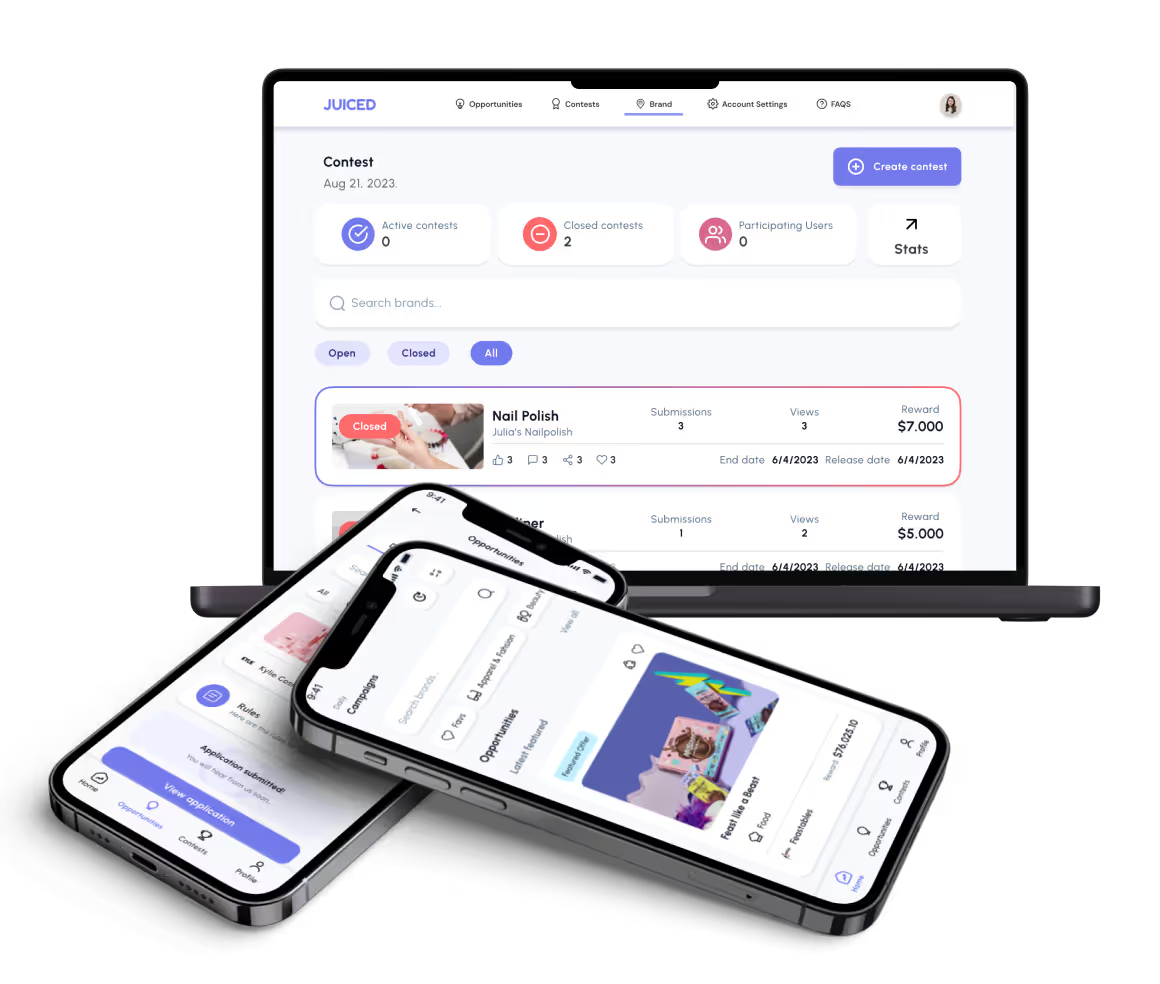

What Can FlutterFlow Build for a Points Rewards App?
FlutterFlow builds the complete user-facing layer of a points rewards app: points dashboards, earning flows, reward catalogues, redemption screens, transaction history, and notifications. All balance calculation and fraud prevention logic must run in Cloud Functions.
For a broader look at FlutterFlow rewards app capabilities, the platform overview explains what the visual builder supports without custom code.
Points Balance Dashboard
Each user's current point balance, lifetime earned, and recently redeemed points display in a real-time updated dashboard. The balance figure is always read from Firestore, never calculated client-side.
The dashboard loads on app open and refreshes after any earning or redemption event to reflect the latest server-confirmed balance.
- Real-time balance display: The points balance reads directly from a Firestore document updated atomically by Cloud Functions, ensuring accuracy at all times.
- Lifetime and recent activity summary: Lifetime earned, total redeemed, and recent transaction summaries display in summary cards beneath the current balance figure.
- Balance refresh trigger: The dashboard triggers a Firestore read after any earning or redemption action, keeping the displayed figure current with the server state.
Earning Actions and Triggers
Points-earning events such as purchases, referrals, reviews, social shares, and check-ins each trigger a Cloud Function that atomically updates the user's Firestore balance. FlutterFlow surfaces the result.
Earning triggers are configured as Cloud Function listeners tied to specific Firestore write events or webhook calls from connected systems.
- Purchase-triggered earning: A webhook from your POS or ecommerce platform calls a Cloud Function that calculates and atomically writes the earned points to the user's Firestore record.
- Referral point awards: Referee tracking and delayed point award on first qualifying action are handled in Cloud Functions, with FlutterFlow displaying the pending and confirmed states.
- Review and social earning: In-app actions like submitting a review trigger Cloud Functions that validate the action and award points only once per eligible event.
Reward Catalogue Browsing
A categorised, searchable reward catalogue with point cost, availability, expiry dates, and redemption instructions for each reward is achievable in FlutterFlow using Firestore-backed list and filter views.
Catalogue content is managed in Firestore and can be updated by non-technical team members through a simple admin interface built alongside the main app.
- Categorised catalogue view: Rewards display in a filterable grid or list organised by category, with point cost and availability status shown on each reward card.
- Search and filter: Users search rewards by name or filter by category and point range using FlutterFlow's built-in filter logic and Firestore queries.
- Reward detail screen: Tapping a reward opens a detail view with full description, redemption instructions, expiry date, and a redeem button that initiates the server-side flow.
Redemption Flow and Voucher Generation
Users redeem points for rewards through a server-side flow: FlutterFlow calls a Cloud Function that validates the user's balance, deducts points atomically, generates a single-use voucher code, and returns a QR code for display.
The voucher code is generated and stored server-side before the QR screen is shown to the user.
- Atomic balance deduction: The redemption Cloud Function checks the user's balance and deducts points in a single Firestore transaction, preventing double-spend race conditions.
- Single-use code generation: Each redemption generates a unique, one-time-use voucher code stored in Firestore and invalidated server-side immediately after validation.
- QR code display: The generated voucher code renders as a QR code in FlutterFlow for point-of-sale scanning, with a timer or single-display restriction enforced by the Cloud Function.
Transaction History and Statements
A detailed chronological log of all earning and redemption events with timestamps, descriptions, and a running balance displays in a paginated list view. Firestore pagination handles large history volumes efficiently.
Each transaction record writes to a sub-collection on the user document at the time of the event, keeping the history complete and auditable.
- Chronological event log: All earning and redemption events display in reverse chronological order with event type, point value, description, and timestamp for each entry.
- Running balance column: Each transaction record shows the point balance after that event, making it easy for users to reconcile their history without recalculation.
- Pagination for large histories: Firestore pagination loads transaction history in batches, keeping the screen performant for users with long activity records.
Points Expiry Management
Automatic expiry of points not used within a defined window, with expiry warning push notifications sent in advance, is handled by a scheduled Cloud Function that runs daily or weekly.
FlutterFlow surfaces expiry dates in the balance dashboard and transaction history. The expiry logic and batch processing run entirely server-side.
- Scheduled expiry processing: A Firebase scheduled Cloud Function runs daily to identify points approaching expiry, marks them as expired, and updates user balances accordingly.
- Expiry warning notifications: Push notifications via Firebase Cloud Messaging alert users 7, 14, or 30 days before points expire, driving re-engagement before the deadline.
- Expired points display: The transaction history marks expired point events clearly, so users understand why their balance decreased without contacting support.
Referral Programme Integration
Users earn points for referring new members, with referee tracking and delayed point award on first qualifying action by the referred user. All referral logic runs in Cloud Functions.
FlutterFlow displays the referral code, tracks referral status, and shows pending and confirmed point awards in the user's activity feed.
- Unique referral code generation: Each user's referral code is generated and stored in Firestore on account creation, ready to display and share from the profile screen.
- Referee tracking: When a new user registers with a referral code, a Cloud Function links the accounts and begins monitoring for the first qualifying action.
- Delayed point award: Points for the referring user are awarded only after the referred user completes a qualifying action, enforced entirely in Cloud Functions to prevent gaming.
How Long Does It Take to Build a Points Rewards App with FlutterFlow?
A simple rewards MVP covering balance display, basic earning, and a reward catalogue takes 4-7 weeks. A full-featured rewards app with fraud prevention, expiry management, a referral programme, and an admin panel takes 9-15 weeks.
Timeline factors include the number of earning triggers, integration with external ecommerce or POS systems, voucher generation mechanism, and admin portal scope.
- Simple MVP timeline: Points balance, basic earning triggers, and reward catalogue browsing ship in 4-7 weeks with a focused scope and no external system integration.
- Full platform timeline: Adding fraud prevention, expiry management, referral programme, and admin portal extends the build to 9-15 weeks depending on integration complexity.
- Ecommerce integration factor: Connecting earning triggers to Shopify, WooCommerce, or a POS system adds 2-4 weeks for webhook configuration and error handling.
- Admin panel scope: A separate admin interface for managing rewards, viewing user balances, and monitoring fraud events adds 2-3 weeks to the total timeline.
- Phased approach advantage: Launching balance display and catalogue first, then adding referral and expiry management in phase two, gets value to users earlier.
FlutterFlow builds the UI and basic earning logic 45-60% faster than custom development. The Cloud Function architecture time is similar regardless of front-end tool.
What Does It Cost to Build a FlutterFlow Points Rewards App?
FlutterFlow points rewards apps cost $12,000-$65,000 depending on scope. A single-business rewards programme sits at the lower end; a multi-brand platform with fraud prevention, referral, and admin tools sits at the top.
Review the FlutterFlow plan pricing breakdown first, as the chosen plan tier determines which API integration and Cloud Function capabilities are available to your rewards app.
- Platform cost is minimal: FlutterFlow's monthly fee is a small fraction of total project cost; Cloud Function architecture and fraud prevention logic drive the budget.
- Break-even versus SaaS: A custom FlutterFlow rewards app eliminates per-user licensing fees; break-even versus third-party platforms typically occurs at 500-1,000 monthly active users.
- Freelancer scope: Solo developers suit a single-business rewards programme with one earning trigger type and a straightforward redemption flow.
- Agency scope: Multi-brand or SaaS rewards platforms with fraud prevention, referral programmes, and admin portals require a full team with Firestore transaction expertise.
- Hidden cost: POS integration middleware: Connecting earning triggers to a legacy POS system may require middleware development that adds $3,000-$8,000 to the project cost.
- Hidden cost: SMS notifications: Adding SMS as a channel for expiry reminders and reward alerts adds ongoing messaging costs not included in base Firebase pricing.
Budget a 15-20% contingency for fraud pattern discovery during testing and ecommerce integration complexity.
How Does FlutterFlow Compare to Custom Development for Points Rewards Apps?
FlutterFlow is 40-60% cheaper at the build stage and deploys a rewards UI in 4-7 weeks versus 4-7 months for custom development. Complex multi-partner coalition programmes and real-time POS sync at enterprise scale require custom code beyond FlutterFlow's native capabilities.
- Speed advantage is clear: FlutterFlow delivers a working rewards UI and earning flow in weeks; custom builds take months to reach the same functional state.
- Maintenance advantage: Marketing and operations teams can update reward catalogues and promotions in FlutterFlow without developer involvement, reducing ongoing costs.
- When FlutterFlow wins: SME retailers, hospitality businesses, and SaaS platforms adding rewards as a retention feature with defined earning trigger types.
- When custom wins: Large-scale coalition programmes across multiple brands, financial services rewards platforms, and real-time high-volume earning engines at enterprise scale.
Understanding FlutterFlow rewards programme trade-offs helps businesses set honest expectations before choosing between the platform and a fully custom rewards engine.
What Are the Limitations of FlutterFlow for Points Rewards Apps?
Points must never be calculated client-side in FlutterFlow. Any action that updates a balance on the device can be manipulated. All balance changes, redemption flows, and expiry processing must run in Cloud Functions with atomic Firestore transactions.
Following FlutterFlow rewards app best practices on points architecture prevents the fraud vulnerabilities that undermine consumer trust in rewards programmes.
- Client-side balance manipulation risk: Any FlutterFlow condition or action that updates a points balance on the device is exploitable, all balance changes must be handled server-side without exception.
- Redemption fraud prevention is server-side only: Single-use codes must be generated and invalidated in Cloud Functions; FlutterFlow cannot enforce single-use logic at the client layer.
- Complex earning rules require Cloud Functions: Spend-tier multipliers, category-specific bonuses, and time-of-day earning rates need Cloud Function logic beyond FlutterFlow's visual action builder.
- Batch expiry at scale: Processing point expiry for a large user base requires a scheduled Cloud Function; FlutterFlow does not offer native scheduled task execution.
- Third-party loyalty platform integration: Connecting FlutterFlow to an existing loyalty platform API like Antavo or LoyaltyLion adds significant integration scope and development time.
- Code export as an option: Code export is available on paid plans for businesses that need full codebase ownership as the platform grows beyond FlutterFlow's native capabilities.
These limits are architectural, not cosmetic. Discovering them after launch is far more expensive than designing around them from the start.
How Do You Get a FlutterFlow Points Rewards App Built?
You need a developer with Firestore atomic transaction experience, Cloud Functions expertise, and a track record with fraud prevention patterns, not just FlutterFlow UI skills. The back-end architecture is where rewards apps succeed or fail.
Working with top FlutterFlow development agencies experienced in loyalty data architecture prevents the server-side logic gaps that make rewards programmes exploitable.
- Required expertise: Firestore atomic transactions, Cloud Functions for server-side point awards, single-use voucher code generation and invalidation, and fraud prevention architecture.
- Freelancer scope: Freelancers suit a single-business rewards programme with one earning trigger and a straightforward, low-fraud-risk redemption flow.
- Agency scope: Multi-brand or SaaS rewards platforms with multiple earning types, fraud prevention, and admin dashboards require a team with Firestore and Cloud Function depth.
- Red flag when hiring: Any developer who proposes updating point balances directly from FlutterFlow client actions without server validation is not the right choice for a rewards project.
- Key interview question: Ask specifically how they prevent point balance manipulation and how they generate and invalidate single-use reward codes at redemption.
- Expected project timeline: Architecture and Cloud Function design take 2 weeks; FlutterFlow build runs 4-10 weeks; fraud testing and admin portal add 2-3 weeks before launch.
Interview candidates specifically about their Firestore transaction and Cloud Function experience, not just their FlutterFlow portfolio.
Conclusion
FlutterFlow is a practical platform for points rewards apps. The UI, earning flows, and reward catalogue all work well, and the platform gets you to market significantly faster than a custom build.
The integrity of every point balance update depends on server-side Cloud Function logic designed correctly from day one. Define every earning trigger and every redemption flow before scoping, then verify with your developer that each one is handled server-side rather than in FlutterFlow's client logic.
Building a Points Rewards App with FlutterFlow? Here Is How LOW/CODE Agency Approaches It.
Rewards apps look straightforward until the first fraud attempt or balance manipulation event. The server-side architecture for points integrity, redemption fraud prevention, and batch expiry processing is where most rewards builds either hold up or fall apart.
As AI development experts, we at LOW/CODE Agency help SMBs ship real software — web and mobile applications, intelligent chatbots, RAG pipelines, and autonomous AI agents built for businesses that need results, not platforms. We build FlutterFlow rewards applications with the full Cloud Function architecture behind them: atomic Firestore transactions for balance updates, server-side single-use code generation, fraud prevention patterns, and admin tooling from a team that has shipped loyalty platforms at scale.
- Points integrity architecture: We design all balance update logic as atomic Firestore transactions in Cloud Functions, preventing client-side manipulation from day one.
- Redemption fraud prevention: We build single-use voucher generation, QR validation, and replay attack prevention as server-side logic that FlutterFlow displays, never controls.
- Earning trigger integration: We connect purchase webhooks from your POS or ecommerce platform to Cloud Functions that validate, calculate, and award points atomically.
- Expiry management: We implement scheduled Cloud Functions for batch point expiry processing and configure push notification delivery for expiry warning campaigns.
- Admin portal: We build a management interface for reward catalogue updates, user balance queries, and fraud monitoring so your team can operate the programme without developer support.
- Phased delivery: We scope and ship your balance and catalogue MVP first, then layer in referral programme and expiry management so you validate earning behaviour with real users early.
- Full product team: Strategy, UX, development, and QA from a single team so your rewards app is fraud-resistant, performant, and ready for production from launch.
We have built 350+ products for clients including Coca-Cola, American Express, and Sotheby's. We know how to design loyalty programmes that hold up under real user behaviour.
Related Articles
- How to Build a SaaS App with FlutterFlow
- How to Build a Route Optimization App with FlutterFlow
- How to Build a Ride Sharing App with FlutterFlow
- How to Build a Retirement Planning Tool with FlutterFlow
- How to Build a Restaurant Management System with FlutterFlow
- How to Build Data and Reporting Tools with FlutterFlow
Last updated on
September 3, 2026
.

Jesus is a visionary entrepreneur and tech expert. After nearly a decade working in web development, he founded LOW/CODE Agency to help businesses optimize their operations through custom software solutions.


FAQs
What are the first steps to create a points rewards app in FlutterFlow?
How do I manage user points securely in FlutterFlow?
Can I customize reward tiers and redemption options in FlutterFlow?
What are common challenges when building a rewards app with FlutterFlow?
How do I test the points calculation and redemption process?
Is it possible to integrate third-party APIs for additional rewards features?
Related Articles

FlutterFlow
How to Build a Business Intelligence Dashboard with FlutterFlow
Learn how to create a business intelligence dashboard using FlutterFlow with step-by-step guidance and best practices for data visualization.
FlutterFlow
How to Build a Taxi Booking App with FlutterFlow
Learn how to create a taxi booking app using FlutterFlow with step-by-step guidance and tips for a smooth development process.
.avif)
FlutterFlow
Comparison
FlutterFlow vs Bravo Studio | 8 Factors to Decide the Best One
Compare FlutterFlow vs Bravo Studio across 8 key factors like ease of use, design, backend, and publishing to choose the best no-code tool for your mobile app
FlutterFlow
How to Build an Equipment Maintenance Scheduler with FlutterFlow
Learn how to create an equipment maintenance scheduler using FlutterFlow with step-by-step guidance and best practices.
Why customers trust us for no-code development


