

How to Build an LMS with FlutterFlow
13 min
read
Learn step-by-step how to create a learning management system using FlutterFlow with no coding required. Start building your LMS today.


Companies and schools paying $10,000–$50,000 per year for LMS platforms they barely use are discovering that FlutterFlow LMS development delivers more relevant features at a fraction of the ongoing cost. The right LMS is the one built for how your learners and instructors actually work.
A custom FlutterFlow LMS gives you course management, video lessons, assessments, progress tracking, and instructor dashboards without the bloat of enterprise platforms. This article covers what FlutterFlow can build, realistic costs, honest limitations, and how to find the right team.
Key Takeaways
- FlutterFlow can build a functional LMS: Course management, video lessons, assessments, progress tracking, instructor dashboards, and learner certificates are all achievable.
- SCORM and xAPI require backend middleware: FlutterFlow is not natively SCORM-compliant; enterprise deployments with compliance requirements need additional backend work.
- Build timeline is 10–20 weeks: A basic LMS MVP ships in 10 weeks; a full-featured platform with multi-instructor management, assessments, and analytics takes 18–22 weeks.
- Costs range from $25,000–$85,000: Multi-instructor management, SCORM middleware, and detailed learning analytics are the primary cost drivers.
- Video hosting is the largest ongoing cost: Every LMS video lesson requires an external provider, adding $100–$1,000+/month depending on library size.

What Can FlutterFlow Build for an LMS?
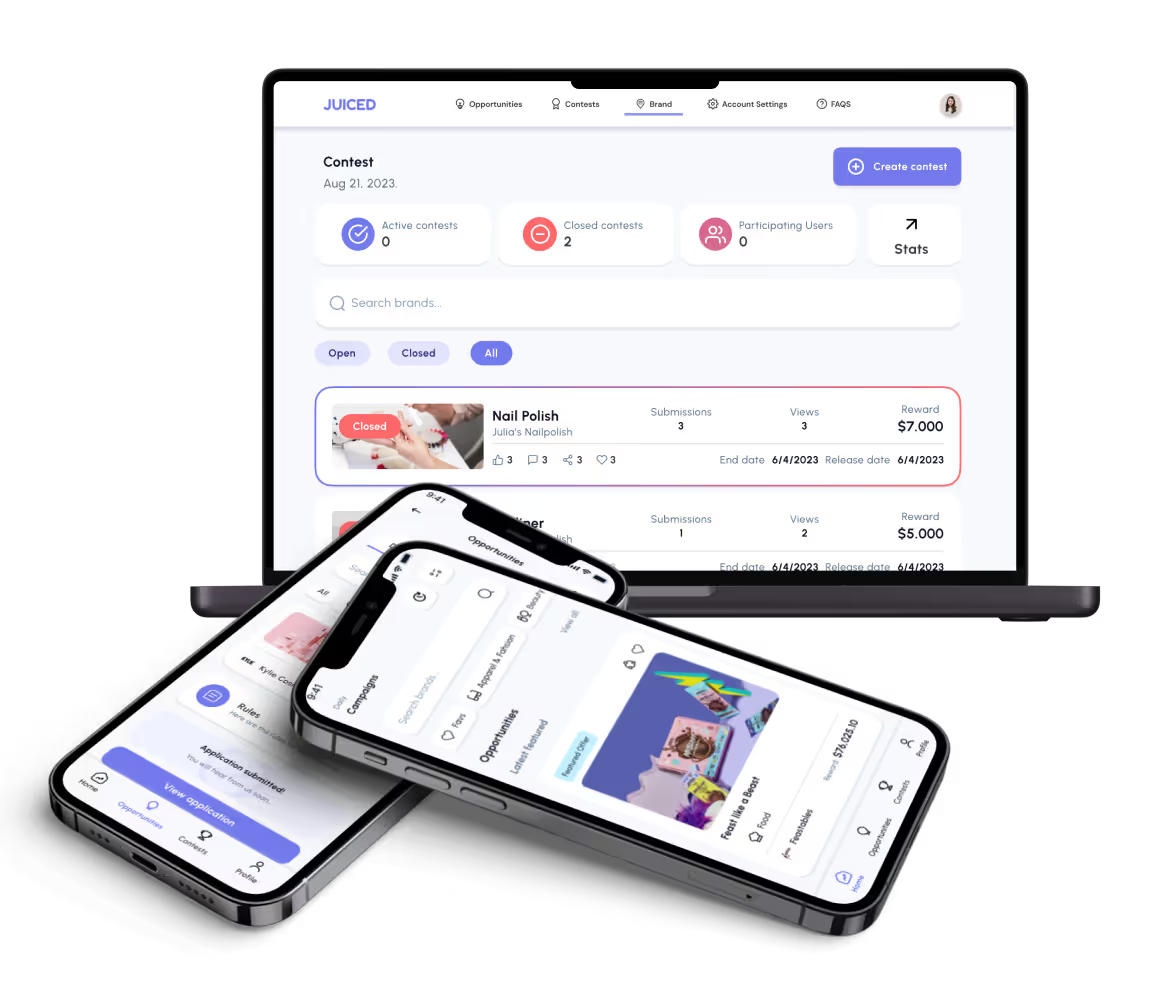
FlutterFlow can build a complete learning management system with course and curriculum management, video lesson delivery, graded assessments, learner progress dashboards, instructor analytics, role-based access, completion certificates, and cohort enrolment management.
All FlutterFlow LMS builds benefit from careful data modeling early. For teams planning a multi-tenant training platform, understanding how LMS platforms work as SaaS in FlutterFlow, including tenant isolation and subscription management, is foundational.
Course and Curriculum Builder
- Structured course hierarchy: Instructors create courses with modules, lessons, and resources, organized in a prerequisite-aware curriculum structure.
- Admin course builder interface: A dedicated admin interface allows content managers to build and edit course structure without touching the learner-facing app.
- Prerequisite dependencies: Lesson and module unlock conditions gate content so learners complete foundational material before progressing.
The course data model drives everything downstream. Getting the hierarchy right in discovery prevents structural rebuilds as the content library grows.
Video Lesson Delivery
- Third-party video hosting: Video content streams from Vimeo, Mux, or Wistia embedded in the lesson player, keeping hosting costs and performance predictable.
- Chapter markers and completion tracking: Video lessons track completion status per learner, gating the next lesson until the current one is finished.
- Playback controls: Standard pause, resume, and seek controls work within the embedded player, with completion logged at the lesson record level.
Video hosting is the single largest ongoing cost in any LMS build. Budget for it explicitly before committing to a content library size.
Assessments and Graded Quizzes
- Automatic scoring: Multiple-choice, multi-select, and true/false questions are scored instantly after submission with pass/fail logic applied per quiz.
- Short-answer routing: Written responses route to an instructor grading queue with rubric notes visible to the reviewer.
- Retry policy enforcement: Quiz retry limits and cooldown periods are configurable per assessment, enforced by the app logic.
Assessment logic is one of the more complex features in an LMS build and should be scoped with explicit attention to retry rules, partial credit, and grading queue design.
Learner Progress Dashboard
- Personal learning overview: Students see their course completion percentage, quiz scores, time spent, and remaining modules at a glance.
- Module-level progress tracking: Progress tracks at the individual lesson and module level, not just at the top-level course.
- Streak and engagement indicators: Optional engagement metrics show learners their activity patterns, supporting habit-formation for self-paced courses.
The learner dashboard is the most frequently accessed screen in any LMS and must load quickly even as completion data grows.
Instructor Dashboard and Analytics
- Enrolment and completion rates: Instructors see real-time enrolment numbers and completion rates per course with trend data over time.
- Individual learner progress: Instructors drill down to individual learner records to identify students at risk of falling behind or dropping out.
- Average quiz scores: Assessment performance data per quiz and per question helps instructors identify content that is consistently difficult or ambiguous.
Instructor analytics are what justify the LMS investment for corporate training teams evaluating completion rates against training objectives.
Role-Based Access (Admin, Instructor, Learner)
- Three distinct roles: Admins manage all content and users; instructors manage their assigned courses; learners access only enrolled content.
- Role-based navigation: Each role sees a different app interface with actions and data scoped to their permissions.
- Group manager role optional: A fourth role for team managers or cohort leads can view group progress without full admin access.
Role hierarchy is one of the most important data modeling decisions in an LMS and must be defined before the first screen is built.
Certification and Badges
- PDF certificate generation: Completion certificates are generated via a Cloud Function PDF generator and delivered to learners on course completion.
- Digital badges: Badges are awarded on course or module completion and are shareable to LinkedIn or downloadable as image files.
- Certificate registry: Admins can search and verify issued certificates from a registry view, supporting compliance and audit requirements.
Certificates are a key deliverable for compliance-driven corporate training programs and should be designed with the required fields confirmed by HR or legal.
Cohort and Group Enrolment
- Bulk enrolment: Administrators enrol entire teams, company cohorts, or class groups into specific courses in a single operation.
- Group progress visibility: Assigned managers see aggregate completion data for their group without accessing individual learner records.
- Cohort-based start dates: Courses can be configured to open access on a fixed date for all cohort members simultaneously.
Cohort enrolment is the primary delivery model for corporate onboarding and training programs, and it drives most of the multi-role complexity in LMS builds.
How Long Does It Take to Build an LMS with FlutterFlow?
A simple LMS MVP with course structure, video lessons, quizzes, progress tracking, and basic admin ships in 9–12 weeks. A full LMS with multi-instructor management, cohort enrolment, graded assessments, certificates, and analytics takes 18–22 weeks.
LMS builds benefit significantly from a phased approach: launch with video lessons and completion tracking first, then layer in graded assessments, certificates, and analytics.
- Simple MVP timeline: Course structure, embedded video, multiple-choice quizzes, progress tracking, and basic admin are achievable in 9–12 weeks.
- Full platform timeline: Adding multi-instructor management, cohort enrolment, graded assessments, certificates, and learning analytics extends to 18–22 weeks.
- SCORM middleware adds time: Enterprise deployments requiring SCORM compliance need a separate middleware layer, adding 4–8 weeks to the backend build.
- Graded assessment queues add complexity: Instructor review queues for written responses require a purpose-built grading interface with rubric support.
- Multi-language support extends timelines: Localization for multilingual learner bases adds 2–4 weeks per additional language depending on content volume.
- FlutterFlow speed advantage: Pre-built components reduce build time by 40–60% compared to custom LMS development from scratch.
Applying LMS architecture best practices in FlutterFlow, particularly around role hierarchy and content access gating, prevents structural rebuilds as the course library grows.
What Does It Cost to Build an LMS with FlutterFlow?
Understanding FlutterFlow LMS build pricing across platform, video hosting, and backend services prevents the common mistake of underestimating total operating costs.
Developer costs for a full-featured LMS build run $25,000–$85,000. Agency builds with multi-instructor management and analytics run $35,000–$120,000. The platform subscription itself is a minor cost item.
- Video hosting is underestimated most often: A library of 50+ courses with HD video can cost $300–$1,000/month in hosting before a single student logs in.
- SCORM middleware is a separate project: Enterprise compliance middleware for SCORM or xAPI is not included in a standard FlutterFlow build and adds $10,000–$30,000.
- Accessibility compliance costs: Institutional clients requiring WCAG 2.1 or Section 508 compliance need additional development and testing beyond standard LMS builds.
- Multi-language localization: Each additional language for a multilingual LMS requires content management infrastructure and translation workflow integration.
Custom development of an equivalent LMS costs $100,000–$350,000. FlutterFlow delivers the same core learning experience at a fraction of the cost for corporate training, online academies, and vocational programs.
How Does FlutterFlow Compare to Custom Development for an LMS?
FlutterFlow delivers an LMS in 9–22 weeks at $25,000–$120,000. Custom development takes 9–18 months at $100,000–$400,000+. FlutterFlow wins for most corporate training and online academy builds.
The capability gap with custom development is narrow for most LMS use cases. It only becomes material for accredited institutions with SIS integration or platforms requiring SCORM compliance certification.
- FlutterFlow wins for: Corporate training platforms, online academies, coaching programs, vocational training providers, and employee onboarding systems.
- Custom wins for: Accredited educational institutions with SIS integration requirements, platforms requiring SCORM compliance certification, and adaptive learning systems for regulated industries.
- Maintenance advantage: FlutterFlow makes it straightforward to update course structures and instructor tools without a full development engagement for routine content changes.
An LMS builder tool comparison between FlutterFlow and Bubble helps teams understand which platform's data model and API integration approach fits their content delivery requirements.
What Are the Limitations of FlutterFlow for LMS Development?
LMS concurrent user scalability in FlutterFlow is worth stress-testing before launch. Platforms with cohort-based start dates create predictable traffic spikes that must be planned for in the backend architecture.
FlutterFlow builds capable LMS platforms, but several enterprise requirements sit outside what the visual builder handles natively.
- SCORM and xAPI not natively supported: Corporate and institutional LMS deployments requiring learning standard compliance need backend middleware developed separately from the FlutterFlow build.
- Adaptive learning paths are complex: Content that adapts based on performance history requires conditional logic that is difficult to maintain cleanly in the visual builder at scale.
- Instructor-graded assessment limits: Written response grading queues with rubric support are complex to implement and maintain cleanly in the visual builder as content volume grows.
- Complex logic grows harder to maintain: As the course catalog, cohort logic, and assessment rules expand, the visual logic graph becomes increasingly difficult to manage without dedicated developer time.
- Concurrent video streaming at scale: Thousands of students streaming video simultaneously at cohort start dates requires careful infrastructure planning beyond standard Firebase defaults.
- Video provider dependency: Changes in video hosting pricing and API structure directly affect lesson delivery cost and require migration work if providers are switched.
- Code export as an escape valve: Exporting Flutter code allows teams to implement custom assessment engines and advanced analytics beyond what the visual builder supports.
Planning for these limitations during the discovery and architecture phase is what enables a FlutterFlow LMS to scale without structural rebuilds.
How Do You Find the Right Team to Build a FlutterFlow LMS?
Identifying top LMS FlutterFlow agencies with multi-instructor and assessment experience reduces the risk of hiring generalist developers who underscope the content management complexity.
LMS builds are among the more complex FlutterFlow projects. The multi-role data model, assessment design, and video integration requirements eliminate generalist developers from the shortlist quickly.
- Required expertise: Look for experience with video platform integration, multi-role data models, Stripe subscription billing, assessment design, and Firebase performance at scale.
- Agencies over freelancers: Agencies are strongly preferred for LMS builds with instructor management, cohort enrolment, and analytics requirements due to the coordination complexity.
- Red flag, assumes SCORM is included: Any developer claiming FlutterFlow supports SCORM out of the box does not understand the platform's compliance architecture.
- Red flag, no LMS portfolio: A development team without an LMS or training platform in their portfolio cannot demonstrate the required domain and data modeling experience.
- Ask about multi-role access: "How have you handled multi-role LMS access in FlutterFlow?" reveals real experience with role-based data scoping versus surface-level claims.
- Ask about graded assessments: "What approach do you use for graded assessments with instructor review queues?" surfaces whether they understand the grading queue design requirement.
Expect a good team to spend 2–3 weeks in discovery covering content structure, assessment design, role hierarchy, and compliance requirements before producing a build estimate.
Conclusion
FlutterFlow is a capable platform for LMS development, particularly for corporate training, online academies, and vocational programs that need a branded learning environment without the cost and timeline of a custom build.
Before approaching a development team, map your course hierarchy (courses, modules, lessons), your user roles (admin, instructor, learner), and your compliance requirements. These three inputs drive the entire LMS architecture and determine the true scope of the build.
Building an LMS with FlutterFlow? Here Is How LOW/CODE Agency Approaches It.
Most LMS builds fail because the course data model, role hierarchy, or assessment logic was not properly designed before development began. Fixing these issues after the first build adds months and budget.
As AI development experts, we at LOW/CODE Agency help SMBs ship real software — web and mobile applications, intelligent chatbots, RAG pipelines, and autonomous AI agents built for businesses that need results, not platforms. We build FlutterFlow LMS platforms for corporate training teams, online educators, and vocational providers who need a fully functional learning environment designed for their specific content and learner structure.
- Discovery and content architecture: We map your course hierarchy, user roles, assessment types, and compliance requirements before any build begins.
- Multi-role data model: We design the admin, instructor, learner, and optional group manager role hierarchy so data scoping is correct from the first deployment.
- Video hosting integration: We select and integrate the right video provider for your content library size and traffic pattern, with completion tracking wired in from day one.
- Assessment and grading system: We build the graded assessment queue with automatic scoring, instructor review interfaces, and retry policy enforcement.
- Cohort enrolment and management: We build bulk enrolment, group progress visibility, and cohort-based start date logic for corporate and group training delivery.
- Certificate and badge generation: We build the Cloud Function PDF generator and badge system so completion credentials are produced automatically on course completion.
- Full product team: Strategy, UX, development, and QA from a single team invested in your learning platform performing correctly from day one.
We have built 350+ products for clients including Coca-Cola, American Express, and Sotheby's. We apply the same disciplined process to LMS builds that we use across every product we ship.
Related Articles
- How to Build a Marketplace App with FlutterFlow
- How to Build Manufacturing Apps with FlutterFlow
- How to Build a Logistics App with FlutterFlow
- How to Build a Livestock Tracking App with FlutterFlow
- How to Build a Live Class Scheduling App with FlutterFlow
- How to Build a Lending Platform App with FlutterFlow
Last updated on
September 24, 2026
.

Jesus is a visionary entrepreneur and tech expert. After nearly a decade working in web development, he founded LOW/CODE Agency to help businesses optimize their operations through custom software solutions.


FAQs
What is the first step to create an LMS using FlutterFlow?
Can I integrate payment gateways in a FlutterFlow LMS?
How do I manage user authentication in a FlutterFlow LMS?
Is it possible to add quizzes and assessments in a FlutterFlow LMS?
What are common challenges when building an LMS with FlutterFlow?
How do I deploy and maintain my FlutterFlow LMS app?
Related Articles
FlutterFlow
How to Build an Inventory Scanning App with FlutterFlow
Learn how to create an inventory scanning app using FlutterFlow with step-by-step guidance and best practices for smooth development.

FlutterFlow
How to Build a Tour Guide App with FlutterFlow
Learn how to create a tour guide app using FlutterFlow with step-by-step tips and best practices for a smooth development process.

FlutterFlow
How to Build a Housing Management Platform with FlutterFlow
Learn how to create a housing management platform using FlutterFlow with step-by-step guidance and best practices.
FlutterFlow
How to Build a Fitness Tracking App with FlutterFlow
Learn how to create a fitness tracking app using FlutterFlow with step-by-step tips and best practices for beginners and developers.

Why customers trust us for no-code development


