

How to Build a Peer-to-Peer Payments App with FlutterFlow
Learn how to create a secure peer-to-peer payments app using FlutterFlow with step-by-step guidance and best practices.

A FlutterFlow peer-to-peer payments app is one of the most technically demanding consumer finance products you can build. It requires real-time transaction processing, security architecture that prevents fraud, and a user experience that makes sending money feel instant and safe.
FlutterFlow handles the UX layer with speed. The payment processing, fraud prevention, and regulatory compliance live in external services that must be planned before the first screen is designed. Get that architecture right and the build timeline is 8-20 weeks. Get it wrong and you are rebuilding from the foundation.
Key Takeaways
- Core P2P features are achievable: Contact-based transfers, QR code payments, split bills, and transaction history are all buildable in FlutterFlow.
- Payment processing is external: Stripe Connect, Paystack, or Flutterwave handle the actual money movement; FlutterFlow manages the UX layer.
- Security architecture is critical: P2P apps are high-fraud targets; biometric authentication, OTP confirmation, and secure API calls require deliberate design.
- MVPs ship in 8-14 weeks: A focused transfer-and-history app can reach production in that window with an experienced team.
- Regulatory requirements are significant: Money transmission licenses and AML obligations vary by jurisdiction and must be assessed before build starts.

What Can FlutterFlow Build for a Peer to Peer Payments App?
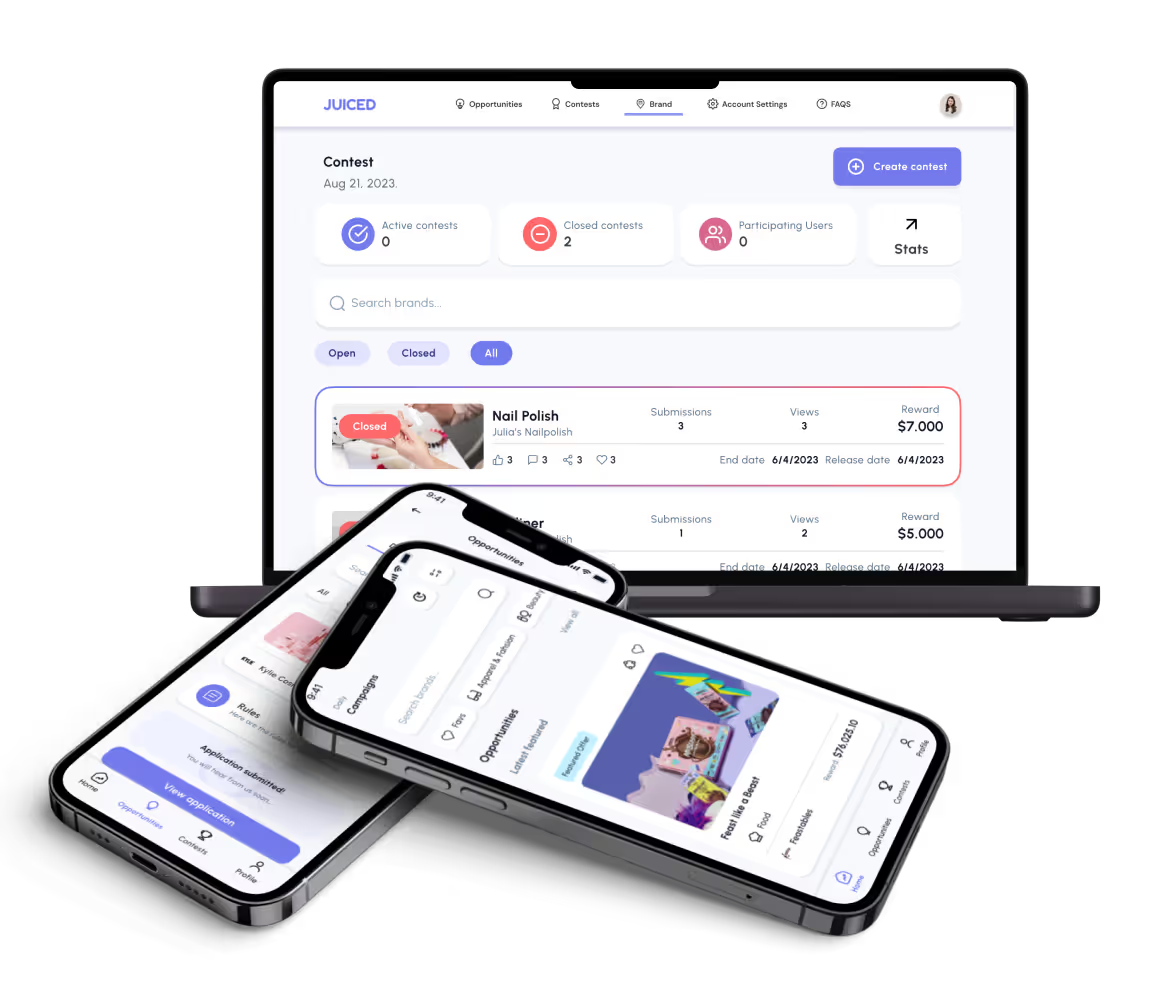
FlutterFlow can build the full P2P payments UX layer: contact-based transfers, QR code payments, split bill requests, wallet management, transaction history, biometric confirmation, and push notifications. All money movement runs through an external payment gateway API.
If your P2P app roadmap includes fraud detection or smart spending insights, exploring AI-powered FlutterFlow app features will show what is achievable within the platform for those additions.
Contact-Based Money Transfer
Users search by phone number or username, enter an amount, add an optional note, and confirm the transfer. The transaction writes to Firestore and triggers a payment gateway API call, keeping the user flow fast and the money movement secure.
QR Code Payment Generation and Scanning
Payment request QR codes generate in FlutterFlow using a QR library. The device camera scans incoming QR codes to pre-fill transfer details, enabling fast in-person P2P payments without manual amount entry.
Split Bill and Group Payment Requests
One user creates a payment request and shares it with contacts. Individual payment status tracks in real time via Firestore document listeners. The requesting user sees who has paid and who has not without chasing manually.
Wallet Balance and Funding Source Management
Users view their in-app balance, add funding sources via card or bank account through Stripe or a regional gateway, and switch between sources. All balance data and funding source management runs through FlutterFlow's UI and backend API calls.
Transaction History with Search and Filter
A paginated transaction feed with search by contact name, filter by date range, and direction filter (sent or received) is achievable using Firestore queries and FlutterFlow's list view components. Transaction detail screens display full metadata for each transfer.
Biometric and OTP Payment Confirmation
Before any transfer executes, FlutterFlow requires biometric authentication (fingerprint or Face ID) or OTP verification. This confirmation step is the most important fraud prevention layer in the entire application.
Push Notifications for Received Payments
Firebase Cloud Messaging delivers instant push notifications when a user receives money. The notification includes sender name and amount, giving the recipient immediate confirmation without opening the app.
These features form a complete P2P payments UX. The transaction security, idempotency logic, and regulatory compliance architecture are what separate a production-ready app from a demo that handles the happy path.
How Long Does It Take to Build a Peer to Peer Payments App with FlutterFlow?
A simple P2P MVP with contact search, send money, and transaction history takes 8-12 weeks with an experienced FlutterFlow developer. A full-featured app with QR payments, bill splitting, wallet funding, and biometric confirmation takes 14-20 weeks.
The phased approach reduces launch risk. Start with domestic user-to-user transfers, validate the payment flow with real users, then add QR payments, group splitting, and international transfers in phase two.
- Simple MVP timeline: Contact transfer, transaction history, and OTP confirmation delivered in 8-12 weeks by a developer with fintech experience.
- Full app timeline: QR payments, bill splitting, wallet funding, and biometric confirmation add 6-8 weeks to the MVP scope.
- Payment gateway certification: Stripe and Paystack both require integration review for live payment flows; factor 1-2 weeks for certification into the timeline.
- Money transmission licensing: Regulatory approval timelines in most jurisdictions run weeks to months and are entirely outside the build timeline.
- Fraud prevention logic: Idempotency checks, duplicate transaction detection, and failed transfer recovery are engineering-intensive and add time to the payment layer.
- FlutterFlow speed advantage: Pre-built UI components, Firebase integration, and visual workflow tools reduce build time by 40-60% compared to writing Flutter from scratch.
What Does a FlutterFlow Peer to Peer Payments App Cost to Build?
FlutterFlow P2P payments app builds run $20,000-$65,000 for developer builds and $25,000-$85,000 for agency builds with compliance awareness and fraud architecture included. Custom equivalents typically cost $100,000-$300,000.
Alongside the FlutterFlow plan pricing breakdown, budget for payment gateway fees and regulatory compliance costs. For P2P apps, they often exceed platform costs.
- Platform cost: $0-$70/month depending on plan; most production P2P apps need Pro or Teams plan for custom domains and team collaboration.
- Developer cost: FlutterFlow developers charge $50-$150/hour; a full P2P payments build costs $20,000-$65,000 depending on feature scope and gateway integration.
- Agency cost: Agency builds with compliance awareness and fraud prevention architecture run $25,000-$85,000 for a full-featured P2P application.
- Ongoing transaction costs: Payment gateway transaction fees (Stripe: 2.9% + $0.30 per transaction), Firebase hosting, SMS and OTP provider fees, and app store annual fees.
- Hidden compliance costs: Money transmission license legal costs ($5,000-$50,000+ depending on jurisdiction), AML compliance programme setup, and ongoing fraud monitoring service subscription.
How Does FlutterFlow Compare to Custom Development for Peer to Peer Payments Apps?
FlutterFlow delivers a P2P payments app in 8-20 weeks at $20,000-$85,000. Custom development takes 9-18 months at $100,000-$350,000+. The tradeoff is real-time fraud scoring capability and proprietary transaction routing, not the core transfer or history functionality.
For startup P2P apps, community payment platforms, and MVP validation before a funding round, FlutterFlow's speed and cost advantage is significant. For high-volume platforms requiring real-time settlement engines and proprietary fraud detection, custom development becomes relevant.
- Speed advantage is real: FlutterFlow delivers the transfer UX, transaction history, and notification layer at 40-60% of the time required for an equivalent custom Flutter build.
- Cost advantage is substantial: A FlutterFlow build costs 25-35% of an equivalent custom development project for the same user-facing feature set.
- Real-time fraud scoring is beyond FlutterFlow natively: Proprietary risk engines, real-time transaction scoring, and deep bank API integration for instant settlement require custom development or third-party integration.
- Maintenance is easier: FlutterFlow apps allow UI and workflow changes without full developer dependency; custom code requires ongoing developer availability for every update.
- When FlutterFlow wins: Startup P2P apps targeting a defined market, community payment apps, and MVP validation before a funding round.
- When custom wins: High-volume platforms requiring real-time settlement infrastructure, proprietary fraud detection engines, or cross-border payment routing systems.
If you are evaluating web-first alternatives alongside FlutterFlow, a Bubble versus FlutterFlow comparison will clarify which platform is better suited to a mobile-native P2P product.
What Are the Limitations of FlutterFlow for Peer to Peer Payments Apps?
FlutterFlow has specific gaps for P2P payments: no native fraud detection, no money transmission licensing, Firestore idempotency limits at high transaction frequency, and vendor dependency risk for financial-critical systems. These require architecture decisions before the first screen is built.
Before any P2P payment app goes live, a thorough review of FlutterFlow security for P2P transfers is essential. Fraud risk is highest in the peer transfer flow itself.
- Money transmission licensing: Most jurisdictions require a money transmission license for apps holding or moving user funds; this obligation falls entirely on the product owner, not the development platform.
- No native fraud detection: Real-time fraud scoring requires third-party services such as Sift or Sardine integrated via API; FlutterFlow cannot perform fraud analysis natively.
- Transaction idempotency at scale: High-frequency P2P transactions require careful Firestore transaction handling and idempotency logic to prevent double-sends in the event of network failure or retry.
- Complex business logic maintenance: Intricate transfer rules, conditional fee structures, and multi-step compliance checks are harder to maintain in FlutterFlow's visual environment than in code.
- Vendor dependency risk: FlutterFlow controls the deployment pipeline; for a financial-critical system, evaluating the code export option before committing is essential for long-term ownership.
- AML compliance requirements: Anti-money laundering obligations including transaction monitoring, suspicious activity reporting, and customer due diligence must be engineered and maintained separately.
These limitations are manageable with the right payment gateway, fraud tooling, and compliance programme in place before the build starts. They become expensive problems when they are discovered during testing.
How Do You Hire the Right Team to Build a FlutterFlow Peer to Peer Payments App?
The right team for a P2P payments build combines fintech domain knowledge, FlutterFlow platform expertise, proven payment gateway integration experience, and a clear approach to fraud prevention and transaction idempotency. Platform skills alone are not sufficient.
Knowing how to hire FlutterFlow developers fast with genuine P2P payment experience is harder than it looks. Most developers have built e-commerce checkout flows, not real-money transfer architectures.
- Fintech domain knowledge is non-negotiable: A developer who understands transfer idempotency, failed transaction recovery, and fraud risk delivers reliably; one learning these concepts on your project creates financial risk.
- Freelancer vs agency: Freelancers suit smaller scopes with defined payment flows; agencies provide project management, compliance awareness, and post-launch fraud monitoring support.
- Red flags when hiring: No portfolio of payment or financial apps, no demonstrated understanding of transaction idempotency, and no mention of fraud risk or AML obligations.
- Key question to ask: "Show me a FlutterFlow app you built with real-money payment flows and explain how you handled failed transaction recovery."
- Expected timeline from a good agency: Scoping and proposal in week one, architecture review in week two, then staged build delivery through to launch with compliance sign-off.
A team that treats transaction security and idempotency as architecture inputs from day one, rather than QA concerns at the end, is the distinction that determines whether your app is production-ready.
Conclusion
FlutterFlow is a viable platform for P2P payment apps. The speed advantage is real, the cost difference versus custom development is significant, and the core UX layer is entirely achievable within the platform's capabilities.
The constraint is compliance, fraud prevention, and payment gateway architecture. These decisions must be made before the first screen is designed, not after the app is built and payment gateway review begins.
Clarify your jurisdiction's money transmission requirements, select your payment gateway, and engage a FlutterFlow team with a verifiable fintech portfolio before starting design. That sequence is the difference between shipping in 14 weeks and rebuilding at week 12.
Building a Peer to Peer Payments App with FlutterFlow? Here Is How LowCode Agency Approaches It.
Most P2P payments builds hit their most expensive problems after the core screens are built: failed transaction recovery is not handled, idempotency logic is missing, and the payment gateway rejects the integration for security gaps. These are planning failures, not development failures.
At LowCode Agency, we are a strategic product team, not a dev shop. We scope, architect, and build P2P payments apps in FlutterFlow with fraud prevention architecture, payment gateway integration strategy, and transaction security designed into the foundation before any screen is built.
- Payment gateway selection: We evaluate Stripe Connect, Paystack, and Flutterwave against your jurisdiction requirements, user volume, and fee structure before the build begins.
- Transaction security architecture: We design biometric confirmation, OTP verification, and secure API call patterns for every transfer flow before the first screen is built.
- Idempotency and recovery logic: We engineer duplicate transaction prevention and failed transfer recovery so network failures do not result in double charges or unresolved payment states.
- Fraud prevention integration: We integrate third-party fraud scoring services where transaction volume and risk profile require real-time monitoring beyond gateway-level checks.
- Compliance planning: We map your jurisdiction's money transmission and AML requirements and identify the regulatory steps that must run in parallel with the build.
- Phased delivery: We launch domestic transfers first, validate with real users, then add QR payments, bill splitting, and international transfers in a structured second phase.
- Full product team: Strategy, design, development, and QA from a single team with fintech experience and no handoff gaps between disciplines.
We have built 350+ products for clients including Coca-Cola, American Express, and Sotheby's. We know where fintech builds fail and we address those failure points before they surface in production.
If you are serious about building a P2P payments app that works in the real world, let's scope it together.
Last updated on
May 13, 2026
.

Jesus is a visionary entrepreneur and tech expert. After nearly a decade working in web development, he founded LowCode Agency to help businesses optimize their operations through custom software solutions.


FAQs
What are the key features needed for a peer-to-peer payments app?
How does FlutterFlow simplify building payment apps?
What security measures should be implemented in a payments app?
Can I integrate popular payment gateways in FlutterFlow?
How do I test the peer-to-peer payment functionality before launch?
What are common challenges when building a payments app with FlutterFlow?
Related Articles
Comparison
FlutterFlow
FlutterFlow vs WeWeb | 10 Factors Compared (2026)
FlutterFlow vs WeWeb compared across 10 key factors including scalability, pricing, backend, and flexibility. See which no-code builder fits your 2026 app goals.

FlutterFlow
How to Build a Law Firm CRM Platform with FlutterFlow
Learn how to create a custom law firm CRM platform using FlutterFlow with step-by-step guidance and best practices.
Comparison
FlutterFlow
FlutterFlow vs OutSystems | 10 Factors Compared (2026)
Compare FlutterFlow vs OutSystems across 10 key factors including enterprise scalability, customization, backend architecture, pricing, and long-term flexibility in 2026.

FlutterFlow
How to Build a Budget Planning App with FlutterFlow
Learn how to create a budget planning app using FlutterFlow with step-by-step guidance and best practices for beginners.

Why customers trust us for no-code development


