

How to Build Onboarding and SOP Apps with FlutterFlow
12 min
read
Learn how to create onboarding and SOP apps using FlutterFlow with step-by-step guidance and best practices for smooth app development.

Most businesses onboard new staff with printed handbooks and verbal walkthroughs. FlutterFlow onboarding and SOP apps replace that with a structured, trackable, mobile-first process that works the same way every time.
This guide covers what FlutterFlow can build, what it costs, how long it takes, and the limitations that matter most, particularly around e-signatures, version control, and offline access.
Key Takeaways
- Structured workflows supported: Step-by-step task checklists, document delivery, video embeds, and acknowledgement sign-offs all work within FlutterFlow.
- E-signature is not native: DocuSign, HelloSign, or Adobe Sign APIs are required for legally binding document sign-off.
- Version control needs planning: Managing SOP versions and ensuring staff see current content requires a deliberate Firestore data structure.
- Offline access matters: Field workers in warehouses or construction sites need onboarding content available without internet.
- Build time is 6–12 weeks: A full onboarding and SOP platform with video modules, quizzes, and manager dashboards takes 8–14 weeks.

What Can FlutterFlow Build for Onboarding and SOP Apps?
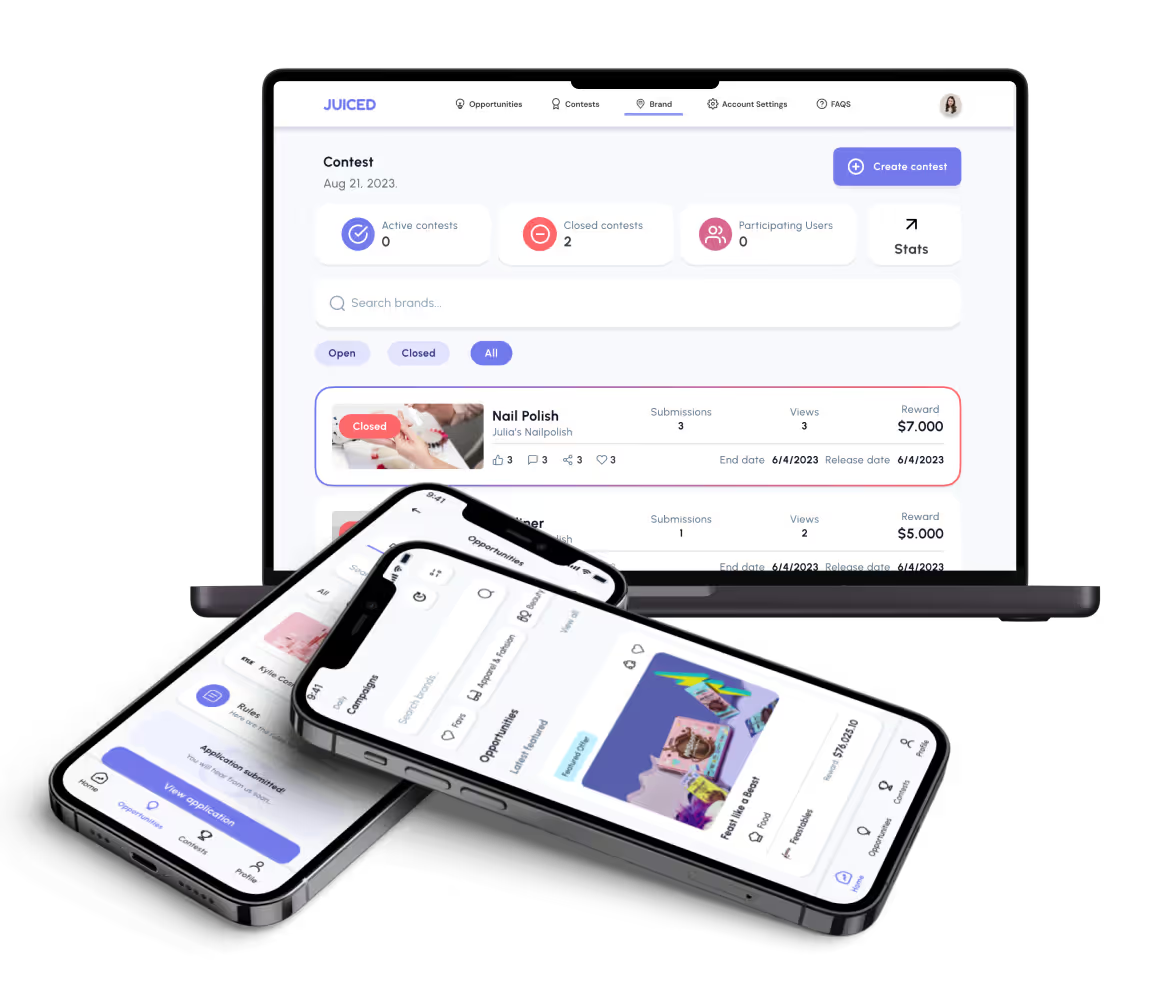
FlutterFlow can deliver structured onboarding journeys, document libraries, video training modules, knowledge quizzes, role-based content, and manager progress dashboards. It handles the full onboarding workflow for most small-to-mid-sized operations teams.
Following FlutterFlow operations app examples from HR and field service contexts shows how these workflows translate into production mobile applications.
Step-by-Step Onboarding Task Checklists
Build structured onboarding journeys where new employees complete tasks in sequence, with progress tracked per user in Firestore.
- Sequential task design: Employees complete reading, video, and quiz tasks in order before advancing to the next onboarding stage.
- Per-user progress tracking: Firestore stores completion status per employee, so managers see exactly where each person is in the workflow.
- Conditional task unlocking: Later tasks only unlock when prior steps are confirmed complete, preventing skipped content.
Document and Resource Library
Store and display policy documents, SOPs, and reference guides from Firebase Storage, searchable by category and role.
- Role-filtered content: Documents display based on the employee's department, location, or role assigned in Firebase Auth.
- Always-current version delivery: The library serves the approved version field from Firestore, not a static file link that can become outdated.
- Category and keyword search: Employees find specific SOPs without scrolling through an unorganised document list.
Video-Embedded Training Modules
Embed instructional videos from YouTube, Vimeo, or Firebase Storage within training screens, with completion tracking on playback.
- Completion tracking on playback: The app records video progress and only marks a module complete once the employee reaches the required threshold.
- Multi-source video support: Videos can pull from YouTube, Vimeo, or Firebase Storage depending on your content hosting preference.
- Module-level progress integration: Video completion feeds into the overall onboarding checklist, keeping all progress data in one Firestore record.
Knowledge Check Quizzes
Insert multiple-choice quizzes at key onboarding stages to verify comprehension before the employee advances.
- Comprehension gates: Employees must pass a quiz before the next module unlocks, ensuring content was absorbed, not just clicked through.
- Score tracking in Firestore: Quiz results store per employee per module, giving HR a record of knowledge verification for compliance purposes.
- Retry logic: Configurable retry limits and feedback messaging guide employees to correct answers without exposing the full answer set.
Digital Acknowledgement and Sign-Off
Capture employee acknowledgement of policies with timestamped in-app confirmations, or route legally required signatures through an integrated e-signature API.
- Timestamped in-app acknowledgement: The app records when each employee confirmed reading a policy, stored as a Firestore document with user ID and timestamp.
- E-signature API integration: For legally binding sign-off, DocuSign, HelloSign, or Adobe Sign connects via API within the FlutterFlow app.
- Compliance record storage: All acknowledgements and signed documents link back to the employee record for audit access by HR.
Role-Based Content Assignment
Assign different onboarding tracks and SOP libraries by department, role, or location using Firebase Auth roles and Firestore data conditions.
- Multi-track onboarding support: A warehouse employee sees a different onboarding sequence from an office administrator, all managed within a single app build.
- Location-based content: Franchise or multi-site operations can serve location-specific SOPs without building separate apps per site.
- Dynamic content rules: Adding a new role or department requires a Firestore update, not a new app deployment.
Progress Reporting for Managers
Give HR and operations managers a dashboard showing which employees have completed which onboarding steps, with outstanding tasks highlighted.
- Team-wide progress view: Managers see every employee's onboarding status in a single dashboard, filtered by team or location.
- Outstanding task alerts: Employees with stalled or overdue onboarding steps surface automatically, reducing manual chase-up.
- Completion rate reporting: Aggregate completion data feeds into HR reporting for audit trail and compliance documentation.
Seeing these features in context is useful before scoping your own build.
How Long Does It Take to Build a FlutterFlow Onboarding and SOP App?
A simple MVP with task checklists, a document library, and basic progress tracking takes 4–7 weeks. A full-featured platform with video modules, quizzes, e-signature integration, a manager dashboard, and role-based content takes 8–14 weeks.
FlutterFlow is 45–60% faster to build with than a bespoke LMS or custom onboarding system.
- Phased delivery recommended: Launch task checklists and documents first, then add video modules and quizzes in a second phase.
- E-signature adds time: DocuSign or Adobe Sign API integration adds 1–2 weeks depending on legal workflow complexity.
- Offline caching extends timelines: Implementing Firestore offline persistence for field workers adds 1–2 weeks of deliberate testing.
- Content volume at launch matters: Large document libraries require structured data entry time beyond development hours.
A phased approach is almost always faster than trying to build every feature in one go.
What Does It Cost to Build a FlutterFlow Onboarding and SOP App?
Costs range from $12,000–$65,000 depending on feature scope. A freelancer-built single-department app sits at the lower end. An agency-built multi-role onboarding platform with e-signature and manager dashboards sits at the higher end.
FlutterFlow plan pricing options determine which features are available at each tier, which matters for an onboarding app that needs Firebase Storage and custom API integrations.
- Firebase Storage costs scale: Document and video storage costs grow with content volume and are often underestimated in initial budgets.
- E-signature fees are ongoing: DocuSign charges per signed envelope, so high employee turnover increases per-month costs noticeably.
- Off-the-shelf LMS comparison: TalentLMS and Trainual charge per seat. A custom FlutterFlow app avoids per-seat fees at scale.
- Hidden cost: content versioning pipeline: Building a proper version control system for SOPs is often scoped out and added back as a change request.
Clarify e-signature volume and Firebase Storage estimates before finalising a budget with any developer.
How Does FlutterFlow Compare to Custom Development for Onboarding and SOP Apps?
FlutterFlow delivers an onboarding MVP in 4–7 weeks versus 4–8 months for a fully custom build. It costs 40–60% less at the build stage. The trade-off is capability ceiling: SCORM compliance, adaptive learning paths, and full HRIS integration favour custom development.
FlutterFlow wins for SMEs, franchises, retail and hospitality chains, and field service businesses with clearly defined onboarding workflows.
- Maintenance advantage: FlutterFlow allows HR and operations teams to update SOP content and add modules without developer involvement after launch.
- Custom wins for enterprise: Large organisations requiring Workday or BambooHR integration, SCORM compliance, or adaptive learning algorithms need a custom build.
- FlutterFlow wins for most operators: Franchises, field service businesses, and growing SMEs get a production-ready onboarding app much faster.
Understanding FlutterFlow operations platform trade-offs helps HR leaders decide when FlutterFlow fits and when enterprise LMS tooling is needed.
What Are the Limitations of FlutterFlow for Onboarding and SOP Apps?
The most important limitations are e-signature (not native), version control (requires deliberate design), offline access (must be explicitly enabled), and SCORM compliance (not supported). These are solvable with the right developer, but not solvable by accident.
Applying FlutterFlow SOP app best practices to document versioning and offline caching prevents the content inconsistency issues that make SOP apps unreliable in the field.
- E-signature is not a checkbox: FlutterFlow's acknowledgement tick-box is not a legally binding e-signature. DocuSign, HelloSign, or Adobe Sign API integration is required for compliance-sensitive documents.
- Version control requires explicit design: Firestore does not automatically version documents. An explicit versioning scheme with version number fields and archived document collections must be built into the data model from day one.
- Offline access needs deliberate implementation: Firestore offline persistence must be explicitly enabled and tested. Field workers in warehouses or construction sites will expose this gap immediately if it is skipped.
- SCORM compliance is not achievable: Formal e-learning standards (SCORM, xAPI) are not supported in FlutterFlow without custom code, which limits suitability for formal accreditation programmes.
- HRIS integration requires API work: Connecting to Workday, BambooHR, or SAP HCM for employee roster sync requires API integration outside FlutterFlow's visual builder.
- Code export is available: On paid plans, teams that need full codebase ownership can export the Flutter/Dart code for independent deployment.
The e-signature and version control gaps are the two most likely to cause compliance problems post-launch if not addressed in the initial build scope.
How Do You Get a FlutterFlow Onboarding and SOP App Built?
Knowing how to hire a FlutterFlow developer with operations app experience ensures version control and e-signature requirements are handled correctly rather than overlooked.
The right hire has specific experience with Firebase Storage document management, e-signature API integration, Firestore offline persistence, and role-based content assignment.
- Freelancer vs agency: Freelancers suit a single-department onboarding app. Agencies suit multi-site or franchise onboarding platforms with complex role structures.
- Red flag: checkbox as e-signature: Any developer who treats FlutterFlow's confirmation tick-box as a legal e-signature does not understand compliance requirements.
- Red flag: no version control discussion: Document version control is a data architecture decision, not a UI feature. It must be planned before the database is structured.
- Red flag: no offline strategy: A developer who has not thought about offline access for field workers will discover the gap during user acceptance testing.
- Key question to ask: "How do you ensure employees always see the current version of a SOP?" The answer reveals whether the developer has built this before.
- Key question to ask: "What e-signature solution do you recommend for our legal requirements?" A good developer has a specific recommendation, not a vague answer.
Expect 6–14 weeks end-to-end, including discovery, design, build, and testing with real onboarding content before launch.
Conclusion
FlutterFlow is a strong platform for onboarding and SOP apps. Task checklists, document libraries, video modules, and progress tracking all work well within its visual builder.
The limitations that matter most are e-signature, version control, and offline access. These are not blockers, but they require deliberate technical design that not all developers plan for upfront.
Before starting any build, identify which documents require legally binding signatures and confirm your chosen developer has a specific e-signature integration plan.
Building an Onboarding and SOP App with FlutterFlow? Here Is How LOW/CODE Agency Approaches It.
Most onboarding app builds fail at the compliance layer. The app looks right, but the e-signature is a checkbox, the SOP versions are inconsistent, and field workers discover the offline gap on day one of rollout.
As AI development experts, we at LOW/CODE Agency help SMBs ship real software — web and mobile applications, intelligent chatbots, RAG pipelines, and autonomous AI agents built for businesses that need results, not platforms. We build FlutterFlow onboarding and SOP platforms with the version control, e-signature integration, and offline architecture built in from the start, not added as afterthoughts when compliance flags them.
- Workflow scoping: We map your onboarding tracks, document types, and role structures before writing a single screen or Firestore rule.
- E-signature integration: We specify and integrate the right e-signature API for your legal requirements, not a workaround that creates compliance risk.
- Document version control: We design the Firestore data architecture so employees always see the current SOP version and superseded content is archived correctly.
- Offline access implementation: We enable and test Firestore offline persistence specifically for your field worker use cases before any device leaves the office.
- Role-based content architecture: We build the Firebase Auth and Firestore rules so each role sees only the content relevant to their position and location.
- Manager dashboard and reporting: We deliver the HR oversight layer so managers have real-time visibility into onboarding completion without chasing staff individually.
- Post-launch content updates: We hand over the platform so your HR team can update SOPs, add training modules, and adjust onboarding tracks without developer involvement.
We have built 350+ products for clients including Coca-Cola, American Express, and Sotheby's. We know exactly where onboarding app builds go wrong, and we address those decisions before they become problems.
Related Articles
- How to Build a Spending Analytics Dashboard with FlutterFlow
- How to Build a Spa Appointment App with FlutterFlow
- How to Build an SOP Documentation App with FlutterFlow
- How to Build a Solar Monitoring App with FlutterFlow
- How to Build Social Apps with FlutterFlow
- How to Build a Smart Home Control App with FlutterFlow
Last updated on
September 24, 2026
.

Jesus is a visionary entrepreneur and tech expert. After nearly a decade working in web development, he founded LOW/CODE Agency to help businesses optimize their operations through custom software solutions.


FAQs
What are the first steps to create an onboarding app in FlutterFlow?
How can I integrate SOP content effectively in a FlutterFlow app?
Can FlutterFlow handle user authentication for onboarding apps?
What are common challenges when building SOP apps with FlutterFlow?
How do I test onboarding flows built in FlutterFlow before launch?
Is FlutterFlow suitable for building scalable SOP and onboarding apps?
Related Articles

FlutterFlow
How to Build a Subscription Billing App with FlutterFlow
Learn how to create a subscription billing app using FlutterFlow with step-by-step guidance and best practices for seamless payments.
FlutterFlow
How to Build a Volunteer Scheduling App with FlutterFlow
Learn how to create a volunteer scheduling app using FlutterFlow with step-by-step tips and best practices for easy management.

FlutterFlow
How to Build a Bill Payments App with FlutterFlow
Learn how to create a bill payments app using FlutterFlow with step-by-step guidance and best practices for smooth development.
FlutterFlow
How to Build a KPI Tracking App with FlutterFlow
Learn how to create a KPI tracking app using FlutterFlow with step-by-step guidance and best practices for app performance and data management.


Why customers trust us for no-code development


