

How to Build a Payroll Calculator App with FlutterFlow
11 min
read
Learn how to create a payroll calculator app using FlutterFlow with step-by-step guidance and tips for accuracy and user experience.


A FlutterFlow payroll calculator app is feasible, but the distinction between what FlutterFlow handles natively versus what requires a payroll API is a line most guides skip entirely. FlutterFlow builds the interface and the logic layer. It is not a calculation engine.
Treat it like one and your project will look functional in demos but fail at compliance and scale. This guide draws that line clearly and covers timelines, costs, and honest limitations.
Key Takeaways
- Interface, not engine: FlutterFlow builds payroll data entry, gross pay displays, deduction summaries, and payslip interfaces connected to a payroll API for tax calculations.
- Tax logic lives elsewhere: PAYE, NI, federal and state tax calculations require a payroll API such as Gusto, ADP, or Xero Payroll.
- MVP timeline: A payroll calculator interface takes 5-8 weeks; a full management app with API integration takes 12-20 weeks.
- Cost range: Projects run $18,000-$65,000 depending on payroll API integration depth and pay type complexity.
- Best fit: Companies wanting a custom payroll interface over an existing provider, or internal tools for salary modelling and compensation planning.

What Can FlutterFlow Build for Payroll Calculation?
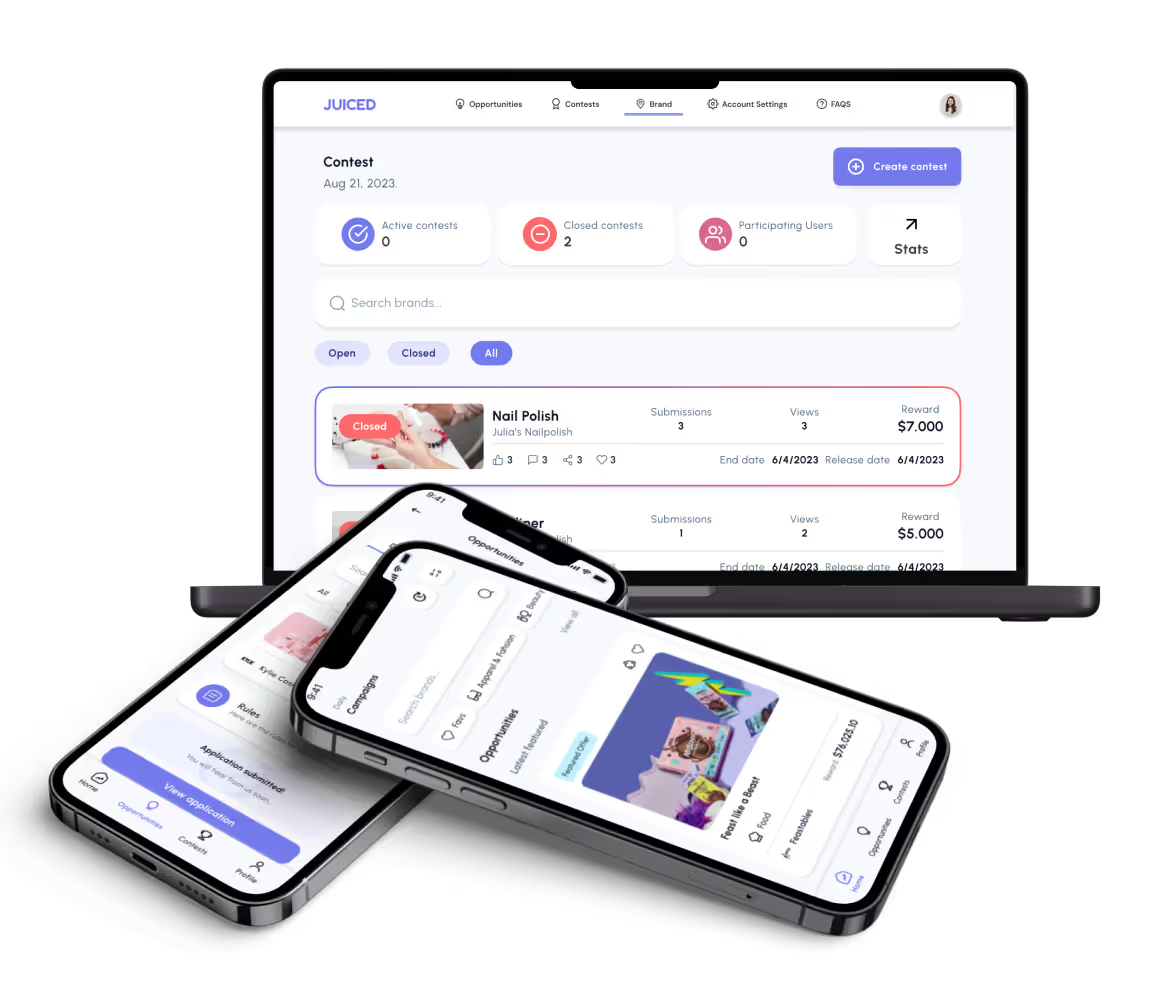
FlutterFlow can build the full payroll interface layer: gross pay inputs, deduction displays, payslip generation, payroll run dashboards, and employee self-service. Tax and compliance calculations must come from a connected payroll API.
Understanding what FlutterFlow can and cannot do natively is the starting point for scoping any payroll app build correctly.
Gross Pay Calculator Interface
Build input forms for hours worked, hourly rate or salary, bonus amounts, and commission figures. Real-time gross pay displays update as inputs change, giving payroll administrators an immediate review view.
Deduction Summary Display
Show structured deduction breakdowns for tax, pension, health insurance, and garnishments pulled from a payroll API or manually configured rule sets. Deduction line items display alongside gross pay on the same screen.
Multi-Pay-Type Support
Handle hourly, salaried, part-time, contractor, and commission-based pay types within a single app. Each pay type renders an appropriate calculation display with correct field sets for that employment category.
Payslip Generation and Distribution
Generate formatted payslip PDFs via a document generation API and distribute them to employees through in-app download or email. Payslip layouts match your company's format requirements without template constraints.
Payroll Run Management Dashboard
Give payroll administrators a dashboard to review all employee pay calculations before submission, flag anomalies, and approve the payroll run. Approval actions trigger the payroll API submission.
Compensation Planning and Modelling Tool
Build scenario modelling screens where HR or finance teams can simulate salary changes, bonus distributions, or headcount additions. Projected cost impact displays immediately as inputs change.
Employee Pay History Access
Provide employees with a self-service screen to view current and historical payslips, year-to-date earnings, and tax deduction summaries without contacting HR for records.
Payroll API Integration Layer
Connect to Gusto, ADP, or Xero Payroll via API to pass employee data, receive calculated payroll outputs, and display results within the FlutterFlow interface. The API handles all statutory compliance logic.
Every feature above depends on the payroll API doing the calculation work. FlutterFlow presents, collects, and displays. The API computes.
How Long Does It Take to Build a Payroll Calculator App with FlutterFlow?
A simple payroll calculator MVP takes 5-8 weeks with an experienced FlutterFlow developer. A full payroll management app with API integration, approval workflows, and payslip generation takes 12-20 weeks.
The phased approach delivers value faster by launching the calculator interface first and adding API integration and approval logic in phase two.
- Simple MVP timeline: Gross pay input, deduction display, and payslip view delivered in 5-8 weeks with a developer experienced in financial interfaces.
- Full app timeline: Multi-pay-type support, payroll API integration, approval workflow, and distribution adds 7-12 weeks to the base scope.
- Payroll API complexity matters: Gusto integration is significantly simpler than ADP Enterprise; confirm your API choice before estimating timeline.
- Jurisdiction count adds time: Each additional tax jurisdiction requires separate logic configuration in the payroll API, not the FlutterFlow layer.
- Phased approach advantage: Launching the calculator interface first lets HR validate workflows before the API integration phase begins, reducing rework.
- FlutterFlow speed advantage: Pre-built form components, Firestore data binding, and visual workflow tools eliminate 2-3 months of custom scaffolding work.
Teams building for growth should confirm that their payroll API supports the jurisdictions and pay types they need before committing to a build approach.
What Does It Cost to Build a FlutterFlow Payroll Calculator App?
FlutterFlow payroll app builds run $18,000-$65,000 for developer builds and $25,000-$80,000 for agency builds with compliance and security review included. This compares to $100,000-$250,000+ for a fully custom equivalent.
Reviewing the FlutterFlow pricing plans breakdown before budgeting helps set the right expectation: the platform cost is modest, but payroll API fees and development are the main cost drivers.
- Platform cost: $0-$70/month depending on plan; production payroll apps require Pro or Teams plan for custom domains and team access.
- Developer cost: FlutterFlow developers charge $50-$150/hour; a full payroll app build costs $18,000-$65,000 depending on API integration depth.
- Agency cost: Agency builds with compliance review and multi-jurisdiction support run $25,000-$80,000 for a full payroll management suite.
- Ongoing API costs: Gusto starts at $40/month plus per-employee fees; ADP uses custom enterprise pricing; these are ongoing operational costs, not one-time build costs.
- Hidden costs to plan for: Multi-jurisdiction tax configuration, payroll data migration, legal review of payslip format compliance, and a security audit for financial data handling.
How Does FlutterFlow Compare to Off-the-Shelf Payroll Software?
FlutterFlow builds a custom payroll interface. Gusto, ADP, and Xero Payroll are complete payroll engines with built-in compliance. These are not substitutes for each other; FlutterFlow is a front-end layer that can sit on top of a payroll API.
The right question is not FlutterFlow versus Gusto. It is whether a custom interface over a payroll API delivers more value than Gusto's native interface for your specific pay structure.
- Speed difference is real: Gusto and Xero Payroll activate the same day; a FlutterFlow interface takes 10-20 weeks to build and test before live payroll use.
- Customisation is the core advantage: A FlutterFlow interface is designed around your exact pay structure and approval logic; Gusto forces you to adapt your process to its fixed pay run workflow.
- Compliance stays with the API: Gusto, ADP, and Xero handle tax table updates and year-end compliance automatically; FlutterFlow requires the underlying API to provide this layer.
- Cost comparison at scale: Gusto at $6/employee/month across 200 employees over 36 months totals $43,200 for calculation only; a FlutterFlow interface on top of a cheaper payroll API can reduce total spend.
- When FlutterFlow wins: Companies needing a custom payroll interface, compensation modelling tools, or a unified HR platform where payroll is one module.
- When off-the-shelf wins: Companies needing a complete, compliant payroll engine with no engineering resources to maintain a custom system.
Review the full FlutterFlow pros and cons before committing. Payroll is one of the more nuanced use cases where the platform's limits matter most.
What Are the Limitations of FlutterFlow for Payroll?
FlutterFlow cannot calculate taxes, generate compliance filings, or handle multi-jurisdiction payroll logic natively. These gaps are architectural, not bugs. They require deliberate planning before the first screen is built.
Financial data handling in payroll apps requires security architecture that FlutterFlow does not configure by default. Review FlutterFlow security and data handling before designing any screen that stores salary figures or banking details.
- No native tax calculation: FlutterFlow cannot calculate PAYE, NI, federal or state taxes, or statutory deductions; all tax logic must come from a connected payroll API.
- No built-in compliance: Year-end P60s, W-2s, EEO filings, and pension auto-enrolment compliance require a payroll API; FlutterFlow cannot generate these natively.
- Financial data security complexity: Storing salary and bank account data requires encryption, role-based access control, and audit logging that must be deliberately engineered into the architecture.
- Multi-jurisdiction payroll limits: Running payroll across multiple countries or US states requires jurisdiction-specific logic that FlutterFlow's visual builder cannot model without significant custom Dart code.
- Audit trail requirements: Financial audit trails require immutable record architecture; standard FlutterFlow database setups are not audit-trail-ready by default and need deliberate configuration.
- Vendor dependency risk: A FlutterFlow platform change could affect a payroll interface; for a financial-critical system, code export and Flutter maintenance are essential risk mitigations.
These limitations are manageable with the right architecture decisions upfront. They become expensive problems when discovered after the build has started.
How Do You Get a FlutterFlow Payroll App Built?
The right team for a payroll app build combines payroll domain knowledge, FlutterFlow platform expertise, experience with payroll API integrations, and financial data security practice. Generalist FlutterFlow developers are not sufficient for this use case.
For a financial-critical app like payroll, top FlutterFlow development agencies with compliance and security experience are worth the investment over generalist freelancers.
- Domain knowledge is non-negotiable: A developer who understands payroll workflows, deduction structures, and audit requirements delivers reliably; one who learns on the job creates compliance risk.
- Freelancer vs agency: Payroll apps handle sensitive financial data and compliance requirements; agencies with security and compliance experience are strongly preferred over freelancers for this use case.
- Red flags when hiring: No prior payroll API integration experience, vague approach to financial data security, unfamiliarity with audit trail requirements.
- Questions to ask: "Which payroll APIs have you integrated with FlutterFlow before?" and "How do you approach financial data encryption and role-based access for salary data?"
- Expected timeline from a good team: 14-20 weeks for a full payroll management interface with API integration, approval workflows, and payslip generation.
A team that treats financial data security as an architecture input, not a final checkbox, is the distinction that determines whether a payroll app ships production-ready.
Conclusion
FlutterFlow is a capable platform for building a payroll calculator interface and payroll management app. The constraint is scope: it works when correctly positioned as a front-end layer connected to a payroll API, not as the calculation engine itself.
Get that scope wrong and the result looks functional but fails at compliance and scale. Get it right and you deliver a custom payroll interface at a fraction of the cost of a full custom build.
Before briefing any developer, confirm which payroll API will handle the calculation backbone. Define exactly which tax and compliance calculations live in the API versus the FlutterFlow interface. That single decision determines the entire architecture.
Building a Custom FlutterFlow Payroll Calculator App? Here Is How LOW/CODE Agency Approaches It.
Most payroll app projects go wrong before a screen is designed. The scope is set without a clear API strategy, financial data security is treated as an afterthought, and the team discovers compliance gaps during testing rather than planning.
As AI development experts, we at LOW/CODE Agency help SMBs ship real software — web and mobile applications, intelligent chatbots, RAG pipelines, and autonomous AI agents built for businesses that need results, not platforms. We scope, architect, and build custom payroll interfaces in FlutterFlow with the payroll API integration, financial data security, and compliance architecture designed into the foundation from day one.
- Payroll API selection: We evaluate Gusto, ADP, and Xero Payroll against your pay type requirements, jurisdiction scope, and API access constraints before any build begins.
- Financial data security design: We configure encryption at rest, role-based access control, and audit logging for every screen that handles salary, banking, or personal financial data.
- Interface architecture: We design the FlutterFlow layer to display, collect, and route payroll data without attempting native tax calculations the platform cannot support.
- Phased delivery: We sequence the calculator interface first, validate it with your HR team, then integrate the payroll API and approval workflows in phase two.
- Multi-jurisdiction planning: We map jurisdiction requirements to your payroll API's compliance support before build, preventing late-stage scope expansions.
- Audit trail configuration: We engineer immutable record structures for payroll data that satisfy financial audit requirements, not just standard database defaults.
- Full product team: Strategy, design, development, and QA from a single team with financial app experience and no handoff gaps between disciplines.
We have built 350+ products for clients including Coca-Cola, American Express, and Sotheby's. We apply the same structured approach to every financial app build, from initial API selection through compliance sign-off.
Related Articles
- How to Build Personal Finance Apps with FlutterFlow
- How to Build a Performance Review System with FlutterFlow
- How to Build a Peer-to-Peer Marketplace with FlutterFlow
- How to Build a Patient Portal with FlutterFlow
- How to Build a Partner CRM Platform with FlutterFlow
- How to Build a Peer-to-Peer Payments App with FlutterFlow
Last updated on
September 24, 2026
.

Jesus is a visionary entrepreneur and tech expert. After nearly a decade working in web development, he founded LOW/CODE Agency to help businesses optimize their operations through custom software solutions.


FAQs
What are the basic steps to create a payroll calculator app in FlutterFlow?
Can FlutterFlow handle complex payroll calculations like tax deductions?
How do I ensure the payroll calculator app is user-friendly in FlutterFlow?
Is it possible to export payroll data from a FlutterFlow app?
What are common challenges when building a payroll calculator app with FlutterFlow?
How can I update payroll rates and tax rules in the FlutterFlow app?
Related Articles
FlutterFlow
How to Build a Savings Tracker App with FlutterFlow
Learn how to create a savings tracker app using FlutterFlow with step-by-step guidance and tips for beginners.

FlutterFlow
How to Build a Healthcare App with FlutterFlow
Learn step-by-step how to create a healthcare app using FlutterFlow with no coding required. Start building your app today.

FlutterFlow
How to Build a Warehouse Management System with FlutterFlow
Learn how to create a warehouse management system using FlutterFlow with step-by-step guidance and best practices.
FlutterFlow
How to Build a Job Marketplace App with FlutterFlow
Learn how to create a job marketplace app using FlutterFlow with step-by-step guidance and tips for a smooth development process.

Why customers trust us for no-code development


