

How to Build a Bookkeeping Platform with FlutterFlow
12 min
read
Learn how to create a bookkeeping platform using FlutterFlow with step-by-step guidance and best practices for efficient app development.


Bookkeeping firms managing dozens of client accounts spend significant time switching between generic tools, chasing client documents, and assembling reports manually. A FlutterFlow bookkeeping platform can eliminate most of that overhead, replacing fragmented email chains and shared drives with a structured client portal.
The scope matters. FlutterFlow builds the workflow, portal, and communication layer. The accounting engine, bank reconciliation, and tax calculations must live in Xero, QuickBooks, or an equivalent backend. This guide covers what FlutterFlow can build and where it stops.
Key Takeaways
- Platform scope is workflow and portal: A FlutterFlow bookkeeping platform suits client portals, document collection, transaction review interfaces, and reporting dashboards, not double-entry bookkeeping engines.
- Accounting backend is required: The general ledger, bank feeds, and tax calculations must live in Xero or QuickBooks; FlutterFlow surfaces and manages workflow around them.
- Bank API integration is achievable: Plaid and TrueLayer connect via REST API, enabling transaction feed display and basic categorisation support within a FlutterFlow interface.
- Build cost is accessible: A bookkeeping platform typically costs $20,000–$65,000 depending on client count, feature scope, and integration complexity.
- Audit trail must be engineered deliberately: Bookkeeping platforms require immutable audit trails for all data changes; this must be built into the backend, not assumed from FlutterFlow defaults.

What Can FlutterFlow Build for a Bookkeeping Platform?
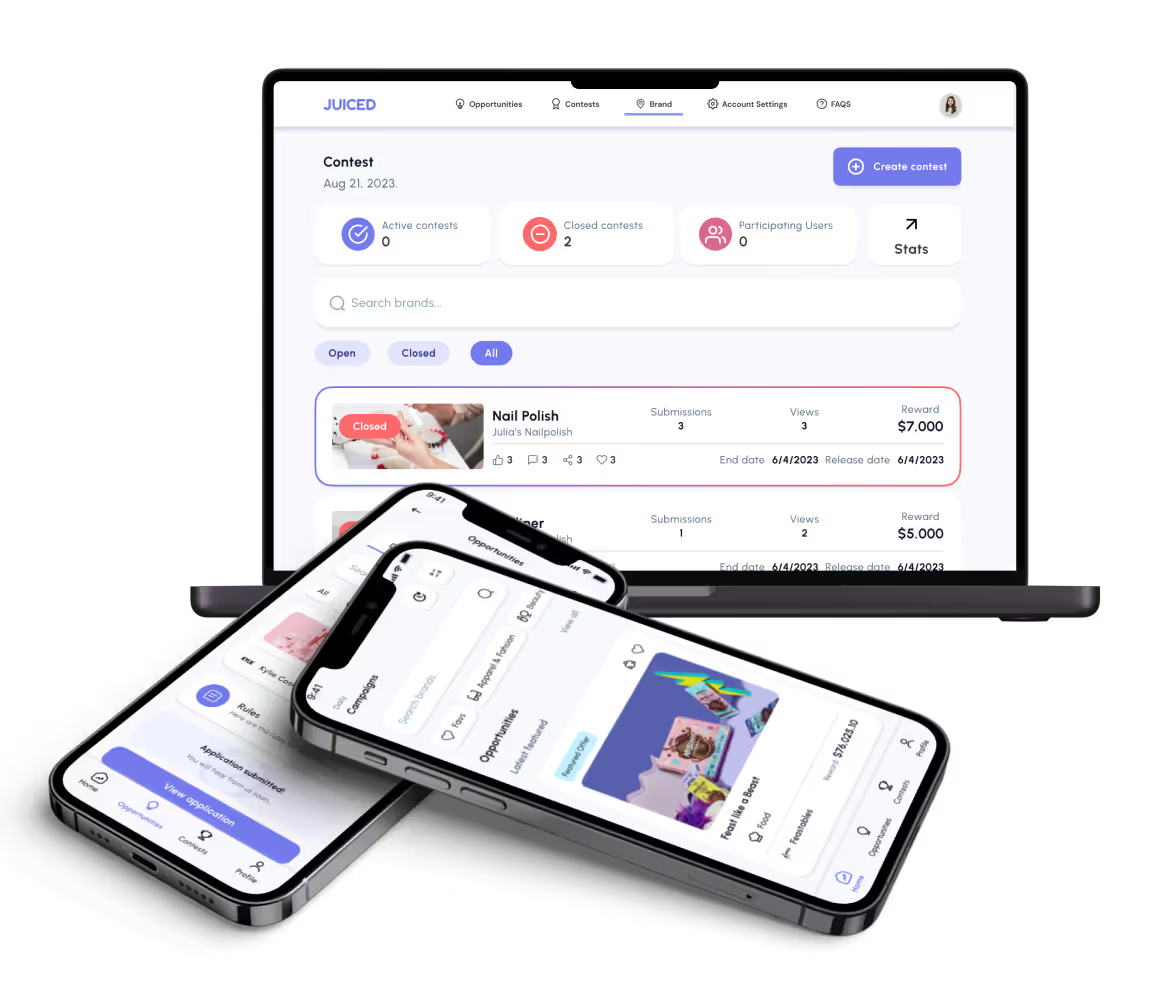
FlutterFlow can build client account dashboards, document request and upload flows, transaction review and categorisation interfaces, approval and sign-off workflows, report delivery portals, task and deadline management, and bookkeeper-client messaging. Each feature is achievable using Firebase, accounting APIs, and FlutterFlow's visual builder.
Applying FlutterFlow platform best practices, particularly around multi-tenant data isolation and role-based access, is critical when a bookkeeping platform manages sensitive financial data for multiple client businesses.
Client Account Dashboard
A portfolio view of all managed client accounts displays at-a-glance status indicators for outstanding tasks, document requests, and reporting deadlines. Bookkeepers see their full client workload from a single screen.
Client Document Request and Upload
Structured document requests are sent to clients through the app. Clients upload bank statements, receipts, and payroll records through a guided upload flow, replacing unstructured email document collection.
Transaction Review and Categorisation Interface
Bank transactions from a Plaid or accounting API feed are displayed for bookkeeper review. Transactions are categorised, flagged, and routed for client confirmation through the FlutterFlow interface without leaving the app.
Client Approval and Sign-Off Workflows
Completed period-end summaries, VAT returns, or management accounts are routed to clients for digital review and approval before finalisation. Sign-off status is tracked per document and per client in Firestore.
Financial Report Delivery Portal
Monthly management accounts, P&L reports, and balance sheets are delivered to clients within the app. A read-confirmation tracking feature shows bookkeepers which clients have reviewed each report.
Task and Deadline Management
Bookkeeping workload is managed across clients with task assignment, deadline tracking, and completion status. Upcoming deadlines for bank reconciliation, VAT filing, and payroll submission are visible at a glance.
Bookkeeper-Client Messaging
A structured in-app communication channel handles queries, document clarifications, and approval discussions between bookkeepers and clients. This replaces ad hoc email chains with a traceable, searchable message history.
How Long Does It Take to Build a Bookkeeping Platform with FlutterFlow?
A simple bookkeeping platform MVP with client portal, document upload, and report delivery takes 5–8 weeks. A full platform with document workflows, transaction review, approval flows, task management, and messaging takes 14–24 weeks. Phasing the build reduces time to first client onboarding significantly.
The timeline is driven primarily by the number of accounting API integrations and the complexity of your multi-tenant client data architecture.
- Phase one: document collection and report delivery: Launching client portal access, document upload, and report delivery for one test client within four to five weeks validates the core workflow before adding complexity.
- Phase two: transaction review and approvals: Adding transaction categorisation and sign-off workflows in a second phase avoids the most common scope-creep failure in bookkeeping portal builds.
- Multi-tenant architecture adds design time: A platform serving multiple client businesses requires deliberate Firestore data architecture before any screen is built; allocate one to two weeks for data modelling.
- FlutterFlow ships two to three times faster: Equivalent custom-built accounting service portals take 12–24 months; FlutterFlow delivers the same workflow and portal layer in a fraction of that time.
Teams that attempt full feature delivery in a single phase consistently miss their target dates. A working client portal for one client in week five is more valuable than a delayed full platform in week thirty.
What Does It Cost to Build a FlutterFlow Bookkeeping Platform?
A FlutterFlow bookkeeping platform costs $15,000–$55,000 for a developer build and $25,000–$75,000 with an agency for a complete platform with accounting API integration and client portal. Practice management tools like Karbon or TaxDome cost $50–$150 per user per month; custom-built alternatives start at $150,000.
The FlutterFlow pricing breakdown is straightforward, but a bookkeeping platform's total cost must include backend accounting APIs, document storage, and the multi-tenant architecture that separates client data securely.
- Accounting API subscriptions are ongoing costs: Xero and QuickBooks developer API tiers carry monthly fees that scale with client account volume and must be factored into operating costs.
- Multi-tenant architecture adds upfront engineering cost: Designing Firebase security rules that keep each client's financial data invisible to other clients requires dedicated architecture time before building.
- GDPR and data residency compliance adds cost: Client financial records may carry data residency requirements; legal review and Firebase regional configuration add to the platform cost.
The comparison to practice management SaaS is most useful for firms needing significant workflow customisation beyond what Karbon or TaxDome offer out of the box. At that point, a custom FlutterFlow platform is competitive.
How Does FlutterFlow Compare to Custom Development or Enterprise Software for Bookkeeping Platforms?
FlutterFlow delivers a bookkeeping platform in 10–24 weeks at $25,000–$75,000, compared to 12–24 months and $150,000+ for custom development. Practice management SaaS configures in one to four weeks but lacks the deep workflow customisation a branded client portal requires.
The decision between FlutterFlow and enterprise practice management software is a workflow customisation question, not a cost question.
- FlutterFlow wins for custom-branded client portals: Firms wanting a portal that goes beyond what TaxDome or Karbon offer out of the box get to market at competitive cost with FlutterFlow.
- Custom development wins for large firms: Large accounting firms needing deep ERP integration, automated tax compliance workflows, or multi-jurisdiction statutory reporting need custom infrastructure.
- Practice management SaaS wins for standard workflows: Firms with standard bookkeeping workflows and no differentiation requirements are better served by configuring an existing platform than building a custom one.
A clear understanding of FlutterFlow advantages and limits helps bookkeeping firms decide whether a custom portal adds enough differentiation over configuring an existing practice management platform.
What Are the Limitations of FlutterFlow for a Bookkeeping Platform?
FlutterFlow cannot maintain double-entry ledgers, post journal entries, perform automated bank reconciliation, or submit directly to tax authorities. These functions must live in Xero, QuickBooks, or equivalent specialist software. FlutterFlow wraps and supports accounting tools but cannot replace the core bookkeeping function.
FlutterFlow security for accounting platforms demands that multi-tenant data isolation and immutable audit logging are designed before a single screen is built.
- Not a bookkeeping engine: FlutterFlow cannot maintain double-entry ledgers, post journal entries, or calculate tax. These functions must live in Xero, QuickBooks, or equivalent dedicated software.
- Automated reconciliation requires custom backend logic: Matching bank transactions to invoices and journal entries algorithmically requires backend logic that FlutterFlow's visual editor cannot manage natively.
- Tax authority submission requires specialist software: Making Tax Digital, HMRC, IRS, or other direct tax authority integrations require certified specialist software, not FlutterFlow custom API actions.
- Audit trail integrity needs deliberate engineering: Standard FlutterFlow data updates allow modification without logging; bookkeeping audit trails must be immutable and tamper-evident, requiring custom Firestore write rules.
- Client data isolation is your responsibility: In a multi-tenant platform, strict Firebase security rules must ensure each client's financial data is invisible to other clients and only accessible to their assigned bookkeeper.
- GDPR and financial data residency add compliance complexity: Client financial records may have data residency requirements that Firebase's default multi-region deployment does not satisfy without explicit regional configuration.
The most common catastrophic failure in bookkeeping platform builds is data leakage between client accounts. A Firestore security rule error that exposes one client's financials to another is a business-ending event. Design the data isolation architecture before any development begins.
How Do You Get a FlutterFlow Bookkeeping Platform Built?
Engaging top FlutterFlow development agencies with financial services experience gives a bookkeeping platform project the security architecture and accounting integration depth it requires. Multi-tenant data isolation, accounting API integration, and audit trail design are specialist capabilities, not standard FlutterFlow skills.
Freelancers handle focused client portals. Agencies are better for full bookkeeping platforms with accounting integrations, document workflows, and the security architecture that multi-tenant financial data requires.
- Multi-tenant Firebase architecture is the core skill: Ask specifically how the team has implemented data isolation between multiple client businesses in a previous FlutterFlow project.
- Accounting API experience is essential: Teams with Xero and QuickBooks API integration experience understand data model implications for bookkeeping workflows that general API experience does not prepare them for.
- Audit trail design is a diagnostic question: Ask "How would you design an immutable audit trail in a FlutterFlow-backed system?" A team that cannot answer this question is not ready for this project.
- Red flags to watch for: No experience with multi-tenant data isolation, unfamiliarity with accounting APIs, and no questions about audit trail requirements or client data separation are all disqualifying signals.
- Expect a four-to-five week first milestone: A working client portal with document upload and report delivery for one test client in four to five weeks is a reasonable first deliverable from a competent team.
A team that asks about your client onboarding process, document types, and approval workflows before scoping the project is demonstrating the domain understanding bookkeeping platforms require.
Conclusion
FlutterFlow is a viable platform for building the workflow, portal, and communication layer of a bookkeeping platform. Client document collection, transaction review, approval workflows, and report delivery are all achievable at a fraction of custom development cost.
Map your current client document collection and approval process, identify the three biggest workflow inefficiencies, and scope a five-week MVP covering client portal access, document upload, and report delivery as the first milestone.
Building a Bookkeeping Platform with FlutterFlow? Here Is How LOW/CODE Agency Approaches It.
Most bookkeeping platform builds underestimate two things: the complexity of multi-tenant client data isolation and the importance of designing the audit trail architecture before any screen is built. Both are existential risks for a financial data platform.
At LOW/CODE Agency, we help SMBs compete with AI-powered software built for them — custom web and mobile apps, RAG systems, chatbots, and intelligent agents delivered by a senior development team. We design the Firebase security architecture, accounting API integrations, and audit trail engineering before writing a single FlutterFlow screen, so your platform handles sensitive client financial data correctly from the first login.
- Multi-tenant data architecture: We design Firestore security rules and collection structures that isolate each client's financial data before any development begins.
- Accounting API integration: We connect Xero or QuickBooks APIs to your FlutterFlow interface, mapping data models to your document collection and reporting workflows.
- Plaid and TrueLayer bank feed setup: We integrate transaction feed APIs and build the categorisation and review interface your bookkeepers use to process client transactions.
- Audit trail engineering: We implement immutable Firestore write rules and change logging so every data modification is traceable and tamper-evident for compliance purposes.
- Client approval workflows: We build the sign-off and approval routing logic for period-end documents, VAT returns, and management accounts with full status tracking.
- Post-launch client onboarding support: We provide the technical support for onboarding your first client cohort, resolving integration edge cases before they become client-facing problems.
- Full product team: Strategy, UX, development, and QA from a single team that understands both FlutterFlow and the financial data compliance requirements that bookkeeping platforms carry.
We have built 350+ products for clients including Coca-Cola, American Express, and Sotheby's. We know exactly where bookkeeping platform builds create compliance risks and we architect around those risks from day one.
Related Articles
- How to Build a Budgeting App with FlutterFlow
- How to Build a Budget Planning App with FlutterFlow
- How to Build a Brand Collaboration App with FlutterFlow
- How to Build an Appointment Booking App with FlutterFlow
- How to Build a Bill Payments App with FlutterFlow
- How to Build a Business Intelligence Dashboard with FlutterFlow
Last updated on
September 24, 2026
.

Jesus is a visionary entrepreneur and tech expert. After nearly a decade working in web development, he founded LOW/CODE Agency to help businesses optimize their operations through custom software solutions.


FAQs
What are the first steps to create a bookkeeping app in FlutterFlow?
Can FlutterFlow handle complex bookkeeping calculations?
How do I ensure data security in a FlutterFlow bookkeeping app?
Is FlutterFlow suitable for multi-user bookkeeping platforms?
What are the limitations of using FlutterFlow for bookkeeping apps?
How can I integrate payment processing in a FlutterFlow bookkeeping app?
Related Articles

FlutterFlow
Can You Build SaaS With FlutterFlow in 2026? | Expert Guide
Learn if FlutterFlow can truly build SaaS products, including limitations, architecture, cost, and real decision criteria. Practical answers, no fluff.

FlutterFlow
How to Build a Rental Marketplace App with FlutterFlow
Learn how to create a rental marketplace app using FlutterFlow with step-by-step tips and best practices for smooth development.

FlutterFlow
How to Build a Banking App with FlutterFlow
Learn how to create a secure banking app using FlutterFlow with easy steps, key features, and best practices for fintech development.

FlutterFlow
How to Build a Prescription Management App with FlutterFlow
Learn how to create a prescription management app using FlutterFlow with step-by-step guidance and best practices.


Why customers trust us for no-code development


